Wrongful Death of a Child in a Bus Accident in Texas


Every article on this site is researched by our internal team, reviewed for legal accuracy against current Texas law, and held to State Bar of Texas advertising standards before publication. We do not publish content that overstates outcomes or makes promises about results.
Learn more about our
editorial standards .
Key Takeaways
- Texas parents can file a wrongful death claim directly after a child dies in a bus crash.
- A government bus triggers a six-month written notice deadline that can bar your claim.
- School district recovery is capped at $100,000 per person; private bus claims are uncapped.
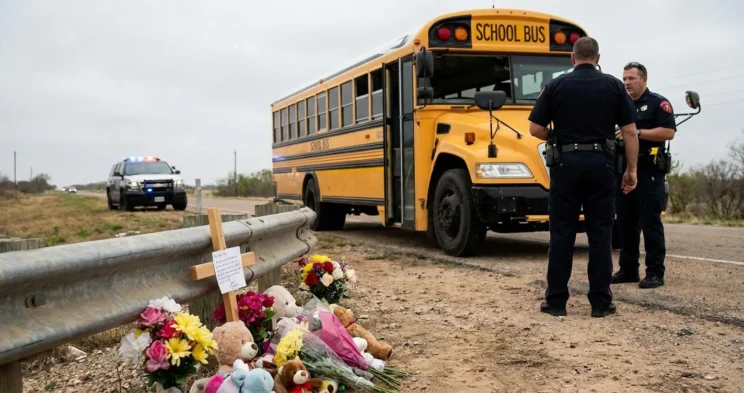
The school called, and now you are sitting in a hospital waiting room in Houston, trying to understand how a routine ride down Westheimer Road took your child away. People keep telling you to focus on grieving, not on lawyers. But a quiet question keeps surfacing: does the law give you any right to answers, and who do you even hold responsible?
Who Can File a Wrongful Death Claim in Texas
As the parent of a child who died, you have the direct legal right to file a wrongful death claim in Texas. Under Texas Civil Practice and Remedies Code (CPRC) § 71.004, the surviving spouse, children, and parents of the person who died are the only people who can bring this kind of action.
When the person who died is a child, that means you. No outside party stands ahead of you in line, and you do not need anyone’s permission to begin.
There are actually two separate claims you may be able to bring, and they cover different losses. A wrongful death claim compensates you, the surviving family, for your own losses, such as grief, lost financial support, and companionship.
A survival action under Texas Civil Practice and Remedies Code (CPRC) § 71.021 is different. It compensates your child’s estate for what your child went through before passing. Both claims can apply at once, and you should weigh them together rather than choosing one blindly.
One timing rule catches families off guard. If no eligible family member files within three months of the death, the personal representative of the estate is required to bring the action on behalf of all beneficiaries — unless every eligible family member asks the representative not to.
You do not want to lose control of that decision by waiting, so treat the first weeks as the time to understand your options.
Deadlines That Can End Your Claim Early
The deadline most families never hear about is the one that can quietly destroy a valid case: a six-month notice rule that applies when a government bus is involved. If a school district or public transit authority operated the bus, you must send written notice to that governmental unit within six months of the accident, or the claim is barred.
This requirement comes from Texas Civil Practice and Remedies Code (CPRC) § 101.101. It is the most dangerous and least-known deadline a grieving parent faces, because it runs far faster than the deadline most people assume applies. If you are anywhere inside that six-month window, this is the point where speaking with an attorney early can protect a claim you might otherwise lose.
The second deadline is the two-year statute of limitations under Texas Civil Practice and Remedies Code (CPRC) § 16.003. It gives you two years to file a wrongful death lawsuit, and the clock starts on the date of death, not the date of the original injury.
These two deadlines are independent of each other. Meeting the six-month notice rule does not satisfy the two-year filing rule, and filing within two years does not excuse a missed notice. You have to satisfy both when a government bus is involved.
Government Bus vs. Private Bus: Why It Matters
Who operated the bus changes almost everything about your claim, from how much you can recover to whether the law caps your recovery at all. School districts and public agencies sit under one set of rules. Private companies sit under a very different one.
School District & Government Bus Claims
When a school district or public transit authority runs the bus, the door to a claim opens through the Texas Tort Claims Act (Chapter 101). It gives up the government’s usual immunity for claims that come from a government employee negligently operating a motor vehicle.
That waiver is exactly what lets you sue a school district over a bus crash. Without it, the district would be shielded entirely.
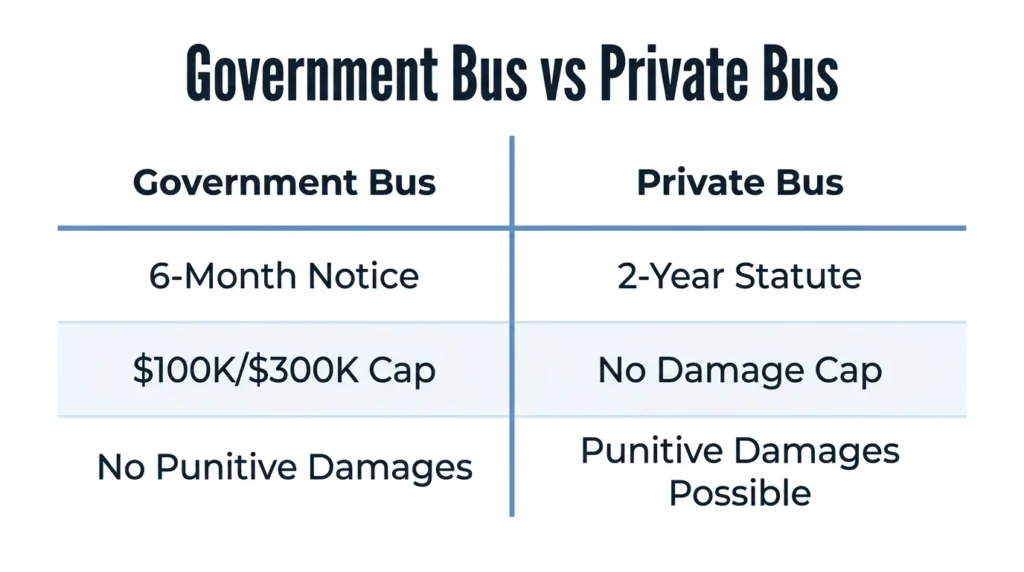
The trade-off is a hard limit on what money you can recover. Under Texas Civil Practice and Remedies CPRC § 101.023, a school district’s liability is capped at $100,000 per person and $300,000 per occurrence, no matter what a jury decides your actual losses are. Other governmental units, such as a city, can face a higher cap.
You also cannot pursue punitive damages against a government defendant. Recovery stays limited to your actual damages within the cap, which is why understanding how Tort Claims Act limits work in bus cases matters before you decide how to proceed.
Private Charter & Commercial Bus Claims
A private bus changes the math completely, because no government cap applies. Private bus companies, charter operators, and motor carriers are not governmental units, so you may recover the full measure of your economic and non-economic damages.
If the driver’s conduct was grossly negligent, you may also pursue exemplary damages under Texas Civil Practice and Remedies Code (CPRC) § 41. Those damages are still subject to a statutory cap formula, but they are available in a way they never would be against a public agency.
Responsibility in a private case often reaches well beyond the driver. The bus company, a manufacturer whose defect contributed, or a contractor who maintained the bus may all share fault.
Sorting out who can be held liable in a Texas bus accident is one of the most important early steps in bus accident claims.
Damages Available to Texas Parents
Texas law recognizes both the financial cost and the human cost of losing your child, and you can seek compensation for each. The categories fall into three groups: economic losses, your own non-economic losses, and what your child suffered before death.
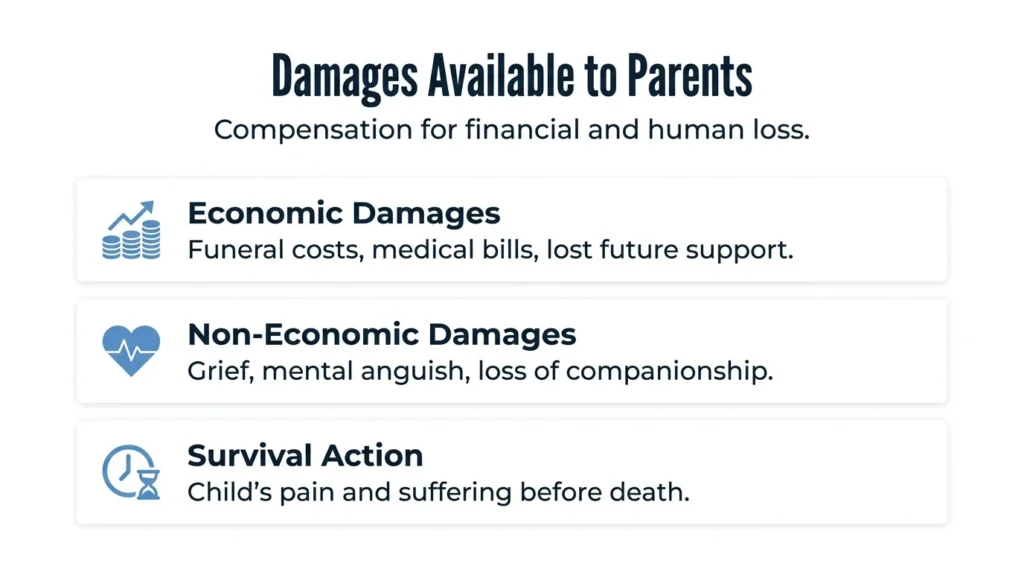
Economic damages cover the concrete bills. They include funeral and burial expenses, any medical costs between the accident and your child’s death, and the present value of your child’s future earning capacity and household contributions.
Non-economic damages address what no invoice can measure. For parents, that means mental anguish, grief, loss of companionship, and the loss of the parent-child relationship. These are usually the largest part of recovery in a child’s wrongful death case.
A survival action, filed through the estate, covers a different loss. It seeks compensation for the physical pain and mental anguish your child experienced before death, if there was any period of conscious suffering. The same wrongful death and survival framework under Chapter 71 governs how these losses are claimed, and you can see how this plays out in fatal crash and wrongful death cases.
When a school district is the defendant, the caps from the prior section apply to all of these categories combined, not to each one separately. Knowing that limit in advance shapes how you weigh a settlement against a trial.
Steps to Take After a Child Dies in a Bus Accident
The single most protective action you can take is to preserve evidence quickly, before records are routinely overwritten, or deleted. The steps below follow a sequence you can work through even while grieving:
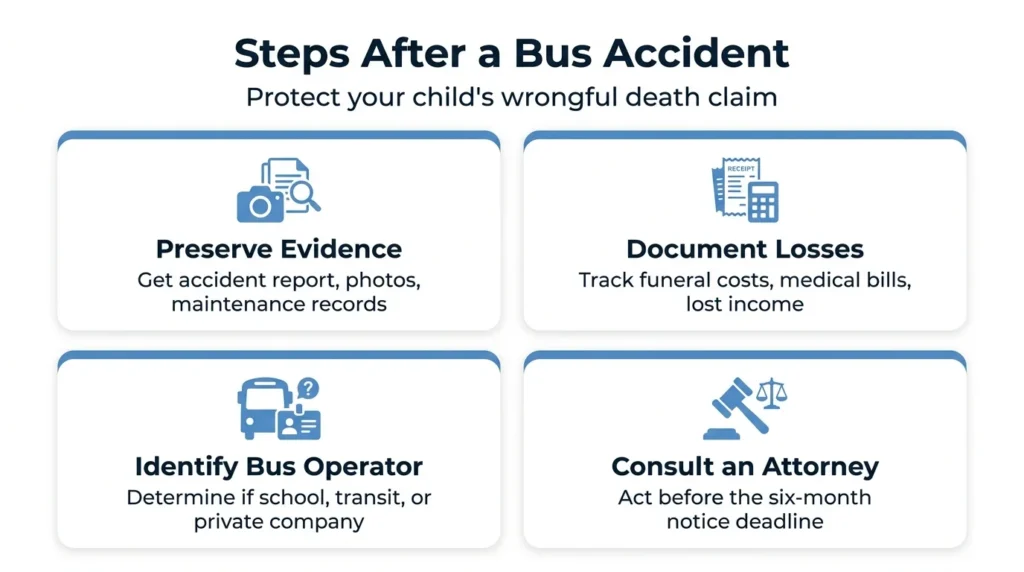
- Step 1: Preserve the evidence right away. Request the accident report from the school district or law enforcement, gather any photos or video from the scene or the bus’s onboard camera, and ask for the bus’s maintenance and inspection records.
- Step 2: Document your family’s losses. Keep records of funeral expenses, medical bills, and any work or income disruption the death caused. These records build the foundation for your damages claim.
- Step 3: Identify who operated the bus. Determine whether a school district, a city transit authority, or a private company ran the bus. The correct deadline, six-month notice or two-year filing, depends entirely on this answer.
- Step 4: Consult an attorney before the six-month window closes. Once that notice deadline passes, a claim against a government entity is permanently barred, no matter how strong your evidence is.
Talk to an Attorney About Your Child’s Case
No parent should have to think about legal deadlines while grieving a child, and the decision in front of you is one of the heaviest you will ever make. Angel Reyes & Associates has spent over 30 years standing with Texas families through catastrophic loss, and we have recovered more than $1 billion for clients across the state.
We work on a contingency basis, which means no fee unless we win and a free initial consultation to start. We are available 24/7 and serve families throughout all of Texas, so you never have to face the insurance companies or a school district’s lawyers alone.
When you are ready, you can reach out to us for a free, no-pressure conversation about your child’s case.
Past results do not guarantee future outcomes.
Wrongful Death of a Child in a Bus Accident FAQs
Does a child's own behavior in the accident affect the parents' wrongful death claim?
Texas follows a proportionate responsibility system, so a finding that the child shared fault does not automatically prevent you from receiving compensation. It can reduce the damages amount, but parents can still recover as long as the child’s share of fault does not exceed 50 percent.
What happens to the $300,000 cap when more than one child was killed in the same school bus accident?
The $300,000 per occurrence cap is the most a school district must pay across all claims from a single accident. If multiple families are injured or killed in the same crash, they share that pool, which can sharply reduce what each family recovers individually.
Does it matter if the school district hired a private charter company to operate the bus instead of using its own drivers?
If the school district contracted a private company to run the bus, the private operator may not be shielded by governmental immunity, which means the Tort Claims Act caps may not apply to that company. Liability in those situations often depends on how much control the district exercised over the driver and the vehicle.
Can a Texas wrongful death claim for a child resolve through settlement rather than trial?
Most wrongful death claims settle before trial, and settlement is available at any stage of the process. When a school district is involved, any settlement is still bound by the Tort Claims Act’s damage caps.
What if the bus driver was classified as an independent contractor rather than a school district employee?
The Texas Tort Claims Act’s immunity waiver applies when a government employee negligently operates a vehicle, so contractor status can affect whether the district is shielded. The contractor may still be sued directly under standard negligence rules, and the school district’s exposure depends on how closely it supervised and directed the work.
About the Authors

Angel Reyes
Writer
Angel L. Reyes, III is the Founder and Managing Partner of Angel Reyes & Associates. A nationally recognized trial attorney and business leader, Angel has helped over 70,000 injury victims recover more than $1 billion since founding the firm in 1993. Named to the Texas Super Lawyers list annually since 2008, Angel brings Wall Street experience, Ivy League education, and a deep commitment to client advocacy. He is a frequent legal commentator and published author with extensive contributions to legal scholarship, trial strategy, and consumer protection.

Kyle Nicolas
Editor
Kyle Nicolas is the Web Content & SEO Manager at Angel Reyes & Associates. He has more than 10 years of experience as a marketing co...

Angel Reyes
Reviewer
Angel L. Reyes, III is the Founder and Managing Partner of Angel Reyes & Associates. A nationally recognized trial attorney and business...