How Long Does a Car Accident Settlement Take in Texas?


Every article on this site is researched by our internal team, reviewed for legal accuracy against current Texas law, and held to State Bar of Texas advertising standards before publication. We do not publish content that overstates outcomes or makes promises about results.
Learn more about our
editorial standards .
Key Takeaways
- A straightforward Texas settlement typically takes three to nine months to resolve.
- Multiple defendants and disputed liability are two of the biggest delays.
- Filing a lawsuit starts a separate, longer clock than settling directly.
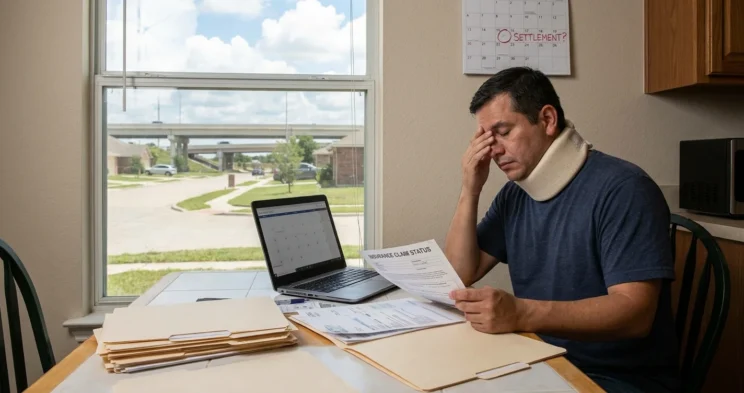
You finished physical therapy for your neck last month, and you’re still waiting to hear anything about your claim. That wait is normal, and it doesn’t mean your case has stalled.
Settlement Timeline vs. Lawsuit Timeline
A car accident settlement and a car accident lawsuit follow two different clocks. Most Texas car accident claims settle directly with the insurance company, without ever becoming a lawsuit.
A straightforward settlement typically takes three to nine months from the crash to a signed release. A lawsuit is a separate, longer track that only starts if settlement talks stall, and even then, most filed cases still settle before trial.
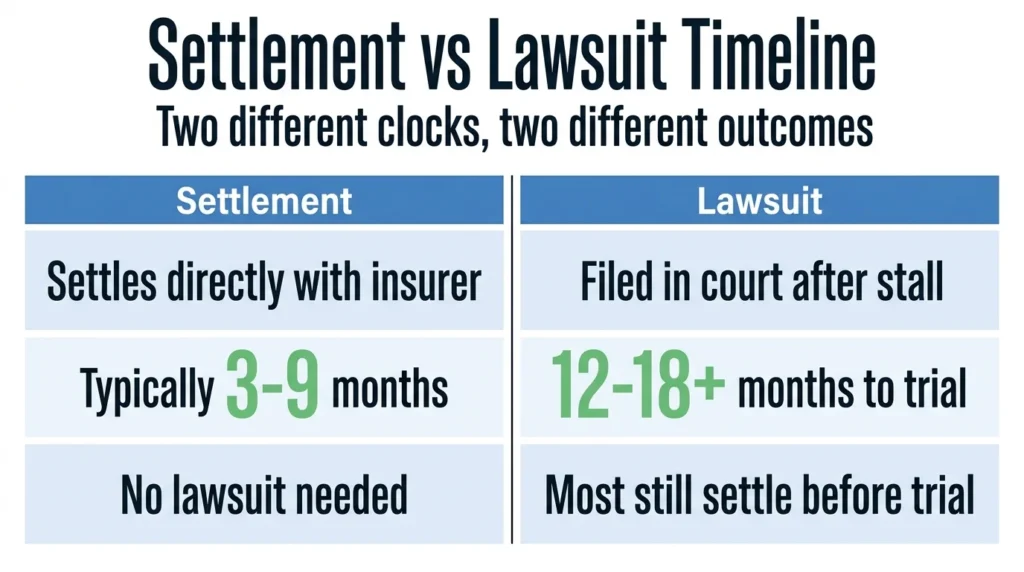
Because these are two different clocks, a case that moves toward a lawsuit has not failed. It simply means settlement did not happen fast enough on its own.
Treatment & Recovery Set the Clock
Your settlement timeline starts with your medical treatment, not with a phone call to an adjuster. Insurers wait to make a fair offer until your treatment reaches a clear stopping point.
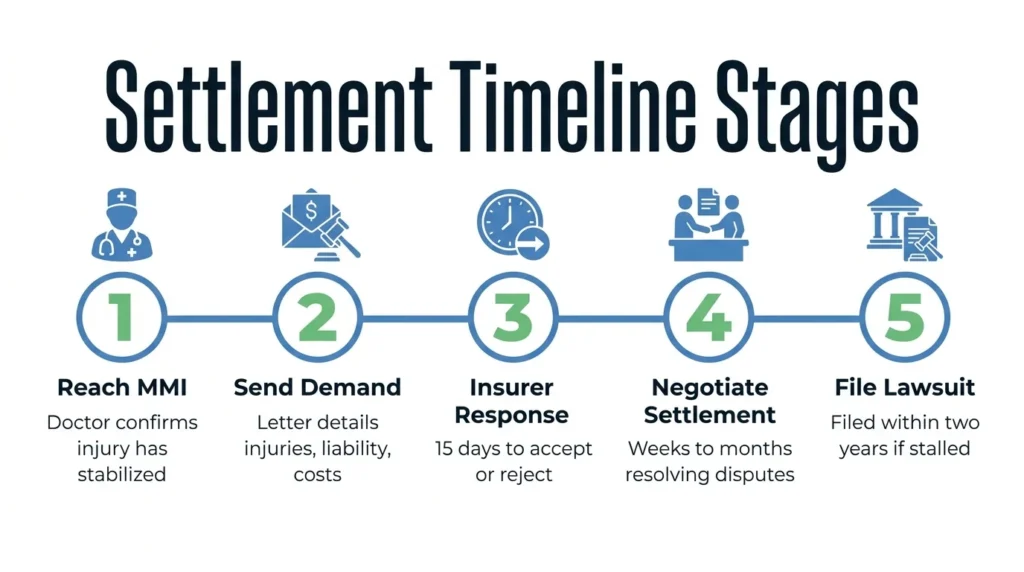
That stopping point is called maximum medical improvement, the point where a doctor confirms your condition has stabilized. A minor injury may reach that point in a few weeks. A more serious injury can take several months.
Ongoing medical treatment is the single biggest reason a settlement takes longer than you might expect. Settling before treatment ends usually means guessing at future costs, and that guess tends to favor the insurer, leaving you without a large enough settlement to cover your medical bills and lost wages.
Your medical records also need to show a clear, unbroken line between the crash and your injuries. Gaps in treatment give an insurer room to argue that something other than the crash explains your ongoing pain.
Sending the Demand Letter
Once your treatment reaches maximum medical improvement, your demand letter goes out. The letter lays out liability, your injuries, and an itemized total the insurer must respond to.
Sending the demand too early, before the medical picture is clear, is the main way this stage gets rushed and undervalues the claim.
Negotiating a Fair Settlement
Once the insurer has your demand, Texas Insurance Code § 542.056 gives it 15 business days to accept or reject the claim, extendable to 45 more days with written notice. Negotiation itself often runs several weeks to a few months beyond that.
Disputed liability is the most common reason negotiation drags on. Texas follows a modified comparative negligence rule under Texas Civil Practice and Remedies Code (CPRC) § 33.001: You recover a reduced amount if you share fault, and nothing once your own share passes 50%.
Insurers know this, so they often argue for a bigger share of fault on your side. Determining fault becomes the center of the delay.
Missing paperwork, like complete medical records or proof of lost wages, is another common reason negotiation drags out longer than it should.
If the number on the table still feels wrong once liability is settled, pushing back on a lowball offer is a reasonable next step before considering a lawsuit.
Filing Suit When Settlement Talks Stall
Filing suit becomes the realistic option once negotiation stalls without a fair offer. The deadline is firm: Suit must be filed within two years of the crash under § 16.003, or the court dismisses the case regardless of fault.
Multiple defendants stretch a filed case further. When more than one driver, company, or vehicle owner shares fault, § 33.013 governs how liable parties share and contest the damages among themselves, which adds negotiation layers no single-defendant case has.
After filing, both sides exchange records and take sworn testimony during discovery. Most filed cases still settle somewhere in this stretch, before a trial date ever arrives.
Court scheduling adds the final layer of delay. Busy county dockets can push a filed case’s trial date out well beyond the 12 to 18 months a straightforward Texas settlement timeline would otherwise take.
Work with a Texas Injury Attorney
Angel Reyes & Associates has guided Texas accident victims through the settlement and litigation process for more than 30 years. Our case results reflect more than $1 billion recovered for clients, and you pay nothing unless we win.
Contact us for a free consultation to talk through where your claim stands and what realistically comes next.
Past results do not guarantee future outcomes.
Car Accident Settlement FAQs
Can I get medical bills paid while my settlement is still pending?
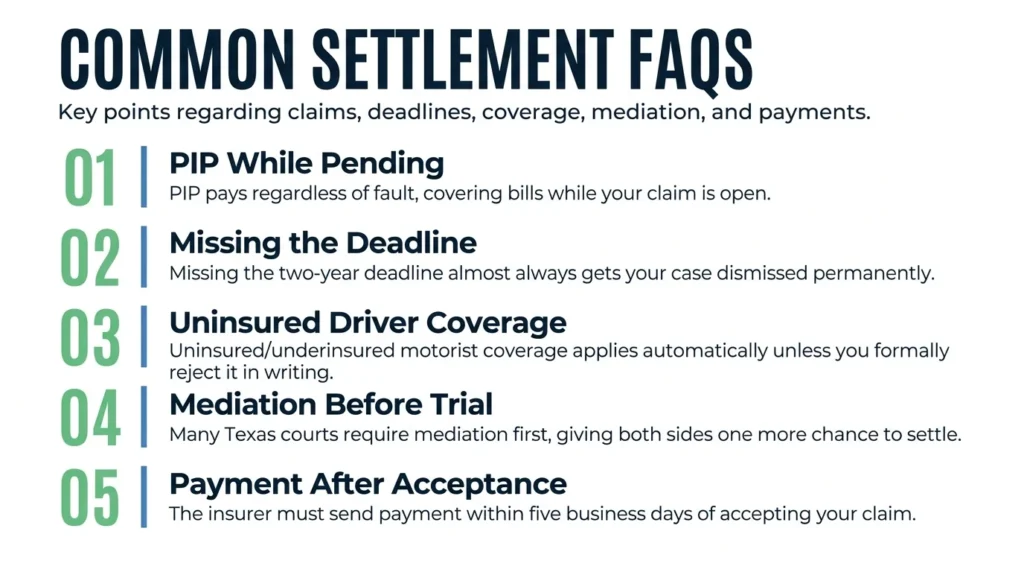
Yes, if you carry personal injury protection, since Texas auto policies include it automatically unless you reject it in writing under Texas Insurance Code § 1952.152. PIP pays regardless of who caused the crash, so it can cover bills while your claim is still open.
What happens if I miss the two-year deadline to file a lawsuit?
Missing the deadline set by Texas CPRC § 16.003 almost always results in the court dismissing your case permanently, regardless of how clear the other driver’s fault was.
If the at-fault driver has no insurance, does that change my timeline?
It usually shifts the claim to your own uninsured or underinsured motorist coverage, since Texas requires insurers to include that coverage on every policy unless you reject it in writing under Texas Insurance Code § 1952.101.
Does my case have to go to mediation before it can go to trial?
Many Texas courts require mediation before setting a filed personal injury case for trial, which gives both sides one more settlement opportunity even after a lawsuit is underway.
How quickly do I get paid once I accept a settlement?
The insurer must send payment within 5 business days of accepting your claim under Texas Insurance Code § 542.057.
About the Authors

Spencer Browne
Writer
Spencer Browne is a partner at Angel Reyes & Associates and a Board Certified personal injury trial lawyer with nearly 100 jury trials across Texas. He focuses on car, truck, and wrongful death cases, with notable verdicts including a landmark win in the Choctaw Casino bus crash case. A recognized speaker and legal educator, Spencer is a member of the American Board of Trial Advocates and has been honored as a Texas Super Lawyer and one of D Magazine’s Best Lawyers in Dallas. He brings deep trial experience and relentless advocacy to every client he represents.

Kyle Nicolas
Editor
Kyle Nicolas is the Web Content & SEO Manager at Angel Reyes & Associates. He has more than 10 years of experience as a marketing co...

Angel Reyes
Reviewer
Angel L. Reyes, III is the Founder and Managing Partner of Angel Reyes & Associates. A nationally recognized trial attorney and business...