What Is a Demand Letter?


Every article on this site is researched by our internal team, reviewed for legal accuracy against current Texas law, and held to State Bar of Texas advertising standards before publication. We do not publish content that overstates outcomes or makes promises about results.
Learn more about our
editorial standards .
Key Takeaways
- A demand letter needs medical bills, wage proof, and liability evidence attached.
- Texas insurers must accept or reject a claim within 15 business days of full proof.
- A lowball counteroffer is an opening number, not the insurer's final position.
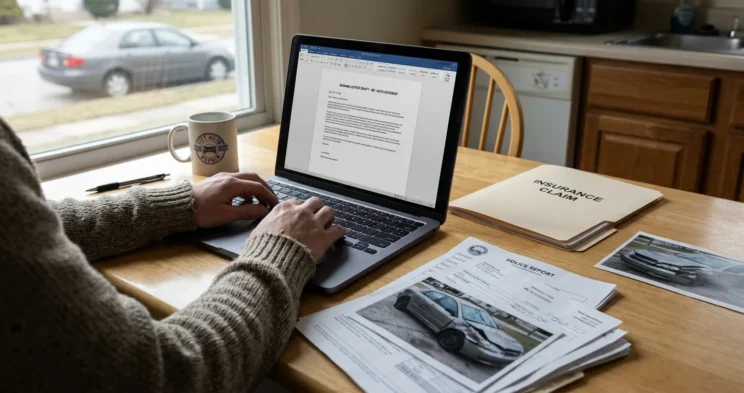
You’re driving home on the Gulf Freeway in Houston when another driver rear-ends you at a red light. Weeks later, you’re still waiting for the insurance company to make a real offer. A demand letter is what turns that wait into a formal negotiation.
What Is a Demand Letter?
A demand letter is a formal written request for compensation that lays out what happened, who caused it, and what you’re owed for your injuries and losses. Unlike a phone call to an adjuster, it creates a permanent, evidence-backed record of your claim.
It also calls on Texas negligence and liability standards, showing the insurer you understand your legal position. A Houston car accident claim moves through the same process, whether the crash happened on the Gulf Freeway or a quiet side street.
What a Demand Letter Must Include
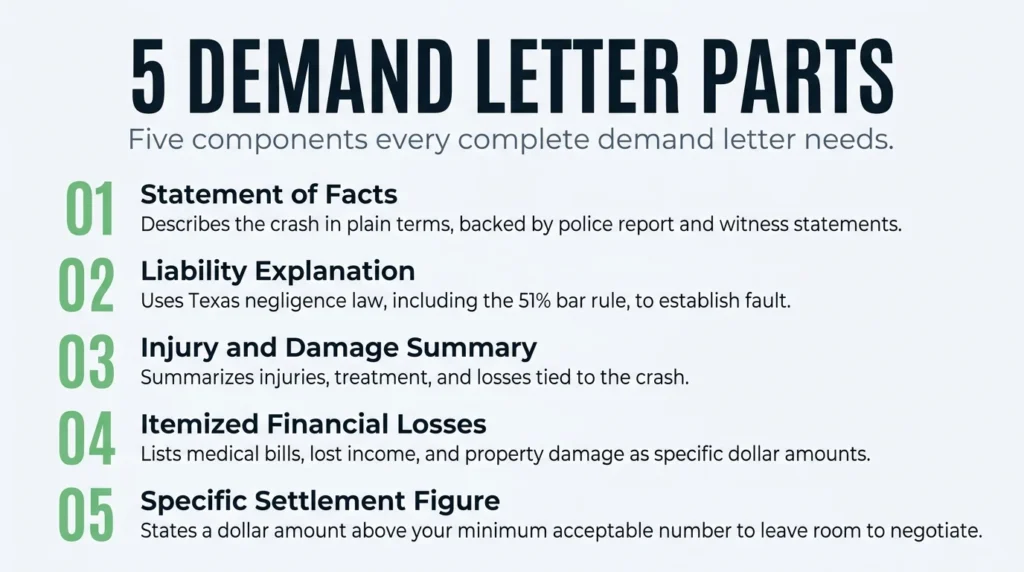
A complete demand letter has five parts: a statement of facts, a liability explanation, an injury and damage summary, an itemized list of financial losses, and a specific settlement figure. The statement of facts describes the crash in plain terms, backed by the police report and any witness statements.
The liability explanation is where Texas law does the heavy lifting. Texas follows a modified comparative negligence rule, often called the 51% bar rule: under Texas Civil Practice and Remedies Code Section 33.001, you recover no money if you’re found more than half responsible for the crash.
If the other driver broke a traffic law, such as following too closely under Texas Transportation Code Section 545.062, that violation alone can establish negligence per se. This shortcut proves fault without a lengthy argument over what a reasonable driver should have done.
From there, the letter summarizes your injuries and treatment, itemizes every financial loss, medical bills, lost income, property damage, and closes with a specific dollar amount. That figure should sit above your minimum acceptable number, leaving room to negotiate.
The Evidence You Need to Attach
Every claim in your demand letter needs a document behind it, or the insurer has an easy reason to discount it. Three categories carry the most weight:
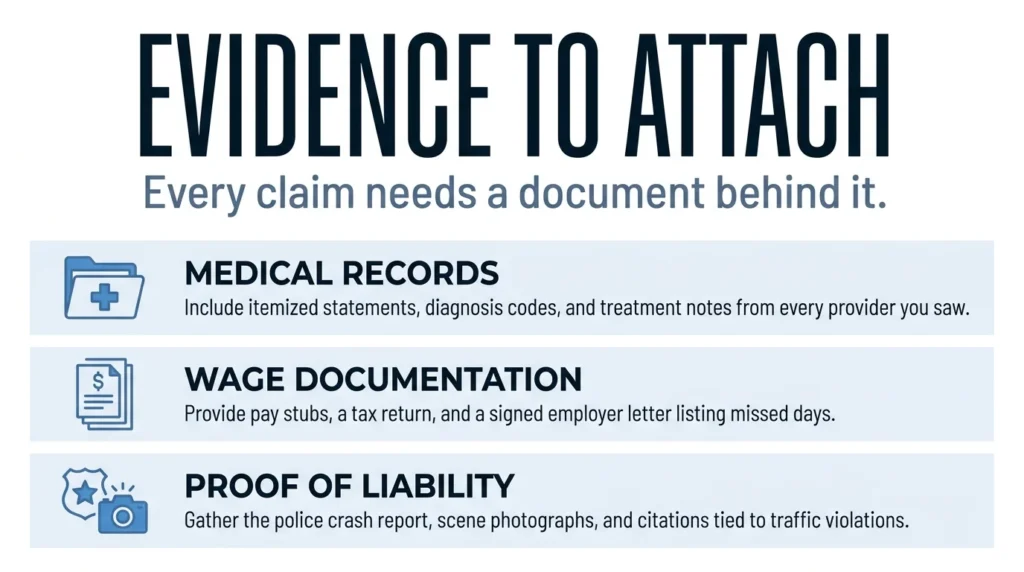
- Medical records and bills. Itemized statements, diagnosis codes, and treatment notes from every provider you saw, not just the emergency room.
- Wage documentation. Pay stubs from before the crash, a W-2 or recent tax return, and a signed letter from your employer listing your pay rate and the days you missed.
- Proof of liability. The police crash report, scene photographs, and any citation tied to a traffic law violation.
Skipping any one of these gives the adjuster an easy reason to argue your number is inflated.
What Does a Well-Documented File Look Like?
A well-built file pairs every dollar you’re asking for with the paperwork that proves it, so nothing in your letter reads as a guess. Medical bills match the treatment summary, wage records match the days you missed, and the police report matches your account of who ran the light.
A file like this rarely draws a lowball response, because there is nothing left to dispute. Most attorneys wait to send it until you reach maximum medical improvement, the point where doctors can say your treatment has leveled off.
Sending earlier means guessing at future costs. Texas’s two-year deadline under Texas Civil Practice and Remedies Code Section 16.003 still leaves time to wait for that clarity in most cases.
Assembling a complete file is where most claimants get stuck, especially while they are still recovering from their injuries. This documentation-first approach holds true across case types, including motorcycle accident settlements in Texas.
What Happens After You Send It?
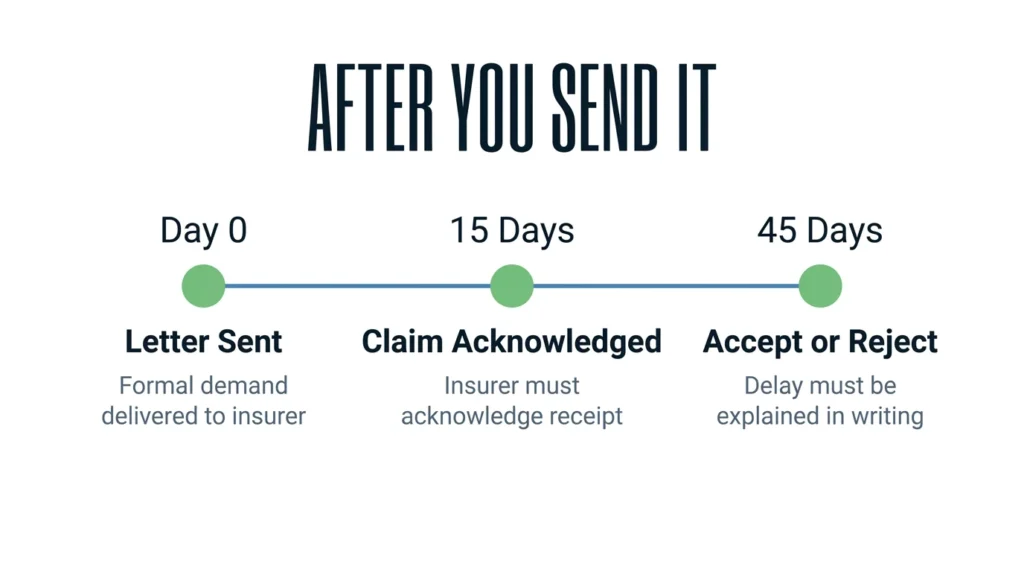
Once your letter arrives, Texas law puts insurers on the clock. They must acknowledge your claim within 15 calendar days of receiving it, then accept or reject it within 15 business days after they have everything they need, though that second deadline can stretch to the 45th day if they explain the delay in writing.
That timeline comes from Texas Insurance Code Section 542.056, part of the state’s prompt payment rules for insurance claims.
A lowball counter is an opening number, not a final answer. It typically undercuts your documented losses because the adjuster tests whether you will accept less before anyone pushes back.
If the first offer looks like an insult next to your file, fighting a lowball insurance offer starts with pointing back to the documentation you already sent. A weak opening offer is usually a sign to get a second opinion on your file, not a reason to accept it.
Work with an Experienced Attorney Today
Angel Reyes & Associates has fought for Texas accident victims since 1993, and we know what insurers look for in a demand letter file. We build every claim on documented medical records, wage proof, and liability evidence, then negotiate from a position insurers cannot easily push around.
We work on contingency, so you pay nothing unless we win your case. That track record includes more than $1 billion recovered for clients, detailed on our case results page.
Contact us for a free consultation, and let’s start building the documentation your claim needs to get a fair offer instead of a lowball one.
Past results do not guarantee future outcomes.
Demand Letter FAQs
What happens if the insurance company denies my demand letter without a good reason?
Texas law prohibits insurers from refusing to attempt a prompt, fair settlement once liability is reasonably clear, and a denial that ignores your documentation can violate the state’s unfair settlement practices rule. A wrongful denial does not end your claim; it can support further negotiation or a lawsuit.
How is the pain and suffering portion of a demand amount usually calculated?
Many insurers and attorneys use the multiplier method: add up medical bills and lost wages, then multiply that total by a number between 1.5 and 5 depending on injury severity to estimate the pain and suffering multiplier. More severe or permanent injuries generally support a higher multiplier.
Do I still need to send a demand letter if the other driver had no insurance?
Yes. You send it to your own insurer instead, since Texas requires auto policies to include uninsured or underinsured motorist coverage unless you reject it in writing. The same documentation standard, medical bills, wage proof, and liability evidence, still applies.
Can my demand letter be used against me later if my case goes to trial?
No. Under Texas Rule of Evidence 408, settlement offers and statements made during negotiation generally cannot be used to prove liability or the value of your claim at trial. The medical records and evidence you attached are still discoverable on their own.
About the Authors

Angel Reyes
Writer
Angel L. Reyes, III is the Founder and Managing Partner of Angel Reyes & Associates. A nationally recognized trial attorney and business leader, Angel has helped over 70,000 injury victims recover more than $1 billion since founding the firm in 1993. Named to the Texas Super Lawyers list annually since 2008, Angel brings Wall Street experience, Ivy League education, and a deep commitment to client advocacy. He is a frequent legal commentator and published author with extensive contributions to legal scholarship, trial strategy, and consumer protection.

Graham Griffin
Editor
Graham Griffin is the Web & Content Manager at Angel Reyes & Associates, where he oversees content strategy, AI-powered workflows, a...

Angel Reyes
Reviewer
Angel L. Reyes, III is the Founder and Managing Partner of Angel Reyes & Associates. A nationally recognized trial attorney and business...