Can Social Media Posts Hurt Your Car Accident Claim?


Every article on this site is researched by our internal team, reviewed for legal accuracy against current Texas law, and held to State Bar of Texas advertising standards before publication. We do not publish content that overstates outcomes or makes promises about results.
Learn more about our
editorial standards .
Key Takeaways
- Texas bars recovery once you are found more than 50 percent at fault for a crash.
- A lawsuit lets defense attorneys request private posts through formal discovery rules.
- Deleting a post after a claim begins can trigger sanctions for evidence spoliation.
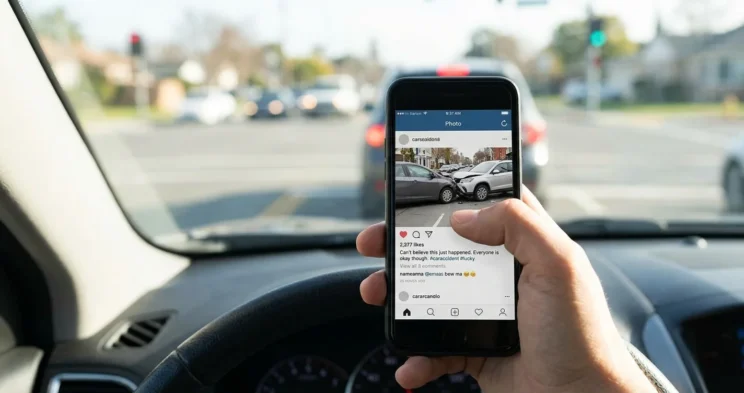
You are sitting in traffic on I-45 in Houston, three days after a driver rear-ended you at a red light. Your neck still aches, but your phone keeps buzzing with people asking how you are doing. Before you type an update or accept a new friend request, you should know that a single post can become evidence an insurer uses against you.
Why Social Media Means Something in Your Claim
Texas follows a proportionate responsibility rule. Under Texas Civil Practice and Remedies Code § 33.001, you cannot recover any compensation if a jury finds you more than 50 percent responsible for the crash.
Insurers know this rule well, so they search for anything that shifts blame toward you. A single post can hand them exactly what they need.
TxDOT’s statewide crash data shows serious injury crashes happen across Texas every day. That volume gives insurers plenty of practice building comparative fault arguments from whatever evidence they can find, including your social accounts.
A post, comment, or tag can become part of the factual record used against you. Insurers and defense attorneys cite this record when arguing comparative fault in any car accident claim, from a minor fender bender to a serious multi vehicle crash.
7 Social Media Mistakes That Hurt Claims
These seven behaviors show up again and again in claims that lose value because of social media. Check your own accounts against this list today:
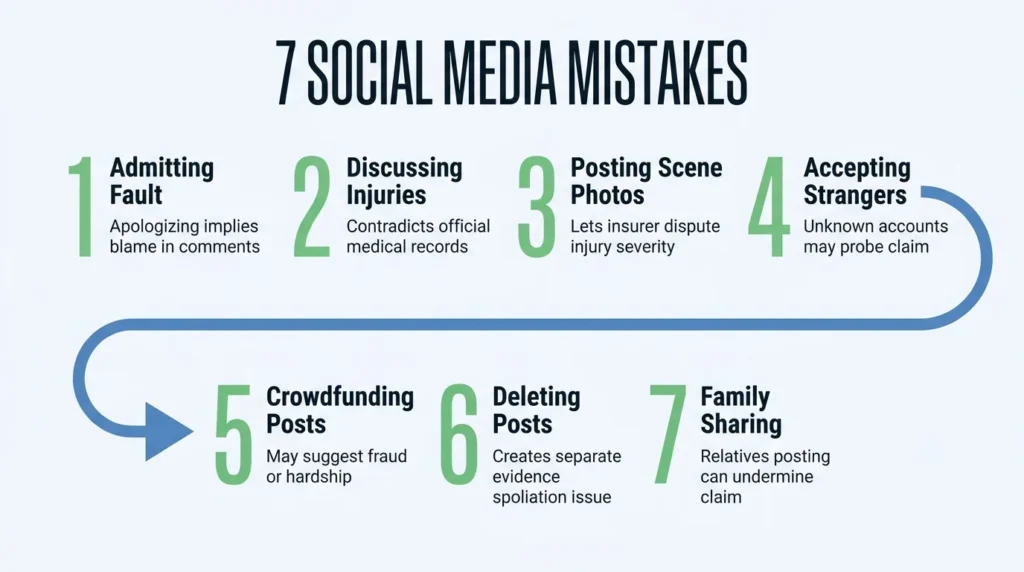
- Admitting fault or apologizing in a post or comment, even casually.
- Discussing your injuries, pain levels, or treatment in a way that contradicts your medical records.
- Posting scene photos or video that let an insurer dispute how severe your injuries are or how the timeline unfolded.
- Accepting friend requests from unfamiliar accounts while your claim stays open. The same risk applies after any serious wreck, including truck accidents, so do not assume a smaller claim is automatically safe.
- Posting about a crowdfunding campaign that suggests financial hardship or contradicts your injury claims. Mismatched details here can even trigger an insurance fraud accusation.
- Deleting or editing posts after your claim begins. This creates a separate evidence problem, covered below under “What to Do About Existing Posts.”
- Letting family members post updates, photos, or opinions about the crash on their own accounts.
Can Insurers See Private Posts?
Privacy settings limit who can casually browse your profile. They do not block every way an insurer or defense attorney can reach your posts.
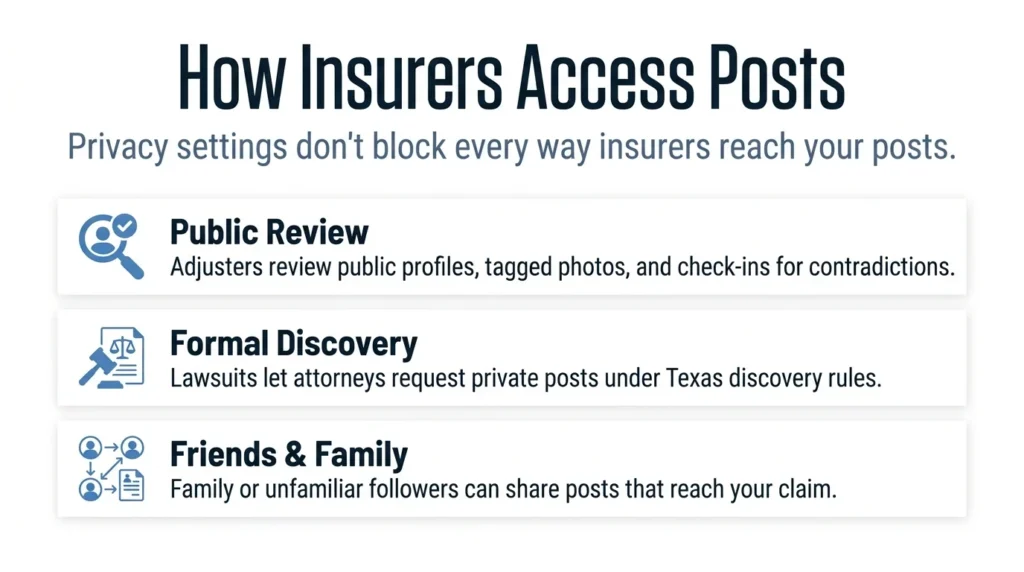
Public Profile Review
Adjusters and investigators usually start with whatever is publicly visible, plus anything visible through mutual connections. Each platform tends to surface different evidence.
Facebook and Instagram often reveal check ins, tagged photos, and activity timelines that place you somewhere your claim says you should not have been. TikTok videos can show physical activity that contradicts a claimed limitation. LinkedIn activity, including a new job or an endorsement, can undercut a claim for lost earning capacity.
Formal Discovery Requests
Once a lawsuit is filed, defense attorneys are not limited to what is public. Texas Rule of Civil Procedure 192.3 defines discovery broadly enough to reach relevant private content, including posts behind privacy settings.
This formal process is separate from the informal review that adjusters conduct before any lawsuit exists.
Friends & Family Sharing
Content you never posted yourself can still reach the people evaluating your claim. A friend or follower request from an unfamiliar account during an open claim deserves scrutiny before you accept it.
Photos or comments posted by family members about the crash can surface in the same review. This holds true even when your own accounts stay locked down.
Posting on Social Media Safely
The safest approach pairs strict privacy settings with a short list of ground rules for yourself and the people around you:
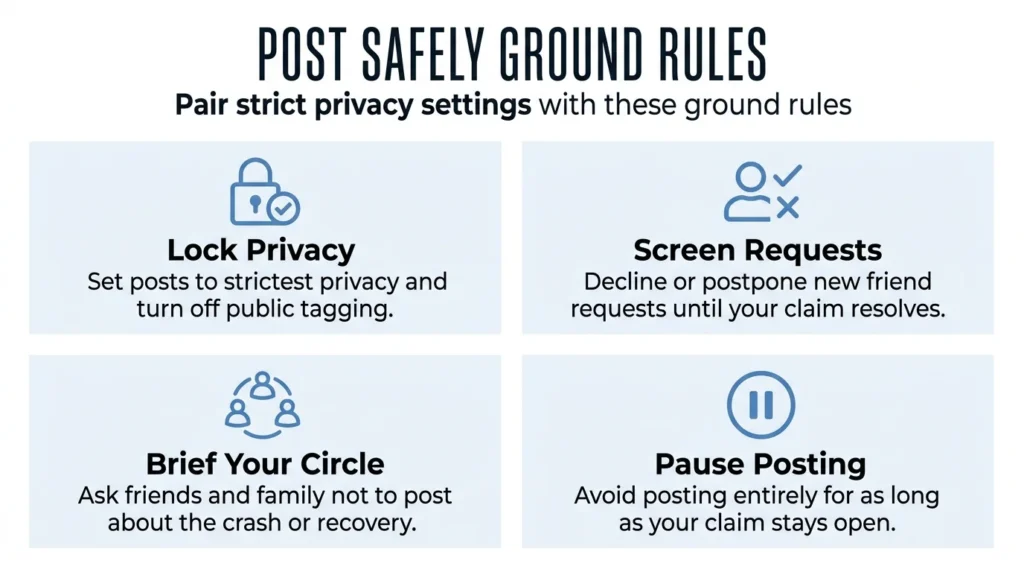
- Set every existing and future post to the most restrictive privacy option your platform offers. Turn off public tagging so no one can tag you into content the public can see.
- Decline or postpone new friend and follower requests from unfamiliar accounts until your claim resolves.
- Ask close friends and family not to post about the crash, your recovery, or related activities. Explain that even a well-meaning post can be misread out of context.
- Avoid posting at all, rather than trusting privacy settings alone, for as long as your claim stays open. Claims can remain open for months, so plan for a long pause. A typical Texas settlement timeline can help you gauge how long that pause might last.
What to Do About Existing Posts
Do not delete, edit, or hide any existing post about the crash, your injuries, or your recovery once you anticipate or file a claim. Deleting it creates a separate legal problem, evidence spoliation, and that problem can be worse than the post itself.
Once you reasonably anticipate a claim, Texas law imposes a duty to preserve relevant evidence. In Brookshire Bros., Ltd. v. Aldridge, Texas courts confirmed that intentional deletion can lead to an adverse jury instruction or another court sanction.
Instead of deleting anything, document the post as it currently exists. Save a screenshot, the URL, and the timestamp, then send it to your attorney.
If you are weighing whether a past post already hurt your claim, review real client outcomes for context on how cases like this get handled. Understanding how insurers scrutinize claim evidence in general can help you judge whether an existing post is actually a problem.
Speak with a Knowledgeable Attorney Today
Social media mistakes are avoidable, but building a strong claim still takes skilled representation. Angel Reyes & Associates has spent years fighting for injured Texans, with more than $1 billion recovered for clients, and we never charge a fee unless we win your case.
If a post, a tag, or a stalled negotiation has you worried about your claim, talk to an attorney before you post anything else. Contact Angel Reyes & Associates for a free case review.
Past results do not guarantee future outcomes.
Social Media Post & Car Accident Claim FAQs
Can posts I made before my accident hurt my claim?
Yes. Insurers sometimes review posts made before the crash to argue that an injury already existed or is unrelated to the wreck, even if the post has nothing to do with the accident itself.
Is switching my social media accounts to private after an accident risky?
No. Adjusting your privacy settings to limit public viewing is generally allowed and is different from removing or editing posts you already made.
Can I send accident photos directly to my insurance adjuster?
Yes, sharing photos with your assigned adjuster as part of your claim file is a normal step in the process. This differs from posting the same images publicly, so send only what matches what you have already reported.
Should I turn off fitness apps like Strava or Fitbit during my claim?
It is a smart precaution. Courts have allowed fitness tracker data as evidence in injury cases, and activity records showing more movement than you reported could be used to question your claim.
About the Authors

Angel Reyes
Writer
Angel L. Reyes, III is the Founder and Managing Partner of Angel Reyes & Associates. A nationally recognized trial attorney and business leader, Angel has helped over 70,000 injury victims recover more than $1 billion since founding the firm in 1993. Named to the Texas Super Lawyers list annually since 2008, Angel brings Wall Street experience, Ivy League education, and a deep commitment to client advocacy. He is a frequent legal commentator and published author with extensive contributions to legal scholarship, trial strategy, and consumer protection.

Kyle Nicolas
Editor
Kyle Nicolas is the Web Content & SEO Manager at Angel Reyes & Associates. He has more than 10 years of experience as a marketing co...

Spencer Browne
Reviewer
Spencer Browne is a partner at Angel Reyes & Associates and a Board Certified personal injury trial lawyer with nearly 100 jury trials a...