How Fault Is Determined in Lane Change Accidents with Motorcycles


Every article on this site is researched by our internal team, reviewed for legal accuracy against current Texas law, and held to State Bar of Texas advertising standards before publication. We do not publish content that overstates outcomes or makes promises about results.
Learn more about our
editorial standards .
Key Takeaways
- Texas Transportation Code § 545.060 places the legal duty to merge safely on the lane-changing driver.
- A motorcyclist found 51 percent or more at fault under Texas law recovers nothing from the claim.
- Dashcam footage, witness statements, and lane-position evidence are key to defeating biker bias.
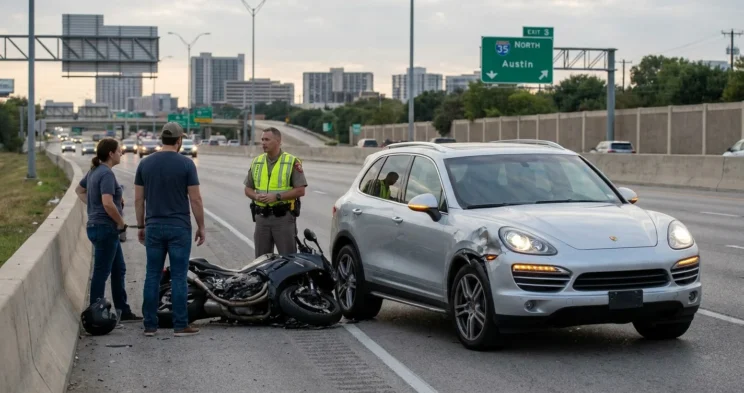
You were cruising north on I-35 through Austin when the SUV in the next lane drifted right without a signal and clipped your handlebars, and you went down hard. Now the driver’s insurance adjuster is telling you that you should have given the SUV more room, and that the company is assigning you a chunk of the fault for what happened.
What Texas Law Says on Changing Lanes
Texas places the legal duty on the driver changing lanes, not the motorcyclist already occupying it. Under Texas Transportation Code § 545.060, every driver must drive as nearly as practical entirely within a single marked lane and may not move out of that lane unless the movement can be made safely. A violation of this rule is the starting point for fault in most lane-change motorcycle crashes.
This statute creates what lawyers call negligence per se, where, when a driver breaks a safety law and that violation causes a crash, the driver’s duty and breach are already established. You do not have to separately prove the driver acted unreasonably. The statutory violation itself does that work.
Texas law requires a turn signal before changing lanes under Texas Transportation Code § 545.104, though the statute does not specify a minimum distance for lane-change signals the same way it does for turns. Adjusters and jurors still weigh the absence of any signal when deciding whether the merge was lawful.
Motorcyclists have the same legal right to a full lane as any other vehicle. You were not required to ride to the edge of your lane to make room for someone else’s merge. Insurance adjusters sometimes argue otherwise, but that framing has no support in Texas law or in the rules governing motorcycle accident claims.
Evidence That Establishes Fault in These Crashes
The right evidence can flip an adjuster’s fault narrative quickly. In a lane change motorcycle accident, fault often turns on lane position, signal use, and visibility at the moment of the merge. Several categories of evidence answer those questions directly, and the sooner each is preserved, the stronger your claim becomes.
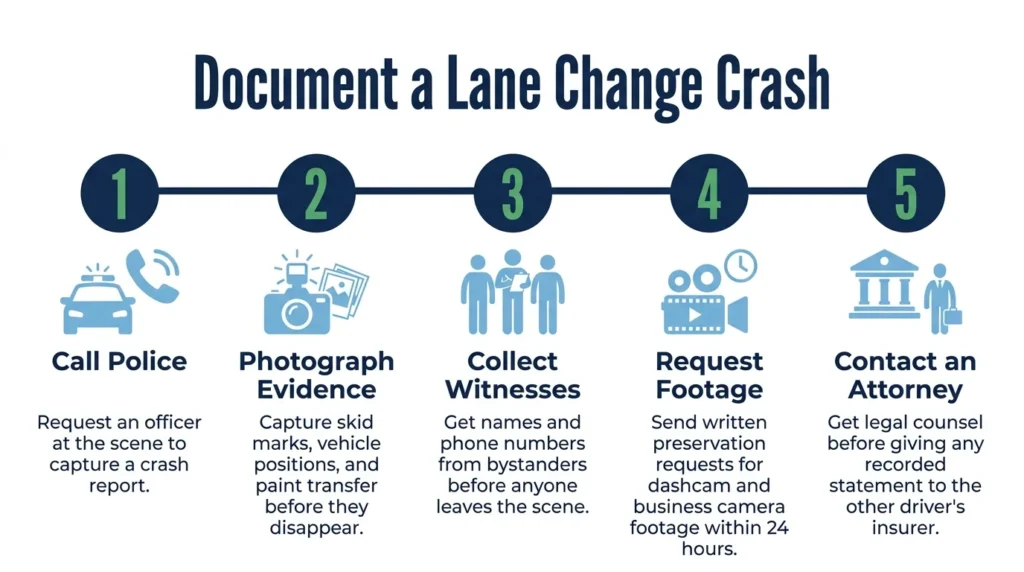
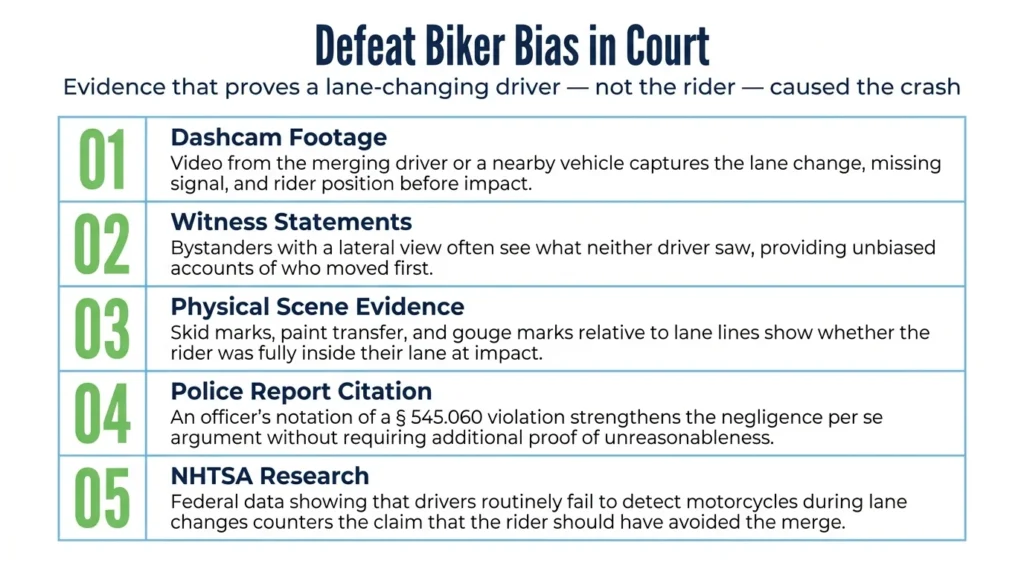
Video footage typically offers the most compelling evidence. A dashcam from the merging driver, a nearby business camera, or a highway traffic camera may capture the lane change, the absence of a signal, and your position before impact. Request preservation of the video footage in writing before it is overwritten.
Witness statements matter for the same reason. Other drivers and bystanders often have a lateral view that neither you nor the driver had. Get names and phone numbers at the scene if you can, because memories fade and contact information disappears within days.
Physical evidence at the scene tells its own story. Skid marks, gouge marks, paint transfer, and final vehicle positions relative to lane lines can show whether you were fully inside your lane when the contact occurred. The police report also matters: an officer’s notation of a § 545.060 violation strengthens the negligence per se argument, though no citation does not eliminate it.
Federal data backs up the visibility issue, as NHTSA motorcycle safety research documents that car drivers routinely fail to detect motorcycles before lane changes because of their smaller profile. That pattern is foreseeable, not an excuse, and it supports the case that the driver, not the rider, bears responsibility. Knowing the common injuries in motorcycle accidents also helps frame the damages side of the claim.
How Texas Comparative Fault Applies to Your Claim
Texas uses a modified comparative fault system. Under the Texas Civil Practice and Remedies Code (CPRC) Chapter 33, fault is split as a percentage between everyone responsible, and your recovery is reduced by your share.
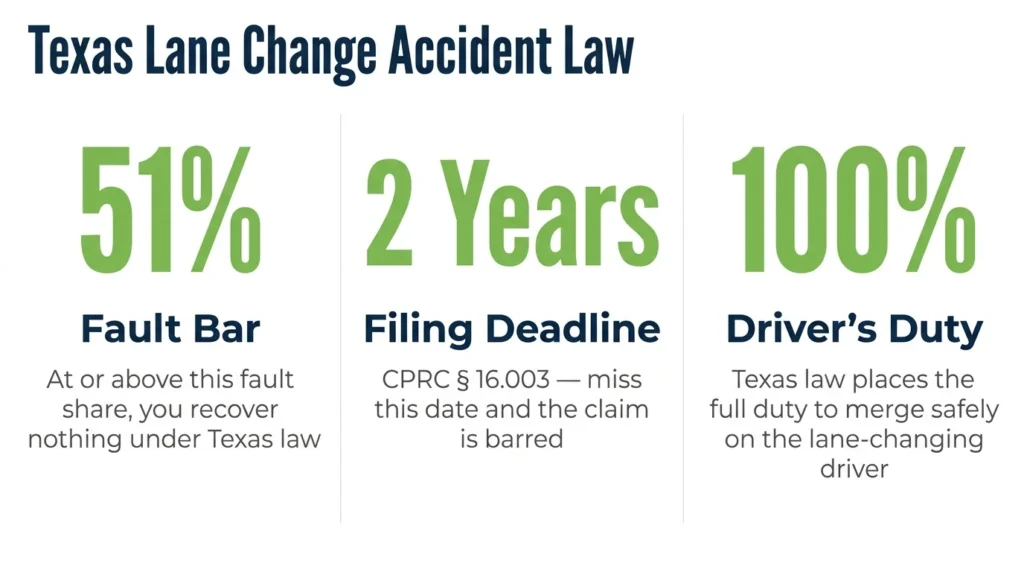
The system is built around one critical threshold: the 51 percent bar. If you are found 51 percent or more at fault, you recover nothing, but if you are found 50 percent or less at fault, you recover damages reduced by your percentage. The 51 percent rule under Texas comparative negligence is why adjusters sometimes push fault allocations right up to that line.
Say you sustain $100,000 in damages and are found 20 percent at fault, meaning your recovery drops to $80,000. At 40 percent fault, you still recover $60,000. At 51 percent, you recover zero.
Simultaneous lane change scenarios get even more complex when both vehicles were merging at once, meaning fault may be split between the two drivers. This does not mean that the split automatically lands at 50/50, as physical evidence and statute violations still drive the allocation. Before accepting any adjuster’s fault percentage, it is worth understanding how partial fault works in Texas accident claims.
Timing matters too. Texas Civil Practice and Remedies Code (CPRC) § 16.003 gives you two years from the crash date to file a personal injury lawsuit. Miss that deadline and the claim is gone, regardless of how strong the liability evidence looks.
Why Adjusters Blame Motorcyclists & How to Push Back
Biker bias is the documented tendency of insurance adjusters, and sometimes jurors, to assign motorcyclists more fault than the evidence supports. It rests on assumptions about riding risk and rider behavior rather than the specific facts of a crash. Lane change claims are especially vulnerable to it.
The merging driver almost always says they did not see the motorcycle. Adjusters then reframe a clear statutory violation as a shared visibility problem and blame the rider for failing to avoid a driver who could not see them. That framing flips the legal duty backward.
The negligence per se argument cuts through this; § 545.060 places the duty on the driver to merge safely. Your lane position, the driver’s failure to signal, and the absence of any rider duty to yield to an illegal merge all become the focus. Texas case law on how fault is determined in motor vehicle crashes supports this analysis.
Watch for specific adjuster tactics, as early recorded statements often try to draw out admissions about speed or lane positioning. Low settlement offers may arrive before liability and damages are fully understood. And fault allocations that land at exactly 51 percent are designed to trigger the recovery bar.
An attorney can also explain how motorcycle accident settlements actually work in Texas before you respond to an offer.
Speak with a Texas Motorcycle Accident Attorney
If an adjuster has assigned you fault for a lane change crash you did not cause, you have options. Angel Reyes & Associates has over 30 years of experience handling Texas motorcycle accident claims, and our case results reflect more than $1 billion recovered for clients. Our firm has over 20 offices across Texas and a team of more than 600 dedicated professionals to fight for you.
We work on contingency, so there is no fee unless we win, and consultations are always free. Our teams are available 24/7, so contact us today to talk through what happened and to find out what your claim may be worth.
Past results do not guarantee future outcomes.
Lane Change Fault FAQs
Can I file a claim if the driver who hit me during a lane change was uninsured?
Yes, if you carry uninsured motorist (UM) coverage on your motorcycle policy, that coverage can pay for your injuries when the at-fault driver has no insurance. Texas law requires insurers to offer UM coverage, though riders can reject it in writing.
Does Texas require motorcyclists to carry any specific insurance coverage after a crash like this?
Texas requires all motor vehicle operators, including motorcyclists, to carry minimum liability coverage of $30,000 per person, $60,000 per crash, and $25,000 for property damage. Carrying only the minimum may leave significant gaps if your damages exceed those limits.
Will a lane change motorcycle accident show up on my driving record in Texas?
A crash where you were not cited for a moving violation typically does not add points to your driving record, but the crash itself may still be reported to the Texas Department of Transportation and visible to insurers. Your insurer may adjust your premiums even when you were not at fault.
Can the merging driver's insurance company contact me directly before I have an attorney?
Yes, the other driver’s insurer can contact you directly, though you are not required to give a recorded statement to their adjuster. Anything you say can be used to inflate your fault percentage, so you have the right to decline until you decide how to proceed.
How long does a lane change motorcycle accident claim typically take to resolve in Texas?
Settlement timelines vary widely based on injury severity, disputed liability, and how quickly insurers respond, but claims with serious injuries often take anywhere from several months to over a year to resolve. Cases that go to trial take longer than those settled through negotiation.
About the Authors

Angel Reyes
Writer
Angel L. Reyes, III is the Founder and Managing Partner of Angel Reyes & Associates. A nationally recognized trial attorney and business leader, Angel has helped over 70,000 injury victims recover more than $1 billion since founding the firm in 1993. Named to the Texas Super Lawyers list annually since 2008, Angel brings Wall Street experience, Ivy League education, and a deep commitment to client advocacy. He is a frequent legal commentator and published author with extensive contributions to legal scholarship, trial strategy, and consumer protection.

Kyle Nicolas
Editor
Kyle Nicolas is the Web Content & SEO Manager at Angel Reyes & Associates. He has more than 10 years of experience as a marketing co...

Angel Reyes
Reviewer
Angel L. Reyes, III is the Founder and Managing Partner of Angel Reyes & Associates. A nationally recognized trial attorney and business...