Motorcycle Passenger Injury Claims in Texas


Every article on this site is researched by our internal team, reviewed for legal accuracy against current Texas law, and held to State Bar of Texas advertising standards before publication. We do not publish content that overstates outcomes or makes promises about results.
Learn more about our
editorial standards .
Key Takeaways
- Texas motorcycle passengers are rarely assigned fault and keep full recovery rights after a crash.
- Passengers can file against the other driver, the motorcycle operator, or both at the same time.
- Texas gives passengers two years from the crash date to file an injury lawsuit under § 16.003.
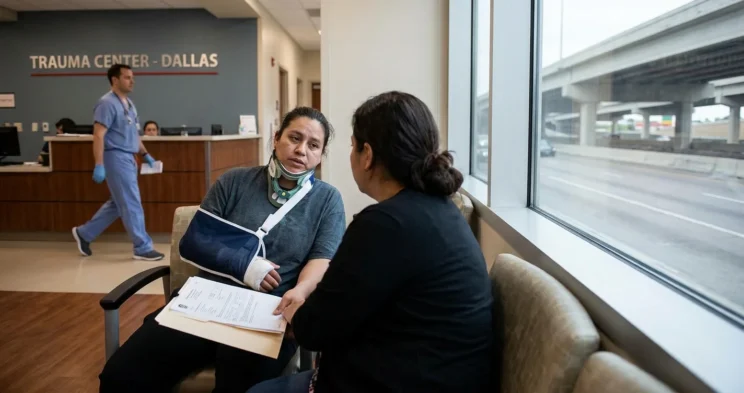
You were on the back of a friend’s bike heading out toward Plano on the Dallas North Tollway when a driver changed lanes without looking and clipped the front tire. The bike went down, and you woke up in the ER with a broken collarbone and questions about whether you can file a claim if your friend was driving or if the other driver caused it. You need clear answers before the medical bills start stacking up.
Why Passengers Have Stronger Fault Positions

Motorcycle passengers in Texas are rarely assigned any share of fault after a crash. Because a passenger does not control the bike’s speed, lane position, or reaction to traffic, there is no operational conduct to apportion under Texas proportionate responsibility rules. This puts passengers in a stronger recovery position than the operator or any other driver involved.
Texas law divides fault among the parties whose conduct contributed to the crash. Under the Texas Civil Practice and Remedies Code (CPRC) Chapter 33, each defendant’s responsibility is measured by what they actually did or failed to do. A passenger who was simply riding has no driving decisions to weigh.
There is one rule worth knowing, as a passenger, called the 51 percent bar, meaning a plaintiff who is found 51% or more responsible for the crash cannot recover anything at all. For an operator who may have been speeding or following too closely, their recovery can be reduced or eliminated based on their share of fault.
You can read more about how this works in our breakdown of Texas comparative negligence and the 51 percent rule. As a passenger, the 51 percent bar rarely comes into play, and you face no equivalent risk.
Who Can a Motorcycle Passenger Sue in Texas?
A passenger can file against the other driver, against the motorcycle operator, or against both at the same time when fault is shared. The right to recover is not tied to your relationship with the person driving the bike. In most cases, the claim is paid by an insurance policy, not out of anyone’s personal bank account.
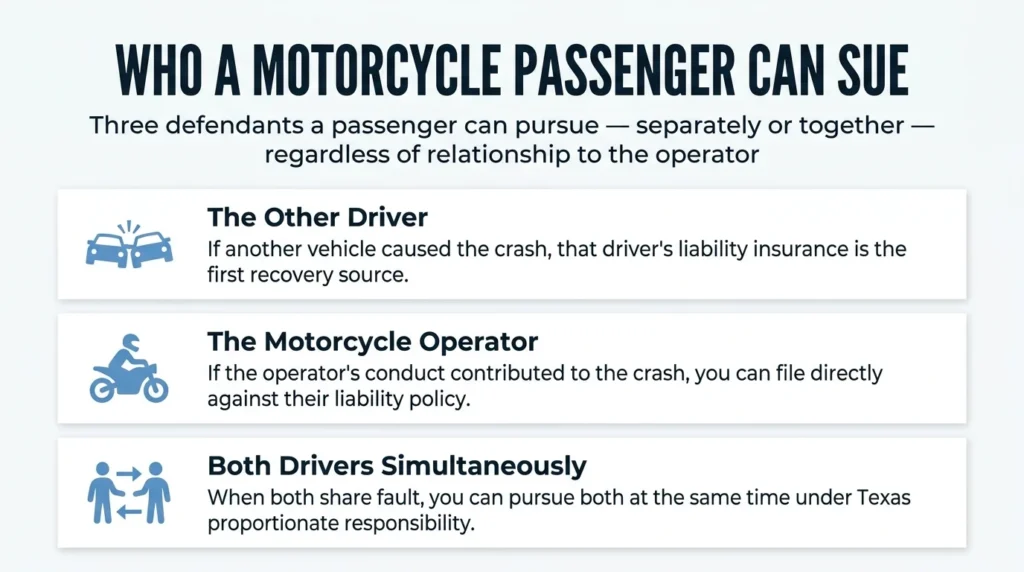
If another vehicle caused the crash, that driver’s liability coverage is the first place to look. This is true whether or not the operator of the bike also bears some fault. If the operator made a mistake, like running a light or losing control, you can file a claim against the operator’s policy directly.
This is where many passengers hesitate because the person driving the bike is often a friend, a partner, or a family member, making filing a claim feel personal. In practice, you are pursuing their insurance company, which is exactly what the policy is designed to handle. The operator’s premiums covered this possibility.
When both drivers share fault, you do not have to choose between them. You can pursue both, and each pays based on their assigned share of responsibility. Our guide to how motorcycle accident settlements work in Texas walks through how multi-defendant payouts get sorted.
In a single-vehicle crash with no other driver involved, the operator’s liability coverage becomes your primary recovery source. An attorney who handles Texas motorcycle accident claims can identify which policies apply and how to pursue them in the right order.
Insurance Sources Available to an Injured Passenger
Passengers can typically draw on three separate insurance tracks: liability coverage from the at-fault party, uninsured/underinsured motorist coverage, and MedPay. These are not mutually exclusive. A single crash can trigger all three, and using one does not block the others.
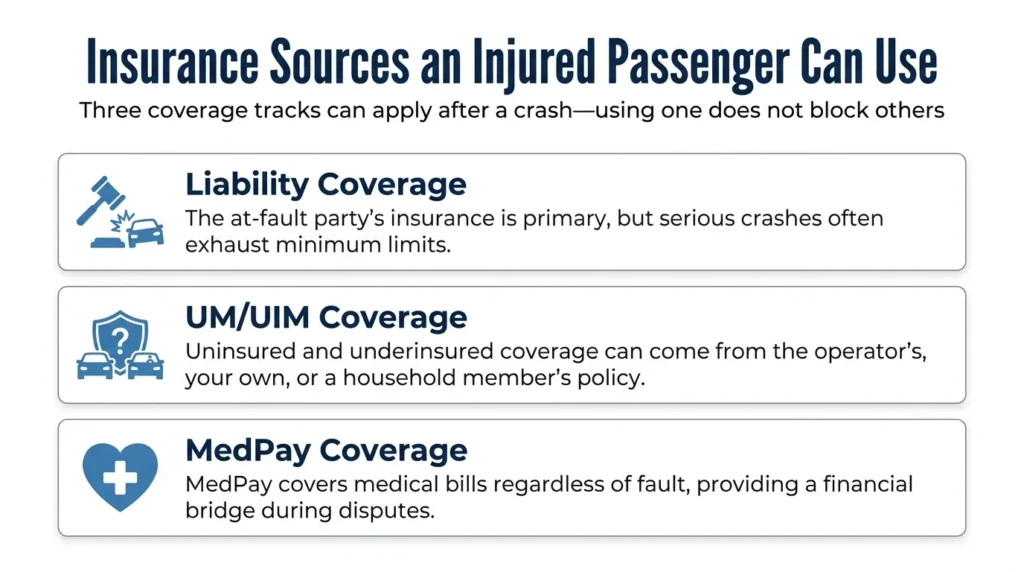
Liability coverage is the first track, and Texas drivers must carry minimum limits of 30/60/25 under Texas Transportation Code § 601.072. Those minimums are often too low for a serious crash. When liability runs out, the next two tracks become critical.
UM/UIM Coverage for Motorcycle Passengers
Uninsured motorists (UM)/underinsured motorist (UIM) coverage pays when the at-fault party has no insurance or not enough to cover your losses. UM applies when the at-fault driver has no liability policy at all. UIM applies when their limits are exhausted before your medical bills and lost wages are paid.
UM/UIM may attach to the motorcycle operator’s policy, but it may also attach to your own auto policy if you have one, or even a household member’s policy. A passenger who does not own a vehicle is often surprised to learn they are covered under a parent’s or spouse’s auto policy. This is one of the most commonly missed coverage sources.
The Texas Insurance Code Chapter 1952 governs how UM/UIM coverage must be offered and structured. Our uninsured motorist accident guide explains how to stack these policies when more than one applies.
MedPay Coverage for Motorcycle Passengers
MedPay is a first-party coverage that pays medical bills regardless of fault. It does not require a liability finding, and it does not reduce your ability to pursue a separate claim. That makes it useful for covering early treatment costs while the fault dispute is still being worked out.
MedPay can sit on the operator’s policy, your own auto policy, or a household member’s policy. Limits are usually modest, often $1,000 to $10,000, but the money is available quickly. MedPay acts as an immediate financial bridge rather than a replacement for your main claim.
Texas Filing Deadlines for Passenger Injury Claims
You have two years from the date of the crash to file a personal injury lawsuit in Texas. Missing that deadline ends the claim, no matter how strong it would have been. The clock does not wait for you to finish medical treatment or sort out who was at fault.
The deadline comes from CPRC § 16.003. Two years sounds like plenty of time, but the practical window is shorter. Investigators need to gather scene evidence, witnesses need to be interviewed while memories are fresh, and insurers expect a documented demand long before any lawsuit is filed.
If the passenger was a minor at the time of the crash, the two-year limitations period may be tolled under CPRC § 16.001 until they turn 18, meaning the deadline to file would generally fall on their 20th birthday rather than their 18th. This is a narrow exception, and you should not assume it applies without legal review.
Treatment and a claim can move forward at the same time, as starting the process early does not mean settling early. It means preserving evidence and protecting your options while you focus on recovery. Knowing the common injuries in motorcycle accidents can help you anticipate what documentation matters most.
How damages get valued under shared-fault scenarios is covered in our explainer on Texas modified comparative negligence laws.
Work with a Texas Motorcycle Injury Attorney
As a passenger, you are rarely at fault, and you often have more than one recovery track open. Sorting through liability policies, UM/UIM, and MedPay across multiple defendants is where most passengers lose value if they handle the claim alone.
Angel Reyes & Associates has over 30 years of experience handling Texas motorcycle injury claims, and has recovered more than $1 billion for clients. We work on contingency, which means no fee unless we win, and free consultations are available 24/7 in English and Spanish. Contact us today to talk through your situation with a real attorney, no obligation.
Past results do not guarantee future outcomes.
Motorcycle Passenger Injury Claim FAQs
Can a motorcycle passenger in Texas file a claim if the crash was caused by a road defect or poor road conditions?
Yes. If a dangerous road condition caused or contributed to the crash, a passenger may have a claim against the government entity responsible for maintaining that road. Claims against Texas government entities follow a separate process under the Texas Tort Claims Act (CPRC Chapter 101) and carry a shorter notice deadline than the standard two-year statute of limitations.
Can a passenger recover compensation for lost wages, or only for medical bills?
A passenger’s injury claim in Texas can include lost wages, reduced earning capacity, pain and suffering, and other damages beyond medical costs. The total recoverable amount depends on the severity of the injuries and how well those losses are documented.
If a motorcycle passenger was not wearing a helmet, does that affect their claim in Texas?
Texas does not impose a contributory fault finding on adult passengers solely for not wearing a helmet, but the defense may argue that the absence of a helmet worsened the injuries. This could affect the damages portion of a claim rather than the question of who caused the crash.
What happens to a passenger's claim if the motorcycle operator who caused the crash dies from their injuries?
The passenger can still pursue a claim against the operator’s estate, and the operator’s liability insurance policy remains available regardless of whether the operator survived. The claim process continues through the estate and the insurer rather than against the operator personally.
About the Authors

Angel Reyes
Writer
Angel L. Reyes, III is the Founder and Managing Partner of Angel Reyes & Associates. A nationally recognized trial attorney and business leader, Angel has helped over 70,000 injury victims recover more than $1 billion since founding the firm in 1993. Named to the Texas Super Lawyers list annually since 2008, Angel brings Wall Street experience, Ivy League education, and a deep commitment to client advocacy. He is a frequent legal commentator and published author with extensive contributions to legal scholarship, trial strategy, and consumer protection.

Kyle Nicolas
Editor
Kyle Nicolas is the Web Content & SEO Manager at Angel Reyes & Associates. He has more than 10 years of experience as a marketing co...

Angel Reyes
Reviewer
Angel L. Reyes, III is the Founder and Managing Partner of Angel Reyes & Associates. A nationally recognized trial attorney and business...