Does Medicare Cover Motorcycle Accidents in Texas?


Every article on this site is researched by our internal team, reviewed for legal accuracy against current Texas law, and held to State Bar of Texas advertising standards before publication. We do not publish content that overstates outcomes or makes promises about results.
Learn more about our
editorial standards .
Key Takeaways
- Medicare pays for motorcycle accident injuries, but creates a mandatory lien on your settlement proceeds.
- The Medicare lien must be fully resolved before any settlement funds can be distributed to you.
- Texas gives you two years to file a personal injury claim, and that deadline is separate from Medicare's lien process.
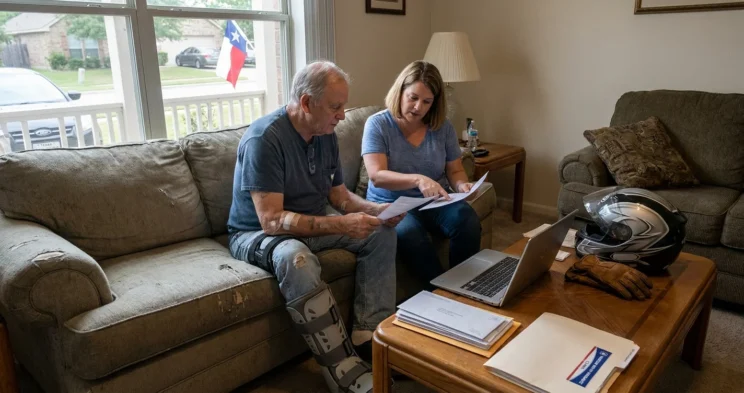
You were riding on I-35 between Austin and San Marcos when a driver clipped your rear wheel and sent you skidding across two lanes. The ambulance ride, the surgery, and the physical therapy sessions that followed all added up quickly. You are on Medicare and wondering whether it will cover any of this.
How Medicare Covers Motorcycle Accident Injuries
Medicare pays for accident-related medical care, including motorcycle crashes. Your coverage is not dependent on how the injury happened; it is dependent on whether the service you need is a covered Medicare benefit.
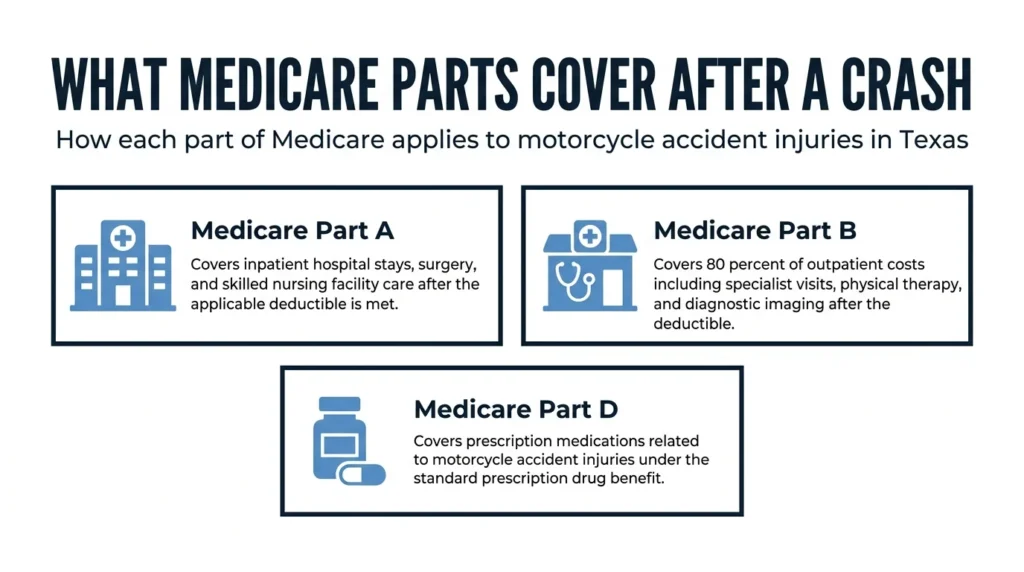
Medicare Part A covers inpatient hospital stays, surgery, and skilled nursing facility care after you meet your deductible. Medicare Part B covers 80 percent of outpatient costs once you meet your deductible, including specialist visits, physical therapy, and diagnostic imaging. With Medicare Part D, prescription medications related to your injuries may be covered there as well.
Medicare does not wait for the at-fault driver’s insurance company to pay before covering your treatment. If the liability insurer has not paid within 120 days, Medicare steps in and pays your providers directly. This keeps your bills out of collections while your case is still pending.
How the Secondary Payer Act Impacts Your Settlement
While Medicare will pay your medical bills upfront, that coverage comes with a catch. Every dollar Medicare spends on your accident-related care becomes a mandatory lien on your personal injury settlement.
Under 42 U.S.C. § 1395y (Medicare Secondary Payer Act), liability insurance is the primary payer. Medicare is the secondary payer, meaning it covers costs only when the liable party’s insurer has not paid or cannot pay promptly. When a settlement, judgment, or award is reached, Medicare’s conditional payments must be repaid from those proceeds.
Medicare pays your bills now on the condition that they will be reimbursed later. The lien is not optional, and it does not go away. It is a binding federal requirement that applies in Texas exactly as it does in every other state.
Your settlement cannot be distributed until the Medicare lien is fully resolved. This is not a formality. If the lien is not cleared before funds are distributed, both you and your attorney can face personal liability under the MSP Act, including the possibility of the government pursuing double the amount of the conditional payments.
If you are approaching a motorcycle accident settlement and are unsure whether a Medicare lien applies to your case, an attorney experienced in Texas accident cases can review your situation and help you avoid a costly compliance error.
Notifying CMS & Resolving the Lien
Resolving the Medicare lien requires active steps on your part, or your attorney’s part, before and after the settlement.
The Centers for Medicare and Medicaid Services (CMS) has a detailed process for recovering conditional payments. The contractor that manages these recoveries is called the Benefits Coordination and Recovery Center, or BCRC. Notify the BCRC as soon as a personal injury claim is filed. The BCRC assigns a case and begins tracking Medicare’s conditional payments related to your injuries.
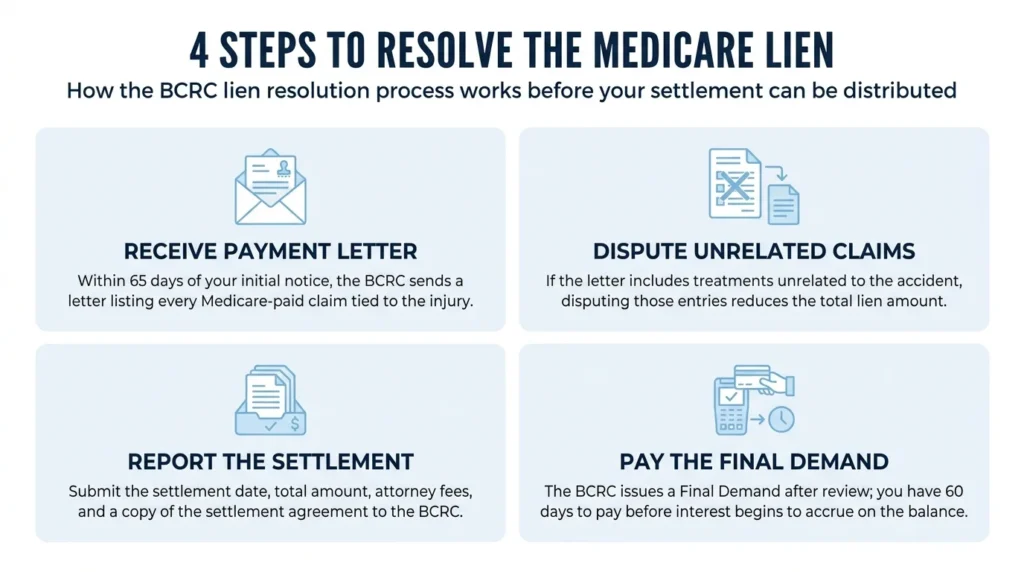
Here is how the process unfolds once you notify the BCRC:
- Step 1: Receive the Conditional Payment Letter. Within 65 days of your initial notice, the BCRC sends a Conditional Payment Letter listing every Medicare-paid claim tied to the injury. This is the baseline lien figure.
- Step 2: Dispute unrelated claims. If the Conditional Payment Letter includes treatments unrelated to the accident, you can dispute those entries. Removing unrelated claims reduces the lien amount.
- Step 3: Report the settlement. Once the case settles, submit the settlement details to the BCRC, including the settlement date, total amount, attorney fees, and a copy of the settlement agreement.
- Step 4: Receive and pay the Final Demand. After you submit the settlement details, the BCRC reviews the information and issues a Final Demand. Once you receive the Final Demand, you have 60 days to pay before interest begins to accrue.
Medicare can reduce the lien by a proportionate share of your attorney fees and litigation costs. In cases involving financial hardship or disputed liability, a formal compromise or waiver of the lien amount is possible.
Texas Filing Deadlines & the Lien Timeline
Resolving a Medicare lien takes time–often months. However, the Texas legal clock does not pause or slow down just because you are waiting on federal paperwork.
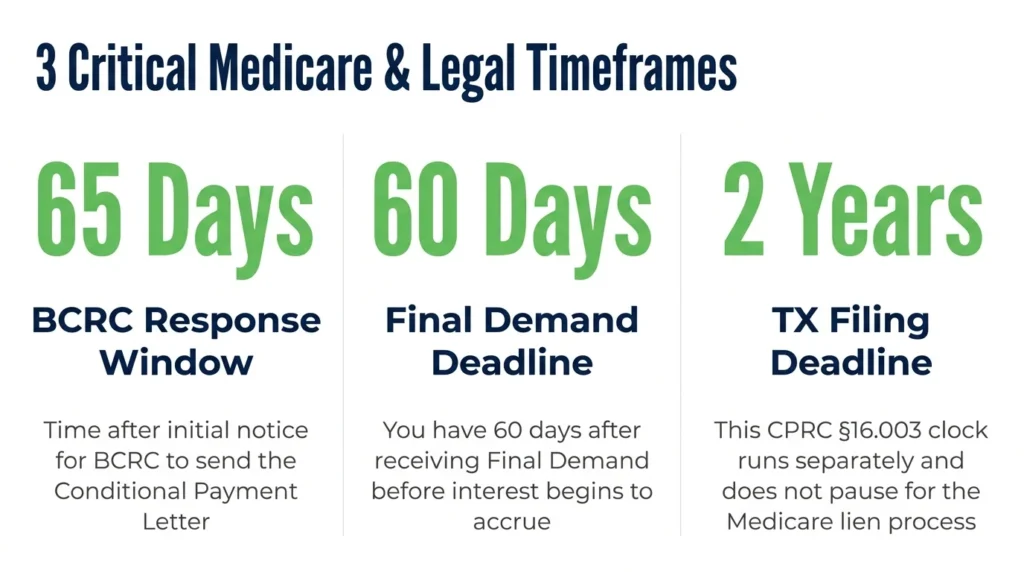
Texas Civil Practice and Remedies Code (CPRC) § 16.003 gives you exactly two years from the date of your accident to file a personal injury lawsuit.Many people mistakenly delay filing their lawsuit or pausing settlement talks because they are still waiting for Medicare to finish processing their lien. These two timelines run on completely separate tracks, so it’s important that you do not delay.
Waiting until the last minute leaves you completely in the dark. If you do not start the lien resolution process early, you may face immense pressure to accept a lower settlement offer before you even know how much money you legally owe back to Medicare.
Need Help? Review Your Options with an Attorney
Medicare coverage is a vital safety net after a motorcycle crash, but the federal lien it creates is absolute. Getting your medical bills paid upfront is only half the battle. Knowing exactly what you owe Medicare—and resolving that debt properly before your settlement is finalized—is the only way to protect your money and actually keep your recovery.
For over 30 years, Angel Reyes & Associates has helped injured Texans navigate these complex federal rules. We handle motorcycle accident cases across the state, protecting riders from insurance company tactics and federal lien traps. We offer 100% free consultations, and you never pay us a dime unless we win your case.
If you have questions about a Medicare lien, a pending settlement, or what your rights are after a Texas motorcycle crash, reach out to us today.
Medicare Coverage for Motorcycle Accidents FAQs
Can a Medicare lien be reduced below the original amount?
Yes. Medicare will subtract a proportionate share of your attorney fees and case costs from the lien total. If your settlement is small relative to your injuries or liability is genuinely disputed, you may also apply for a formal compromise or waiver through the BCRC’s administrative process.
Does Medicare cover future medical expenses from my motorcycle crash?
Medicare pays for care that has already been provided, not for future treatment. Once the lien is resolved and the settlement is distributed, Medicare continues to cover future accident-related care you receive as a regular Medicare benefit, subject to your normal cost-sharing.
Does Medicaid work the same way as Medicare for motorcycle accident settlements in Texas?
Both programs assert liens on personal injury settlements, but they operate under different rules. Medicare is governed by federal law and applies uniformly in every state. Texas Medicaid liens are governed by a combination of federal and state law, and the recovery rules differ, including what portions of the settlement are subject to the lien.
Does Medicare Advantage (Part C) work differently than traditional Medicare in a motorcycle accident case?
Medicare Advantage plans are private plans approved by Medicare, and they have their own reimbursement rights under the MSP Act. If you receive care through a Medicare Advantage plan after a motorcycle crash, that plan can assert its own lien on your settlement, similar to traditional Medicare, though the administration process may differ by plan.
About the Authors

Alex Ivanov
Writer
Alex Ivanov is a personal injury attorney at Angel Reyes & Associates, focused on car, truck, and motorcycle accident cases. Licensed in Texas and multiple federal districts, Alex brings international legal experience and a global education to his practice. He earned his LL.M. from Texas A&M University School of Law after graduating from Belarussian State University in 2016. Alex is fluent in Russian, English, Ukrainian, and Belarussian, and is recognized by multiple national trial lawyer associations for his results and leadership under 40.

Kyle Nicolas
Editor
Kyle Nicolas is the Web Content & SEO Manager at Angel Reyes & Associates. He has more than 10 years of experience as a marketing co...

Angel Reyes
Reviewer
Angel L. Reyes, III is the Founder and Managing Partner of Angel Reyes & Associates. A nationally recognized trial attorney and business...