Distracted Rideshare Driver Accidents in Texas


Every article on this site is researched by our internal team, reviewed for legal accuracy against current Texas law, and held to State Bar of Texas advertising standards before publication. We do not publish content that overstates outcomes or makes promises about results.
Learn more about our
editorial standards .
Key Takeaways
- Texas law bans handheld electronic messaging while driving, and that ban applies to Uber and Lyft drivers.
- The driver's app status at crash time determines whether $50K or $1M in coverage applies.
- Digital evidence like app logs and phone records can prove distraction but must be preserved fast.
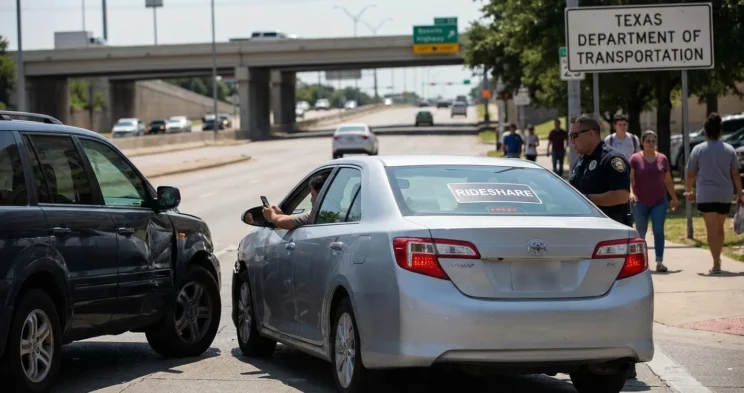
You ordered an Uber home from a late dinner in Houston’s Montrose neighborhood, trusting the driver to keep both eyes on the road. Instead, you watched him swiping through his phone as the car drifted and hit the vehicle ahead of you on Westheimer Road. Now you have medical bills, a neck injury, and no clear answer about who pays.
Rideshare crashes involving distracted drivers are more complicated than a typical car accident. Two insurance companies, an app company’s legal team, and an independent contractor classification all stand between you and the compensation you need.
What Counts as Distracted Driving for a Rideshare Driver?
Texas law sets a clear baseline. Texas Transportation Code § 545.4251 prohibits using a portable wireless device to read, write, or send an electronic message while operating a motor vehicle. That law applies to rideshare drivers the same as any other motorist.
But rideshare drivers face a category of distraction that other drivers do not. To earn income, they must interact with the app continuously. Accepting a new ride request, checking a destination address, monitoring a promotion, or switching between the Uber and Lyft apps all require taking eyes off the road and hands off the wheel.
Navigation use has a strong defense under the statute, but manually entering addresses, accepting ride requests, or toggling between apps does not.
Dual-apping raises the distraction level further. Some drivers run both the Uber and Lyft apps simultaneously to maximize trip opportunities. Each incoming request creates a notification and demands a decision. That divided attention is not just dangerous. It creates significant insurance complications.
Negligence Theories in a Distracted Rideshare Driver Claim
A distracted rideshare driver can be held liable under the same negligence framework that governs any Texas personal injury case. The driver owed you a duty of care and violated that duty by driving while distracted, causing the crash and your resulting injuries. That four-part framework applies regardless of whether the driver was an Uber driver, a Lyft driver, or a private motorist.
The harder question is whether the rideshare company itself shares any responsibility. Uber and Lyft classify their drivers as independent contractors, not employees. That classification is how they avoid direct vicarious liability under the respondeat superior doctrine. Texas courts have largely accepted this structure.
Direct negligence theories, however, are still available against the company. If Uber or Lyft designed an app that required unsafe levels of in-car interaction, failed to enforce its own distracted driving policies, or continued to allow a driver it knew was dangerous to operate on the platform, those facts may support a claim against the company directly. The threshold is higher, but the theory is viable in the right case.
Texas proportionate responsibility rules also apply. Under Texas Civil Practice and Remedies Code (CPRC) Chapter 33, each party’s fault is assigned as a percentage. Your recovery is reduced by your own share of fault. If your percentage exceeds 50%, you cannot recover at all.
Which Insurance Policy Covers a Distracted Rideshare Crash?
The driver’s app status at the moment of the crash determines which insurance policy applies. Texas Insurance Code Chapter 1954 sets the minimum coverage requirements for transportation network companies, and the tiers differ significantly.
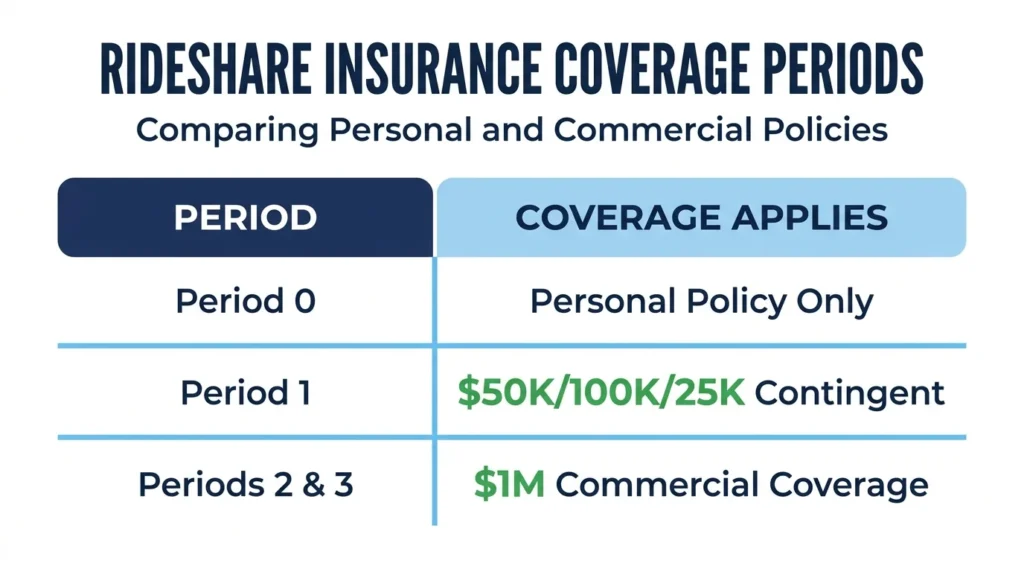
Period 0 is when the app is off entirely. The driver is not working, and only their personal auto policy applies. Uber and Lyft provide no coverage during this period.
Period 1 begins the moment the driver activates the app and becomes available for rides but before any ride is accepted. During Period 1, Texas Insurance Code Chapter 1954 requires Uber or Lyft to provide contingent liability coverage of at least $50,000 per person, $100,000 per accident, and $25,000 for property damage. Personal auto policies typically exclude rideshare activity entirely, so this contingent coverage becomes the only available protection.
Periods 2 and 3 begin when the driver accepts a ride through passenger drop-off. The platform must provide primary commercial liability coverage of at least $1,000,000 per incident.
Dual-apping creates a genuine coverage gap. If a driver is logged into both platforms at the moment of a crash, each company may argue the other’s policy should respond first. Resolving that dispute takes time and often requires legal pressure to move either insurer.
How to Prove a Rideshare Driver Was Distracted
Proving distraction in a rideshare crash is more difficult than proving a red-light violation, but the digital record a rideshare driver leaves is often richer than the record from any other type of vehicle operator. Here are the main evidence sources:
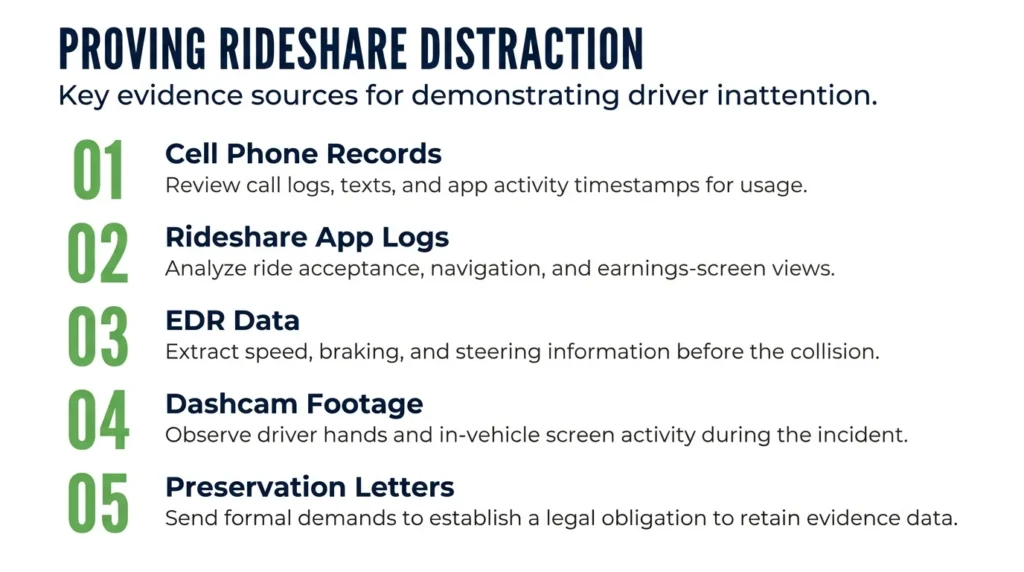
Cell phone records. A subpoena to the driver’s wireless carrier can produce call logs, text message timestamps, and app activity data showing what the phone was doing in the seconds before impact.
Rideshare app logs. Uber and Lyft maintain internal records of every in-app action a driver takes, including ride acceptance timestamps, navigation interactions, and earnings-screen views. These records are available through the litigation discovery process.
Event data recorder (EDR) data. Most modern vehicles contain an EDR that captures vehicle speed, braking force, and steering inputs in the five to 10 seconds before a collision. This data can confirm whether the driver was braking or reacting at all.
Dashcam footage. Many rideshare drivers run dashcams for their own protection. If footage exists, it may show the driver’s hands and screen activity directly.
Preservation letters. An attorney can send formal preservation letters to Uber, Lyft, and the wireless carrier within days of the crash. These create a legal obligation to retain all data rather than allowing it to be overwritten, or deleted, in the normal course of operations.
Time matters here. App logs, wireless carrier records, and EDR data can all be overwritten or purged on short cycles. Knowing what to do immediately after a rideshare accident in Texas ensures you protect essential evidence.
Your Legal Deadline & Next Steps

Texas gives you two years from the date of the crash to file a personal injury lawsuit. That deadline comes from Texas Civil Practice and Remedies Code (CPRC) § 16.003, and courts enforce it strictly. Miss it and your right to recover is almost certainly gone, regardless of how strong the evidence is.
Two years sounds like enough time, but the practical pressure is much earlier. App logs and EDR data can disappear within weeks. Insurers will try to settle quickly for less than the claim is worth. The rideshare company’s legal team starts building its defense from day one.
After the crash, your immediate priorities are to document the scene, report the incident through the rideshare app, seek medical care, and avoid giving a recorded statement to any insurer before speaking with an attorney.
Talk to an Attorney About Your Rideshare Crash
Distracted rideshare driver crashes involve multiple insurers, a corporate defendant with in-house legal resources, and digital evidence that disappears fast. You need someone who knows how to move quickly and how to pressure both the driver’s insurer and the platform.
Angel Reyes & Associates has guided Texans through personal injury claims for over 30 years, including rideshare accidents where the distraction evidence required aggressive preservation tactics and litigation against the platform itself. We work on a contingency basis, meaning no fee unless we win. We can also handle most, if not all, of your case remotely so your life does not stop while your claim moves forward.
Get a free consultation to review your situation. The earlier you reach out, the more evidence options remain available. Our team has recovered compensation for injured Texans across a long record of personal injury cases.
Past results do not guarantee future outcomes.
Distracted Rideshare Driver Accident FAQs
Can I recover compensation as a rideshare passenger even if another driver caused the crash?
Yes. As a rideshare passenger you are almost never considered at fault, and if the other driver caused the collision the $1,000,000 commercial liability policy that Uber or Lyft carries during active trips applies to your injuries.
Will my own auto insurance help if the rideshare driver had no personal coverage?
Your own uninsured or underinsured motorist (UM/UIM) coverage can step in when the at-fault driver’s policy is insufficient or excluded. PIP or MedPay coverage on your own policy may also cover immediate medical expenses regardless of fault.
Does a rideshare driver face criminal penalties for texting at the time of a crash?
Under Texas Transportation Code § 545.4251, texting while driving is a misdemeanor offense carrying fines between $25 and $200. If the distracted driving causes serious injury or death, prosecutors may pursue larger charges under other provisions of Texas law.
What if the rideshare driver was between trips and the app was on when the crash happened?
Period 1 coverage applies when the app is on but no ride has been accepted. Uber and Lyft must provide contingent liability coverage of at least $50,000 per person under Texas Insurance Code Chapter 1954, but the driver’s personal auto policy will typically deny coverage during this window because of commercial-use exclusions.
About the Authors

Angel Reyes
Writer
Angel L. Reyes, III is the Founder and Managing Partner of Angel Reyes & Associates. A nationally recognized trial attorney and business leader, Angel has helped over 70,000 injury victims recover more than $1 billion since founding the firm in 1993. Named to the Texas Super Lawyers list annually since 2008, Angel brings Wall Street experience, Ivy League education, and a deep commitment to client advocacy. He is a frequent legal commentator and published author with extensive contributions to legal scholarship, trial strategy, and consumer protection.

Kyle Nicolas
Editor
Kyle Nicolas is the Web Content & SEO Manager at Angel Reyes & Associates. He has more than 10 years of experience as a marketing co...

Angel Reyes
Reviewer
Angel L. Reyes, III is the Founder and Managing Partner of Angel Reyes & Associates. A nationally recognized trial attorney and business...