What To Do If an Uber Driver Hits Your Car in Texas


Every article on this site is researched by our internal team, reviewed for legal accuracy against current Texas law, and held to State Bar of Texas advertising standards before publication. We do not publish content that overstates outcomes or makes promises about results.
Learn more about our
editorial standards .
Key Takeaways
- The Uber driver's app status at impact determines which insurance policy covers your claim.
- Texas Insurance Code § 1954.053 requires a $1 million policy when the driver was on an active trip.
- You have two years from the crash date to file a personal injury claim under Texas law.
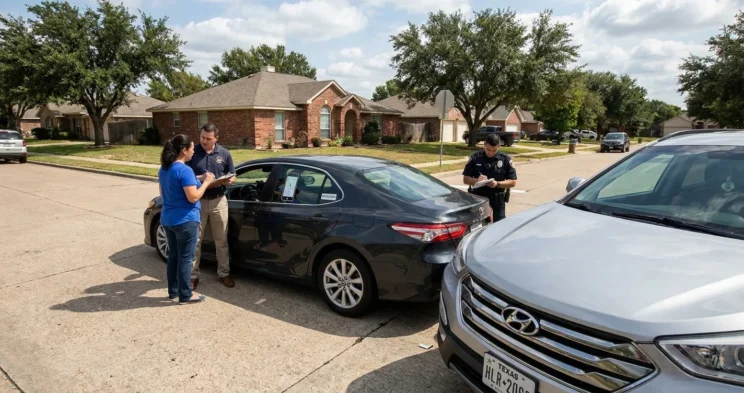
You were stopped at a light on Lamar Boulevard when an Uber driver rear-ended your car. You got out, exchanged information, and noticed the driver had a passenger in the back seat. Now you’re home, your car needs repairs, and you’re staring at your phone wondering who actually pays for this.
This situation is different from a standard car accident, and the steps you take in the next few days can determine whether you recover your full losses or walk away with far less than you’re owed.
Steps To Take at the Scene
Take immediate action to protect your claim from the moment the crash happens. A police report, documented evidence, and a clear record of the Uber driver’s app status are the foundation of any third-party rideshare claim.
You can learn more about what information to collect from the other driver before your claim begins.
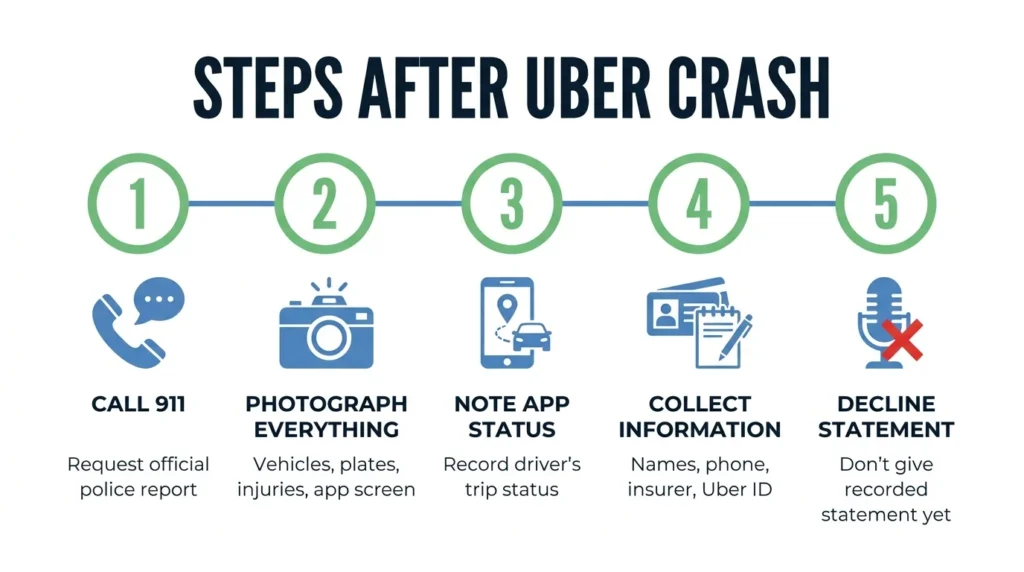
Step 1: Call 911 and request a police report. A police report creates an official record of the crash and is required by most insurers when a commercial vehicle is involved. Do not leave the scene without one.
Step 2: Photograph everything. Both vehicles, the crash location, the driver’s license plate, road conditions, any visible injuries, and any passenger or Uber app screen you can see.
Step 3: Write down the driver’s app status. On a trip, with a passenger in the backseat? Waiting for a ride? App off? Record whatever the driver tells you. If the driver had a passenger, note that. If the driver says they were on a trip or en route to a pickup, write it down. This single detail determines which insurance policy covers your claim.
Step 4: Collect contact information. Driver’s name, phone, insurer, and Uber ID. Every witness name and phone number. Texas law requires all drivers involved in a crash to stop, exchange information, and render aid under Texas Transportation Code § 550.021.
Step 5: Decline a recorded statement. Don’t give a recorded statement to any insurance adjuster at the scene. You can provide a written account later, after speaking with an attorney.
Which Uber Insurance Applies to Your Claim?
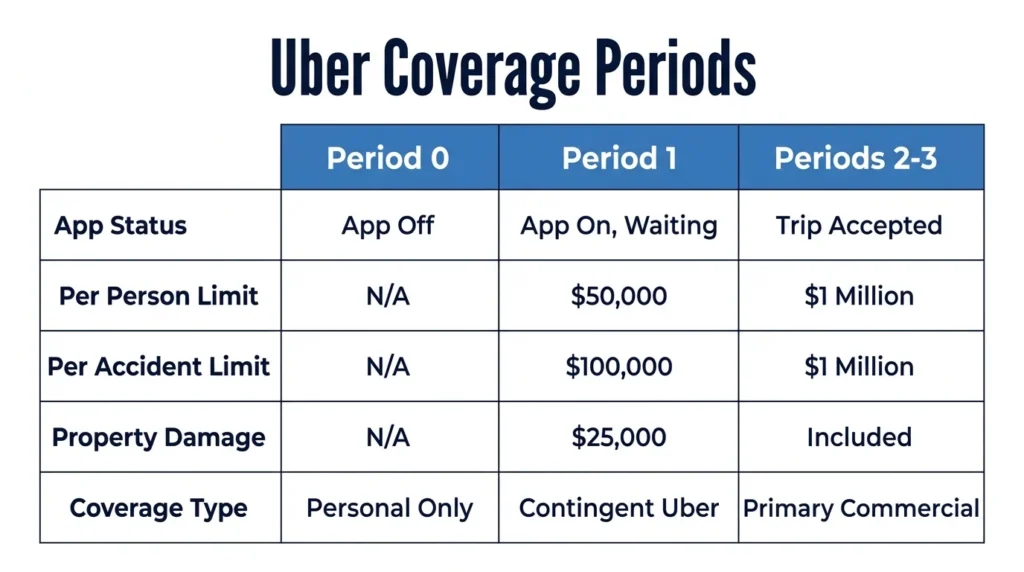
The Uber driver’s app status at the exact moment of the crash controls which insurance pays. Texas Insurance Code Chapter 1954 governs how transportation network companies like Uber must structure coverage, and these rideshare insurance coverage periods create three distinct scenarios with very different outcomes for your claim.
Period 0 (App Off)
When the Uber driver’s app was completely off at the time of the crash, Uber owes you nothing. The crash is treated as a standard Texas car accident between two private drivers.
File your claim with the at-fault driver’s personal auto insurer. If that insurer denies your claim or the driver is uninsured, your own uninsured motorist coverage may apply.
Period 1 (App On, No Ride Accepted)
When the driver was logged in and available but had not yet accepted a ride request, Texas law requires Uber to carry contingent liability coverage. Under Texas Insurance Code § 1954.052, that coverage provides a minimum of $50,000 per person, $100,000 per accident, and $25,000 in property damage.
That coverage is contingent, meaning it only kicks in if the driver’s personal insurer denies the claim first. This gap creates real delays and disputes for third-party claimants, because the personal insurer and Uber’s carrier may both point to each other.
Periods 2 & 3 (Ride Accepted Through Drop-Off)
Once the Uber driver accepted a trip and through the moment the passenger exited the vehicle, Uber’s full commercial policy applies. Texas Insurance Code § 1954.053 requires primary liability coverage of at least $1 million per occurrence. This policy applies whether the driver was actively transporting a passenger or was en route to a pickup.
This is the coverage tier that applies to most third-party claims, because it covers any other driver, pedestrian, or cyclist injured by an Uber driver who was working. If the police report or Uber’s own records confirm the driver had an active trip, your claim goes directly against the commercial policy. Knowing how Texas rideshare claims are handled helps you understand the broader picture of your options.
How To File a Third-Party Claim Against Uber
Once you know which coverage period was active, you can begin the claim process. File early, document everything, and do not let any insurer close your claim before you understand the full scope of your losses.
Report the accident through Uber’s app or website as soon as possible. Prompt reporting preserves your access to the commercial policy and opens the claims process on Uber’s end. The claims adjuster that Uber’s insurer assigns typically contacts you within a few business days.
Do not accept a quick settlement offer before you know the full extent of your vehicle damage and any injuries. A fast, low offer is a business decision by the insurer. Accepting it means giving up your right to ask for more, even if your costs increase later. An attorney familiar with rideshare claims can identify which policies apply and help you avoid the documentation and timing mistakes that insurers use to reduce payouts.
Keep all records: repair estimates, medical bills, rental car receipts, and written communications with every insurer involved. Texas uses a fault-sharing system called proportionate responsibility under Texas Civil Practice and Remedies Code (CPRC) Chapter 33. If any portion of fault is attributed to you, your recovery is reduced by that percentage. If you are found more than 50% at fault, you cannot recover anything.
Accurate documentation of the crash facts protects you against inflated fault attributions. It also helps you back up your side of the story with hard data, in case you sue Uber for an accident in Texas later.
Mistakes That Can Hurt Your Rideshare Claim
Third-party rideshare claims fail for reasons. Knowing what those reasons are puts you in a position to avoid them.
Going to the Wrong Insurer
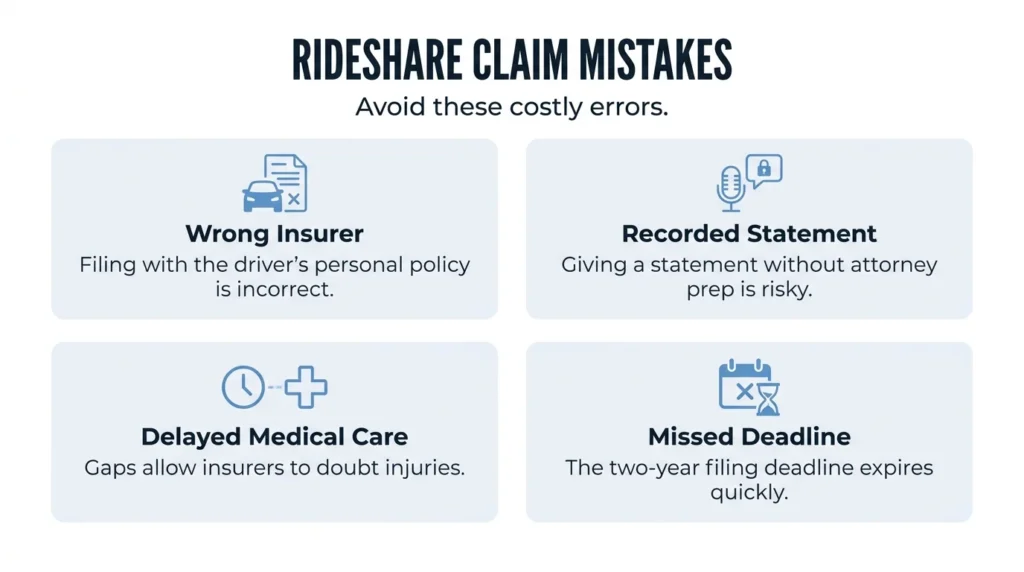
During Periods 2 and 3, the Uber driver’s personal auto policy does not cover the accident. Filing with that carrier wastes time and can result in an outright denial, which some claimants take as a final answer.
Giving a Recorded Statement to Any Insurer Without Preparation
Adjusters are trained to ask questions that elicit responses they can use to minimize your claim. You are not required to give a recorded statement before speaking with an attorney.
Delaying Medical Evaluation
Gaps between the crash date and your first medical appointment give insurers an opening to argue your injuries were minor, pre-existing, or unrelated to the crash. After a rideshare accident in Texas, see a doctor as soon as possible, even if you feel fine at the scene.
Not Knowing the Deadline To File
You have two years from the date of the crash to file a personal injury or property damage lawsuit under Texas Civil Practice and Remedies Code (CPRC) § 16.003. Missing that deadline ends your right to pursue compensation, regardless of how strong your case is. Do not wait.
Talk to an Attorney About Your Rideshare Accident
Rideshare claims involve competing insurance carriers, disputed coverage periods, and adjusters who know these cases better than most claimants do. You do not have to work through that alone.
Angel Reyes & Associates has guided Texans through car accident and rideshare claims for over 30 years. We work on contingency, meaning there is no fee unless we win your case. We offer free consultations and serve clients across the entire state of Texas. Our team has recovered more than $1 billion for clients over the course of the firm’s history. If you were hit by an Uber driver and need to understand your options, contact us for a free consultation. You can also learn more about who we are and how we work before you call.
Past results do not guarantee future outcomes.
Uber Accident FAQs
Can I use my own insurance if an Uber driver hit me in Texas?
Yes. If you have uninsured or underinsured motorist (UM/UIM) coverage, you can file a claim with your own insurer when the Uber driver’s coverage is insufficient or disputed. Texas law requires insurers to offer UM/UIM coverage on every personal auto policy unless you rejected it in writing.
What if an Uber driver hit my parked car and left the scene?
Start by documenting the damage with photos and checking for any witness information or nearby security cameras. If you can identify the driver, contact Uber’s support line to report the incident, then file a claim with the driver’s insurer or Uber’s commercial carrier depending on the driver’s app status at the time.
Can I sue the Uber driver personally for hitting my car?
Yes. You can sue the driver directly if their negligence caused the crash and the available insurance does not fully cover your losses. Uber drivers are classified as independent contractors, so they are personally responsible for their own driving conduct even while working through the app.
How does Uber know what coverage period was active at the time of my crash?
Uber keeps digital records of driver app status, trip acceptance, and route data in real time. If you pursue a claim, Uber’s insurer will pull those records to confirm which coverage period was active when the crash occurred.
Does filing a claim against Uber's insurer affect my own insurance rates?
Filing a third-party claim directly against the at-fault driver’s insurer or Uber’s commercial carrier typically does not affect your own insurance premium. Your rates are more likely to be affected if you file under your own collision or UM/UIM coverage, but that depends on your specific policy terms.
About the Authors

Angel Reyes
Writer
Angel L. Reyes, III is the Founder and Managing Partner of Angel Reyes & Associates. A nationally recognized trial attorney and business leader, Angel has helped over 70,000 injury victims recover more than $1 billion since founding the firm in 1993. Named to the Texas Super Lawyers list annually since 2008, Angel brings Wall Street experience, Ivy League education, and a deep commitment to client advocacy. He is a frequent legal commentator and published author with extensive contributions to legal scholarship, trial strategy, and consumer protection.

Kyle Nicolas
Editor
Kyle Nicolas is the Web Content & SEO Manager at Angel Reyes & Associates. He has more than 10 years of experience as a marketing co...

Angel Reyes
Reviewer
Angel L. Reyes, III is the Founder and Managing Partner of Angel Reyes & Associates. A nationally recognized trial attorney and business...