Who Pays for Damages in a Rideshare Accident in Texas?


Every article on this site is researched by our internal team, reviewed for legal accuracy against current Texas law, and held to State Bar of Texas advertising standards before publication. We do not publish content that overstates outcomes or makes promises about results.
Learn more about our
editorial standards .
Key Takeaways
- Fault decides which insurer pays after a Texas rideshare crash, not the rideshare company.
- Bodily injury and property damage are separate claims that can route to different insurers.
- A driver found 51% or more at fault recovers nothing under Texas Chapter 33.
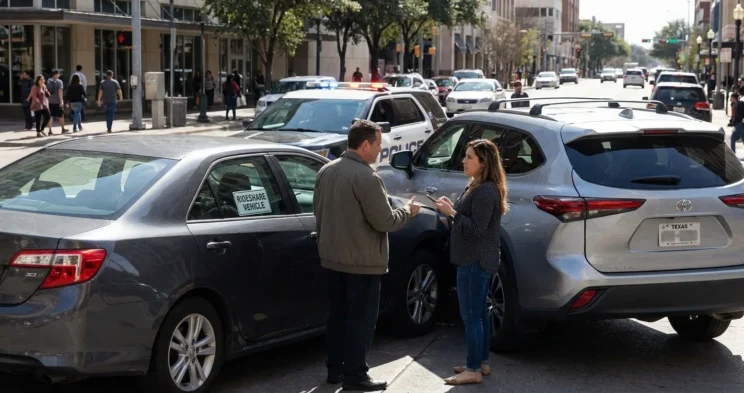
You were riding in an Uber home from a late dinner in Deep Ellum when another car ran a red light and slammed into the side door. Now you have a hospital bill, a phone full of insurance numbers, and no idea which company is supposed to pay. The rideshare driver points to the app. The other driver points to you.
Who actually covers your damages?
How Fault Determines Who Pays in Texas
In Texas, the person who caused the crash controls which insurer pays for your damages. Fault is the switch that routes your claim to the right policy, and rideshare crashes are no different.
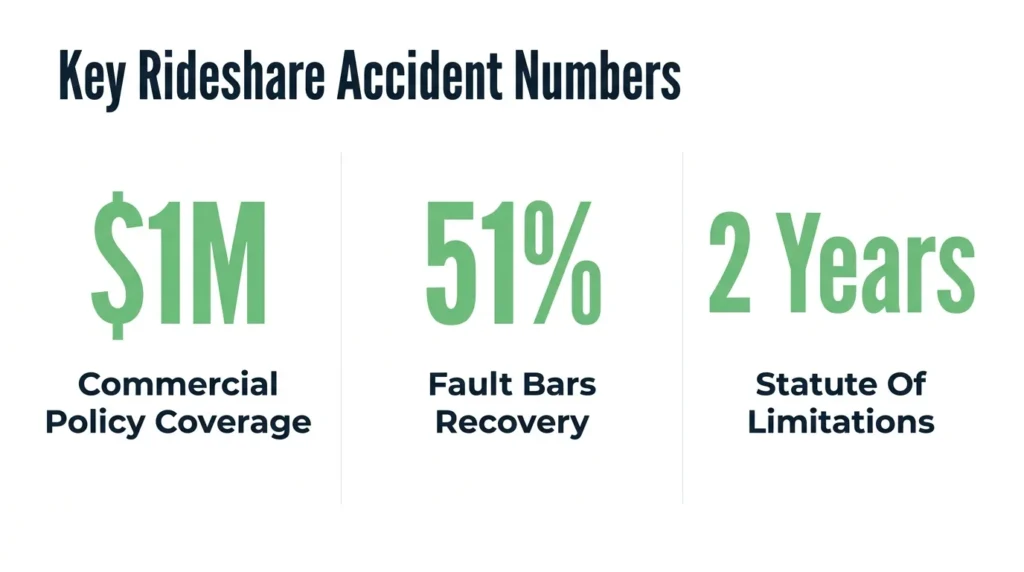
Texas follows a modified comparative fault rule. Each party’s share of fault reduces what they can recover, and anyone found 51% or more at fault recovers nothing. You can read the statute itself in the Texas Civil Practice and Remedies Code (CPRC) Chapter 33.
Fault in a rideshare crash does not land on Uber or Lyft as your employer. It lands on a driver. That might be the rideshare driver, a third-party driver, or both, and the answer decides which insurer steps up first.
This is where most people get tripped up. Who caused the crash controls your bodily injury claim and your property damage claim separately. Those two claims do not always go to the same insurer, even from the same accident. If you want the full breakdown of how Texas splits fault, our explainer on the Texas comparative negligence 51% rule walks through it.
Bodily Injury vs. Property Damage Coverage Lines
Your crash creates two separate coverage questions, not one. Bodily injury coverage pays for what happened to your body. Property damage coverage pays for what happened to your vehicle. They follow the same fault logic but can route to different insurers with different limits.
Bodily Injury Coverage
Bodily injury coverage pays for your medical bills, lost wages, and pain and suffering. Which insurer responds depends on the rideshare driver’s status at the time and on who caused the crash.
When the rideshare driver is at fault during an active ride, the rideshare company’s commercial policy carries at least $1 million in liability coverage per incident. That minimum comes from the Texas Insurance Code § 1954.053, and it covers passengers, other drivers, and pedestrians alike.
When the driver is at fault with the app on but no ride has been accepted, the picture shrinks. The commercial policy drops to contingent minimums of $50,000 per person and $100,000 per accident under Texas Insurance Code § 1954.052. The driver’s personal insurer may also deny coverage, since most personal auto policies exclude commercial driving.
When a third-party driver causes the crash, your bodily injury claim runs against that driver’s personal policy first. The rideshare company’s uninsured and underinsured motorist coverage only kicks in as a backup if that policy falls short. For more information on who pays medical bills after a Texas car accident, a personal injury attorney can help.
Property Damage Coverage
Property damage coverage pays to repair or replace your vehicle. It follows the same at-fault logic but routes on its own track, with its own limits.
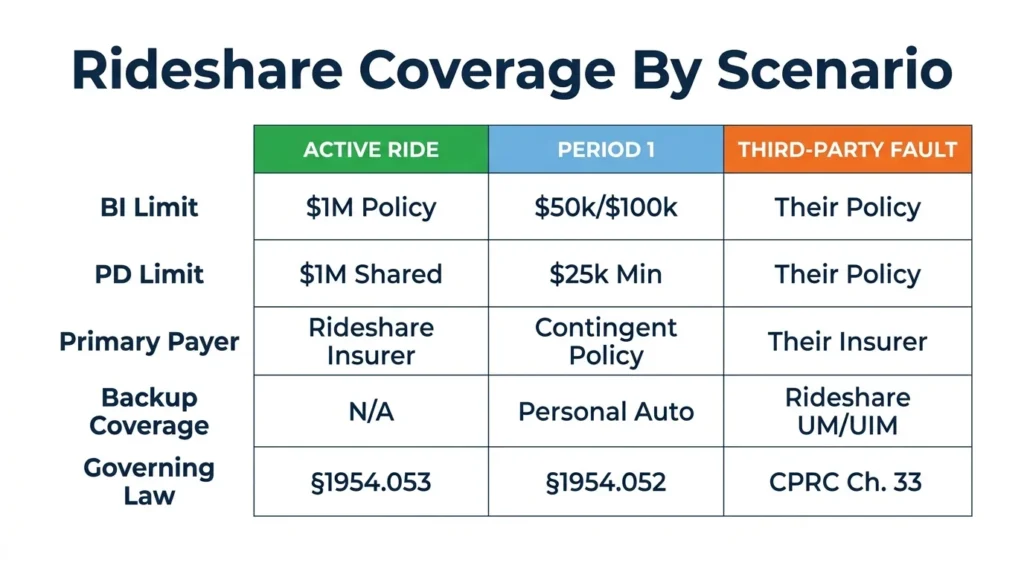
When the rideshare driver is at fault during an active ride, the same $1 million commercial policy under § 1954.053 covers your vehicle too. One catch: that single limit is shared across every loss from the crash, so injuries and vehicle damage draw from the same pool.
When the driver is at fault during Period 1, the contingent property damage minimum under § 1954.052 is just $25,000. That may not cover a totaled vehicle. The driver’s own collision coverage, if they carry it, becomes the secondary layer.
When a third-party driver is at fault, your property damage claim runs against that driver’s liability policy. If that driver has no insurance, your own collision coverage or your uninsured motorist property endorsement becomes the path to getting your car fixed.
When the Rideshare Driver Is at Fault
When the rideshare driver causes your crash, the rideshare company’s commercial policy is your direct route to payment. You do not need to chase the driver’s personal insurance first.
If you were a passenger, you have a direct claim against that commercial policy for both your injuries and your vehicle damage. The rideshare company’s insurer handles it. The driver’s personal policy stays out of it entirely.
Third-party drivers and pedestrians hurt by an at-fault rideshare driver get the same access. The commercial insurer handles the bodily injury and property damage claims directly, no matter who you are in the crash.
The amount of coverage depends on which period the app was in when the crash happened. The gap between Period 1, Period 2, and Period 3 changes the math, and readers who need to pin down their tier can review how the Uber and Lyft insurance coverage periods work before filing. The full set of rideshare insurance rules sits in the Texas Insurance Code Chapter 1954.
When a Third-Party Driver Is at Fault
When a driver other than your rideshare driver causes the crash, the primary claim runs against that driver’s personal policy, not the rideshare company’s. The rideshare company is not automatically the payer just because you were in a rideshare.
If that at-fault driver has no insurance or too little, the rideshare company’s uninsured and underinsured motorist coverage steps in for passengers and the rideshare driver. During an active ride, those minimums track § 1954.053. An attorney who handles Texas rideshare accident claims can explain how these layers fit together.
So if you were a passenger and another driver caused the wreck, you start with that driver’s insurer, not the rideshare company’s primary policy. The claim path runs through the at-fault driver first. Before you accept any early offer, it helps to talk with an attorney who handles Texas car accident claims and knows how multi-insurer cases play out.
When Fault Is Shared or Disputed
When the rideshare driver and a third-party driver both share blame, each insurer pays only for its own driver’s percentage of fault. Your recovery from each one shrinks in proportion to that split.
Your own fault matters too. As long as you stay below 51% at fault, you keep the right to recover from each at-fault party. Cross that line and you recover nothing under CPRC Chapter 33.
Insurers fight hard over fault percentages in these cases, because every percentage point shifts who pays how much. Delay and lowball offers are common when fault is in play. You can see how we have handled disputed claims on our case results page.
If fault in your crash is contested, a few early moves protect what you can recover.
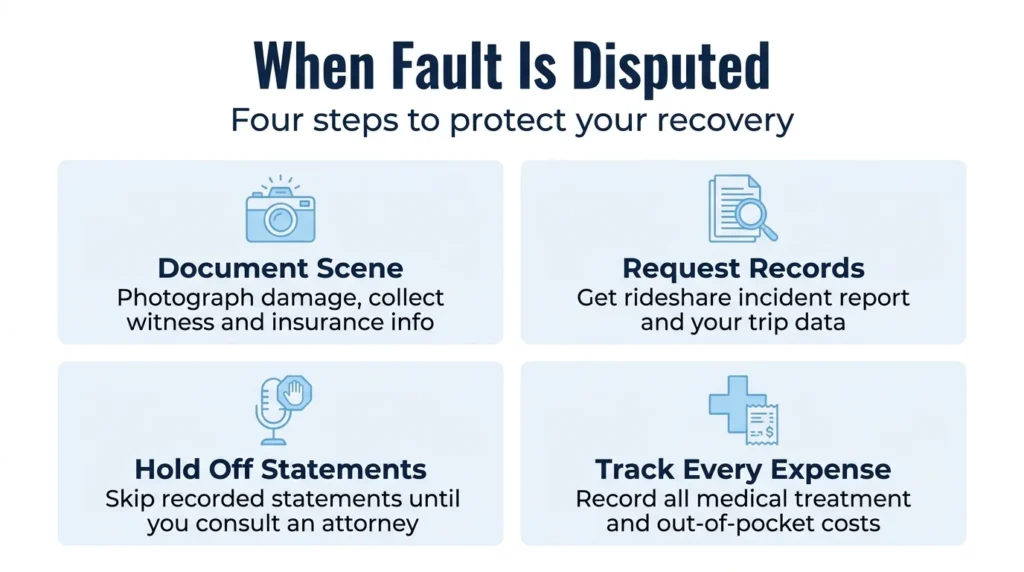
Step 1: Document the scene thoroughly. Photograph vehicle damage and road conditions, collect witness contact information, and get driver and insurance details from every vehicle involved.
Step 2: Request the official records. Ask the rideshare company for its incident report and pull your own trip data from the app.
Step 3: Hold off on recorded statements. Do not give a recorded statement to any insurer before you talk to an attorney.
Step 4: Track every expense. Keep a running record of all medical treatment and out-of-pocket costs from the date of the crash forward.
For a fuller walkthrough, our guide on what to do after a Texas rideshare accident covers each step in depth.
Talk to a Texas Rideshare Accident Attorney
Sorting out who pays after a rideshare crash means untangling several insurers at once, and that is rarely something you should do alone. Angel Reyes & Associates has spent over 30 years helping injured Texans handle rideshare and motor vehicle claims across the state.
We work on contingency, so there is no fee unless we win, and your first consultation is free. Our team has recovered more than $1 billion for clients, and we are available 24/7 when you need answers.
When you are ready to find out which insurer owes you and how much, reach out for a free consultation.
Past results do not guarantee future outcomes.
Frequently Asked Questions
How long do I have to file a claim after a rideshare accident in Texas?
Texas gives you two years from the date of the crash to file a personal injury lawsuit under Texas Civil Practice and Remedies Code Section 16.003. Missing that deadline almost always means losing the right to recover, so acting before the clock runs out matters.
What if the rideshare driver had the app off when the crash happened?
If the app was completely off, neither the rideshare company’s commercial policy nor the Period 1 contingent coverage applies. Your claim runs only against the driver’s personal auto policy, the same as any standard two-vehicle accident.
Can I sue the rideshare driver personally instead of going through insurance?
You can, but it is rarely the most practical path. The rideshare company’s commercial policy is typically the primary source of compensation because the driver’s personal assets and minimum-limit personal policy may fall well short of covering serious injuries.
If I am the rideshare driver and a third-party driver hurts me, does the rideshare company's policy cover my injuries?
During an active ride, the rideshare company’s UM/UIM coverage can step in for your injuries if the at-fault driver’s policy is insufficient. The same $1 million commercial layer that protects passengers also extends to the rideshare driver when a third party causes the crash during Period 2 or 3.
Will my health insurance cover my medical bills while the rideshare claim is still pending?
Health insurance will generally cover your treatment costs while you wait for the liability claim to resolve, but your insurer may later seek reimbursement from any settlement you receive through a process called subrogation. Texas law limits how much a health insurer can recover, so the final amount you keep depends on the size of the settlement and whether you had legal representation.
About the Authors

Angel Reyes
Writer
Angel L. Reyes, III is the Founder and Managing Partner of Angel Reyes & Associates. A nationally recognized trial attorney and business leader, Angel has helped over 70,000 injury victims recover more than $1 billion since founding the firm in 1993. Named to the Texas Super Lawyers list annually since 2008, Angel brings Wall Street experience, Ivy League education, and a deep commitment to client advocacy. He is a frequent legal commentator and published author with extensive contributions to legal scholarship, trial strategy, and consumer protection.

Kyle Nicolas
Editor
Kyle Nicolas is the Web Content & SEO Manager at Angel Reyes & Associates. He has more than 10 years of experience as a marketing co...

Angel Reyes
Reviewer
Angel L. Reyes, III is the Founder and Managing Partner of Angel Reyes & Associates. A nationally recognized trial attorney and business...