Uber Insurance vs. Personal Auto Insurance After an Accident


Every article on this site is researched by our internal team, reviewed for legal accuracy against current Texas law, and held to State Bar of Texas advertising standards before publication. We do not publish content that overstates outcomes or makes promises about results.
Learn more about our
editorial standards .
Key Takeaways
- Personal auto policies exclude rideshare use, so your insurer can deny claims made while the Uber app is on.
- Uber's $1 million liability policy is primary only during Periods 2 and 3, when a ride is accepted or in progress.
- Passengers in an active Uber ride are covered under the $1 million policy regardless of fault or their own insurance status.
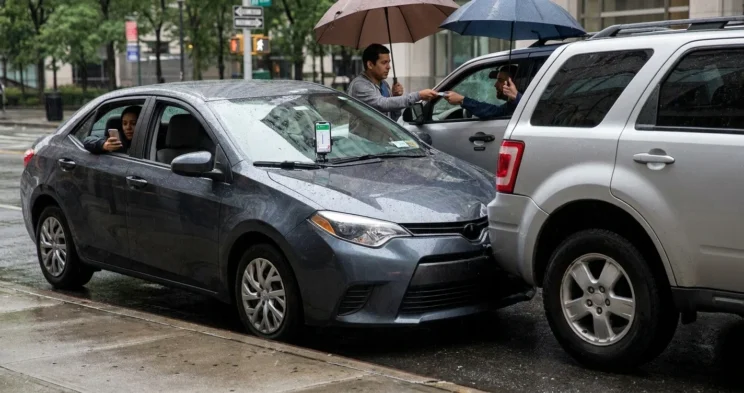
You were driving for Uber on I-35 through Austin when another car ran a red light and hit you. You filed a claim with your personal auto insurer. A few days later, they denied it. The adjuster told you the app was running, which means you were driving for hire, and that falls outside your policy.
Now you’re left with a damaged vehicle, unpaid medical bills, and two insurers pointing at each other.
Why Your Personal Policy Likely Won’t Cover an Uber Accident
The rideshare exclusion buried in most personal auto policies is the first thing that surprises drivers after a crash. Standard personal auto insurance is written to cover personal, non-commercial use of your vehicle. The moment you turn on the Uber app, most insurers treat your vehicle as being used for commercial purposes.
That shifts the risk profile of your policy, and the exclusion kicks in.
This exclusion applies whether or not you caused the accident. Fault is not the issue. The issue is what you were doing when the crash happened. Drivers often learn about this exclusion only after they file a claim and get the denial letter. For anyone relying on rideshare income, that letter can arrive at the worst possible time.
If your personal insurer denied a claim after an Uber accident, understanding your coverage options can change what you recover from a crash.
What Uber Insurance Actually Covers by Period
Uber does maintain commercial insurance on drivers’ behalf, but the amount and type of coverage depends on what the driver was doing at the moment of the crash. Two coverage tiers operate very differently, and confusing them is one of the most common mistakes drivers and passengers make when filing claims.
Period 1 Coverage (App On, No Ride Accepted)
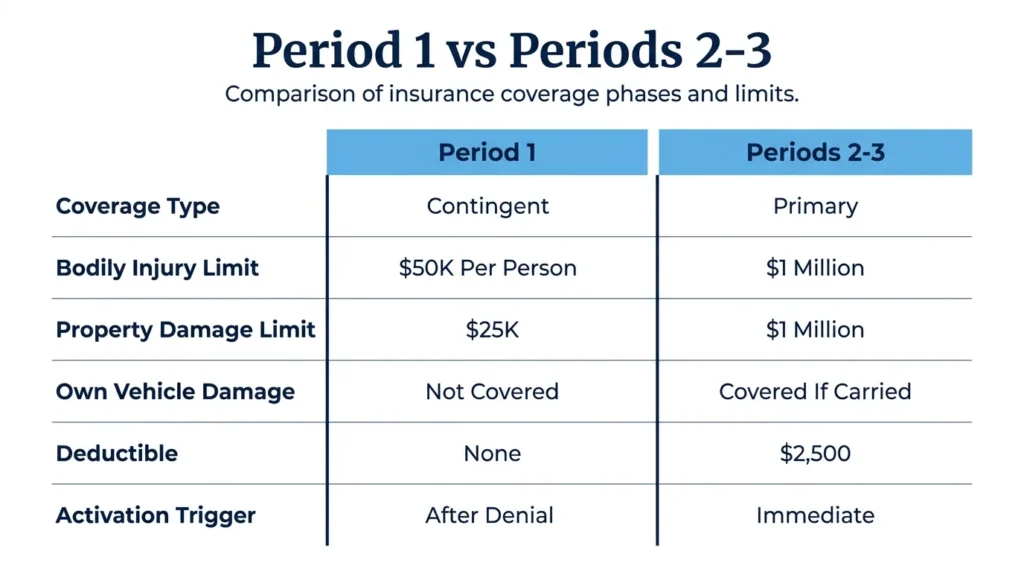
When a driver has the Uber app running but has not yet accepted a ride request, Texas Insurance Code § 1954.052 sets the minimum coverage Uber must carry: $50,000 in bodily injury per person, $100,000 per accident, and $25,000 for property damage.
That coverage is contingent, not primary. It only activates after the driver’s personal policy denies the claim. Because personal policies almost always deny rideshare claims, the Uber coverage usually does end up paying.
But coverage for damage to the driver’s own vehicle is not included during this period. If your car is damaged while you’re in Period 1, you absorb that cost yourself unless you carry a rideshare endorsement on your personal policy.
Periods 2 & 3 Coverage (Ride Accepted Through Trip End)
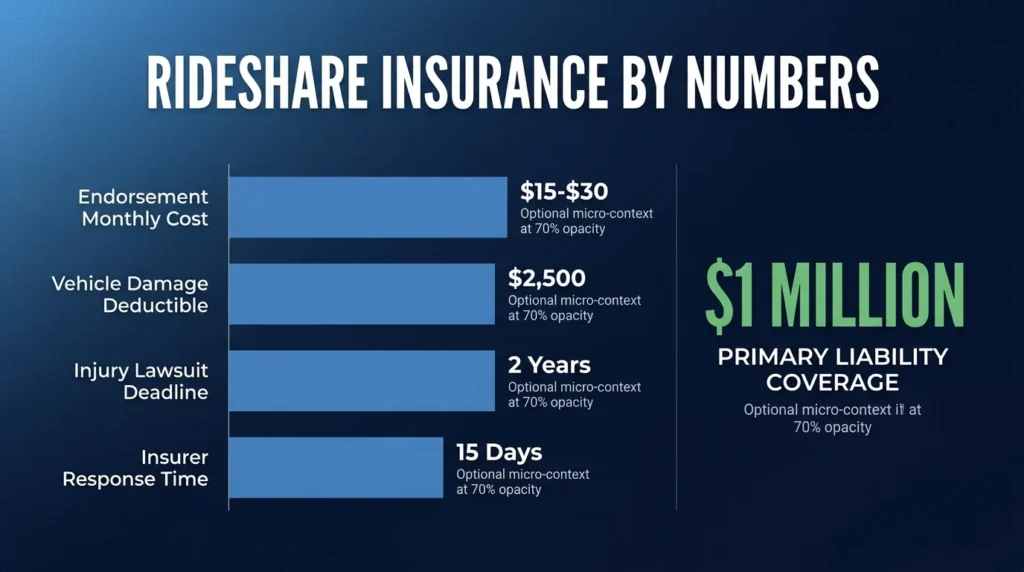
Once a driver accepts a ride request, the coverage picture changes significantly. Under Texas Insurance Code § 1954.053, Uber must carry primary liability coverage with a minimum limit of $1 million for death, bodily injury, and property damage per incident. This policy activates from the moment the ride is accepted through the moment the passenger exits the vehicle.
The $1 million policy does not require the driver’s personal insurer to deny first. It leads. Collision and comprehensive coverage for the driver’s own vehicle also activates during this period, but only if the driver already carries those coverages on their personal policy. Uber applies a $2,500 deductible before that coverage pays.
Passengers injured during Periods 2 or 3 are covered under this commercial rideshare liability policy.
The Gap That Leaves Drivers Uninsured
The gap is not theoretical. It exists in a specific, predictable window: Period 1. Your personal policy excludes rideshare use. Uber’s Period 1 coverage is contingent and covers only liability to others, not damage to your car.
So if you’re in a crash during Period 1 and the other driver is uninsured, or if the damage is to your own vehicle, you are likely paying out of pocket.
The fix is a rideshare endorsement, sometimes called a TNC endorsement. Most major insurers in Texas offer one, and it typically costs between $5 and $30 per month. That endorsement extends your personal coverage into the gap period so both you and your vehicle have protection while the app is running.
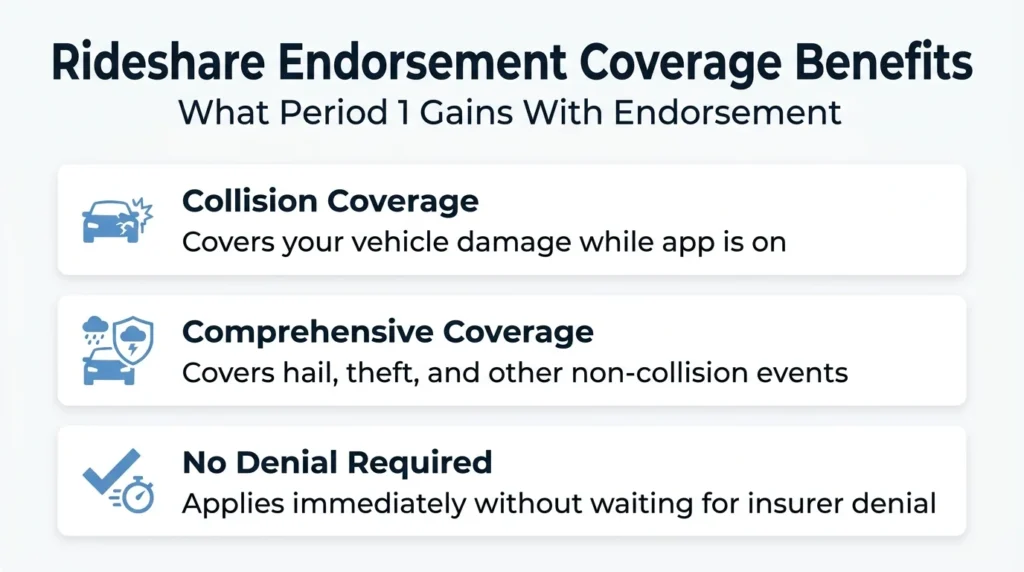
Here is what a rideshare endorsement covers during Period 1 that standard personal policies and Uber’s contingent coverage do not:
- Collision coverage for damage to your own vehicle when you are logged into the app but haven’t accepted a ride.
- Comprehensive coverage for non-collision events like hail or theft while logged in.
- No denial step required — your rideshare endorsement applies directly during Period 1 without waiting for your personal insurer to deny first.
Knowing what to do right after a rideshare crash also makes the following days easier.
How Passengers Are Affected After an Uber Crash
If you were riding in an Uber when the crash happened, your coverage situation is generally stronger than the driver’s. During Periods 2 and 3, Uber’s $1 million commercial liability policy covers passenger injuries regardless of who caused the accident. You do not need to have your own insurance policy to receive compensation under this coverage.
If the Uber driver caused the crash, the $1 million policy is what pays your medical bills, lost wages, and other damages. If another driver caused the crash and that driver has inadequate insurance, Uber’s uninsured and underinsured motorist coverage also applies during Periods 2 and 3.
One deadline applies to all of this. Texas gives personal injury claimants two years from the date of the crash to file a lawsuit. If you were injured as a passenger and you are still dealing with medical treatment, do not let that window close before you understand your options.
Passengers injured in a rideshare accident have specific legal rights that extend beyond what insurers will voluntarily explain.
Speak to a Lawyer After a Rideshare Accident
Rideshare insurance disputes are rarely simple. Uber and the driver’s personal insurer both have incentives to limit what they pay, and the period the driver was in at the time of the crash determines which policy applies. Getting that question answered correctly, and getting the right insurer to pay, often requires someone who knows how TNC coverage works under Texas law.
Angel Reyes & Associates has guided Texans through rideshare accident claims for over 30 years. We work on contingency, which means no fee unless we recover compensation for you. If you were hurt in an Uber accident and you’re not sure who owes you coverage, or if a claim has already been denied, contact us for a free consultation.
You can also review our case results to see the kinds of claims our team has handled. Every case is different.
Past results do not guarantee future outcomes.
Uber Insurance vs. Personal Auto Insurance Post-Accident FAQs
Does Uber's insurance cover the driver's own medical bills after a crash?
Uber’s standard commercial liability policy covers injuries to other people, not the driver. Drivers who want coverage for their own medical expenses must either carry personal injury protection on their personal auto policy or purchase Uber’s optional Injury Protection add-on.
What happens if neither my personal insurer nor Uber accepts responsibility?
A coverage dispute between your personal insurer and Uber is not unusual, especially in Period 1 crashes. An attorney can identify which policy applies based on the driver’s exact app status at the time of the crash and pursue the correct insurer on your behalf.
Does it matter if the other driver caused the accident, not the Uber driver?
Yes. If another driver caused the crash during Periods 2 or 3, Uber’s uninsured and underinsured motorist coverage applies if the at-fault driver lacks enough insurance to cover your injuries. During Period 1, those additional protections are not part of Uber’s contingent coverage.
Can an Uber driver be dropped by their personal insurer for driving for Uber?
Many personal insurers include a clause allowing them to cancel or non-renew a policy if they learn the vehicle is being used for rideshare without proper disclosure. Drivers who add a rideshare endorsement avoid this risk because the commercial use is disclosed and covered within the same policy.
How long does an Uber insurance claim take to resolve in Texas?
There is no fixed timeline, but claims involving coverage disputes between multiple policies typically take longer than standard auto claims. Texas law requires insurers to acknowledge a claim within 15 days and accept or deny it within 15 business days of receiving all required documentation, though complex rideshare cases often involve back-and-forth between Uber’s insurer and the driver’s personal carrier.
About the Authors

Angel Reyes
Writer
Angel L. Reyes, III is the Founder and Managing Partner of Angel Reyes & Associates. A nationally recognized trial attorney and business leader, Angel has helped over 70,000 injury victims recover more than $1 billion since founding the firm in 1993. Named to the Texas Super Lawyers list annually since 2008, Angel brings Wall Street experience, Ivy League education, and a deep commitment to client advocacy. He is a frequent legal commentator and published author with extensive contributions to legal scholarship, trial strategy, and consumer protection.

Kyle Nicolas
Editor
Kyle Nicolas is the Web Content & SEO Manager at Angel Reyes & Associates. He has more than 10 years of experience as a marketing co...

Angel Reyes
Reviewer
Angel L. Reyes, III is the Founder and Managing Partner of Angel Reyes & Associates. A nationally recognized trial attorney and business...