How to Choose a Lawyer After a Rideshare Accident in Texas

Every article on this site is researched by our internal team, reviewed for legal accuracy against current Texas law, and held to State Bar of Texas advertising standards before publication. We do not publish content that overstates outcomes or makes promises about results.
Learn more about our
editorial standards .
Key Takeaways
- Rideshare coverage shifts by app period, so the active period decides which policy pays first.
- Verify a rideshare attorney by TNC case volume, carrier experience, and app-log evidence skill.
- Texas gives you two years from the crash to file a rideshare injury claim under the statute.
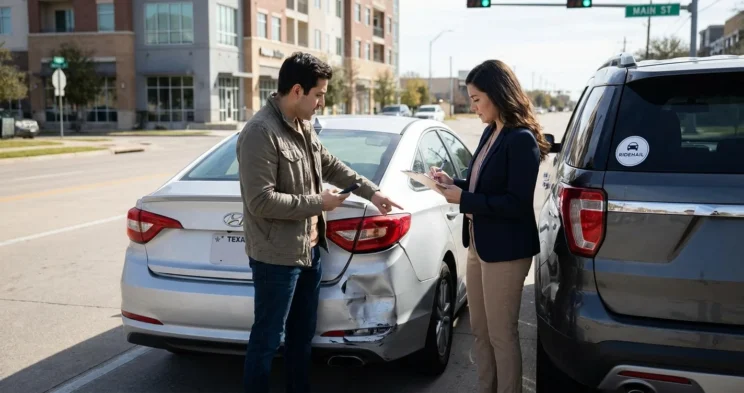
You were riding home from a late dinner in Midtown when your Uber driver got T-boned at a light on Westheimer Road. Now you have a neck injury, a stack of medical bills, and three different insurance companies giving you three different answers. Who actually pays, and which lawyer can untangle it?
Why Rideshare Accidents Are More Complex
A rideshare crash can trigger several insurance policies at once, and the one that applies depends entirely on the driver’s app status at the moment of impact. You might be dealing with the rideshare company’s corporate policy, the driver’s personal auto policy, and your own uninsured or underinsured motorist coverage. Each coverage layer follows different rules.
A general personal injury attorney spends most of their time on standard two-car crashes. They rarely touch the app-status evidence, digital data requests, and multi-carrier negotiations that define these claims. Choosing a generalist can mean a missed coverage tier, a quick settlement against the wrong policy, or lost app log data you needed.
The stakes of that choice come into focus once you see how the coverage works. A driver who settles with one carrier too early can forfeit a larger recovery sitting in another policy.
Rideshare companies operate under Texas Occupations Code Chapter 2402, which sets permit requirements and operating rules a qualified attorney must understand to read a carrier’s coverage position.
The insurance side runs on Texas Insurance Code Chapter 1954, which establishes mandatory coverage periods and minimum limits for rideshare drivers. Together they create the tier structure a specialist navigates on every claim.
Texas TNC Insurance Tiers Explained
Texas law splits rideshare coverage into periods tied to the driver’s app status, and the active period decides which policy pays first. The lowest-coverage zones leave you most exposed, so knowing where your crash falls is the starting point for any honest case evaluation.
Period 0 & Period 1 Coverage
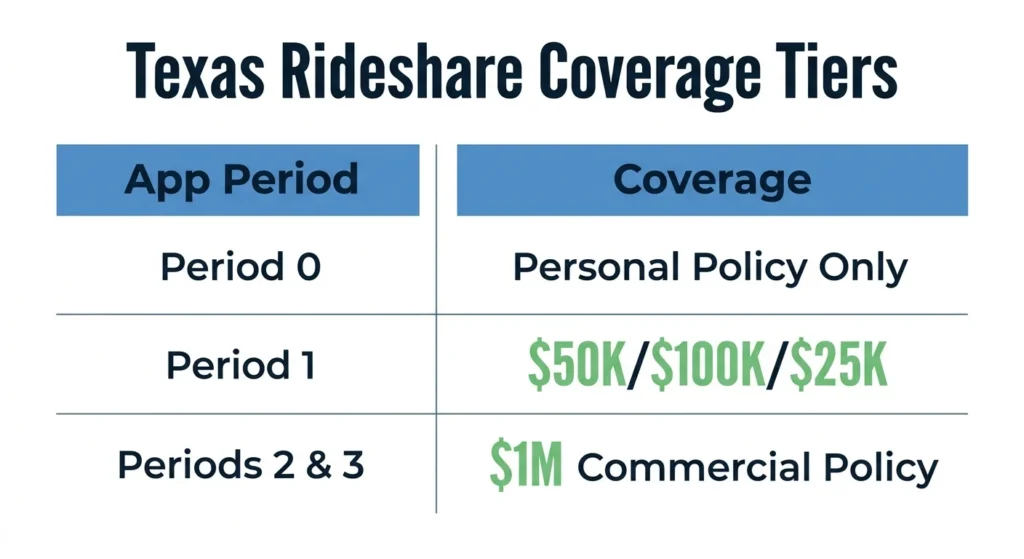
Period 0 means the app is off, and only the driver’s personal auto policy is in play. Period 1 means the app is on but no ride is accepted yet, and this is the most dangerous zone for an injured party.
During Period 1, the rideshare company’s contingent liability coverage operates as a backstop, providing $50,000 per person, $100,000 per accident, and $25,000 for property damage, and under Texas Insurance Code § 1954.055 this coverage cannot be withheld simply because the driver’s personal insurer has not yet denied the claim.
In practice, the driver’s personal policy and the company’s lower-limit coverage may both be in play, which is exactly the gap that makes Period 1 crashes the most complicated to resolve.
Period 2 & Period 3 Coverage
Periods 2 and 3 cover the stretch from accepting a ride through dropping the passenger off, and they trigger the company’s primary commercial policy at one-million-dollar limits. These are the highest-coverage zones available to you.
The carrier holding that primary commercial policy has shifted in recent years and differs between Uber and Lyft. An attorney with active rideshare case volume knows the current carriers and how each one handles demand letters, discovery disputes, and settlement talks. When the corporate entity’s own conduct contributes to a crash, a direct claim against Uber may also be on the table.
Key Criteria for Rideshare Accident Attorney Selection
The right attorney can be verified against four concrete criteria, not firm size or billboard count. Each one is something you can ask about directly and confirm before you sign anything.
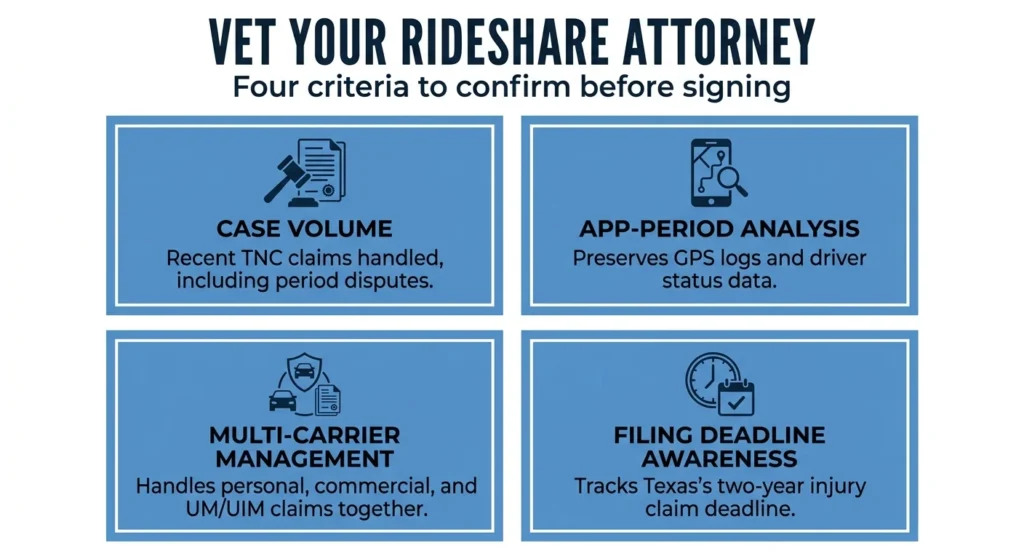
Transportation Network Company (TNC) case volume and recency. An attorney who handles rideshare claims actively knows the current carriers, the standard demand timelines, and which evidence requests get contested. Ask how many rideshare cases they have handled in the past two years and whether any involved a fight over which coverage period applied.
App-period analysis capability. Your attorney must be able to find and preserve app-status evidence, including GPS logs, driver status timestamps, and trip data from the platform. Ask whether they have sent preservation requests to rideshare platforms and pulled internal records through discovery.
Multi-carrier claim management. Your case can involve simultaneous claims against the driver’s personal insurer, the company’s commercial carrier, and your own UM/UIM coverage. An attorney who works only the commercial carrier and overlooks the UM/UIM angle leaves money on the table.
Texas filing deadline awareness. Under Texas Civil Practice and Remedies Code § 16.003, you have two years from the crash to file a personal injury claim. A qualified attorney flags this at the first meeting and explains how evidence preservation and insurance investigation timelines press against it.
Questions to Ask a Lawyer With Rideshare Experience
A short list of pointed questions will tell you more in one consultation than any advertisement. Each question below is built to surface verifiable facts rather than a sales pitch.
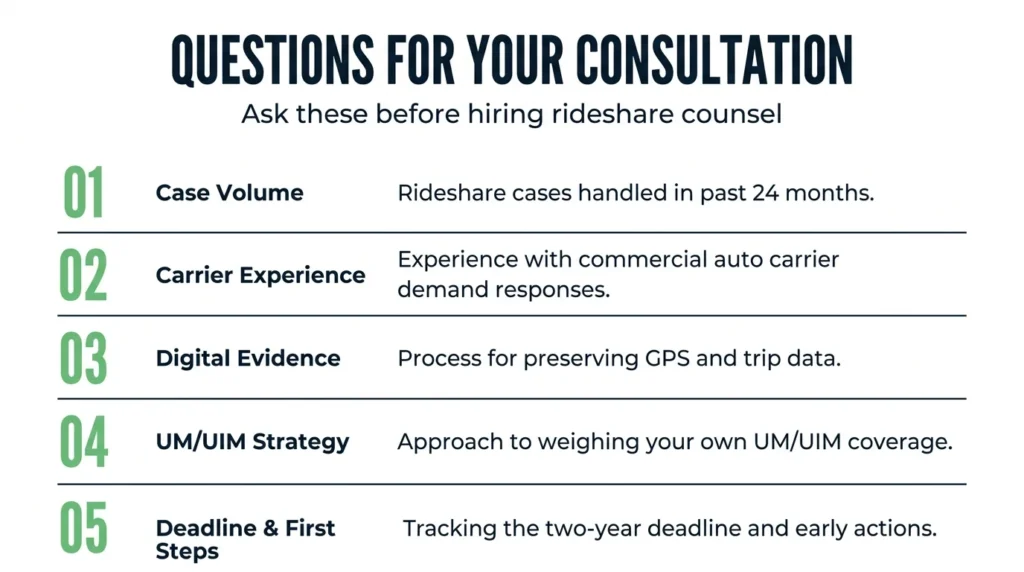
- Ask about case volume. How many rideshare cases have you handled in Texas in the past 24 months, and how many involved a dispute over which app period was active?
- Ask about carrier experience. Have you handled claims against rideshare commercial auto carriers, and how do those carriers respond to demand letters compared to standard auto insurers?
- Ask about digital evidence. How do you find and preserve GPS data, driver status logs, and trip records from the platform?
- Ask about UM/UIM strategy. What is your process for weighing my own uninsured and underinsured motorist coverage as a recovery source alongside the commercial policy?
- Ask about the deadline and first steps. How do you track the two-year filing deadline, and what do you do in the first 30 days to protect against evidence loss?
The answers will also tell you how prepared you should be on your end.
Talk to an Attorney About Your Rideshare Case
Rideshare claims reward the attorney who understands the coverage tiers, the carriers, and the deadline pressing on your case. Angel Reyes & Associates has guided injured Texans through complex crash claims for more than 30 years, with more than $1 billion recovered for clients.
We handle rideshare cases on a contingency basis, which means no fee unless we win, and we are available 24/7 across the state.
You can learn about the people who would handle your case and what past clients have said in our client reviews and testimonials.
When you are ready, schedule a free consultation and we will review which policies apply and what your claim is worth.
Past results do not guarantee future outcomes.
FAQs About Choosing an Attorney After a Rideshare Accident
Can I sue Uber or Lyft directly for my accident, not just the driver?
Yes, but a direct claim against the company requires more than proving the driver caused the crash. It depends on facts specific to the company’s conduct, such as whether it failed to screen or remove a driver with a known history of serious violations.
What if the other driver, not my rideshare driver, caused the crash?
As a passenger, you can file a claim against the at-fault driver’s auto insurance. If that driver had no insurance or too little coverage, the rideshare company’s own uninsured and underinsured motorist policy may cover the gap during an active trip.
Does TNC insurance coverage apply if I was a pedestrian or cyclist hit by a rideshare vehicle?
Yes. Pedestrians and cyclists hit by a rideshare driver have the same right to pursue compensation through the applicable coverage tier as any other injured party. The coverage that applies depends on which period the driver was in at the moment of impact.
What happens when both the rideshare driver and another driver share fault in Texas?
Texas uses a proportionate responsibility system, meaning each driver’s share of fault determines how much they owe. Under Texas Civil Practice and Remedies Code Chapter 33, your recovery is reduced by your own percentage of fault, and you cannot recover at all if you are found more than 50 percent responsible.
About the Authors

Angel Reyes
Writer
Angel L. Reyes, III is the Founder and Managing Partner of Angel Reyes & Associates. A nationally recognized trial attorney and business leader, Angel has helped over 70,000 injury victims recover more than $1 billion since founding the firm in 1993. Named to the Texas Super Lawyers list annually since 2008, Angel brings Wall Street experience, Ivy League education, and a deep commitment to client advocacy. He is a frequent legal commentator and published author with extensive contributions to legal scholarship, trial strategy, and consumer protection.

Graham Griffin
Editor
Graham Griffin is the editorial director responsible for accuracy and legal compliance across all firm content.
Graham Griffin
Reviewer
Graham Griffin also serves as legal reviewer, ensuring all claims and advice reflect current Texas statutes and case law.