Restitution vs. Wrongful Death After a Fatal DWI in Texas


Every article on this site is researched by our internal team, reviewed for legal accuracy against current Texas law, and held to State Bar of Texas advertising standards before publication. We do not publish content that overstates outcomes or makes promises about results.
Learn more about our
editorial standards .
Key Takeaways
- Restitution and a wrongful death claim are separate courses of action that you can pursue at the same time.
- Criminal restitution covers only documented losses (like funeral and burial costs).
- A guilty plea in a DWI case can strengthen your civil wrongful death claim.
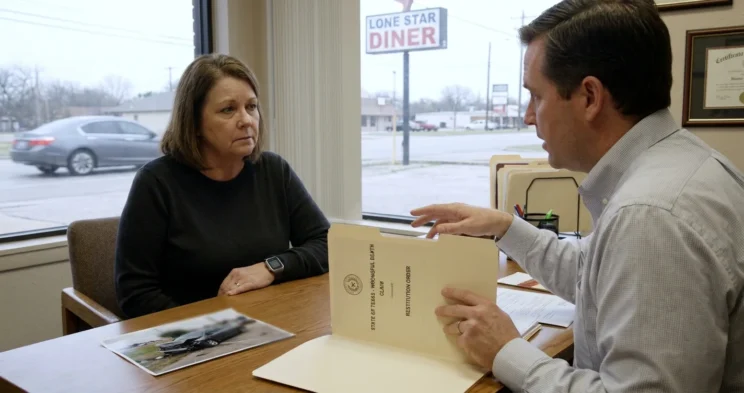
Your husband was killed by a drunk driver on I-45 near The Woodlands. Now, the court is talking about money the driver must pay, the district attorney mentioned restitution, and you are left wondering whether the court-ordered payment is all your family can receive, or if you still have other options.
How Restitution Works in Texas DWI Cases
Restitution is money that a criminal court orders the at-fault driver to pay you after they are convicted or plead guilty. It is part of a criminal case and is separate from any damages that your family might pursue through a civil lawsuit.
A Texas criminal court can order restitution only for documented, quantifiable losses. Under Texas Code of Criminal Procedure Article 42.037, this usually means funeral and burial expenses, not the full weight of what your family has lost.
The court decides how much restitution the at-fault driver must pay and enforces that payment as part of the criminal case. The amount is based on the driver’s conviction and their ability to pay, not on your family’s total losses. Read more on how restitution fits into the rights of drunk driving victims.
Wrongful Death Lawsuits in Texas
A wrongful death claim is a separate civil lawsuit, and only the surviving spouse, children, or parents of the person who died can file it. It moves forward separate of whatever happens in the criminal case.
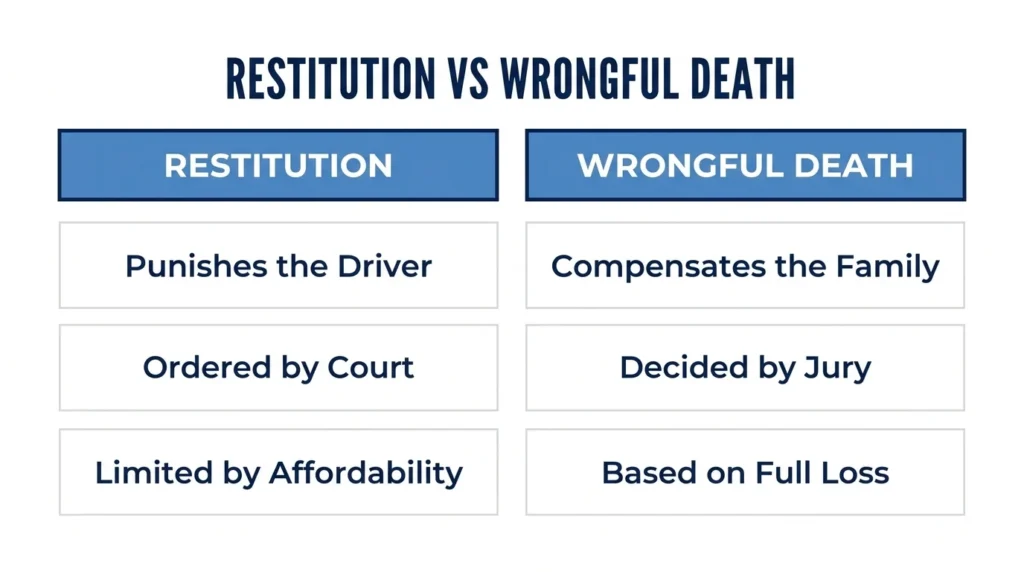
Texas wrongful death claims exist to compensate the family, while the criminal case exists to punish the at-fault driver.
The Texas Civil Practice and Remedies Code (CPRC) Chapter 71 determines who may file a wrongful death lawsuit, and how much money the family can recover.
A wrongful death claim also has a lower standard of proof than a criminal case. In a criminal case, the state must prove that the driver was guilty beyond a reasonable doubt. Your civil claim only needs to prove that the driver was likely at fault.
Your civil claim can move forward whether or not the court ordered restitution. A guilty plea or conviction in the DWI case can support your civil claim.
Criminal Restitution vs. Civil Wrongful Death Lawsuits
Families often assume one of three things:
- Restitution and a civil lawsuit are the same process.
- Collecting restitution prevents you from filing a civil lawsuit.
- Winning a civil lawsuit prevents you from collecting restitution.
However, restitution and civil lawsuits are two different tools, built for two different purposes.
Criminal Restitution
Criminal restitution serves two purposes:
- It punishes the driver for reckless behavior.
- It reimburses certain documented losses caused by the crash.
A criminal court decides the amount of restitution to be paid as part of the sentence. The driver usually pays on a set schedule determined by the court (often in small amounts over several years). The amount is limited to what the court believes the driver can actually afford to pay.
Civil Wrongful Death Lawsuits
The purpose of a civil wrongful death claim is to compensate your family for the full scope of your loss, not just documented bills.
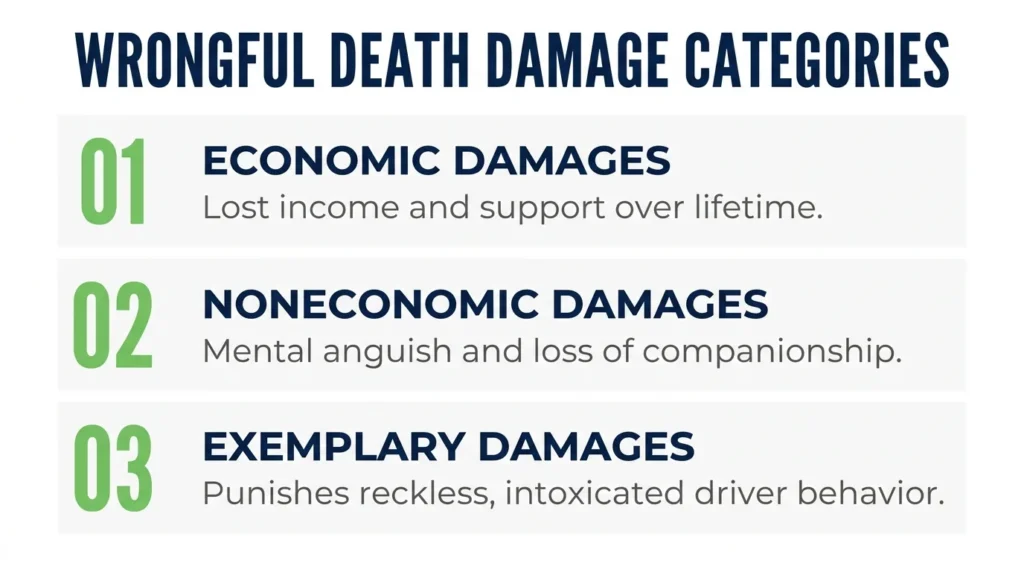
Your recovery generally falls into three categories:
- Economic damages: These represent the income and financial support that your loved one would have provided you over their lifetime.
- Noneconomic damages: These represent the mental anguish and loss of companionship that your family will suffer.
- Exemplary damages: These are additional damages that are sometimes available to punish a driver who was under the influence and driving recklessly.
Our breakdown of average wrongful death settlement values explains how much money your family can recover in a civil lawsuit, in addition to restitution.
Does Restitution Affect a Wrongful Death Claim?
No. Restitution and a civil wrongful death claim are separate courses of legal action, so receiving one does not automatically stop you from receiving the other.
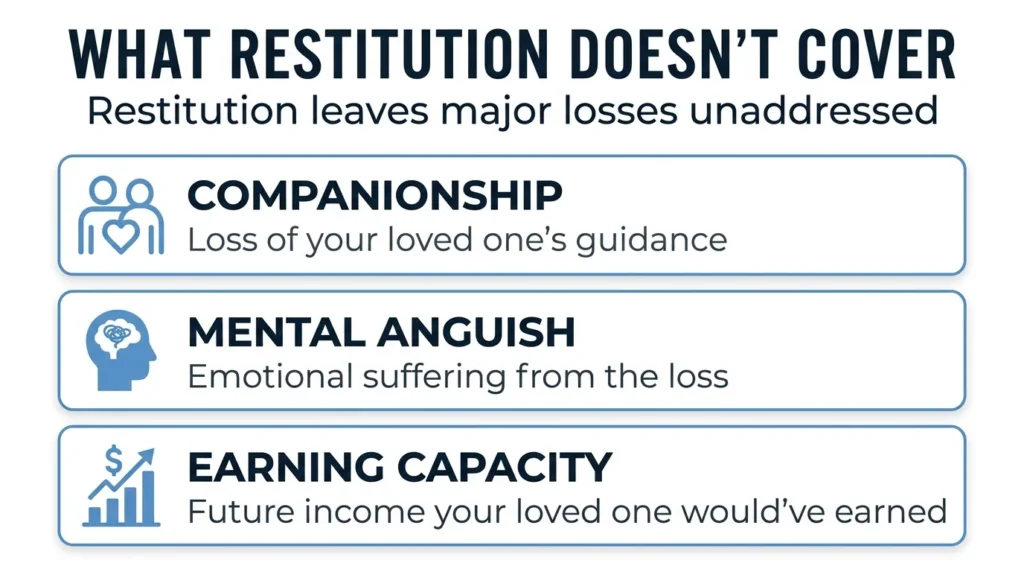
Restitution covers only limited documented losses identified by the criminal court. This leaves whole categories untouched, such as:
- Loss of companionship
- Mental anguish
- The earning capacity that your loved one would have built over their lifetime
Restitution is often paid out slowly, and sometimes only partially. When the driver cannot pay in full, uninsured or underinsured motorist coverage may cover some of the difference.
Families who do not pursue a civil claim after receiving restitution risk leaving compensation unclaimed. Our guide to the full cost of drunk driving crashes can show you what restitution does not cover.
Can You Sue a Drunk Driver After Receiving Restitution?
Yes. A criminal restitution order does not dismiss your right to file a separate civil wrongful death claim because they are two separate courses of action.
In fact, you can usually introduce a conviction or guilty plea from the DWI case as evidence in your civil claim, which strengthens your claim overall.
A civil claim against an intoxicated driver can also open the door to exemplary damages under Texas Civil Practice and Remedies Code § 71.009, which restitution does not provide. Chapter 41 covers the applicable limits and standards, and our overview of drunk driving accident claims covers exemplary damages in more detail.
Work with an Attorney on Your Wrongful Death Lawsuit in Texas
Losing someone to a drunk driver leaves your family facing a criminal process and a civil lawsuit, often at the same time. Angel Reyes & Associates has spent more than 30 years helping Texas families work through wrongful death and drunk driving cases like yours.
We work on contingency, so you pay nothing upfront, and you owe no fees unless we win. Our results include more than $1 billion recovered for clients across Texas.
Read about our team and look at what other clients say about working with us. When you are ready, schedule a free consultation, so we can review the restitution order and your family’s civil suit options.
Past results do not guarantee future outcomes.
Restitution vs. Wrongful Death Claim FAQs
How long do you have to file a wrongful death lawsuit after a fatal DWI crash in Texas?
Texas law generally gives families two years from the date of death to file a wrongful death lawsuit. This deadline does not pause while the criminal case is pending.
What happens if the driver stops paying court-ordered restitution?
An unpaid restitution order can be enforced through the same collection methods used for other court-ordered debts. Nonpayment can also trigger consequences if the driver is on probation or parole. These consequences are separate from any civil wrongful death claim that the family pursues.
Who decides whether a judge orders restitution in a DWI case?
The criminal court decides the restitution amount at sentencing, usually after the prosecutor requests it. The amount is based on documented losses (like funeral costs). Family members can also submit a written statement asking the court to consider restitution.
Is money from a wrongful death settlement taxable?
Compensation from a wrongful death claim is generally not taxed as income under federal law. Exemplary damages are treated differently, as these are usually taxable, even if they are a part of the same case.
About the Authors

Spencer Browne
Writer
Spencer Browne is a partner at Angel Reyes & Associates and a Board Certified personal injury trial lawyer with nearly 100 jury trials across Texas. He focuses on car, truck, and wrongful death cases, with notable verdicts including a landmark win in the Choctaw Casino bus crash case. A recognized speaker and legal educator, Spencer is a member of the American Board of Trial Advocates and has been honored as a Texas Super Lawyer and one of D Magazine’s Best Lawyers in Dallas. He brings deep trial experience and relentless advocacy to every client he represents.

Kyle Nicolas
Editor
Kyle Nicolas is the Web Content & SEO Manager at Angel Reyes & Associates. He has more than 10 years of experience as a marketing co...

Angel Reyes
Reviewer
Angel L. Reyes, III is the Founder and Managing Partner of Angel Reyes & Associates. A nationally recognized trial attorney and business...