Bad Weather Motorcycle Accident Claims in Texas


Every article on this site is researched by our internal team, reviewed for legal accuracy against current Texas law, and held to State Bar of Texas advertising standards before publication. We do not publish content that overstates outcomes or makes promises about results.
Learn more about our
editorial standards .
Key Takeaways
- Bad weather doesn't erase another driver's duty of care under Texas traffic and negligence law.
- A rider over 50% at fault recovers nothing under Texas's modified comparative negligence rules.
- Most Texas motorcycle injury claims must be filed within two years under CPRC § 16.003.
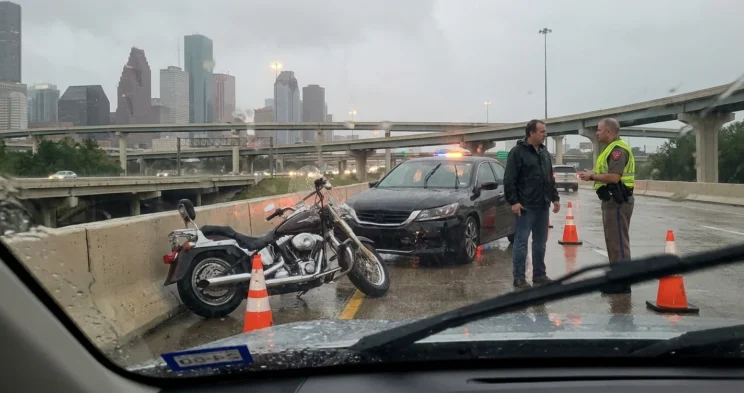
You were heading west on I-10 near the Galleria when a light rain turned the pavement slick, and the driver behind you closed the gap too fast. They clipped your rear tire, sending your bike sliding across two lanes.
Now the insurance adjuster is on the phone, talking about the weather like it ended the possibility of the other driver being at fault before it started. It didn’t, and knowing how to approach these incidents can help you protect your right to recovery.
Does Weather Remove the Other Driver’s Fault?
No. Rain, fog, and wet roads do not erase another driver’s duty of care. Texas drivers must adjust to the conditions in front of them. A driver who fails to slow down or keep a proper distance in the rain has breached that duty, and weather alone is not a legal defense to negligence. Their conduct is still the cause of your injuries.
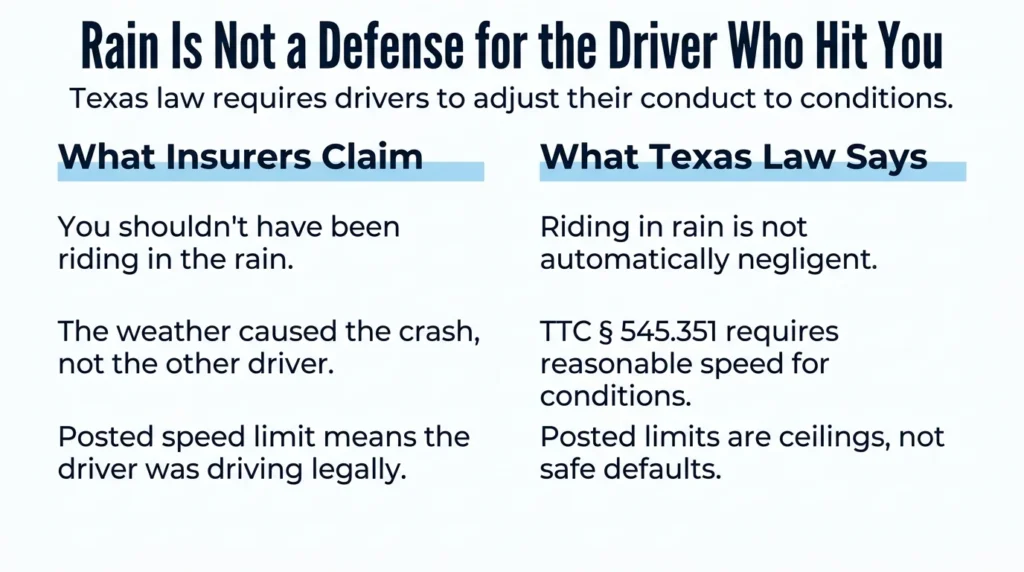
Bad weather is a condition drivers handle every day across Texas. It is not a shield against liability when someone makes a careless choice behind the wheel.
State law requires every driver to travel at a speed that is reasonable and prudent for the conditions, including wet roads and reduced visibility, under Texas Transportation Code § 545.351. A driver going the posted limit in heavy rain can still be driving too fast.
Motorcyclists face real physical risk on wet roads, and jurors understand that reduced traction makes another driver’s mistakes far more dangerous. National data on rider injuries reflects that gap in protection, which is why the NHTSA motorcycle safety resources treat motorcyclists as especially vulnerable road users.
If another driver hit you, the weather does not change what they owed you. Your Texas motorcycle accident claim starts with that principle.
How Texas Comparative Fault Works in Weather Crashes
Texas uses a modified comparative fault system. Each person in a crash is assigned a percentage of fault. Your recovery is reduced by your share. If you are found more than 50% at fault, you recover nothing. If you are 50% or less at fault, your recovery is reduced by your percentage of fault.
The full rule lives in the Texas Civil Practice and Remedies Code (CPRC) Chapter 33, which sets out how courts and insurers assign proportionate responsibility.
Insurers know this rule too. A common tactic is to argue that you should not have been riding in the rain at all, then push your fault percentage up toward that 51% line. Watch for that move.
Riding a motorcycle in the rain is not automatically negligent under Texas law. What matters is your specific conduct: your speed, your lane position, your reaction at the moment of impact. The Texas 51% bar rule for comparative negligence depends on those facts, not on the weather forecast.
If you have already been told you share fault, it is worth understanding how partial fault is assessed in Texas crashes before you accept that assessment.
Other Driver Behaviors That Establish Negligence in Rain
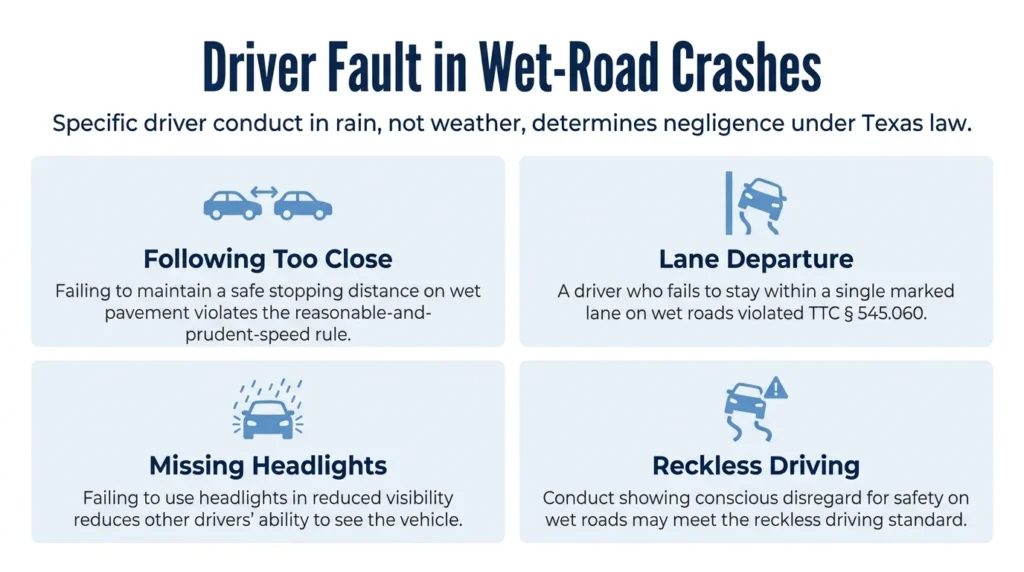
Fault attaches to behavior, not to weather. When you look at what the other driver actually did, the picture often becomes clearer. Specific conduct that breaks traffic law or safety norms in wet conditions is the core of any negligence claim, and Texas statutes give that conduct a name.
Failure to slow for wet conditions violates the reasonable-and-prudent-speed rule under § 545.351 discussed above. Posted speed limits are ceilings, not safe defaults.
Failure to stay in a single lane on wet roads is governed by Texas Transportation Code § 545.060. A driver who drifted into your lane during rain cannot pin that on the storm.
When a driver’s conduct goes beyond carelessness and shows conscious disregard for danger, Texas Transportation Code § 545.401 defines reckless driving. Reckless conduct can open the door to exemplary damages on top of your medical bills and lost wages.
Other behaviors worth documenting include driving without headlights in heavy rain or fog, tailgating on wet pavement, sudden braking on slick surfaces, and failing to yield where standing water makes intersections more dangerous. Each one points to driver choice, not weather. The most common injuries in motorcycle accidents often trace back to exactly these kinds of driver decisions.
Evidence That Supports a Weather-Related Motorcycle Claim
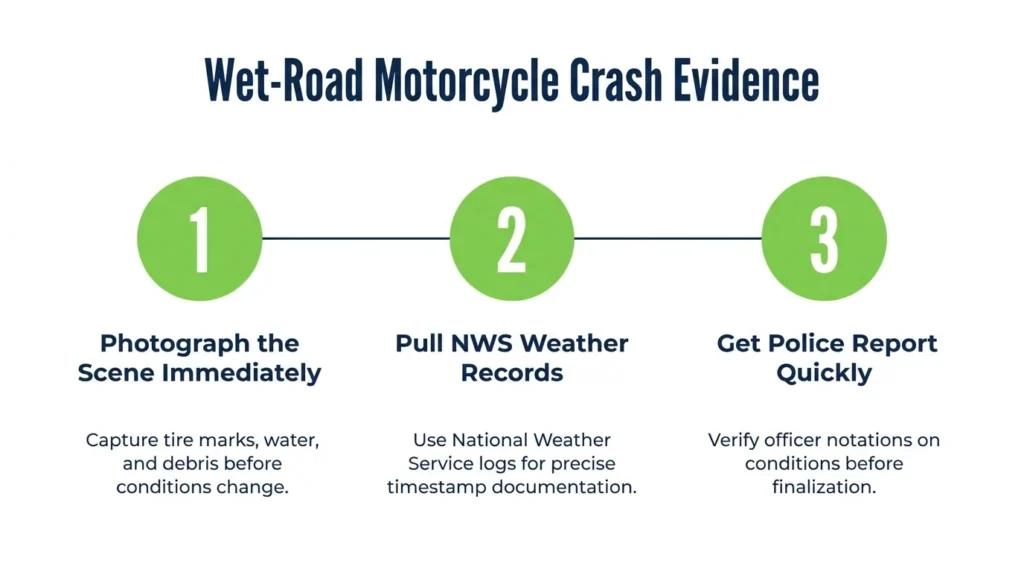
Strong evidence shifts the conversation away from “it was raining” and back to “the other driver made a choice.” When you capture the right records early, you can isolate the driver’s conduct from the conditions and challenge the insurer’s framing. Most of this evidence has a short shelf life, so timing matters.
Weather Records
Weather records from the National Weather Service can show what was actually happening at the time and location of your crash. Radar captures and station logs are far more specific than the adjuster’s general “bad weather” claim.
Police Report
Police report notations about road condition, visibility, and weather should be reviewed before the report is final. Errors are easier to correct early.
Photographs of the Scene
Take scene photographs of tire marks, road surface, standing water, and debris on the day of the crash — traffic will wipe those signs out within hours. Take them yourself or have someone take them for you.
Electronic Evidence
The other driver’s event data recorder, their cell phone records, and any nearby traffic camera footage can pin down their speed, attention, and reaction independent of the weather. An attorney can move quickly to preserve this data before it is overwritten.
Pursue Your Claim with Angel Reyes & Associates
Texas sets a two-year deadline to file most personal injury lawsuits under Texas Civil Practice and Remedies Code § 16.003. Claims involving a government entity, such as a road-defect theory against TxDOT, carry shorter notice deadlines that can run in months, not years. Either way, the Texas modified comparative negligence framework will apply to how your recovery is calculated.
Angel Reyes & Associates handles motorcycle accident claims across Texas, including crashes where weather is being used to push fault onto the rider. We work on contingency, which means no fee unless we win, and we have more than $1 billion recovered for clients.
If you were hurt in a rain or weather crash, contact us for a free consultation, and we will review your situation.
Past results do not guarantee future outcomes.
Bad-Weather Motorcycle Accident FAQs
Can a road defect contribute to fault in a wet-road motorcycle crash in Texas?
Yes. If standing water, a pothole, or a drainage failure made the road unreasonably dangerous, the government entity responsible for maintaining that road may share fault. Claims against TxDOT or a city require a formal notice of claim filed within six months of the incident under the Texas Tort Claims Act.
Does my motorcycle insurance cover my injuries if the other driver is uninsured?
If you carry uninsured or underinsured motorist (UM/UIM) coverage on your motorcycle policy, it can pay for your injuries when the at-fault driver has no insurance or not enough to cover your damages. Texas law requires insurers to offer UM/UIM coverage, so your policy may include it unless you rejected it in writing.
Will my medical bills be paid while my claim is still open?
Texas does not require the at-fault driver’s insurer to pay your medical bills as they come in. You may need to use your own health insurance, MedPay coverage, or pay out of pocket while your claim is pending, with reimbursement sought as part of your final settlement.
Does wearing a helmet affect my fault percentage in a Texas motorcycle crash?
Texas law requires riders over 20 who complete an approved safety course to wear a helmet, but riders over 21 who complete that course may legally ride without one. A defense attorney or insurer may argue that riding without a helmet increased your injuries, which could affect the damages calculation in a comparative fault analysis.
Can I still recover compensation if the crash happened on a private road or parking lot?
Yes. Texas negligence law applies to crashes on private property as well as public roads. The same duty-of-care and comparative fault rules govern those claims, though evidence preservation can be harder when there’s no police report.
About the Authors

Spencer Browne
Writer
Spencer Browne is a partner at Angel Reyes & Associates and a Board Certified personal injury trial lawyer with nearly 100 jury trials across Texas. He focuses on car, truck, and wrongful death cases, with notable verdicts including a landmark win in the Choctaw Casino bus crash case. A recognized speaker and legal educator, Spencer is a member of the American Board of Trial Advocates and has been honored as a Texas Super Lawyer and one of D Magazine’s Best Lawyers in Dallas. He brings deep trial experience and relentless advocacy to every client he represents.

Kyle Nicolas
Editor
Kyle Nicolas is the Web Content & SEO Manager at Angel Reyes & Associates. He has more than 10 years of experience as a marketing co...

Angel Reyes
Reviewer
Angel L. Reyes, III is the Founder and Managing Partner of Angel Reyes & Associates. A nationally recognized trial attorney and business...