Bus Accident with Pre-Existing Injuries in Texas


Every article on this site is researched by our internal team, reviewed for legal accuracy against current Texas law, and held to State Bar of Texas advertising standards before publication. We do not publish content that overstates outcomes or makes promises about results.
Learn more about our
editorial standards .
Key Takeaways
- A pre-existing condition does not bar recovery for a Texas bus accident injury.
- Government bus claims demand written notice within six months of the crash.
- You have two years to file, but documenting the baseline injury wins the claim.
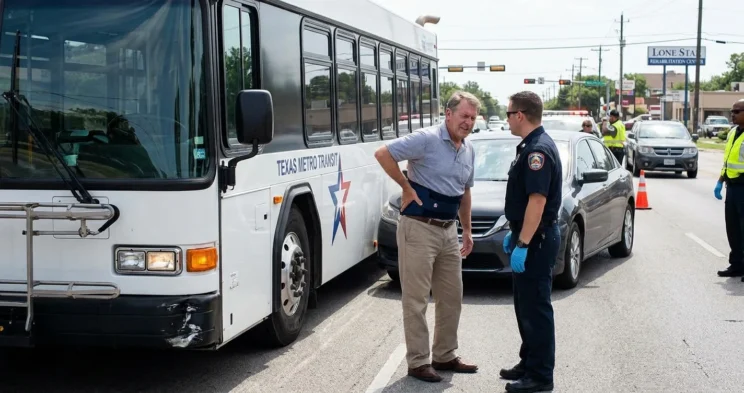
You were riding a transit bus home through downtown Dallas when the driver slammed the brakes and threw you forward against the seat ahead. Your back, the same back you hurt years ago, now feels far worse than it ever did. The insurance adjuster has already called, and they keep circling back to your old injury like it settles everything.
Pre-Existing Conditions & Texas Bus Accident Claims
A pre-existing condition does not prevent you from seeking accident-related compensation in Texas. The person who caused the crash takes you as they find you, old injuries and all.
This rule has a name. It’s called the eggshell plaintiff rule, which holds the at-fault party responsible for the full harm they cause, even when a healthier person would have walked away fine. If the bus accident aggravated your prior condition, the responsible party answers for it.
The adjuster wants you to believe your medical history is a wall. It is not. Your prior injury does not decide your bus accident pre-existing condition claim.
What decides it is causation. The real question is whether the crash worsened, accelerated, or reawakened the condition you already had. You prove that causal link. You do not have to prove the condition never existed.
Every pre-existing condition personal injury claim in Texas turns on that link. If the crash made you worse, the law lets you recover for that change. Speaking with an attorney who handles bus accident claims before you respond to an adjuster can help you understand how that causation gets established.
If you arrived here after a car crash rather than a bus, the same principle applies.
Common Carrier Duty of Care in Texas
Bus operators owe you more than ordinary drivers do. Texas law treats them as common carriers, which raises the legal standard they must meet toward every passenger they accept.
Under Texas Transportation Code Chapter 5 and long-standing Texas common law, a common carrier must use the utmost care and skill to keep passengers safe. An ordinary driver only owes reasonable care. A bus operator owes much more.
Failing that heightened duty is negligence. It does not matter whether you boarded in perfect health or with a documented back problem. The standard of care the operator owes you stays the same.
This elevated duty works in your favor when a prior injury is involved. The operator cannot easily argue you simply accepted the normal risks of riding. When the operator took your fare, it took full responsibility for getting you there safely.
Government Bus Claims & TTCA Notice Requirements
When a city, transit authority, or other public entity runs the bus, a separate set of rules kicks in. These rules carry hard deadlines and compensation limits that private bus claims never face.
Six-Month Notice Requirement
You must give the government written notice within six months of the crash. Under Texas Civil Practice and Remedies Code (CPRC) § 101.101, missing that window can halt your entire claim against a public bus operator. Strong liability evidence will not save a late claim.
The notice has to be in writing and sent to the governmental unit itself. It must state the time and place of the crash and describe what happened. A verbal mention to a driver or an accident report filed by someone else usually will not count.
Damages Caps for Governmental Units
Government bus claims also face recovery caps. Under Texas Civil Practice and Remedies Code (CPRC) § 101.023, the Texas Tort Claims Act limits what you can collect even when your aggravated injuries are worth far more.

For units of local government, the cap is $100,000 per person and $300,000 per occurrence. For municipalities and the state, it is $250,000 per person and $500,000 per occurrence for bodily injury or death. These limits apply to your whole recovery, not just the part tied to the worsening of your injury.
A prior injury bus crash claim in Texas feels this hardest when a severe condition gets substantially aggravated. The same injuries on a private bus would carry no such ceiling. Knowing which rule applies before you settle protects you from leaving real money behind.
The Act only allows these claims at all because Texas Civil Practice and Remedies Code (CPRC) § 101.02 waives the government’s usual immunity from suit for injuries caused by the operation of a motor-driven vehicle by a government employee. That waiver is what opens the door, and the caps are the price of the entry.
How Insurers Attack Pre-Existing Injury Claims
Adjusters have a playbook for these claims. The core move is simple: blame your current pain entirely on the old condition and treat the crash as if it changed nothing.
To build that argument, they ask you to sign broad medical releases. Those releases let them pull years of your prior records and hunt for anything that pre-dates the bus accident. Insurers have several ways to verify pre-existing injuries.
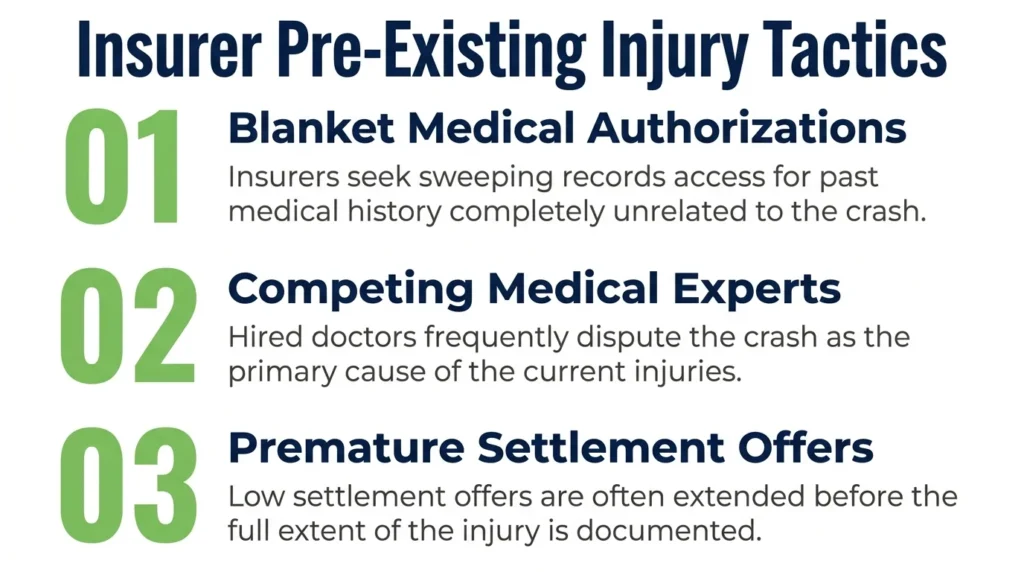
The most common bus accident aggravated injury tactics in Texas fall into a few buckets:
- Blanket medical authorizations: They request sweeping access to years of records that have nothing to do with the crash.
- Competing medical experts: They hire their own doctors to dispute that the crash caused your worsening.
- Premature settlement offers: They push a low number before the full extent of your aggravation is documented.
Your strongest answer is documentation. A clear pre-injury baseline, post-accident imaging, and treating physician notes that tie the crash to your worsened condition will counter most of these moves.
Texas also lets juries divide fault between the parties. Under Texas Civil Practice and Remedies Code § 33.001, this proportionate responsibility rule can cut both ways once a prior condition enters the picture. An attorney familiar with bus accident claims can help secure and present the evidence that separates your pre-accident baseline from crash.
Filing Deadlines & Documentation Steps
You have two years from the date of the crash to file a personal injury claim in Texas. Under Texas Civil Practice and Remedies Code (CPRC) § 16.003, that two-year clock is the outer limit for both private and government bus claims.
For a government bus, the six-month notice deadline runs at the same time. It is not an extension of the two years. You still have to give written notice within six months and file within two years.
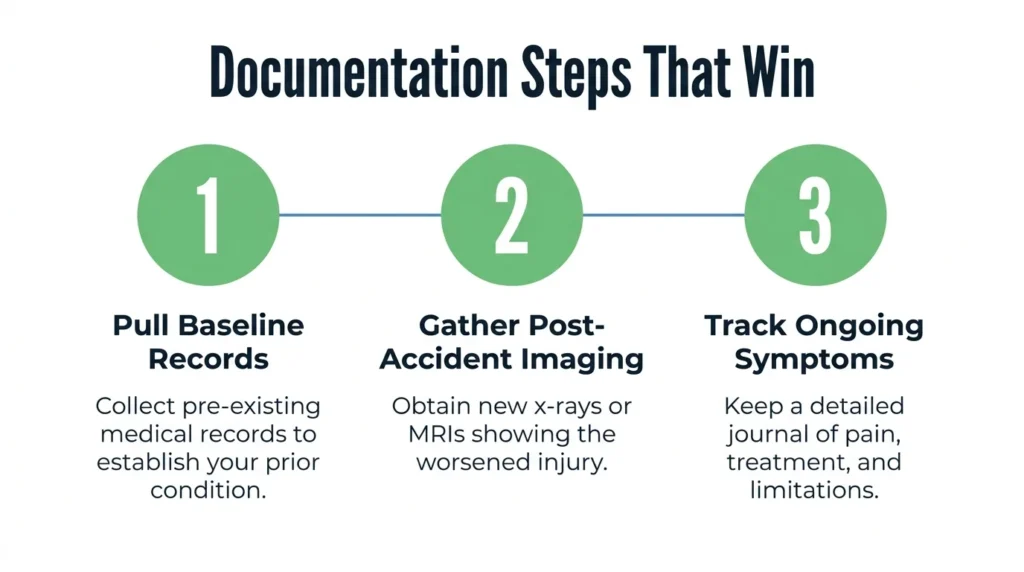
Documentation is what wins an aggravated condition claim. Pull your pre-accident medical records to establish the baseline. Gather post-accident imaging and physician assessments that show the change. Keep contemporaneous records of every new or worsened symptom as it appears.
When a jury splits responsibility, Texas Civil Practice and Remedies Code (CPRC) § 33.003 requires clear evidence separating your old condition from the new aggravation.
Talk to an Experienced Attorney Today
Bus accident claims involving a pre-existing injury get complicated fast, and the right legal counsel can keep an insurer from using your history against you. Angel Reyes & Associates has spent over 30 years helping injured Texans hold negligent parties accountable, with more than $1 billion recovered for clients.
You can learn more about our team and approach and how we build these cases.
We work on a simple promise: no fee unless we win, and your initial consultation is always free. If an adjuster is leaning on your old injury to shrink your claim, contact us for a free consultation before you sign anything.
Past results do not guarantee future outcomes.
Bus Accident with Pre-Existing Injuries FAQs
Does it help your bus accident claim if a doctor previously cleared you from a prior injury?
Yes. A prior discharge or “fully recovered” notation in your records shows your condition had resolved before the crash, which strengthens the argument that your current pain comes from the accident. It gives you a cleaner starting point when proving the aggravated injury.
Can a bus accident aggravate a mental health condition the same way it aggravates a physical injury?
Texas personal injury law does not separate physical and psychological injuries in aggravation claims. If the crash worsened a documented condition like anxiety or PTSD, that worsening is compensable on the same terms as a physical aggravation.
Can you recover future medical costs for a pre-existing condition the bus accident made worse?
Yes. If the aggravation requires ongoing treatment, future medical expenses can be part of your Texas personal injury claim when supported by medical records and physician testimony. The damages cover the change caused by the crash, not the baseline costs you had before it.
Who pays your medical bills while a Texas bus accident claim is still pending?
You may use your own health insurance, MedPay coverage under an auto policy, or Medicare or Medicaid while the claim moves forward. Some providers will also treat on a lien, meaning they wait to be paid from any settlement rather than requiring payment upfront.
Can a gap in medical treatment hurt a pre-existing condition claim after a bus accident?
It can. Insurers use treatment gaps to argue your symptoms were not serious or that they resolved before you sought care again. Consistent follow-up with your doctors after the crash creates a cleaner record connecting your ongoing condition to the accident.
About the Authors

Angel Reyes
Writer
Angel L. Reyes, III is the Founder and Managing Partner of Angel Reyes & Associates. A nationally recognized trial attorney and business leader, Angel has helped over 70,000 injury victims recover more than $1 billion since founding the firm in 1993. Named to the Texas Super Lawyers list annually since 2008, Angel brings Wall Street experience, Ivy League education, and a deep commitment to client advocacy. He is a frequent legal commentator and published author with extensive contributions to legal scholarship, trial strategy, and consumer protection.

Graham Griffin
Editor
Graham Griffin is the Web & Content Manager at Angel Reyes & Associates, where he oversees content strategy, AI-powered workflows, a...

Angel Reyes
Reviewer
Angel L. Reyes, III is the Founder and Managing Partner of Angel Reyes & Associates. A nationally recognized trial attorney and business...