Can You Sue Uber or Lyft for App Distraction Accidents?


Every article on this site is researched by our internal team, reviewed for legal accuracy against current Texas law, and held to State Bar of Texas advertising standards before publication. We do not publish content that overstates outcomes or makes promises about results.
Learn more about our
editorial standards .
Key Takeaways
- Texas Transportation Code § 545.4251 bars the screen taps a rideshare app keeps requiring.
- The product liability theory targets the app's design, sidestepping the contractor defense.
- Acosta v. Uber rejected the app distraction theory, but insurance still offers a recovery path.
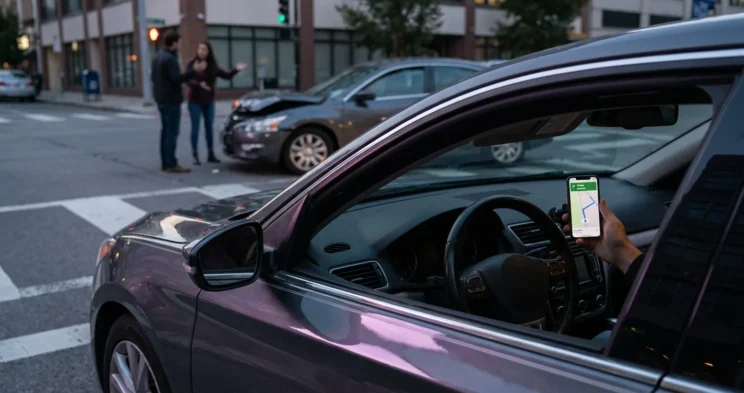
You were heading home on the Southwest Freeway near the Galleria when a rideshare driver drifted into your lane and clipped your bumper. You saw the glow of the phone before the impact. The driver was looking at the app, not the road, and now you are wondering whether the company that built that app shares the blame.
How the App Forces Phone Use While Driving
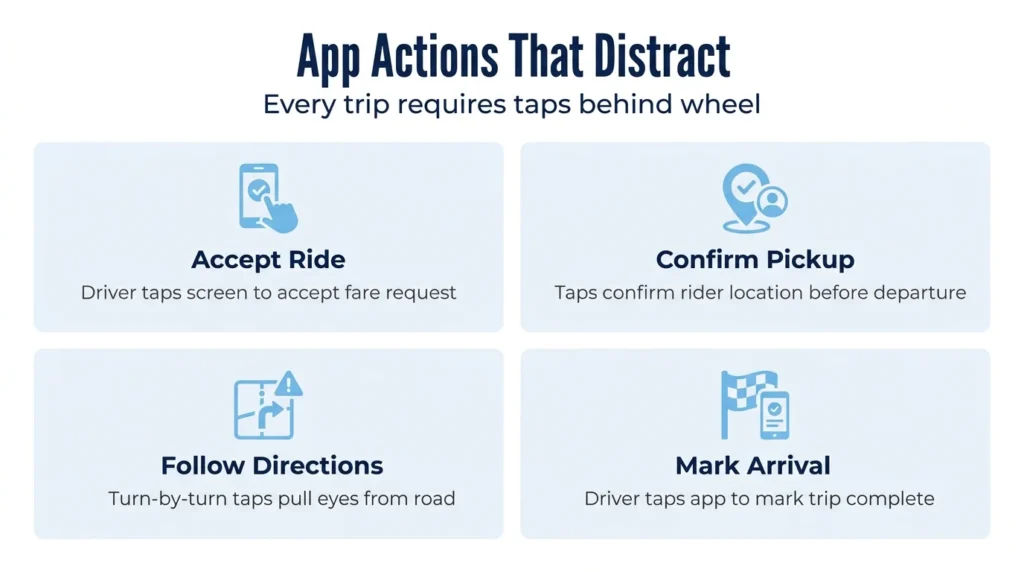
Rideshare drivers cannot do their job without touching the screen while the car is in motion. Accepting a ride request, confirming a pickup, following turn-by-turn directions, and marking an arrival all require taps that pull attention away from the road.
Each of those taps competes with the work of driving. A driver who looks down to accept a fare is, for that moment, not watching traffic ahead.
Texas law treats screen interaction behind the wheel as a serious problem. Drivers may not use a wireless device for electronic messaging while operating a vehicle under Texas Transportation Code § 545.4251. The taps the app requires look a lot like the conduct that statute prohibits.
The scale of the harm is well documented. Federal researchers track mobile-device distraction as a recurring factor in serious crashes, and the latest NHTSA distraction research puts hard numbers behind the danger of split attention.
This sets up the central argument. If the platform’s design makes prohibited phone use part of the job, the design itself may be a cause of the crash. The fault is not just the driver’s choice at the moment.
That framing changes who you can pursue. The same problem shows up in ordinary distracted driving cases, and our overview of distracted driving claims in Texas walks through how fault gets assigned when a phone is involved.
Texas also limits handheld use in specific situations. Our breakdown of the state’s hands-free rules explains those limits in plain terms.
Product Liability Theory Against Rideshare Apps
The product liability theory treats the app as a defective product and names Uber or Lyft itself as the defendant. To win a design defect claim in Texas, you must show that a safer alternative design existed under Texas Civil Practice and Remedies Code (CPRC) § 82.005.
Applied to a rideshare app, the safer design argument is straightforward. An audio-only or fully hands-free interface was feasible, and it would have cut the need for drivers to stare at a screen mid-trip.
The wider framework sits in the Texas Products Liability Act. Chapter 82 lays out what you must prove to proceed against a manufacturer or seller of a product. App developers argue they are neither, and that threshold question is itself contested.
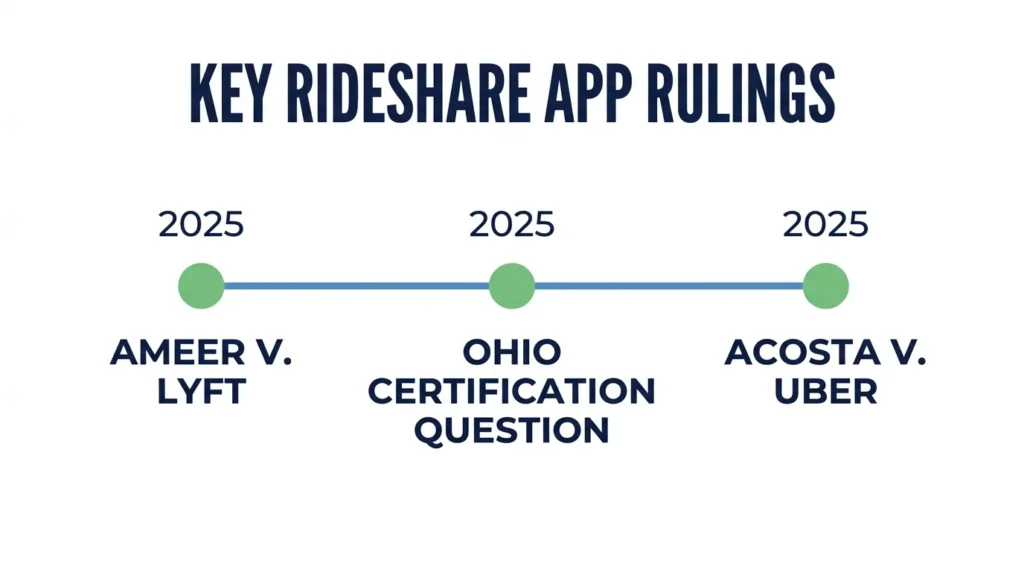
Courts in other states have started to answer it. In 2025, a Missouri appellate court ruled in Ameer v. Lyft that the Lyft app qualifies as a product for design defect purposes. It is the strongest pro-plaintiff decision on the theory so far.
The question is spreading across the country. An Ohio federal court certified the same question to the Ohio Supreme Court, asking whether rideshare apps count as products under Ohio’s product liability law. The divided Ohio Supreme Court declined to answer in a 4-3 decision, sending the case back to the federal court to resolve on common-law grounds.
Why does this product theory carry so much weight? Platforms usually defend driver crashes by calling drivers independent contractors, not employees. That puts the company out of reach for a driver’s negligence.
The design defect claim sidesteps that defense. It targets the platform’s own product rather than the driver’s behavior.
If you believe the app design caused your crash, an attorney can assess whether the product liability theory fits your facts and how rideshare injury cases are handled.
Texas Precedent After Acosta v. Uber
Texas appellate law currently runs against this theory. In Acosta v. Uber Technologies (2025), the Eighth Court of Appeals affirmed summary judgment for Uber. The decision rested primarily on the driver’s independent contractor status under Texas law. Because the plaintiffs had not pleaded a product design defect claim, the court did not directly rule on that theory, leaving the app design question unresolved in Texas. A summary of the El Paso ruling for Uber lays out the reasoning.
The decision turned on whether the app requires interaction while driving. Uber argued that drivers choose when to respond to notifications and are not forced to tap the screen in motion.
The plaintiffs pushed back with expert testimony that the design necessarily distracts drivers. Because the design defect theory was never formally pleaded, the court left that question open.
Where does Acosta leave you in Texas? It is a setback, but not a closed door.
The opinion did not directly rule on the product design defect theory. A properly framed design defect claim may still have room to proceed on different grounds.
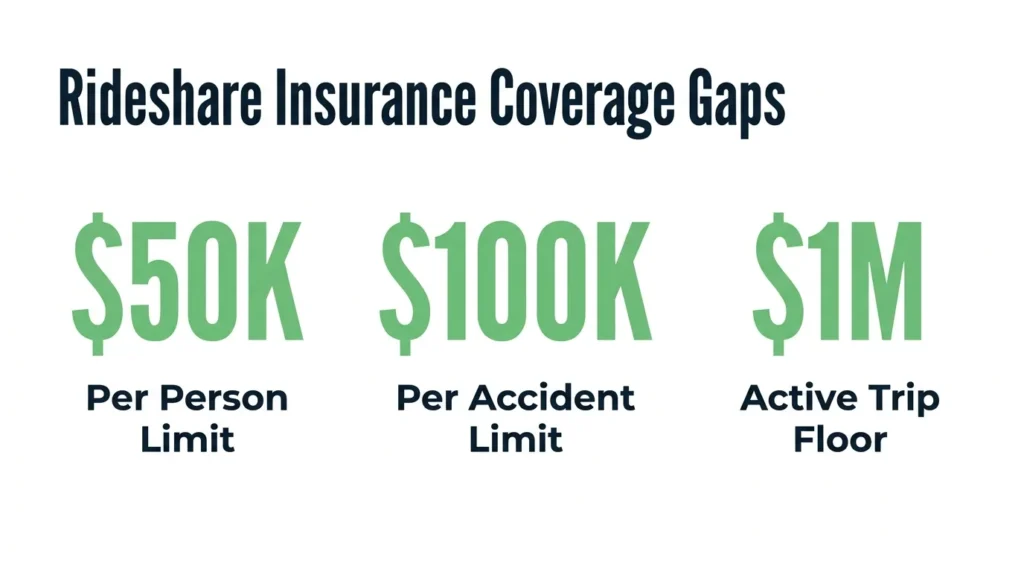
There is also a separate recovery path. Texas Insurance Code Chapter 1954 sets a one-million-dollar liability floor for crashes during an active trip.
Even when a design claim against the platform stalls, that coverage can support a real recovery. Our guide to Uber and Lyft insurance coverage periods explains which phase of the trip triggers which policy.
The driver-at-fault route still exists alongside all of this. For the general framework on holding Uber responsible after a crash in Texas, our prior analysis on suing Uber after a Texas accident covers the standard liability picture.
Litigation Barriers for App Distraction Claims
Two procedural barriers can stop a strong app distraction claim before a judge ever weighs the merits. Both arrive early, and both shape strategy from day one.
Mandatory Arbitration Clauses
The terms of service for both companies route disputes into private arbitration instead of court. The Federal Arbitration Act strongly favors enforcing those clauses, so getting into a courtroom at all is the first hurdle a design defect plaintiff faces.
Whether the clause binds you depends on who you are. An injured bystander or another driver, rather than someone who agreed to the rideshare terms, has a stronger argument that they never signed up to arbitrate anything.
You may also be able to challenge the clause itself. Plaintiffs in other states have argued that Uber’s arbitration mandate is unconscionable in injury cases. No Texas court has settled the point, but the challenge remains a live option here.
Section 230 as a Platform Defense
Section 230 of the Communications Decency Act gives online platforms broad immunity for content posted by their users. Uber and Lyft may raise it by framing app features as content moderation rather than their own design choices.
The dividing line comes from the Ninth Circuit’s decision in Lemmon v. Snap. Claims that target a platform’s own product design are not immunized, while claims targeting user-generated content are. That distinction is the framework courts use when deciding whether Section 230 blocks a design defect claim.
No court has squarely decided whether Section 230 reaches rideshare app design claims. Treat it as a defense to anticipate, not a settled wall.
Because these barriers land so early, an attorney can check whether an arbitration clause even applies to your situation before any claim is filed.
Work with a Texas Rideshare Injury Attorney
This is a complex and still-developing corner of Texas law, and the right path depends heavily on the facts of your crash. Angel Reyes & Associates handles rideshare accident cases throughout Texas, including cases where the platform’s own conduct is at issue. You can read more about who we are and how we work before you reach out.
We offer free consultations, charge no fee unless we win, and have recovered more than $1 billion for clients. If you were hurt in an Uber or Lyft crash and believe the app played a role, gathering your records early helps. Our guide on what to do after a rideshare accident walks through those first steps.
Reach out to us for a free consultation to talk through your options.
Past results do not guarantee future outcomes.
Frequently Asked Questions
What evidence can show an Uber or Lyft driver was distracted by the app at the time of my crash?
App activity logs show exactly when a driver tapped the screen, accepted a fare, or received a notification, and those timestamps can be matched against crash reconstruction data. Your attorney can subpoena Uber or Lyft’s internal trip records and the driver’s phone records through the formal discovery process.
How long do I have to file a lawsuit after a rideshare crash in Texas?
Texas Civil Practice and Remedies Code § 16.003 sets a two-year deadline for personal injury and product liability claims, and the clock generally starts on the date of the crash. Missing that deadline typically ends your right to pursue compensation in court.
Can I still recover damages if I was partly at fault for the crash?
Texas uses a proportionate responsibility system under Chapter 33 of the Civil Practice and Remedies Code, which lets you recover as long as your share of fault is 50 percent or less. Your damages are reduced by your percentage of fault, so a finding of 20 percent fault would lower a $100,000 award to $80,000.
What insurance applies if the Uber or Lyft driver had the app on but had not yet accepted a ride?
When the app is active but no ride has been accepted (Period 1), Uber and Lyft provide only contingent liability coverage of $50,000 per person and $100,000 per accident. That is far less than the $1 million floor that applies once a driver accepts a trip, so the insurance picture looks very different depending on what stage the driver was in.
Can a passenger injured in a rideshare crash pursue a claim against the driver?
Yes. A passenger can bring a negligence claim against the driver directly, and Uber and Lyft’s $1 million liability policy applies during an active trip to cover passenger injuries. Passengers are almost never assigned any fault in these crashes, which strengthens their recovery position.
About the Authors

Angel Reyes
Writer
Angel L. Reyes, III is the Founder and Managing Partner of Angel Reyes & Associates. A nationally recognized trial attorney and business leader, Angel has helped over 70,000 injury victims recover more than $1 billion since founding the firm in 1993. Named to the Texas Super Lawyers list annually since 2008, Angel brings Wall Street experience, Ivy League education, and a deep commitment to client advocacy. He is a frequent legal commentator and published author with extensive contributions to legal scholarship, trial strategy, and consumer protection.

Kyle Nicolas
Editor
Kyle Nicolas is the Web Content & SEO Manager at Angel Reyes & Associates. He has more than 10 years of experience as a marketing co...

Angel Reyes
Reviewer
Angel L. Reyes, III is the Founder and Managing Partner of Angel Reyes & Associates. A nationally recognized trial attorney and business...