CR-3 Motorcycle Accident Police Reports in Texas


Every article on this site is researched by our internal team, reviewed for legal accuracy against current Texas law, and held to State Bar of Texas advertising standards before publication. We do not publish content that overstates outcomes or makes promises about results.
Learn more about our
editorial standards .
Key Takeaways
- The Texas CR-3 is the officer's opinion of the crash, not a binding legal fault determination.
- Insurers use contributing factor codes and fault notation to set their opening liability position.
- Errors in the CR-3 can be challenged with dashcam footage, witnesses, and supplemental statements.
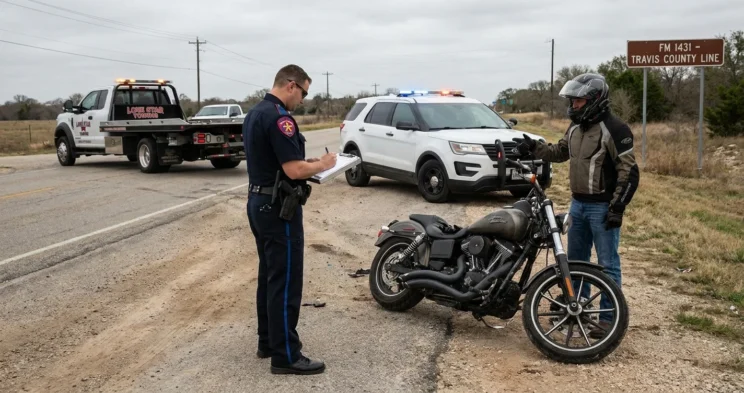
You got back on your feet after the crash, but now the insurance adjuster is quoting a police report that seems to tell a different story than what actually happened. The motorcycle accident police report that the officer filed is shaping the adjuster’s view of who caused the accident, and you are not sure what you can do about it.
The report is important. But it does not have the final word.
What the CR-3 Is & Why It Follows You
The CR-3 is the Texas Peace Officer’s Crash Report, the official form that law enforcement files after investigating a crash involving injury, death, or $1,000 or more in property damage. Under Texas Transportation Code Section 550.062, officers have 10 days from the date of the crash to file the completed report electronically with TxDOT.
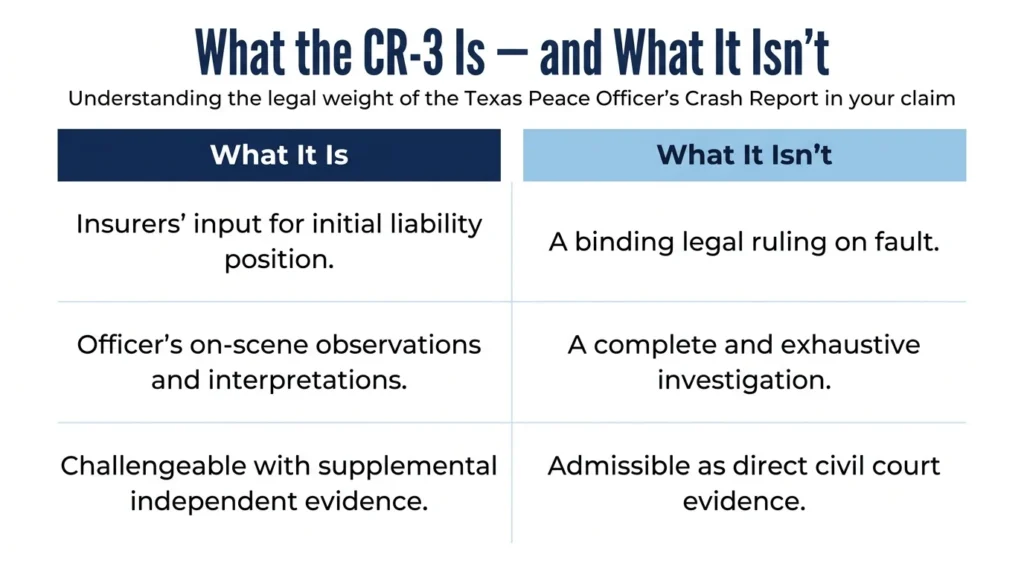
Once filed, the CR-3 becomes part of the official record that insurance companies, attorneys, and courts can access. It travels with your claim from the first phone call with an adjuster through any eventual lawsuit. For motorcycle riders, understanding what the report contains and how adjusters read it gives you a clearer picture of what you are actually dealing with.
The CR-3 uses numeric codes throughout its fields rather than plain language. If you need a copy of your own report, Texas accident reports are available through TxDOT’s Crash Records Information System, where you can purchase standard or certified copies once the officer’s filing is processed.
Four CR-3 Sections That Shape Your Claim
Four fields in particular determine how an adjuster interprets your crash: contributing factor codes, the officer’s fault notation, the crash diagram, and witness information. Each tells a different part of the story.
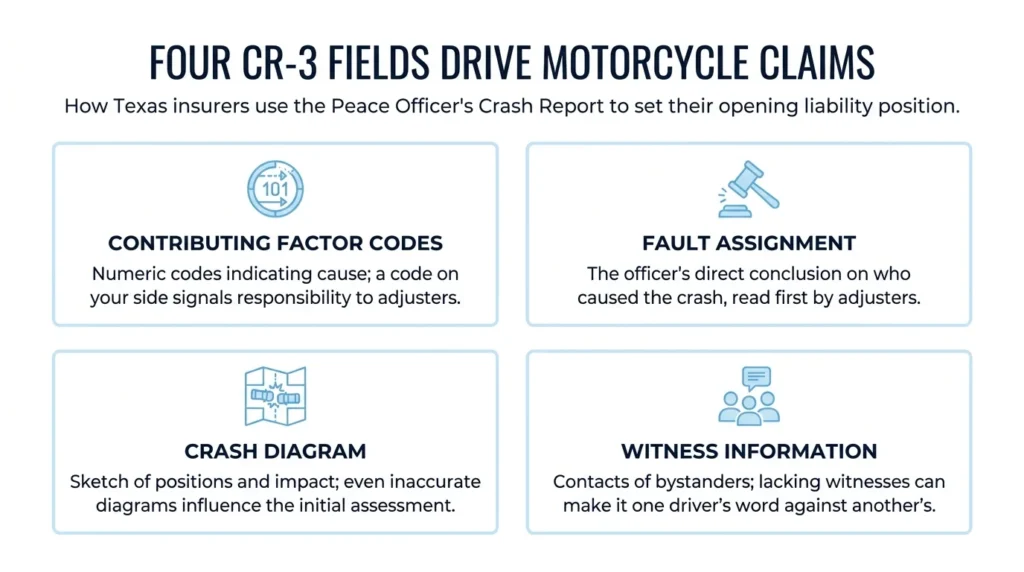
Contributing factor codes are numeric entries the officer selects to record what they believe caused the crash for each vehicle involved. Codes cover categories like failing to yield the right of way, following too closely, distracted driving, and speeding.
If the officer assigned a contributing factor code to you but not to the other driver, that issue tells the adjuster that the officer viewed you as the party responsible for the accident.
The officer’s fault assignment is distinct from contributing factors. It is the officer’s direct conclusion about who is responsible for the collision. This field reflects what the officer observed at the scene, what drivers and witnesses reported, and what physical evidence was present.
The crash diagram is a hand-drawn or digitally produced sketch showing vehicle positions, lane placement, the direction each vehicle was traveling, and the point of impact. Adjusters study the diagram closely because it sometimes captures spatial details that the written narrative does not.
A diagram that shows you entering an intersection from the wrong lane, even inaccurately, can change the adjuster’s initial fault assignment before they review any other evidence.
Witness fields record the names and contact information of bystanders who spoke with the officer at the scene. If the CR-3 lists no witnesses, the adjuster may treat the claim as one driver’s word against another’s. If witnesses were present but the officer did not record them, a supplemental statement becomes necessary.
Motorcycle-Specific Fields in the CR-3
The CR-3 designates motorcycles with unit type code MC-1, and officers complete additional fields that apply specifically to motorcycle crashes. These fields can affect how insurers assess your conduct before, during, and after the collision.
One of those fields covers helmet use. Texas does not require helmets for riders 21 and older who have either completed a state-approved motorcycle safety course or carry health insurance with at least $10,000 in medical coverage, so riding without a helmet is not automatically unlawful.
The officer will still record whether you wore a helmet, and some insurers use that information to argue your injuries were more severe than they would have been, potentially affecting the value assigned to your claim.
Injury severity codes are assigned to each person on the report. Motorcycle riders frequently receive higher severity codes than occupants of enclosed vehicles in the same crash. Those codes directly influence the medical cost projections an adjuster uses when calculating an initial settlement figure, making how motorcycle accident settlements work in Texas worth understanding alongside the report itself.
The CR-3 Is Influential, Not Conclusive
The CR-3 does not determine who owes whom money. Under Texas Civil Practice and Remedies Code Chapter 33, fault in a crash is determined through the legal process, whether by jury verdict or negotiated settlement. The officer’s report is one input, not a ruling.
That said, insurers treat it as a primary input. An adjuster picking up your file will read the CR-3 before anything else. The contributing factor codes and fault notation shape their opening position, which then influences every negotiation that follows.
Officers can only record what they observed at the scene and what parties reported to them. If you were transported by ambulance before you could give a statement, the officer’s account may rely entirely on what the other driver said. If road hazards, tire marks, or traffic camera footage were not noted in the report, those details are simply absent. The report is a snapshot, not a complete investigation.
How police reports affect your car accident case in Texas is worth reviewing alongside your specific CR-3.
Disputing CR-3 Errors with Supplemental Evidence
If the CR-3 contains inaccuracies, you have options. The first is submitting a written supplemental statement to the investigating law enforcement agency. This statement goes into the record alongside the original report and allows you to correct specific factual errors or provide context the officer did not capture.
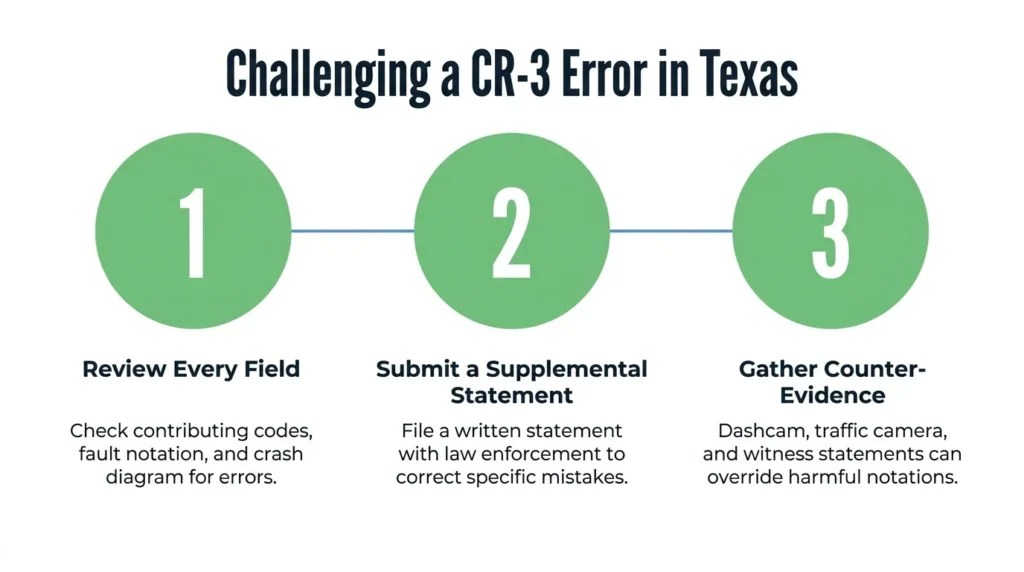
Supplemental evidence can counter a harmful CR-3 notation. Dashcam footage from your bike or a nearby vehicle, traffic camera recordings, cellphone records showing the other driver was distracted, and independent witness statements all carry weight with insurers and, if the case goes to trial, with a jury.
Reviewing how to formally dispute a police report in Texas is a good idea.
An attorney can also send evidence preservation letters to insurers, the other driver’s employer if a company vehicle was involved, and tow yards that may hold your motorcycle. Those letters create a legal obligation to retain evidence before it is lost or destroyed.
Time works against you here: dashcam footage is often overwritten within days and surveillance video may be deleted.
Early legal involvement after a crash gives you access to tools for building a record that goes beyond what the officer noted on the night of the accident. Legal strategies after a motorcycle crash include steps you can take in the days immediately following the crash to protect your claim.
Talk to an Attorney Before the Insurer Closes Your File
If you have not yet reviewed your CR-3 in detail, an attorney familiar with Texas motorcycle accident claims can walk you through which specific fields are most relevant to your situation.
A CR-3 that records the wrong contributing factor codes or points fault at you is not a closed case. It is a starting point that can be challenged with the right evidence and the right approach.
Angel Reyes & Associates has represented injured motorcycle riders across Texas for over 30 years. We handle cases on contingency, meaning you pay no fee unless we recover compensation for you.
Our team can review your CR-3, identify which fields may be working against your claim, and help you build the supplemental evidence record that tells the full story of what happened. Contact us for a free consultation.
Past results do not guarantee future outcomes.
Motorcycle Accident Police Report FAQs
Can the CR-3 be used against me as evidence in a Texas trial?
Texas Transportation Code Section 550.065 makes the CR-3 report itself inadmissible as evidence in a civil court proceeding. However, the officer who filed the report can testify about their observations, and the underlying information in the report can be developed into admissible evidence through that testimony or independent investigation.
What if the officer never filed a CR-3 after my motorcycle crash?
If no officer responded to the scene, you can file a self-report using Texas Form CR-2, sometimes called the Blue Form, directly with TxDOT. If an officer did respond but has not filed within the 10-day window, contact the department to request the report be completed, and consult an attorney if the delay is affecting your insurance claim.
How much does a certified copy of my Texas crash report cost?
A standard copy of the CR-3 costs $6 through TxDOT’s Crash Report Online Purchase System, while a certified copy required for court filings costs $8. Reports are typically available to purchase 7 to 10 business days after the officer files them.
About the Authors

Angel Reyes
Writer
Angel L. Reyes, III is the Founder and Managing Partner of Angel Reyes & Associates. A nationally recognized trial attorney and business leader, Angel has helped over 70,000 injury victims recover more than $1 billion since founding the firm in 1993. Named to the Texas Super Lawyers list annually since 2008, Angel brings Wall Street experience, Ivy League education, and a deep commitment to client advocacy. He is a frequent legal commentator and published author with extensive contributions to legal scholarship, trial strategy, and consumer protection.

Kyle Nicolas
Editor
Kyle Nicolas is the Web Content & SEO Manager at Angel Reyes & Associates. He has more than 10 years of experience as a marketing co...

Angel Reyes
Reviewer
Angel L. Reyes, III is the Founder and Managing Partner of Angel Reyes & Associates. A nationally recognized trial attorney and business...