What Is a Dooring Accident?


Every article on this site is researched by our internal team, reviewed for legal accuracy against current Texas law, and held to State Bar of Texas advertising standards before publication. We do not publish content that overstates outcomes or makes promises about results.
Learn more about our
editorial standards .
Key Takeaways
- A dooring crash happens when someone opens a car door into a motorcyclist's path.
- Texas Transportation Code 545.418 makes the door-opener at fault in nearly every case.
- Riders found 51% or more at fault under Texas law recover no compensation at all.
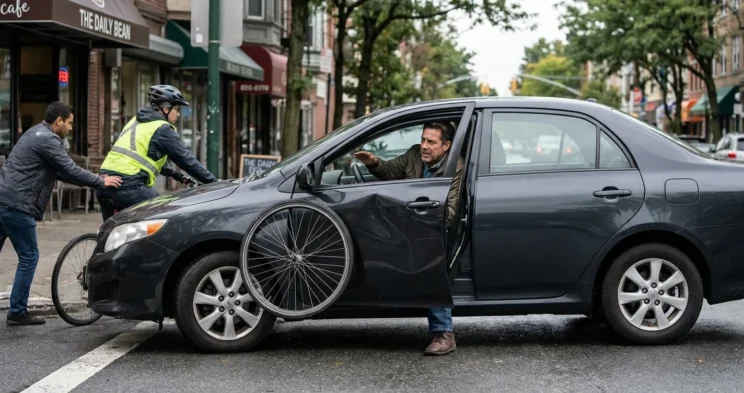
You were riding home through Deep Ellum after work, holding a steady line past a row of parked cars on Commerce Street. Without warning, a driver swung their door open right into your path. There was no time to brake, and the next thing you felt was the pavement.
Now you are hurt, your bike is damaged, and you are not sure who is responsible.
Dooring Accidents: Definition & Mechanics
A dooring accident happens when someone inside a parked vehicle opens a door into the path of an oncoming road user. While bicyclists are the most frequently documented victims nationally, motorcyclists face some of the most serious consequences. There is no protective enclosure, no crumple zone, and the door becomes a wall of steel with no warning.
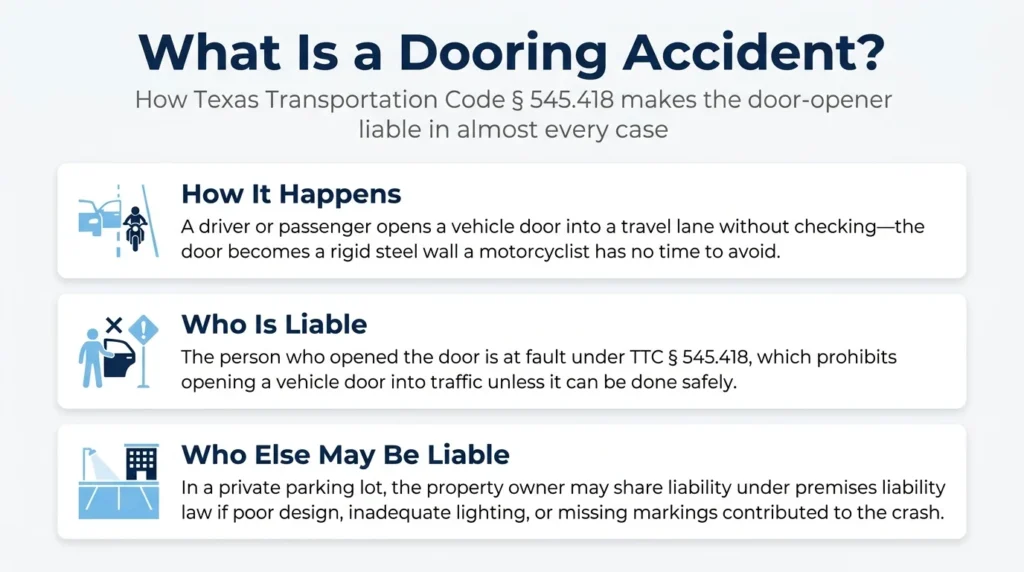
The scenario is almost always the same. You are traveling in a travel lane or bike lane next to parked vehicles. A driver or passenger opens their door without checking mirrors or looking for traffic. The door becomes a sudden, rigid wall directly in your line of travel.
These crashes often happen at low speed, yet the injuries are rarely minor. You have no protective enclosure around you. When your body meets a steel door, there is nothing to absorb the force except you.
A dooring crash is its own kind of collision. It is not a rear-end crash, and it is not a lane-change crash. The door-opener creates the hazard, which gives this type of crash its own legal framework. That framework starts with one specific Texas statute.
Texas Law on Dooring Fault
In nearly every dooring crash, the person who opened the door is at fault. Texas law makes this clear. The Texas Transportation Code § 545.418 prohibits opening a vehicle door into moving traffic unless it can be done safely and without interfering with other road users.
This statute does heavy lifting for an injured rider. When a door-opener breaks this rule, the violation itself counts as negligence. Lawyers call this negligence per se. You do not have to prove the person acted unreasonably under some general standard of care. The broken law settles that question for you.
Liability follows the person who opened the door. That could be the driver, or it could be a passenger who pushed open a rear door into your path. Sometimes both share responsibility, depending on who did what.
Owning the car is not the same as opening the door. The vehicle owner is not automatically responsible just because the car belonged to them. Fault attaches to the hand on the door handle. If you want to understand how these claims develop, review what injured riders can expect in Texas motorcycle accident claims.
Riders who have been hit by an opening car door often have a clearer path to establishing fault than they realize, and a careful review of how § 545.418 applies to a specific crash can confirm it.
Injuries Common in Dooring Crashes
Dooring crashes produce serious injuries even at low speeds. The rider gets thrown over or into the door with no crumple zone, no airbag, and no steel cage to take the hit.
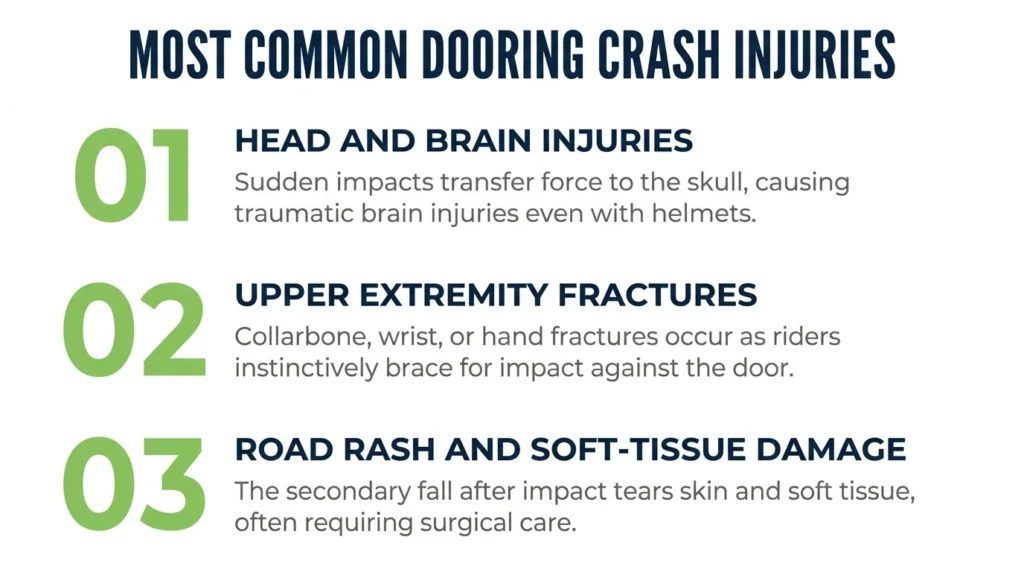
The injuries tend to cluster in predictable places. Riders commonly suffer traumatic brain injuries even while wearing a helmet, broken collarbones, and wrist or hand fractures from instinctively bracing for impact. The secondary fall to the pavement often adds road rash, soft-tissue tears, and knee or hip damage.
Some of these injuries are not apparent at first. Adrenaline can mask pain at the scene, and neurological or soft-tissue damage sometimes shows up hours or even days later. Feeling fine right after the crash does not mean you walked away unhurt.
This is why a same-day or next-day medical record is so important. That record ties your injury directly to the crash. Without it, an adjuster will argue your injuries came from something else, and the data on how serious these crashes get is sobering when you look at the Texas motorcycle accident statistics.
Comparative Fault & Parking Lot Owner Liability
Two complications can shape a dooring claim more than riders expect. One is your own potential share of fault. The other is whether a parking facility owner also bears responsibility.
Comparative Fault in Dooring Claims
Texas can reduce or even erase your recovery if you are found partly responsible for the crash. The Texas Civil Practice and Remedies Code Chapter 33 uses a proportionate responsibility system. Your compensation drops by your percentage of fault.
There is a hard line in that system. If you are found 51% or more responsible for the crash, you recover nothing at all. That makes the fault fight the center of many dooring claims.
Adjusters know this, so they look for ways to shift blame onto you. They may point to excessive speed, weaving in and out of the door zone, lane splitting, which is not legal in Texas, or any sign you were riding under the influence.
You counter those arguments with evidence. Skid marks, the point of impact, witness statements, and dash-cam footage all help establish what really happened.
Parking Lot Owner Liability
When a dooring crash happens in a private parking lot instead of a public street, the property owner may share the blame. Texas premises liability law requires property owners to keep their premises reasonably safe for the people they invite in.
A poorly designed or badly lit lot can contribute to a crash like this. Narrow aisles, faded or missing lane markings, and inadequate signage are the kinds of conditions that can support a claim against the lot owner.
The two claims can run side by side. When a dooring crash happens in a private lot, a premises liability claim against the property owner may run parallel to the claim against the door-opener, and both avenues deserve a close look.
What to Do after a Dooring Crash
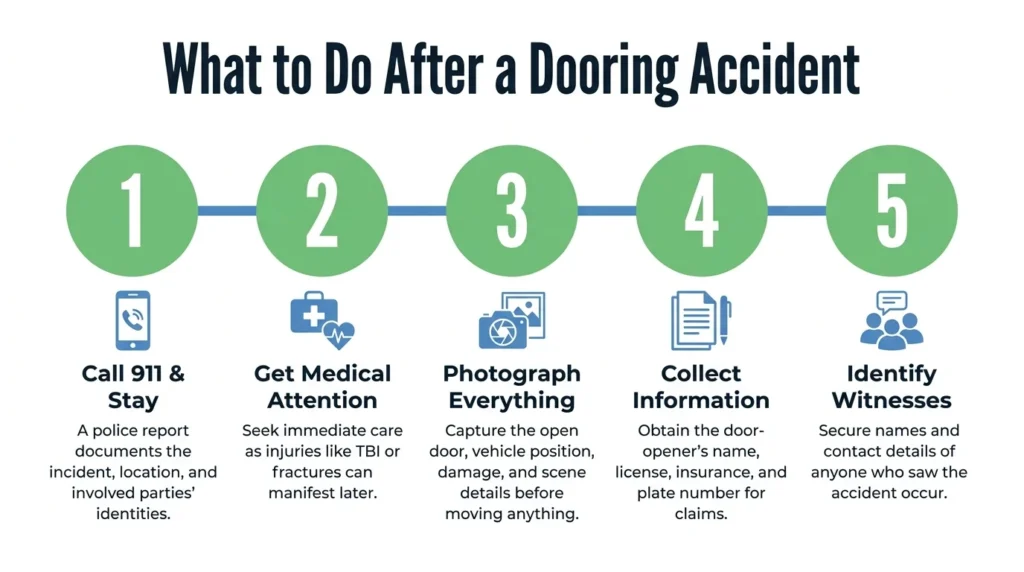
The steps you take in the first hour shape your health and your claim. Move through them in order, starting the moment you are able:
- Step 1: Call 911 and stay at the scene. A police report locks in the date, location, and everyone’s identity. It may also capture the door-opener admitting fault on the spot.
- Step 2: Get medical attention right away. Same-day records are some of the strongest evidence you can have, even when the injuries feel minor.
- Step 3: Document the scene before anything moves. Photograph the open door, the vehicle position, your motorcycle, the road markings, and any damage to the door itself.
- Step 4: Collect the door-opener’s information. Get their name, driver’s license, insurance details, and the vehicle’s license plate.
- Step 5: Identify witnesses before they leave. Write down the name and contact information of anyone who saw what happened.
- Step 6: Say nothing recorded to the other insurer yet. Do not give a recorded statement to the other driver’s insurance company before you speak with an attorney.
Talk to an Experienced Attorney
When a car door turns your ride into a hospital visit, you should not have to fight the insurance company alone. Angel Reyes & Associates has spent more than 30 years helping injured Texans across the entire state. During that time, our attorneys have achieved more than $1 billion recovered for clients.
We work on a no-fee-unless-we-win basis, so there is nothing to pay upfront, and your first consultation is free. Our team can review how the door-opener’s violation, comparative fault, and any parking lot owner’s role apply to your crash.
Reach out to us for a free consultation and let us walk you through your options before you talk to anyone else.
Past results do not guarantee future outcomes.
Motorcycle Dooring Accident FAQs
How long do you have to file a dooring accident lawsuit in Texas?
Texas law gives most injured motorcyclists two years from the date of the crash to file a personal injury lawsuit. Missing that deadline generally bars you from recovering any compensation, regardless of how clear the other party’s fault is.
Does not wearing a helmet affect a dooring accident claim in Texas?
It can reduce your compensation, but it does not automatically bar it. An insurance adjuster may argue that riding without a helmet made your head injuries worse, and a jury could assign you a percentage of fault for those specific injuries while leaving the door-opener’s liability for the crash itself intact.
Whose insurance pays for a dooring accident?
The door-opener’s liability insurance is the primary source of compensation. If that person has no insurance or not enough coverage, your own uninsured or underinsured motorist coverage can step in to cover the gap.
Can you recover compensation for motorcycle damage, not just injuries?
Yes. A dooring claim can include property damage to your motorcycle in addition to your medical bills, lost wages, and pain and suffering. Property damage is typically handled through the door-opener’s liability policy.
What if a rideshare passenger opened the door and caused the crash?
The passenger who opened the door is personally liable under the same Texas statute that applies to drivers. Whether the rideshare company shares any liability depends on the specific facts of the trip, but the passenger’s direct act is the primary basis for the claim.
About the Authors

Angel Reyes
Writer
Angel L. Reyes, III is the Founder and Managing Partner of Angel Reyes & Associates. A nationally recognized trial attorney and business leader, Angel has helped over 70,000 injury victims recover more than $1 billion since founding the firm in 1993. Named to the Texas Super Lawyers list annually since 2008, Angel brings Wall Street experience, Ivy League education, and a deep commitment to client advocacy. He is a frequent legal commentator and published author with extensive contributions to legal scholarship, trial strategy, and consumer protection.

Kyle Nicolas
Editor
Kyle Nicolas is the Web Content & SEO Manager at Angel Reyes & Associates. He has more than 10 years of experience as a marketing co...

Angel Reyes
Reviewer
Angel L. Reyes, III is the Founder and Managing Partner of Angel Reyes & Associates. A nationally recognized trial attorney and business...