How Bus Maintenance Failures Lead to Accidents in Texas


Every article on this site is researched by our internal team, reviewed for legal accuracy against current Texas law, and held to State Bar of Texas advertising standards before publication. We do not publish content that overstates outcomes or makes promises about results.
Learn more about our
editorial standards .
Key Takeaways
- FMCSA Part 396 requires carriers to inspect and repair every bus before it carries riders.
- A carrier's broken safety rule can establish negligence per se in your Texas injury claim.
- Private bus claims allow two years to file; government bus claims allow only six months' notice.
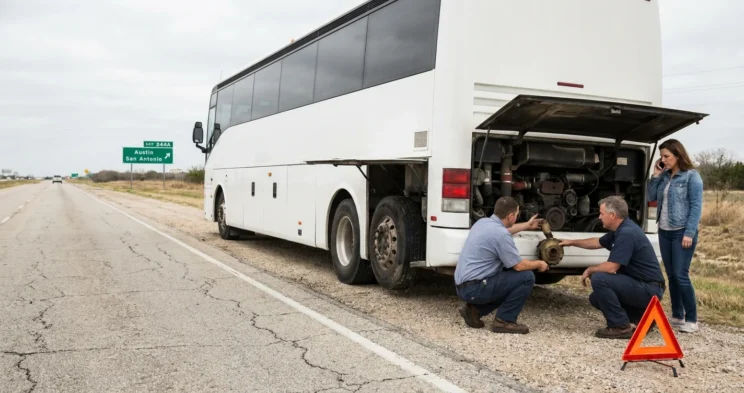
You were riding a charter bus home along I-35 near San Antonio when it lurched hard and the driver fought the wheel. Later you learned the brakes had been slipping for weeks. Now you are stuck with medical bills you did not cause, and you want to know who is responsible.
Federal Maintenance Rules Buses Must Follow
Federal law requires every bus carrier to inspect, repair, and maintain its vehicles before they ever carry a passenger. That duty comes from FMCSA Part 396 systematic maintenance rules, which set the standard a carrier must meet to operate safely.
The rules go further than a general promise to keep buses safe. Drivers who find a defect or have one reported to them must complete a driver vehicle inspection report, often called a DVIR, at the end of each day’s work. The carrier then has to fix those defects before the bus goes back on the road.
Every commercial bus also has to pass an annual periodic inspection. Carriers must keep those inspection records for at least 14 months.
Texas adds its own layer on top of the federal rules. Under the Texas Transportation Code Chapter 548, buses registered in the state must meet a separate inspection requirement. A bus operating here has to satisfy both the federal and state standards.
When a carrier breaks any of these rules, that violation can matter to your case. In Texas, a broken safety regulation can establish negligence per se, meaning the violation itself proves the carrier owed you a duty and failed to meet it. If you want to understand how bus accident claims work overall, our attorneys can walk you through the basics.
Brake, Tire & Steering Failures That Cause Crashes
Most maintenance-related bus crashes trace back to three failures: brakes, tires, and steering. Each one turns a skipped inspection into a wreck that injures the people on board.
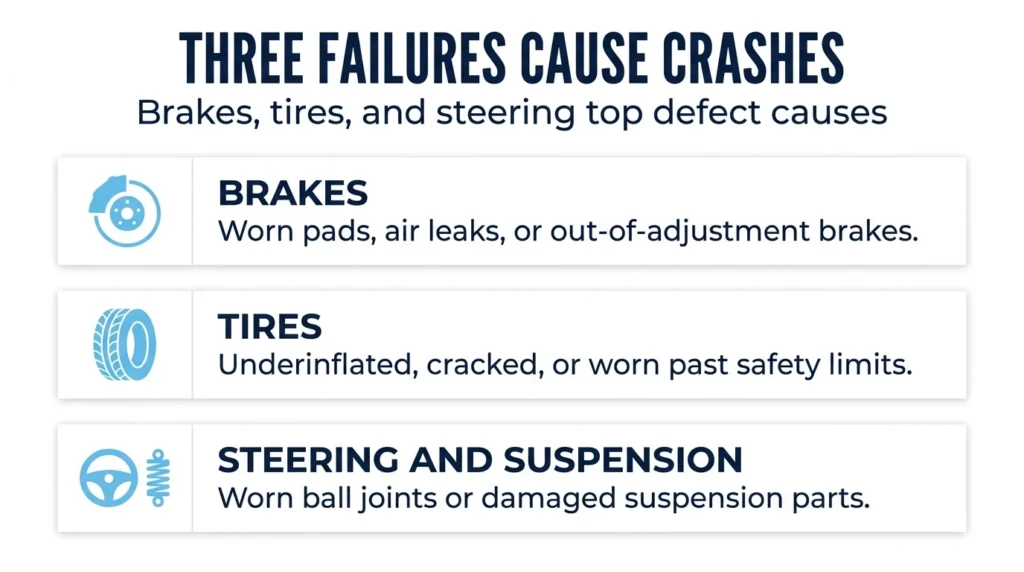
Brake problems lead the list. Worn pads, air brake leaks, and out-of-adjustment brakes are among the most frequently cited maintenance defects in commercial vehicle crash investigations, and FMCSA data show brake violations consistently top the vehicle maintenance violation categories for bus fleets. Federal rules set minimum brake performance standards, and large truck and bus crash data show how often carriers skip verifying them.
Tires are the next weak point. A tire run past its service limit, under-inflated, or cracked along the sidewall can fail without warning. A blowout at highway speed strips the driver of control in an instant.
Steering and suspension come third. When a carrier defers work on steering parts, worn ball joints, or a damaged suspension, the bus can lose its handling on a curve or during a sudden move. That loss of control often arrives at the worst possible moment.
The proof usually lives in the records. Crash investigators look for defect codes, DVIR notes a driver filed that the carrier ignored, and brake or tire parts worn into the red. Those findings tie the deferred maintenance straight to the crash. If you suspect a mechanical defect caused your wreck, you can learn what to do as a bus accident passenger to protect the evidence early.
How Maintenance Negligence Becomes Legal Liability
A maintenance failure becomes legal liability when the carrier’s rule-breaking connects to your injury. Three legal ideas usually carry that weight, and the first does most of the work.
Negligence per se comes first. When a carrier violates the federal motor carrier maintenance rules, the violation proves duty and breach on its own. You still have to show the failure caused your injury and left you with real damages. The regulation handles the hardest part of the standard of care.
Then there is the carrier’s own responsibility. A bus company answers for its driver’s maintenance failures on the job. It also faces direct liability when its inspection program, maintenance schedule, or DVIR follow-up was sloppy in the first place.
Outside contractors can share the blame too. When a carrier hires an outside shop to service its buses, that shop and its employer can be named as defendants. Under Texas proportionate responsibility rules, a court can assign a fault percentage to each responsible party.
Sorting out who shares fault gets complicated fast. For a full breakdown of every party who may be responsible, including the operator, the company, and government entities, please contact our law firm and speak to a bus accident attorney.
Getting Maintenance Records Before They Disappear
The records that prove your case have a short shelf life. FMCSA lets carriers keep inspection and maintenance records for as little as 14 months for periodic inspections and three months for DVIRs. Once those windows close, a carrier can destroy them with no legal duty to keep them.
That short clock is why fast action decides many cases. An attorney can send a litigation hold letter, also called a spoliation notice, right after taking your case. The letter puts the carrier on written notice that destroying maintenance logs, DVIRs, inspection reports, or service invoices can bring court sanctions.
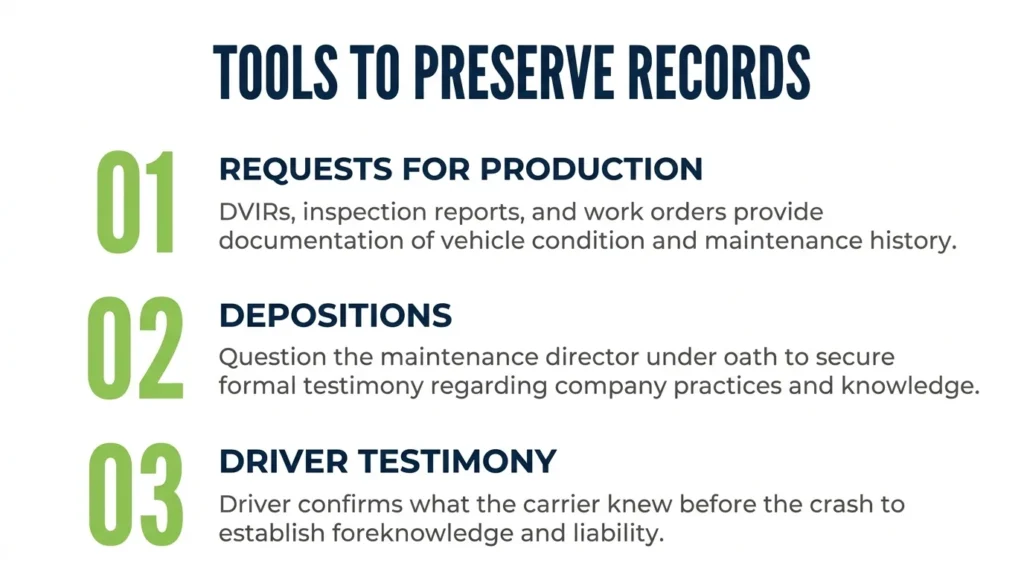
Once a lawsuit begins, several tools pull those records into the open.
- Requests for production: DVIRs, annual inspection reports, brake adjustment logs, tire replacement records, and work orders.
- Depositions: questioning the carrier’s maintenance director under oath.
- Driver testimony: the driver who filed the last DVIR before the crash can confirm what the carrier knew.
Public data can round out the picture. FMCSA’s Safety Measurement System lists a carrier’s inspection violation history, which can reveal a pattern of repeated rule-breaking before your crash. Our guide on how to file a Texas bus accident claim explains how these pieces fit together.
Texas Filing Deadlines for Maintenance Claims
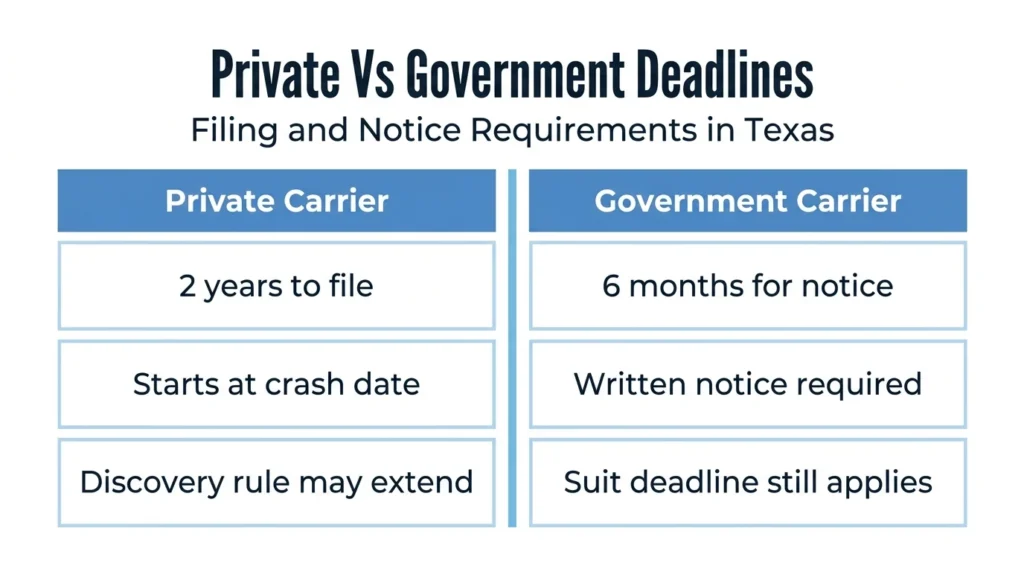
Texas sets firm deadlines for bus maintenance claims, and they change depending on who owned the bus. Private carriers and government transit systems follow very different rules.
Private Bus Operator Claims
For a crash involving a private bus company, the Texas Civil Practice and Remedies Code (CPRC) § 16.003 gives you two years from the crash to file suit. Miss that deadline and your claim is gone for good, no matter how clear the maintenance failure was.
The two-year clock usually starts on the date of the crash. In limited cases where a hidden defect was not obvious at first, the discovery rule can push the start date later.
Filing on time is necessary, but it is not enough by itself. Your attorney also has to move early enough to save the maintenance records before the federal retention windows run out. Our overview of the Texas Tort Claims Act bus accident limits explains why timing drives these cases.
Government Bus Operator Claims
Claims against a public bus system run on a much tighter clock. Under CPRC § 101.101, the Texas Tort Claims Act gives you only six months to notify a government transit agency, such as a city bus line or a public school bus operator. Miss that notice deadline and you waive the claim entirely.
The notice has to be formal and in writing to the governmental unit. A phone call to customer service or a verbal complaint does not count.
Even after proper notice, you still have to file suit within the deadline that applies to your claim. For a government bus case, that means talking with an attorney within weeks of the crash, not months. Because these deadlines are shorter and stricter than the private ones, anyone who suspects public transit negligence should speak with someone about a bus accident claim as soon as possible.
Talk to a Texas Bus Accident Attorney
A bus maintenance case turns on records that can vanish and deadlines that do not forgive delay. That combination makes early, experienced help matter.
Angel Reyes & Associates has handled complex bus and commercial vehicle cases for more than 30 years across Texas. We offer free initial consultations, we charge no fee unless we win, and we have recovered more than $1 billion for clients. You can read what our clients say about working with us to see how we handle cases like yours.
If a maintenance failure contributed to your crash, or a loved one did not survive one, our team can review your options, including a Texas wrongful death claim. Reach out for a free consultation so you understand your rights before time runs out.
Past results do not guarantee future outcomes.
Frequently Asked Questions
Can the maker of a defective bus part be sued alongside the bus company?
Yes. If a faulty component, such as a brake part or tire, left the factory in a dangerous condition, the manufacturer can face strict liability in Texas without proof of carelessness. The bus company and the parts maker can both be named as defendants in the same lawsuit.
Are school district buses subject to the same federal maintenance rules as private bus companies?
No. Under federal law, state and local government agencies that operate their own school buses are largely exempt from FMCSA Part 396 maintenance requirements. Private contractors hired to transport students must follow the federal rules, but school district-run fleets answer to state inspection standards instead.
What types of compensation can a Texas bus crash victim recover?
A victim can seek economic damages, which cover medical bills, lost wages, and future care costs, as well as non-economic damages for pain, suffering, and emotional distress. The total recovery depends on the severity of the injuries and the evidence gathered to support each category of loss.
Can anyone look up a bus company's federal safety record before a lawsuit is filed?
Yes. FMCSA’s Safety Measurement System at ai.fmcsa.dot.gov/SMS lets anyone search a carrier’s inspection history and violation data using the company name or DOT number. For passenger carriers, all safety data in the system is publicly visible, so a pattern of past maintenance violations can be found before litigation even begins.
Does the two-year filing deadline apply the same way when the injured person is a child?
No. In Texas, the two-year statute of limitations is paused for injured minors until they turn 18, giving them until their 20th birthday to file their own claim. However, a parent’s separate claim for the child’s medical expenses is not paused and must be filed within two years of the crash.
About the Authors

Angel Reyes
Writer
Angel L. Reyes, III is the Founder and Managing Partner of Angel Reyes & Associates. A nationally recognized trial attorney and business leader, Angel has helped over 70,000 injury victims recover more than $1 billion since founding the firm in 1993. Named to the Texas Super Lawyers list annually since 2008, Angel brings Wall Street experience, Ivy League education, and a deep commitment to client advocacy. He is a frequent legal commentator and published author with extensive contributions to legal scholarship, trial strategy, and consumer protection.

Graham Griffin
Editor
Graham Griffin is the Web & Content Manager at Angel Reyes & Associates, where he oversees content strategy, AI-powered workflows, a...

Angel Reyes
Reviewer
Angel L. Reyes, III is the Founder and Managing Partner of Angel Reyes & Associates. A nationally recognized trial attorney and business...