Shared Fault & the 51% Bar Rule for Motorcycle Accidents in Texas

Every article on this site is researched by our internal team, reviewed for legal accuracy against current Texas law, and held to State Bar of Texas advertising standards before publication. We do not publish content that overstates outcomes or makes promises about results.
Learn more about our
editorial standards .
Key Takeaways
- Texas bars motorcycle riders from any recovery if their fault exceeds 50% under CPRC § 33.001.
- Insurers use biker bias and early statements to inflate fault before full evidence is gathered.
- Crash reports, witness accounts, and reconstruction analysis are the strongest tools to fight back.
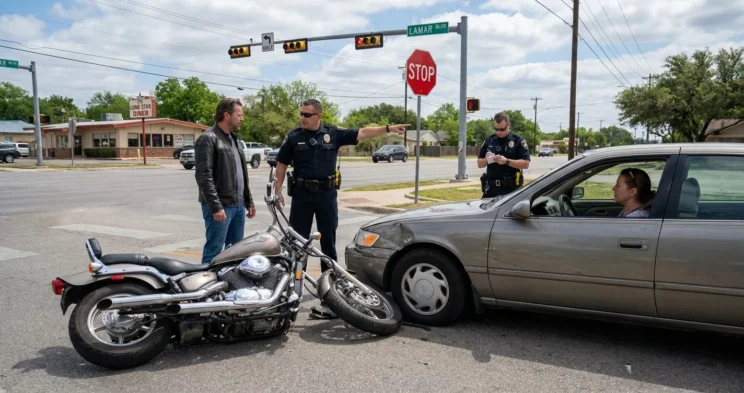
You were heading home on the I-10 corridor when a driver cut across your lane near Katy and the crash happened. Now the other driver’s insurer is calling, and the fault percentage they’ve assigned to your share of the blame feels wrong. You were not the only one at fault.
But that is exactly what the adjuster wants you to think, and the number they picked is not final.
How the 51% Bar Applies to Motorcycle Crashes
Texas does not use an all-or-nothing fault system. Under Texas Civil Practice and Remedies Code (CPRC) § 33.001, you can recover compensation even when you share some responsibility for a crash, as long as your assigned fault percentage stays at 50% or below.
The exact percentage is important because it directly reduces your compensation, or recovery, dollar-for-dollar. CPRC § 33.003 requires the trier of fact to assign each party a whole-number percentage of responsibility.
For example, if a jury finds you 20% at fault for a crash that caused $100,000 in damages, you recover $80,000. If your percentage lands at 51% or higher, you recover nothing. The entire claim is wiped out.
That one-percentage-point cliff is where motorcycle cases are most often won or lost. You can review a broader explanation of how Texas comparative negligence works across all accident types, the Texas comparative negligence 51% rule.
Why Insurers Inflate Motorcycle Rider Fault
Insurance companies are businesses. If your assigned fault percentage is more than 50%, their financial obligation to you ends entirely. That structure creates a direct incentive to push your fault percentage as high as possible.
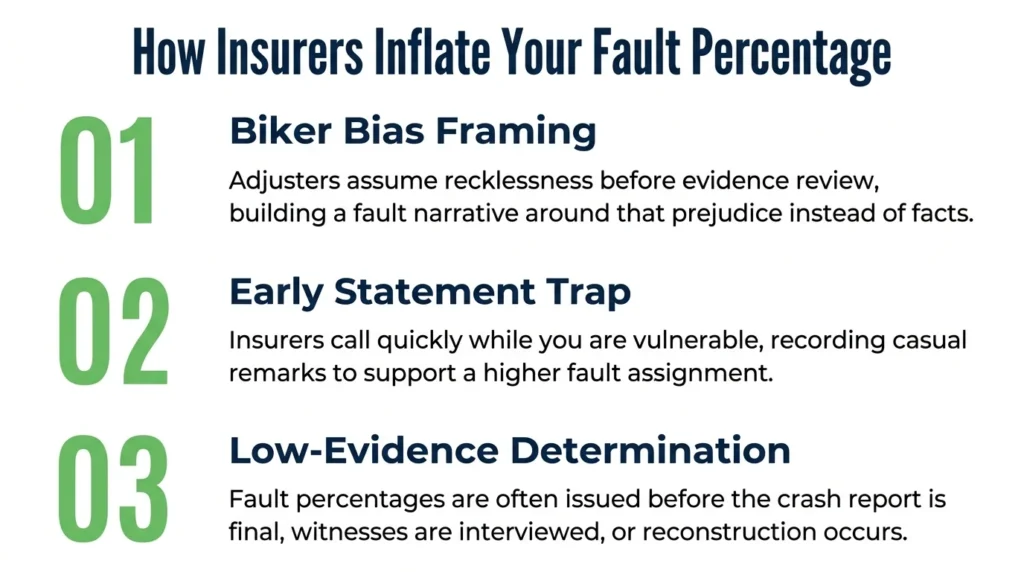
Motorcycle riders deal with issues designed to do exactly that.
The first is what experienced attorneys call biker bias. Adjusters and juries sometimes assume riders are reckless before the evidence is reviewed. Insurers know this and frame the narrative, or accident story, early. By the time an official determination about the accident is made, this framing has already done its work.
The second tactic is the early statement trap. Adjusters often call within days of the crash while you are still in pain, still processing what happened, or still on medication. A casual remark during that call can be recorded and used to support a higher fault assignment. You are not legally required to give that statement.
The third tactic is known as low-evidence determination. Insurers sometimes issue a fault number before the crash report is finalized, before witnesses have been interviewed, and before any recreation of the accident has occurred. That early number affects the negotiation, and getting it moved requires presenting evidence the insurer did not include.
Understanding how motorcycle accident settlements are calculated in Texas can help you see why that initial fault number has such a direct impact on the offer you receive.
Evidence That Counters Inflated Fault Assignments
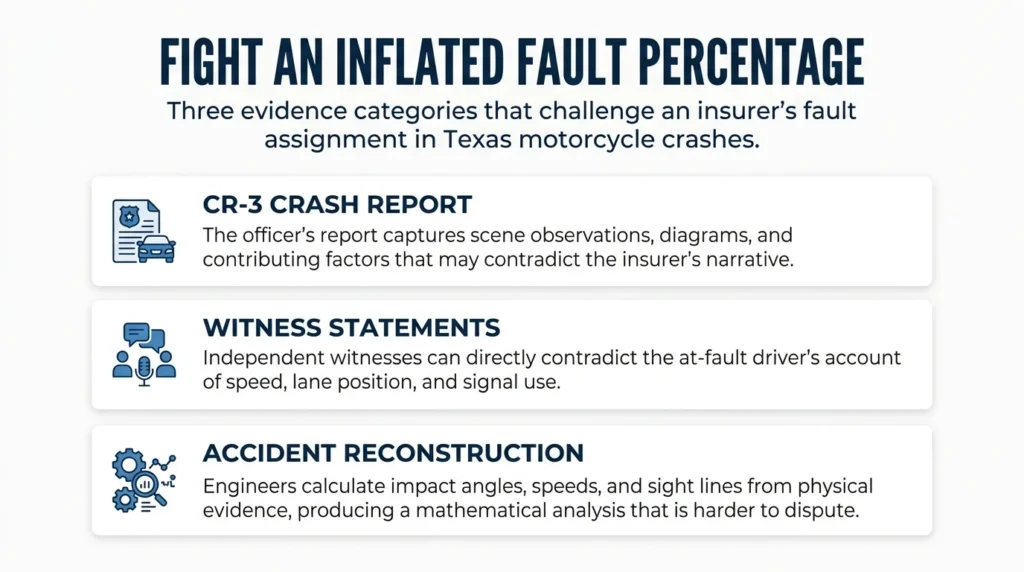
Three categories of evidence most effectively challenge an inflated fault percentage in a motorcycle crash. Each addresses a different part of the insurer’s narrative.
Step 1: The CR-3 crash report. Law enforcement files this report under Texas Transportation Code § 550.062 within 10 days of the crash. The report contains the officer’s observations, a scene diagram, contributing factors, and the statements each party gave at the scene. The report is not a legal ruling on fault, but it is often the first document the insurer cites.
Errors in the report, such as a missed skid mark or an incorrectly checked contributing factor box, can be challenged with additional evidence.
Step 2: Witness statements. Independent witnesses have no financial stake in the claim’s outcome, so their accounts are not biased. Witnesses who can place the other driver in the wrong lane, confirm the traffic signal phase, or describe the other vehicle’s speed before impact can directly contradict the insurer’s story of what happened.
Step 3: Accident reconstruction. Reconstruction specialists are engineers and former law enforcement professionals who analyze physical evidence: skid marks, crush depth, vehicle resting positions, sight lines, and road conditions. They calculate impact angles and speeds mathematically.
A reconstruction report can show that the evidence does not support the fault percentage the insurer assigned.
When physical evidence makes it clear that the insurer’s story is wrong, the insurer’s fault percentage number becomes much harder to defend.
How Fault Gets Decided: Adjuster vs. Jury
Insurance adjusters assign fault during the claims process. They are not subject to the evidentiary standards of a courtroom, and they are not objective. Their determination directly affects the settlement offer they put on the table.
If you challenge the adjuster’s number and the parties cannot reach an agreement, the claim may proceed to litigation. At that point, a jury applies what both drivers claim about fault in Texas standards and CPRC § 33.003 to assign fault in whole-number percentages.
Expert testimony, the crash report, and witness statements all go before the jury. The insurer’s informal determination is replaced by findings the parties must live with.
The adjuster’s number is negotiable. It is an opening position, not a verdict. Counter-evidence, particularly a reconstruction report, is what changes it. You can learn more about how fault is determined in Texas injury cases.
Get Help with Your Shared-Fault Motorcycle Claim
Disputed fault is where motorcycle claims are most often undervalued or denied outright. Countering the insurer’s determination requires evidence, persistence, and an understanding of what the law actually requires.
Angel Reyes & Associates has helped injured Texans work through disputed-fault motorcycle claims for over 30 years. Our team includes investigators and accident reconstruction specialists who know how to challenge an inflated fault percentage with the physical evidence the insurer did not collect. We work on contingency, which means no fee unless we win.
Reach out for a free consultation. Our case results show the work we do for injured Texans.
We handle cases across Texas and can manage most, if not all, of your case remotely.
Past results do not guarantee future outcomes.
FAQs About Shared Fault in Motorcycle Accidents
How long do I have to file a claim after a shared-fault motorcycle accident in Texas?
Texas gives you two years from the date of the crash to file a personal injury lawsuit under Texas Civil Practice and Remedies Code § 16.003. Missing that deadline will almost always end your right to recover, regardless of how strong your evidence is.
Can not wearing a helmet increase my fault percentage in Texas?
Helmet use does not determine who caused the crash, but insurers may argue it contributed to the severity of your head or neck injuries and use that argument to push your fault percentage higher. Texas law allows riders over 21 who carry at least $10,000 in medical coverage to ride without a helmet, but a jury can still consider injury severity when assigning percentages.
Does the insurer's initial fault determination change if I get an attorney involved?
Yes, it can. An attorney can request the basis for the insurer’s determination, gather counter-evidence the adjuster did not consider, and negotiate a revised percentage before the case reaches litigation. The adjuster’s number is a starting position, not a binding legal finding.
How do I get a copy of the Texas CR-3 crash report for my accident?
You can purchase the CR-3 report through TxDOT’s Crash Report Online Purchase System at cris.dot.state.tx.us. Reports are typically available 7 to 14 days after the crash, and the fee is $6 for a standard copy or $8 for a certified copy.
What happens if multiple parties share fault in a Texas motorcycle crash?
Texas proportionate responsibility law applies to all parties. Each person’s fault percentage is assigned by the trier of fact, and damages are reduced accordingly for anyone found 50% or less responsible. A party found more than 50% responsible is barred from any recovery.
About the Authors

Angel Reyes
Writer
Angel L. Reyes, III is the Founder and Managing Partner of Angel Reyes & Associates. A nationally recognized trial attorney and business leader, Angel has helped over 70,000 injury victims recover more than $1 billion since founding the firm in 1993. Named to the Texas Super Lawyers list annually since 2008, Angel brings Wall Street experience, Ivy League education, and a deep commitment to client advocacy. He is a frequent legal commentator and published author with extensive contributions to legal scholarship, trial strategy, and consumer protection.

Graham Griffin
Editor
Graham Griffin is the editorial director responsible for accuracy and legal compliance across all firm content.
Graham Griffin
Reviewer
Graham Griffin also serves as legal reviewer, ensuring all claims and advice reflect current Texas statutes and case law.