How Much Does Insurance Increase After an Accident?


Every article on this site is researched by our internal team, reviewed for legal accuracy against current Texas law, and held to State Bar of Texas advertising standards before publication. We do not publish content that overstates outcomes or makes promises about results.
Learn more about our
editorial standards .
Key Takeaways
- At-fault accidents in Texas typically raise auto insurance premiums by 20% to 40% per year.
- Surcharges usually last three to five years, with the biggest hit in years one and two.
- Carrier choice matters: National carriers often have steeper surcharges than regional ones.
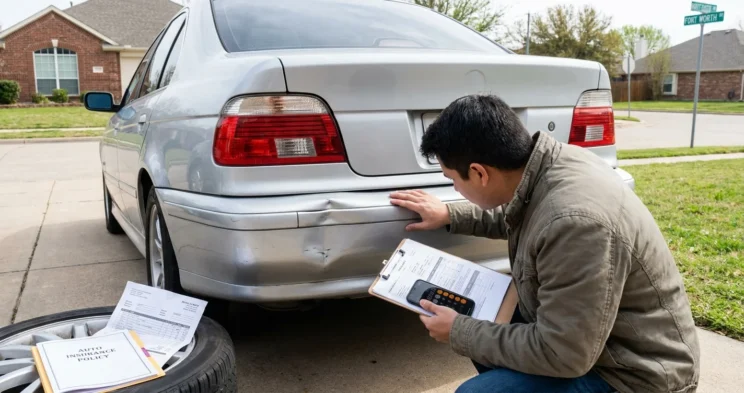
You walk out to your driveway in Fort Worth, look at the dented bumper, and start doing the math. The repair quote stings, but the bigger question is what your insurance company will do next. A single at-fault crash can quietly cost you thousands of dollars over the following years. Knowing the numbers helps you decide whether to file a claim or write a check yourself.
Texas Insurance Rate Increases After Accidents
After an at-fault accident in Texas, drivers typically see auto insurance premiums rise 20% to 40%, which translates to roughly $400 to $900 more per year on a standard policy. The exact number depends on your carrier, your driving history, and how much the claim costs.
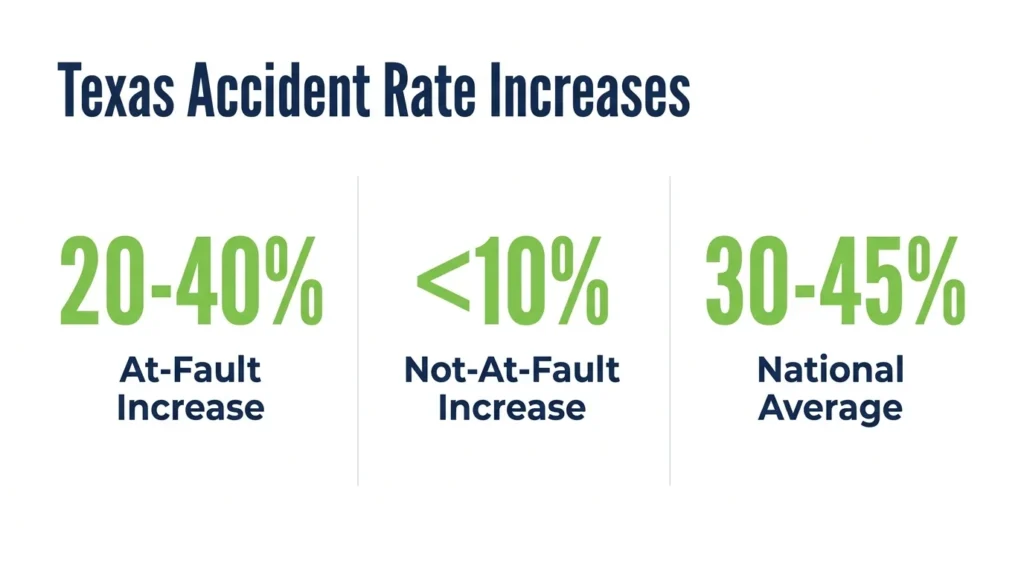
Texas does not prohibit carriers from raising rates after a not-at-fault crash, but the average bump is much smaller, often under 10%. Some drivers see no change at all.
Compared to the national average increase of about 30% to 45%, Texas is in line with broader trends reported by the Insurance Information Institute. However, Texas-specific rates can run higher in dense urban zip codes, where claim frequency drives base premiums up before any surcharge applies. Those carrying Texas minimum coverage limits may see higher percentage increases because they are statistically grouped into higher-risk pools.
Factors That Affect Your Rate Increase
Several variables decide how much your insurance increases after a car accident.
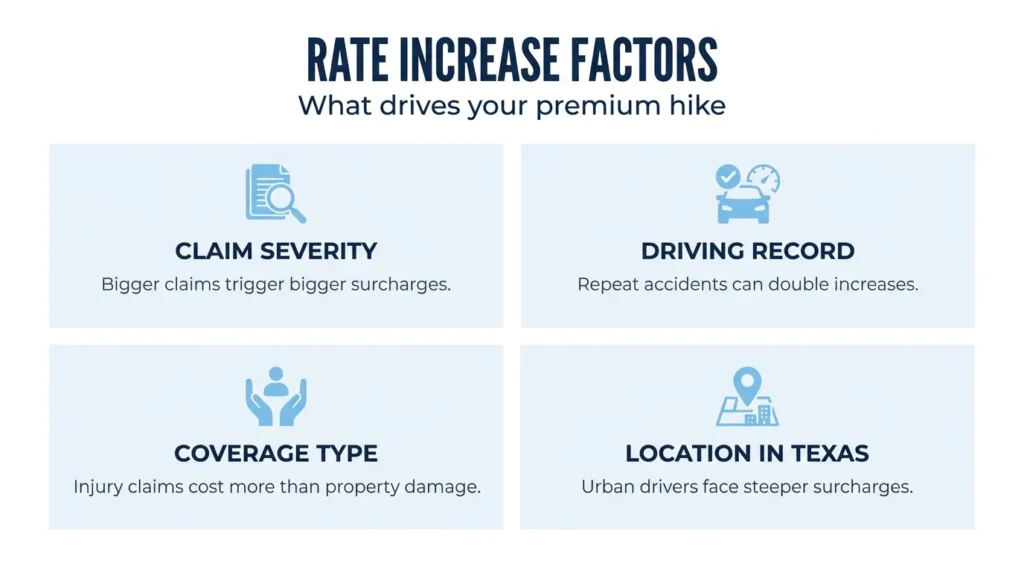
These include:
- Accident severity and claim amount. Carriers treat a $1,500 fender-bender very differently from a $25,000 injury claim. Most insurers use claim-cost thresholds. Cross one, and the surcharge jumps.
- Your driving record and claims history. A clean record before the crash softens the blow. A second at-fault accident within three to five years can double the increase or trigger non-renewal.
- Coverage types involved. A property damage claim hits your rate less than a bodily injury claim. Comprehensive claims, like theft or hail, usually carry the smallest impact. Knowing what to do after a car accident in Texas helps you document the crash properly, which can affect how the claim is coded.
- Geographic location within Texas. Houston and Dallas drivers often pay steeper post-accident surcharges than drivers in smaller markets. Urban claim frequency drives the math.
Texas Carrier Surcharge Comparison
Insurance surcharges vary widely across Texas carriers. In fact, the gap between what the cheapest and the most expensive companies charge after a single at-fault accident can exceed $1,000 per year.
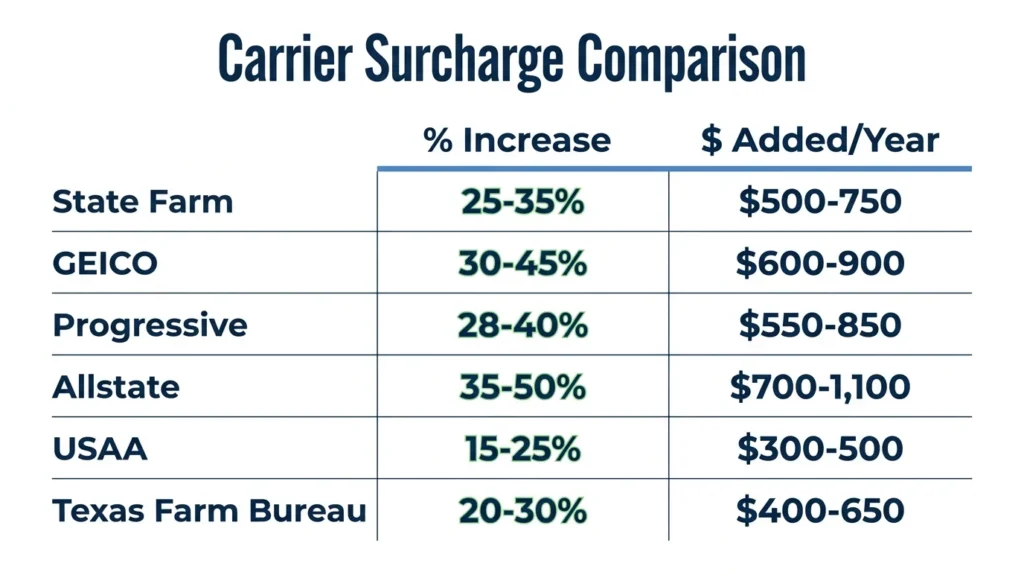
While actual rate increases depend entirely on your individual policy and driving history, industry data points to the following average ranges for first-time at-fault accidents:
- State Farm: 25% to 35% increase (around $500 to $750 per year added)
- GEICO: 30% to 45% increase (around $600 to $900 per year added)
- Progressive: 28% to 40% increase (around $550 to $850 per year added)
- Allstate: 35% to 50% increase (around $700 to $1,100 per year added)
- USAA (eligible members): 15% to 25% increase (around $300 to $500 per year added)
- Texas Farm Bureau: 20% to 30% increase (around $400 to $650 per year added)
Regional carriers like Texas Farm Bureau and Germania often apply smaller surcharges than national giants, partly because their books concentrate in lower-claim areas. National carriers spread risk across more volatile markets and price accordingly.
A driver paying $1,800 per year before an at-fault crash with Allstate could see a renewal closer to $2,500. The same driver with USAA might renew at $2,100.
How Long Do Increases Last?
Most Texas carriers apply at-fault accident surcharges for three to five years from the date of the crash, with the steepest increase in years one and two. After that, the surcharge tapers each renewal cycle until it drops off entirely.
Wondering how long an accident stays on your insurance? By year four or five, most carriers remove the surcharge entirely, though the accident may still appear on your CLUE report when you shop for new coverage.
While a rate hike hurts, you can take proactive steps to soften the long-term financial hit, including:
- Keep your record clean: Avoid any further accidents or moving violations during the surcharge window to prevent your rates from climbing higher.
- Take a defensive driving course: Some Texas insurance carriers will apply a discount or credit to your policy upon completion.
- Shop around at intervals: Compare rates with other companies at the 12-month and 24-month marks, as different competitors penalize at-fault accidents differently.
The Texas Department of Insurance auto insurance guide outlines your consumer rights during this process.
Work with a Texas Accident Attorney
If another driver caused your crash, you should not be the one paying for years of inflated premiums.
Angel Reyes & Associates has helped Texas drivers recover from at-fault parties and push back against unfair insurance practices for decades. Our car accident team works on a contingency fee basis, which means there are no fees unless we win your case.
If you are facing premium hikes after a crash that was not your fault, or you need guidance on protecting your rights, contact us today for a free consultation. We are available 24/7 to discuss your case.
Insurance Increases FAQs
Can I switch insurance companies to avoid a surcharge after an accident?
Switching carriers won’t eliminate the surcharge since your accident history follows you through industry databases. However, different companies apply different surcharge rates, so shopping around can still save you money.
What happens if I have multiple accidents within a few years?
A second at-fault accident typically doubles your surcharge percentage and may trigger policy non-renewal. Some carriers will drop you entirely after two at-fault claims within three years.
Do parking lot accidents count the same as highway accidents for rate increases?
Yes, most carriers apply the same surcharge regardless of where the at-fault accident occurred. A parking lot accident gets treated the same as a highway collision if you’re found at fault.
Will my rates go up if I'm hit by an uninsured driver?
Generally, no, since you’re not at fault. However, if you file an uninsured motorist claim, some carriers may apply a small increase, though it’s typically much less than an at-fault accident surcharge.
Can I remove an accident from my record early by taking a driving course?
Defensive driving courses may earn you a small discount, but they won’t remove the accident surcharge early. The surcharge stays for the full three- to five-year period regardless of additional training.
About the Authors

Angel Reyes
Writer
Angel L. Reyes, III is the Founder and Managing Partner of Angel Reyes & Associates. A nationally recognized trial attorney and business leader, Angel has helped over 70,000 injury victims recover more than $1 billion since founding the firm in 1993. Named to the Texas Super Lawyers list annually since 2008, Angel brings Wall Street experience, Ivy League education, and a deep commitment to client advocacy. He is a frequent legal commentator and published author with extensive contributions to legal scholarship, trial strategy, and consumer protection.

Kyle Nicolas
Editor
Kyle Nicolas is the Web Content & SEO Manager at Angel Reyes & Associates. He has more than 10 years of experience as a marketing co...

Angel Reyes
Reviewer
Angel L. Reyes, III is the Founder and Managing Partner of Angel Reyes & Associates. A nationally recognized trial attorney and business...