How Social Media Can Hurt Your Rideshare Accident Claim


Every article on this site is researched by our internal team, reviewed for legal accuracy against current Texas law, and held to State Bar of Texas advertising standards before publication. We do not publish content that overstates outcomes or makes promises about results.
Learn more about our
editorial standards .
Key Takeaways
- Rideshare insurers monitor social media from day one, including posts that friends tag you in.
- Deleting posts after a rideshare claim is filed can be treated as destruction of evidence in Texas.
- Screenshot your Uber or Lyft trip data immediately after a crash before the app removes it.

You were heading home from work in Midtown Houston when the Uber you were riding in got clipped on I-69. The driver was not at fault. You filed a claim, took photos at the scene, and got checked out at the ER. Then, two days later, a friend tagged you in a photo from a birthday dinner you felt well enough to attend.
That photo may now be in an insurance adjuster’s file.
Why Insurers Watch Your Social Media After a Rideshare Crash
From the moment a rideshare accident claim is filed, the insurers involved begin building a picture of what your injuries actually look like. Social media is one of the first places they look, and they look fast.

In a standard two-car crash, you typically deal with one insurer. In a rideshare accident, the picture is more complicated. Depending on which phase of the trip the crash occurred, coverage periods for Uber and Lyft shift between the driver’s personal carrier and the TNC’s commercial policy. More parties means more adjusters with the financial motive to find social content undermining your claim.
Texas courts treat social media as evidence when it is relevant to a claimant’s physical or mental condition. Under Texas Civil Practice and Remedies Code Chapter 33, the state’s proportionate responsibility law, any post that shifts your perceived fault level by even a small margin can reduce your recovery, or compensation.
If a post pushes your assigned fault above 50 percent, you cannot recover anything at all.
Adjusters also monitor more than just your accounts. Posts from friends and family who tag you, or who comment about your accident or recovery, are fair game too.
Rideshare-Specific Posts That Put Your Claim at Risk
Rideshare accidents carry social media risks that general car accident claims do not. Three of them are unique to the fact that your trip was tracked, rated, and logged in an app.
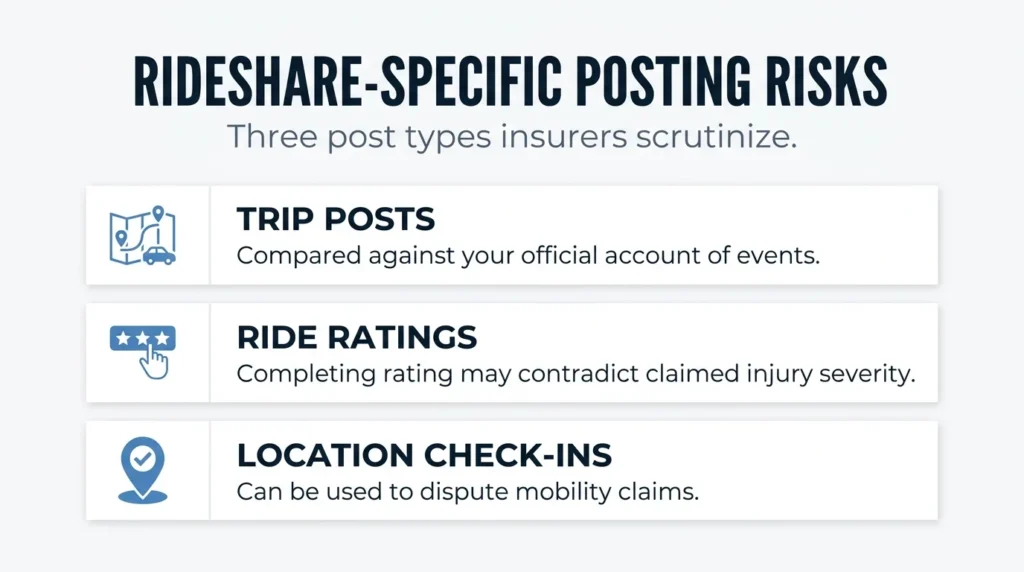
- Trip posts. Any post you make mentioning the ride, commenting on the driver, describing the route, or referencing the crash creates a digital record. That record is compared against your official account of events. Even minor inconsistencies, a different intersection or a different description of what the driver did, can be used to challenge your credibility.
- Ride ratings. If you rated the driver after the crash, an insurer may argue that your ability to complete that interaction contradicts your claimed injury severity. It is a small detail, but adjusters look for any friction between what your body allegedly could not do and what the app data shows you doing.
- Location check-ins and activity posts. If you check in at a restaurant, attend an event, or post from a gym in the days or weeks after the crash, that information can be used to dispute your mobility and daily function claims. A post that shows you at a concert does not automatically prove you are not injured. But an insurer will use it to plant doubt.
Photos and videos from any context carry the same risk. A smiling image at a family gathering, posted by a well-meaning relative, can be used to challenge a loss-of-enjoyment-of-life claim. You can still be in pain. The photo does not show that, and the adjuster reviewing it does not know that.
An attorney familiar with rideshare claims and what not to post after a Texas car accident can advise you on how to handle existing posts before they become a factor in your case.
How Past Posts Can Still Affect Your Claim
If you have already posted about the accident or your recovery, the most important thing to do is stop posting now. The second most important thing is to do nothing else without speaking to an attorney first.
Deleting posts after a claim is filed, or after litigation is reasonably anticipated, can be treated as destruction of evidence under Texas rules. A court can impose sanctions for that, and a jury can be instructed to draw negative inferences from the deletion. The post that was meant to protect you can end up hurting you more than the original content would have.
Texas Insurance Code Chapter 1954 governs TNC insurance requirements and establishes which carrier is responsible at each phase of a rideshare trip. That determination controls which insurer is building a case against your claim, and they are not waiting. Adjusters begin reviewing public profiles within hours of receiving notice of a claim.
Once litigation begins, Texas discovery rules allow opposing attorneys to request both public and private content. Courts can order you to produce posts, direct messages, and photos regardless of your privacy settings. What you believe is locked down is not necessarily protected.
The right move with past posts is to preserve everything, note what exists, and let your attorney assess it before any content is removed or altered.
What to Do to Protect Your Claim Right Now
Understanding what to do after a rideshare accident in Texas is essential. Protecting your rideshare accident claim on social media comes down to four steps. Do them in order:
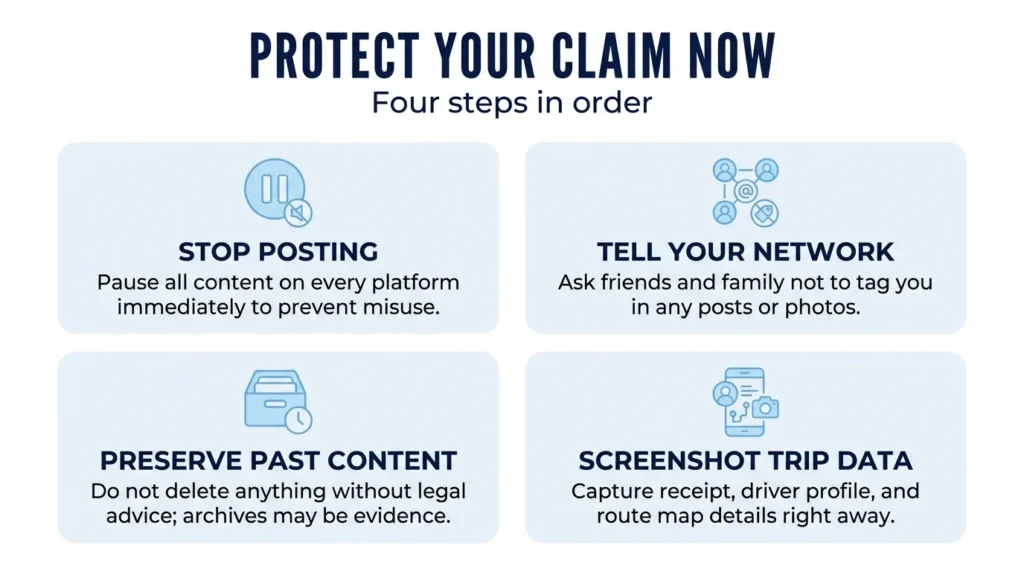
Step 1: Stop posting. No new content about the accident, your injuries, your recovery, or your daily activities. This applies to all platforms, not just the one you use most. The pause begins the moment you decide to pursue a claim.
Step 2: Tell your network. Contact close friends and family directly. Ask them not to tag you in photos, not to post about your accident or recovery, and not to comment on your condition in public forums. Most people will comply when they understand why it matters.
Step 3: Do not delete past content without legal advice. Preserve everything. Make a note of what you have posted since the crash. Your attorney needs that picture before any decision is made about what to remove and when.
Step 4: Screenshot your in-app data immediately. Your trip receipt, the driver’s profile, vehicle information, and the route map in the Uber or Lyft app are evidence in your favor. That data disappears from the app faster than you expect. Capture it now, even if you already have some time-sensitive information.
Your attorney can then assess the full landscape of what exists and advise you on next steps.
Talk to an Attorney Before the Insurer Builds Its Case
Social media monitoring begins before you have had a chance to speak with anyone about your rights. The insurer’s investigators move quickly, and the window to get ahead of any damaging content is short.
Angel Reyes & Associates has helped injured Texans handle the full scope of rideshare accident claims for over 30 years. We know how insurers use digital evidence, and we know how to protect clients before that evidence is locked in as a problem. We work on contingency, which means no upfront cost and no fee unless we recover compensation for you.
If you were injured in a rideshare accident, talk to us before the insurer’s picture of your case is complete. You can learn more about how we handle personal injury cases or reach out directly to schedule a free consultation.
Past results do not guarantee future outcomes.
Social Media & Rideshare Accident Claim FAQs
Should I deactivate my social media accounts after a rideshare accident?
You do not need to deactivate, but stopping all new posts is the safest approach. Deactivating an account after a claim is filed can look like an attempt to hide evidence, which creates its own legal risk. Simply go silent and leave existing content in place until your attorney reviews it.
Can posts I made before the accident be used against me?
Yes, in some cases. Insurers may use pre-accident posts to argue that a condition or limitation existed before the crash. Old posts showing physical activity that contradicts your claimed injuries are particularly vulnerable to this type of challenge.
How long do I have to file a rideshare accident claim in Texas?
Texas gives personal injury claimants two years from the date of the crash to file a lawsuit. If a government entity was involved, that window can be much shorter, sometimes as little as six months, so it is worth confirming your deadline early.
Can an insurance company access my Uber or Lyft trip records without my permission?
Insurers generally cannot pull that data on their own. During formal litigation, your attorney can send a preservation demand to Uber or Lyft to prevent trip records from being deleted, and the data can be obtained through the discovery process. Acting quickly matters because some app data is subject to automatic deletion on rolling retention schedules.
About the Authors

Angel Reyes
Writer
Angel L. Reyes, III is the Founder and Managing Partner of Angel Reyes & Associates. A nationally recognized trial attorney and business leader, Angel has helped over 70,000 injury victims recover more than $1 billion since founding the firm in 1993. Named to the Texas Super Lawyers list annually since 2008, Angel brings Wall Street experience, Ivy League education, and a deep commitment to client advocacy. He is a frequent legal commentator and published author with extensive contributions to legal scholarship, trial strategy, and consumer protection.

Kyle Nicolas
Editor
Kyle Nicolas is the Web Content & SEO Manager at Angel Reyes & Associates. He has more than 10 years of experience as a marketing co...

Angel Reyes
Reviewer
Angel L. Reyes, III is the Founder and Managing Partner of Angel Reyes & Associates. A nationally recognized trial attorney and business...