How to File a Motorcycle Accident Claim in Texas


Every article on this site is researched by our internal team, reviewed for legal accuracy against current Texas law, and held to State Bar of Texas advertising standards before publication. We do not publish content that overstates outcomes or makes promises about results.
Learn more about our
editorial standards .
Key Takeaways
- Texas gives motorcycle accident victims two years from the crash date to file a personal injury lawsuit.
- Insurers must acknowledge your claim in 15 days and accept or reject it within 15 business days after receiving all required documents.
- If your fault exceeds 50% under Texas proportionate responsibility rules, you cannot recover any damages.
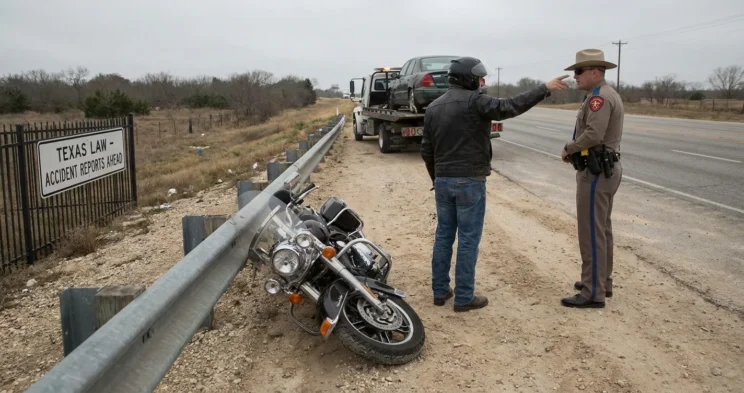
You were riding home on I-35 when another driver cut across your lane and sent you down. Now you are dealing with a wrecked bike, a hospital bill, and an insurance company that has already left two voicemails asking for a recorded statement.
You have rights in this situation. You also have deadlines. Knowing both is how you protect yourself.
Steps to Take Right After the Crash
The actions you take in the first 24 to 48 hours after a motorcycle crash shape the strength of every step that follows.
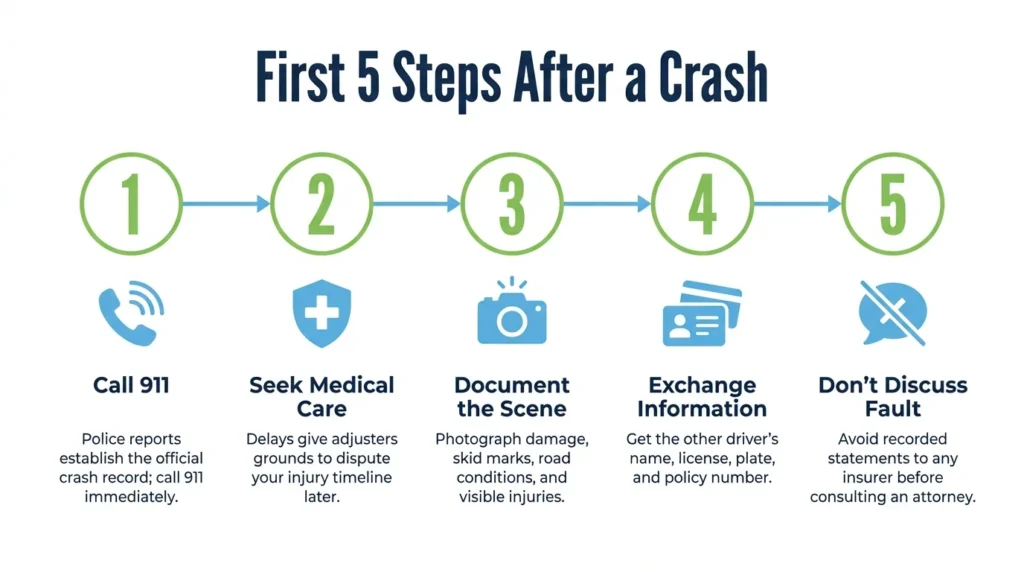
- Step 1: Get to safety and call 911. Move out of traffic if you can do so without making your injuries worse. Ask the dispatcher to send police as well as an ambulance. A police report is the official record of the crash. Without it, the insurer’s version of events carries more weight.
- Step 2: Seek medical attention immediately. Even when you feel fine, go. Internal injuries and soft tissue damage often do not surface for hours or days. Every gap between the crash and your first treatment visit is a gap an adjuster will use to argue that your injuries were not caused by the accident.
- Step 3: Document the scene. Take photos from multiple angles: vehicle damage, skid marks, road conditions, traffic signs, and any visible injuries. If witnesses are present, get their names and phone numbers before anyone leaves.
- Step 4: Exchange information. Get the other driver’s name, license number, license plate, insurance company, and policy number. If there are multiple vehicles involved, get these things from every driver.
- Step 5: Do not discuss fault. Do not apologize. Do not speculate about what caused the crash. Do not give a recorded statement to any insurance company at the scene or in the days immediately following. You are not required to provide a recorded statement to the other driver’s insurer. Speak with an attorney before doing so.
You can also learn more about how motorcycle accident cases develop in Texas and what you can expect.
Filing Your Claim with the Insurance Company
Filing a claim is not the same as filing a lawsuit. A claim is a formal request for compensation submitted to an insurance company. A lawsuit is filed in court. Most cases are resolved at the claim stage.
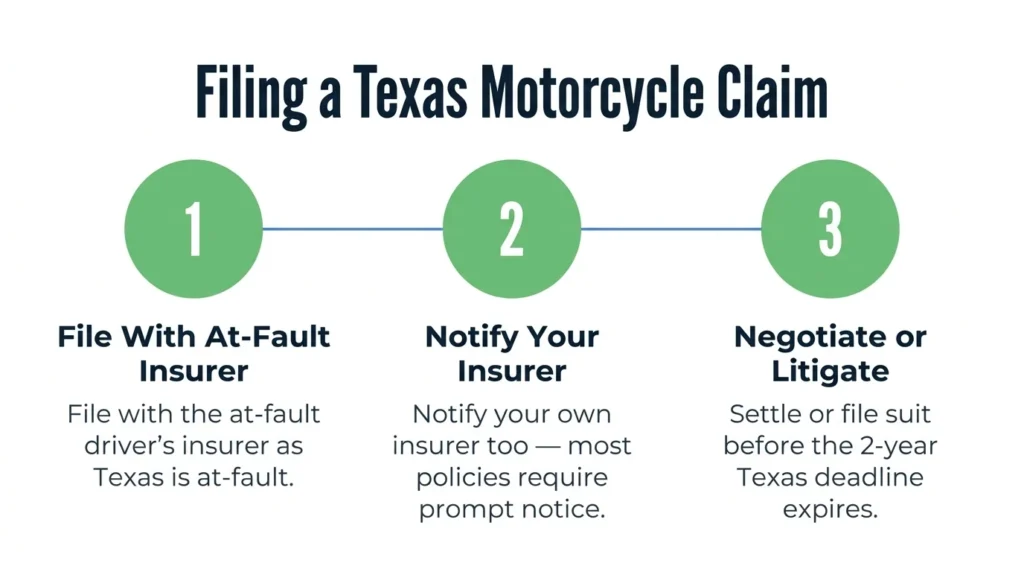
Texas is an at-fault state. That means you file your claim with the insurance company of the driver who caused the crash. If that driver has no insurance or not enough insurance, you file under your own Uninsured Motorist or Underinsured Motorist (UM/UIM) coverage.
Report the accident to your own insurer as well, even if the other driver was fully at fault. Most policies require prompt notice of any accident. Failing to report can affect your ability to use UM/UIM coverage later.
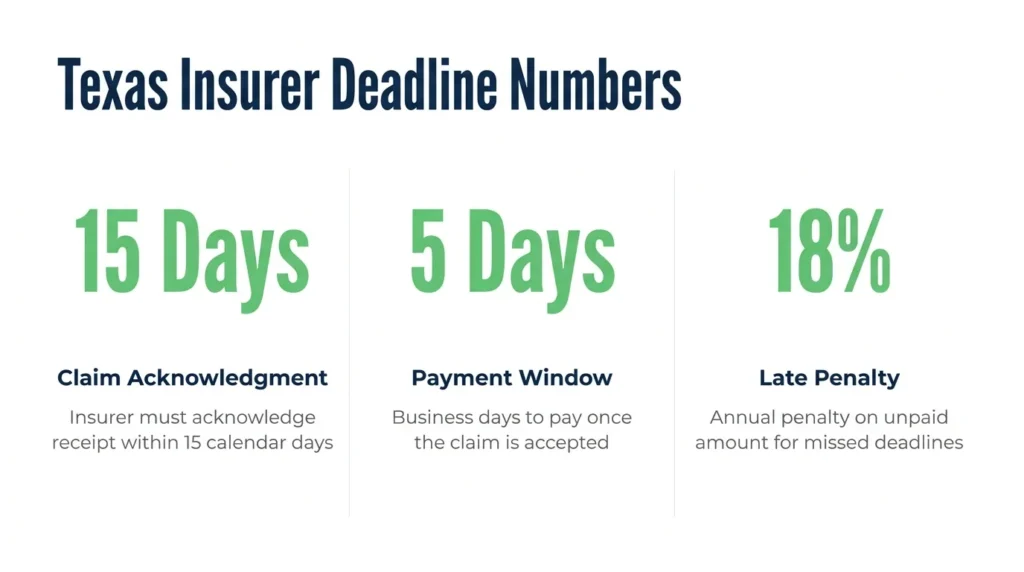
Once you file, Texas law sets firm deadlines for how the insurer must respond. Under Texas Insurance Code Chapter 542, the insurer must acknowledge receipt of your claim within 15 calendar days. After you provide all required documentation, the insurer has 15 business days to accept or reject the claim.
Once the insurer accepts, it must pay within 5 business days. Insurers who miss the payment deadline owe an 18% per annum penalty on the unpaid amount, plus attorney fees.
Those deadlines exist because of you. When an insurer drags its feet without reason, there are legal consequences. An attorney can monitor compliance with Chapter 542 and take action when those deadlines are missed.
For context on how long the full settlement process typically takes, review Texas insurance settlement timelines.
How Texas Fault Rules Affect Your Claim
Before you accept any offer, you need to understand how Texas handles shared fault, because insurers will use this rule to reduce what they owe you.
Texas uses a proportionate responsibility system under the Texas Civil Practice and Remedies Code (CPRC) Chapter 33. The rule is straightforward: if your share of fault exceeds 50%, you cannot recover any compensation. If your fault is 50% or below, you can recover compensation, but your award is reduced by your percentage of responsibility.
A rider found 25% at fault for a crash recovers 75% of their total damages. A rider found 51% at fault recovers nothing.
Adjusters know this rule and they use it. Motorcyclists face a bias in fault assessments. An adjuster may assign higher fault to a rider based on assumptions about speed or lane position, even without concrete evidence. Solid documentation, witness statements, and accident reconstruction work directly counter those assumptions.
For a closer look at how settlements are calculated once fault percentages are established, review how motorcycle accident settlements work in Texas.
The Two-Year Deadline to File a Lawsuit
Most claims settle without a lawsuit. But if negotiations fail, you need the option to sue. That option has a deadline.
Under Texas Civil Practice and Remedies Code (CPRC) § 16.003, you have two years from the date of the accident to file a personal injury lawsuit. Miss that deadline and you almost certainly lose the right to sue, regardless of how strong your case is.
A few narrow exceptions exist. A minor’s two-year clock does not start until they turn 18. A claimant who is legally incapacitated may get additional time. These exceptions are rare and the conditions for qualifying are specific.
Do not count on having the full two years before you need to act. Evidence disappears. Witnesses move. Medical records become harder to obtain. Starting the process early gives your claim the best foundation.
For a detailed breakdown of injury lawsuit deadlines in Texas, check out how long you have to file an injury lawsuit.
Get Legal Help for Your Motorcycle Claim
Motorcycle accident claims move through a process most riders have never dealt with before. The insurer has handled thousands of claims. You are handling your first.
Angel Reyes & Associates has spent over 30 years helping injured Texans work through that process. We work on contingency, meaning you pay nothing unless we recover compensation for you.
Free consultations are available, and we can handle most of your case remotely so your recovery is not disrupted by office visits. You can also review our testimonials from former clients to get a sense of how we approach these cases.
If you have been in a motorcycle crash, contact us to review your options. We’re available 24/7 to take your call.
Past results do not guarantee future outcomes.
Motorcycle Accident Claim FAQs
What if the other driver fled the scene and I don't have their insurance information?
File a claim under your own Uninsured Motorist coverage. In Texas, a hit-and-run driver who cannot be identified is treated as an uninsured motorist, which means your UM coverage steps in to cover your injuries and losses.
Can I still file a claim if there was no police report filed?
Yes, but a police report strengthens your claim significantly. Without one, you will need to rely on photos, witness statements, and your own medical records to establish what happened. If the accident involved injury or significant property damage, Texas law required you to report it to police anyway.
Does Texas law require me to carry Uninsured Motorist coverage on my motorcycle?
No. Texas does not require UM/UIM coverage, but your insurer must offer it. If you signed a written rejection of that coverage when you bought your policy, you will not have a UM/UIM claim against your own insurer if the at-fault driver is uninsured.
Can I file separate claims for my bike damage and my personal injuries?
Yes. Property damage and personal injury are handled as separate claims, though both typically go to the at-fault driver’s insurer first. If your own collision coverage applies, your insurer can handle your bike repair while the liability claim against the other driver’s policy moves forward independently.
What happens if the insurer denies my motorcycle accident claim?
You can dispute the denial by submitting additional documentation or requesting a written explanation. If the denial appears to violate Texas Insurance Code obligations, you may have grounds for a bad faith insurance claim in addition to your underlying injury claim.
About the Authors

Angel Reyes
Writer
Angel L. Reyes, III is the Founder and Managing Partner of Angel Reyes & Associates. A nationally recognized trial attorney and business leader, Angel has helped over 70,000 injury victims recover more than $1 billion since founding the firm in 1993. Named to the Texas Super Lawyers list annually since 2008, Angel brings Wall Street experience, Ivy League education, and a deep commitment to client advocacy. He is a frequent legal commentator and published author with extensive contributions to legal scholarship, trial strategy, and consumer protection.

Kyle Nicolas
Editor
Kyle Nicolas is the Web Content & SEO Manager at Angel Reyes & Associates. He has more than 10 years of experience as a marketing co...

Angel Reyes
Reviewer
Angel L. Reyes, III is the Founder and Managing Partner of Angel Reyes & Associates. A nationally recognized trial attorney and business...