How to Get Medical Bills Paid After a Rideshare Accident in Texas


Every article on this site is researched by our internal team, reviewed for legal accuracy against current Texas law, and held to State Bar of Texas advertising standards before publication. We do not publish content that overstates outcomes or makes promises about results.
Learn more about our
editorial standards .
Key Takeaways
- Which rideshare insurer pays depends on the driver's app status at the crash.
- MedPay and PIP pay your medical bills fast, before any fault decision is made.
- Texas gives you two years to file the injury claim that resolves your bills.

You took an Uber home from a late dinner near the Heights, and on Washington Avenue another car ran the light and slammed into your side of the vehicle. Now the ER bills are stacking up on your kitchen table, and no one will tell you who is supposed to pay them.
The driver’s insurer points at Uber, Uber points back at the driver, and you are stuck in the middle with treatment you cannot afford to delay.
Rideshare Insurance Tiers Texas: Who Owes What?
Who pays your medical bills depends entirely on what the driver was doing in the app when the crash happened. Texas splits rideshare coverage into periods, and the period decides which insurer is on the hook.
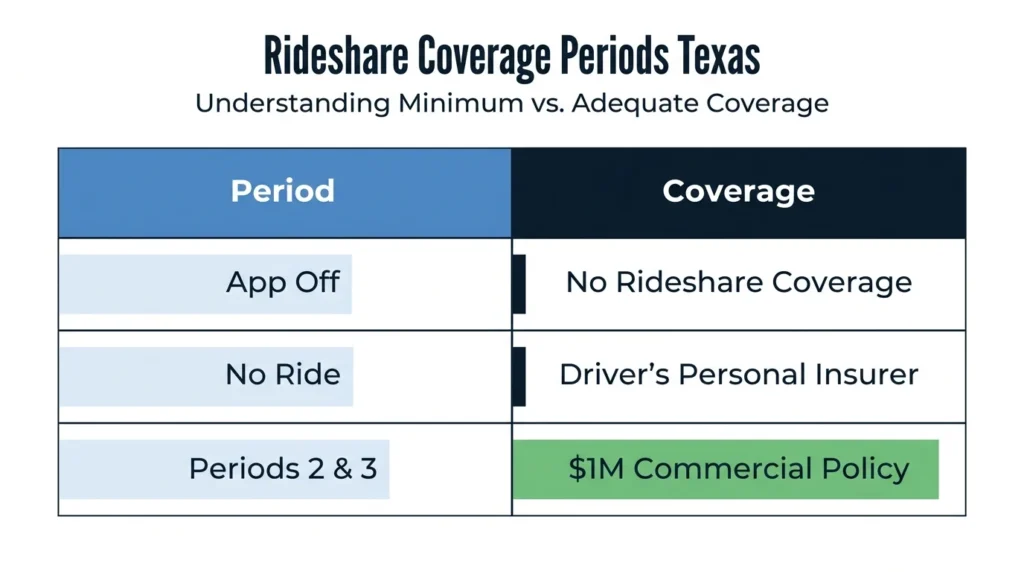
Texas law under the Texas Insurance Code Chapter 1954 sets up three coverage periods tied to the app. Period 0 is the app off, when the driver is using the car for personal reasons. Period 1 is the app on with no ride accepted yet. Periods 2 and 3 run from the moment a ride is accepted through your dropoff.
The period you were injured in changes everything about your claim. During Period 1, Uber and Lyft provide only contingent liability coverage, so the driver’s personal insurer is the primary source. Most personal auto policies exclude commercial use, which often leaves a coverage gap right when you need help.
During Periods 2 and 3, the picture is much clearer for you. Uber and Lyft carry a $1 million commercial liability policy that controls during those periods. If you want to understand how each of these rideshare insurance tiers works in detail, our breakdown of the Uber and Lyft coverage periods walks through each one.
As a passenger, your path depends on when you were hurt. A passenger injured in Period 2 or 3 has the clearest route to that commercial policy. A passenger injured during Period 1, or in a crash with a third-party driver, may face a more fragmented sequence of claims.
If your accident actually involved a non-rideshare vehicle, a different framework applies to you. Our guide on who pays medical bills after a Texas car accident covers that situation. For the full scope of how we handle rideshare claims, see our rideshare accident cases.
MedPay & PIP as a Bridge While Liability Resolves
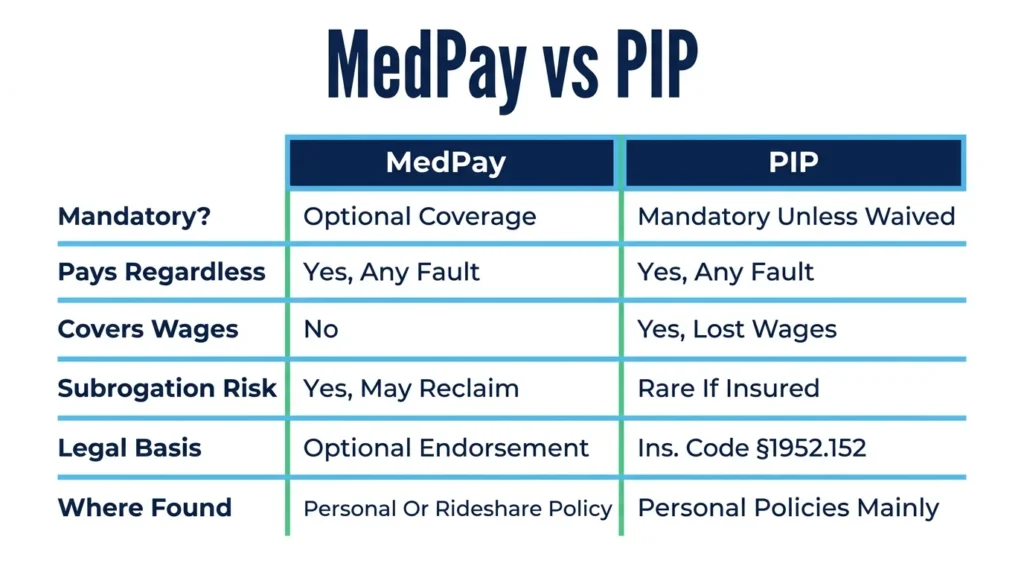
You do not have to wait for a fault decision to start paying medical bills. Two no-fault tools, MedPay and PIP, can pay your bills now while the liability question sorts itself out over the following months.
MedPay After a Rideshare Crash
MedPay, or Medical Payments Coverage, is optional first-party coverage that pays your medical expenses no matter who caused the crash. It can sit on the driver’s personal auto policy, on a rideshare company’s commercial policy, or on your own auto policy.
MedPay pays your bills directly and fast, with no wait for a fault ruling. Benefits are capped at the policy limit. MedPay is often sold in modest amounts, but that money can bridge the gap between treatment and settlement.
Check your own auto policy for MedPay even if you were just a passenger. Personal auto MedPay usually follows the policyholder when riding in someone else’s car, so your own coverage may quietly be available.
PIP Coverage in Texas
PIP is mandatory in Texas auto policies unless you rejected it in writing. Like MedPay, it pays regardless of fault, but PIP goes further and also covers lost wages and other qualifying expenses beyond your medical bills.
Insurers must offer PIP under the Texas Insurance Code § 1952.152, and it applies unless you waived it. That means many people carry PIP without realizing it.
Both the driver’s personal policy and your own policy are worth checking for PIP. This is often the fastest answer to who pays medical bills after an Uber accident before fault is settled. Rideshare commercial policies are less likely to carry PIP, but first-party options vary by company.
Letters of Protection: Treatment Without Upfront Payment
When you have no insurance coverage available yet, a letter of protection can get you treated now and defer payment. An LOP is a contract between your attorney and a medical provider, where the provider agrees to treat you and accept payment from your eventual settlement instead of billing you today.
An LOP can open the door to specialist care, imaging, and follow-up treatment while your liability claim or lawsuit works toward resolution. The provider holds a contractual claim against your settlement, not a statutory lien, so it functions differently from a hospital lien.
Signing an LOP commits your settlement proceeds to that provider up to the agreed amount. Your attorney must honor it at settlement, because it is a contractual obligation under attorney conduct rules, not a specific statute. You should understand exactly what you are promising before you sign. A car accident claim attorney can help you weigh whether a letter of protection fits your situation and negotiate the provider’s fees before you settle.
An LOP does not erase the debt. It only delays it. If your case resolves for less than your total medical bills, your attorney may need to negotiate a reduction with the provider so more of the money stays with you.
When Uber or Lyft’s Insurer Stalls or Disputes Your Claim
A rideshare insurer that goes quiet is often using delay as a strategy, and spotting the tactic is the first step to beating it. Insurers commonly dispute which app-status period applied, argue you share fault, or demand mountains of paperwork before they pay anything.
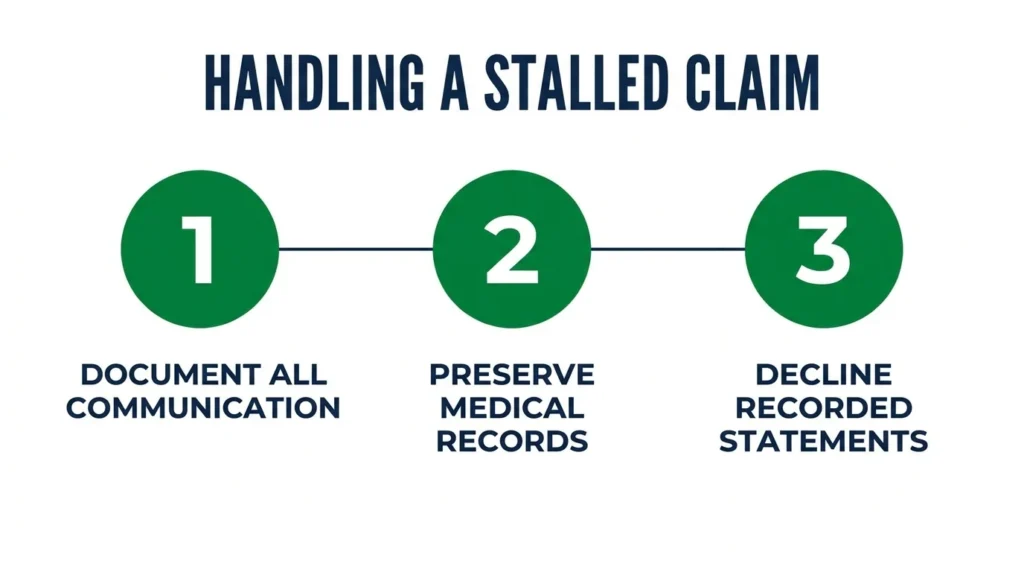
If you are facing a stalled or disputed claim, work through these steps.
Step 1: Document every communication with the insurer. Save emails, log phone calls with dates and names, and keep written notes of what each adjuster tells you.
Step 2: Preserve all of your medical bills and records. These prove both the treatment you received and the cost the insurer is responsible for covering.
Step 3: Decline recorded statements until you have legal guidance. Adjusters use recorded statements to lock you into words they can later use to reduce your payment. Our guide on what to do after a rideshare accident in Texas explains how to handle those early conversations.
When the insurer disputes which period applied, the driver’s app data becomes the central evidence. Uber and Lyft keep trip-status logs, and an attorney can compel that data through discovery when the insurer’s story contradicts the records. Insurers stall for predictable reasons, and knowing why they delay payments in Texas helps you respond.
Sometimes a third-party driver, not the rideshare driver, caused your crash. Then you may have a claim against that driver’s insurer in addition to or instead of the rideshare policy. If that driver had no insurance, your own uninsured motorist coverage may step in, and our guide for when you are hit by an uninsured driver explains how. Facing repeated delay or a flat dispute is a strong signal to get an attorney who can engage the insurer directly and escalate when needed.
How Medical Bills Resolve at Settlement
When your rideshare case settles, the providers who treated you get paid from the settlement proceeds before you receive what is left. This includes any providers who treated you under a letter of protection.
The Texas Property Code Chapter 55 gives hospitals and emergency services providers a statutory lien on your personal injury settlement for the value of their care. This lien attaches to your settlement on its own, separate from any LOP you signed.
Your MedPay carrier may also assert subrogation rights, asking to be repaid for what it covered from your settlement proceeds. PIP carriers, by contrast, generally cannot pursue subrogation against your settlement when the at-fault party carried required insurance under Texas law. Your attorney should confirm how each coverage applies to your specific facts.
You should also watch the clock on the underlying claim. The Texas Civil Practice and Remedies Code § 16.003 gives you two years to file a personal injury claim. Letting that deadline pass can cost you the very liability claim that pays off your medical debt, so it helps to have experienced legal counsel review your timeline.
Get Help from a Texas Rideshare Injury Attorney
Sorting out who pays your medical bills after a rideshare crash is rarely simple, and you should not have to fight several insurers alone while you are trying to heal. Angel Reyes & Associates has spent over 30 years helping injured Texans untangle exactly these claims, with more than $1 billion recovered for clients.
We work on a no fee unless we win basis, so you owe us nothing unless we recover for you. You can read what past clients say about working with us, then schedule a free consultation to review your options.
Past results do not guarantee future outcomes.
Frequently Asked Questions
Can I use my health insurance to pay medical bills after a rideshare accident in Texas?
Yes, your personal health insurance can cover treatment costs after an Uber or Lyft accident, and using it can keep care moving while the liability claim resolves. Be aware that your health insurer may later seek reimbursement from your settlement through subrogation, so the coverage is not free money. It is an advance that gets repaid when you recover.
Will filing a MedPay or PIP claim raise my insurance rates?
No. Texas does not allow insurers to surcharge your policy for filing a no-fault first-party claim, so using MedPay or PIP will not count against you. Both coverages are benefits you already paid for, and you are entitled to use them.
What if I was a pedestrian or cyclist hit by an Uber or Lyft driver?
You do not have to be a passenger to claim against the rideshare company’s commercial policy. If the driver was in Period 2 or Period 3 when the crash happened, the $1 million liability policy covers pedestrians and cyclists the same as other third parties.
Who pays a rideshare driver's medical bills if the driver gets hurt in a crash?
Uber and Lyft classify their drivers as independent contractors, so traditional workers’ compensation does not apply. Both companies offer a form of occupational accident insurance for drivers hurt while the app is active, but limits vary, so injured drivers should review their specific policy terms and may also have a third-party claim against the at-fault driver.
About the Authors

Angel Reyes
Writer
Angel L. Reyes, III is the Founder and Managing Partner of Angel Reyes & Associates. A nationally recognized trial attorney and business leader, Angel has helped over 70,000 injury victims recover more than $1 billion since founding the firm in 1993. Named to the Texas Super Lawyers list annually since 2008, Angel brings Wall Street experience, Ivy League education, and a deep commitment to client advocacy. He is a frequent legal commentator and published author with extensive contributions to legal scholarship, trial strategy, and consumer protection.

Kyle Nicolas
Editor
Kyle Nicolas is the Web Content & SEO Manager at Angel Reyes & Associates. He has more than 10 years of experience as a marketing co...

Angel Reyes
Reviewer
Angel L. Reyes, III is the Founder and Managing Partner of Angel Reyes & Associates. A nationally recognized trial attorney and business...