What Happens If You’re in a Car Accident Without a License in Texas?


Every article on this site is researched by our internal team, reviewed for legal accuracy against current Texas law, and held to State Bar of Texas advertising standards before publication. We do not publish content that overstates outcomes or makes promises about results.
Learn more about our
editorial standards .
Key Takeaways
- Being unlicensed does not add to your fault percentage in a Texas crash.
- A routine license citation rarely carries jail time on its own in Texas.
- You can recover damages if your own fault stays at 50 percent or less.
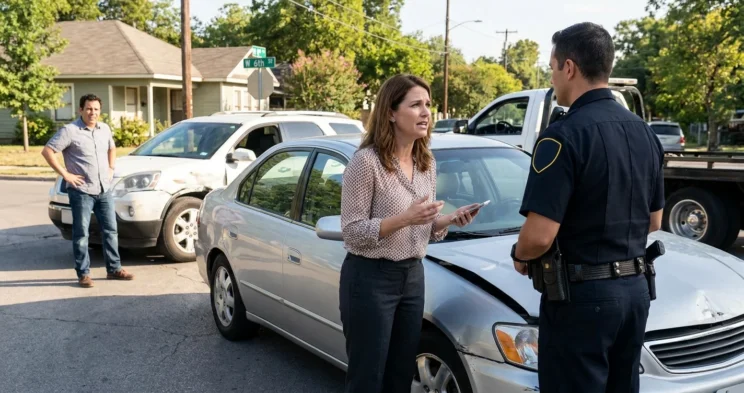
You were driving through downtown Fort Worth without a valid license when another driver clipped your bumper at a red light. Your first fear might be that your missing license alone makes the crash your fault. That assumption is wrong, and it changes everything about what happens next.
Being Unlicensed Doesn’t Automatically Make You at Fault
Fault in a car accident claim comes from who caused the crash. It doesn’t come from whether either driver held a valid license.
Texas applies modified comparative negligence under Texas Civil Practice and Remedies Code Section 33.001 to every driver, licensed or not. A court still has to weigh actual causation before assigning you any share of fault.
Driving without a valid license may sometimes be treated as negligence per se in Texas courts. That’s a legal shortcut that treats breaking a safety law as evidence of carelessness.
Even so, that label only supports a fault finding once it’s shown the missing license actually helped cause the crash. Insurers sometimes lean on your license status alone to push blame onto you, but it shouldn’t work that way.
Citations & Penalties for Driving Without a License
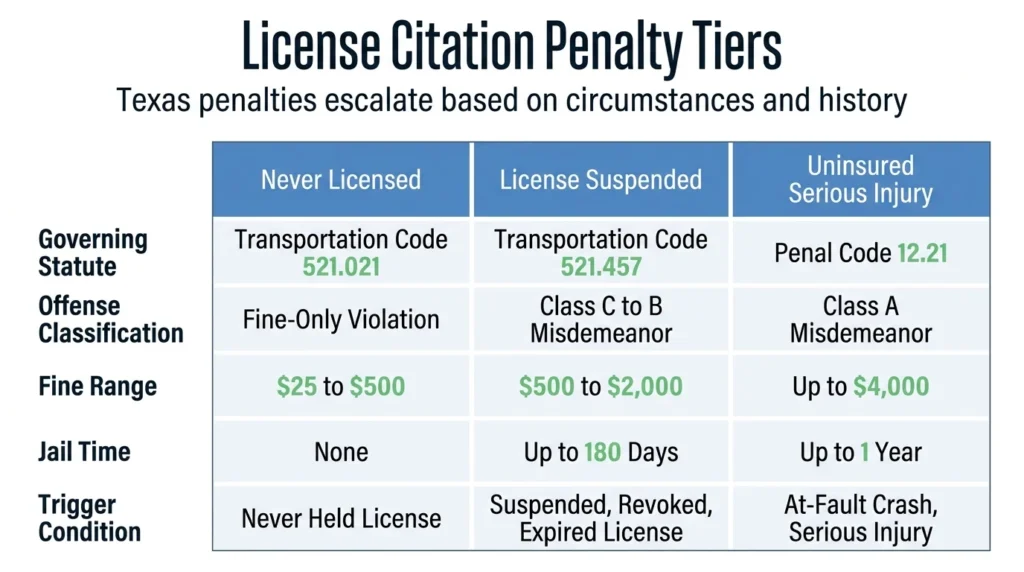
If you’re cited after a crash for driving without a valid license, Texas charges you under one of two statutes, with penalties determined by your history and the circumstances of the crash.
- Never held a valid license: cited under Texas Transportation Code Section 521.021, with a fine up to $200 for a first offense, $25 to $200 for a second offense within a year, and $25 to $500 for a third or later offense within a year.
- License suspended, revoked, canceled, or expired: cited under Texas Transportation Code Section 521.457, starting as a Class C misdemeanor with a fine up to $500, rising to a Class B misdemeanor, up to 180 days in jail and a $2,000 fine, with a prior conviction or if you were also uninsured.
- Unlicensed, uninsured, and at fault in a crash causing serious injury or death: the license offense escalates to a Class A misdemeanor under Texas Penal Code Section 12.21, with a fine up to $4,000 and up to one year in jail.
That last tier is where the harsher fine and jail time you may have heard about actually come from. It only applies when the uninsured requirement under Texas Transportation Code Section 601.191 and a serious injury or fatal crash both apply. A routine citation for driving without a license does not carry that type of penalty on its own.
How This Affects Your Own Insurance Coverage
Texas auto insurance generally follows the vehicle, so the policy on the car you were driving usually still responds to a claim. Driving without a valid license, though, can breach that policy’s own conditions and give the insurer grounds to fight coverage.
Personal injury protection or medical payments coverage, when the policy carries it, is generally designed to pay your own medical bills regardless of fault, though your license status can still affect whether the underlying policy stays valid. That coverage sits separate from liability coverage.
Many insurers also decline to renew a policy, or add you as a named driver, once they learn you were unlicensed at the time of a claim. Carrying at least Texas’s minimum liability coverage matters for what happens after this crash and for whether you stay insurable afterward.
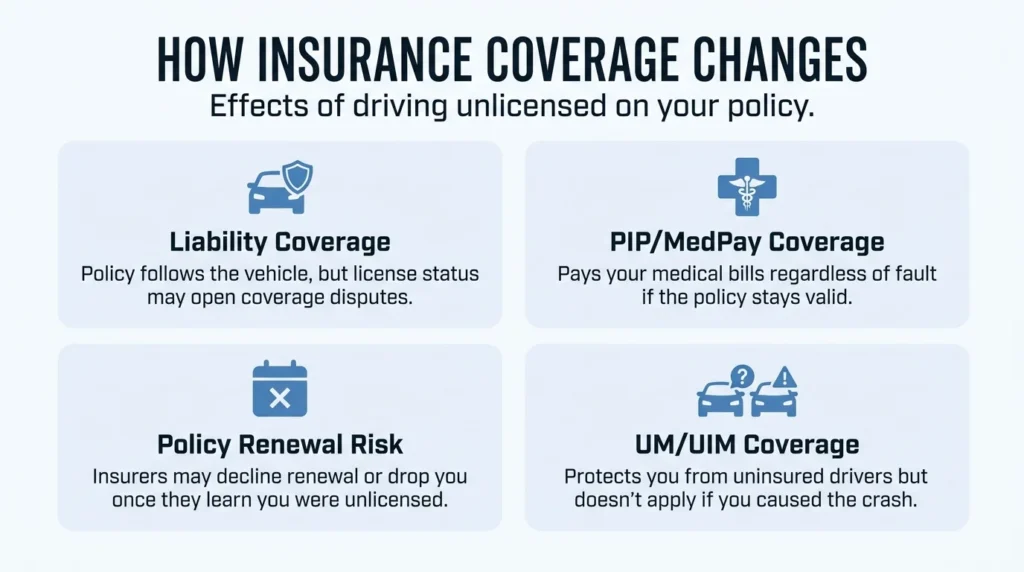
Uninsured and underinsured motorist coverage works the other direction. It protects you when the other driver lacks insurance, but it doesn’t step in for a crash you caused. If you were at fault, that coverage belongs to the other driver’s claim against you, not to yours.
Recovering Damages from the Other At-Fault Driver
You can still recover compensation from another at-fault driver as long as your own share of responsibility is 50 percent or less. Under Section 33.001’s rule, you cannot receive compensation once your share reaches 51 percent or more.
This is often called the 51 percent bar rule, and it applies to every driver in a Texas crash, not just drivers who hold a valid license.
Being unlicensed, on its own, doesn’t add to your fault percentage. Only conduct that actually helped cause the crash does, and getting that fault split reviewed before you accept an insurer’s first offer can change what compensation you ultimately recover.
Work with a Knowledgeable Attorney Today
Angel Reyes & Associates has helped Texas drivers sort through disputed-fault crashes for more than 30 years. That includes cases where a driver’s own license status became a point of contention. We know how insurers try to use a citation as leverage, and how to push back with the facts of the crash itself.
Our attorneys work on contingency, so you pay nothing unless we win your case. That holds true whether you’re pursuing another driver or sorting out your own citation and coverage questions.
Contact us for a free case review, and let’s find out what compensation you’re still entitled to recover.
Past results do not guarantee future outcomes.
Car Accident Without a License FAQs
Can the owner of the car get in trouble too if they let me drive without a license?
Yes. Under Texas negligent entrustment law, a vehicle owner can face a lawsuit for letting an unlicensed driver use their car if that driver then causes a crash.
What happens if I ignore the driving-without-a-license citation from the crash?
Ignoring the charge can lead to additional penalties and even a warrant for your arrest, on top of the original fine.
Do I still have to file a crash report if I didn't have a valid license?
Yes. The same reporting rules apply to every driver: if no officer investigates and the crash meets the injury or $1,000 damage threshold, you must file your own written report within 10 days under Texas Transportation Code Section 550.061.
Can I be personally sued for the full judgment if my own coverage doesn't pay?
Yes. Texas requires drivers to carry insurance specifically because a driver without valid coverage under Section 601.191 can be held personally responsible for paying a judgment out of pocket.
Once my license suspension ends, does my license come back automatically?
No. You typically have to complete the suspension period, pay reinstatement fees, and sometimes file SR-22 insurance before the Texas DPS restores your driving privileges.
About the Authors

Angel Reyes
Writer
Angel L. Reyes, III is the Founder and Managing Partner of Angel Reyes & Associates. A nationally recognized trial attorney and business leader, Angel has helped over 70,000 injury victims recover more than $1 billion since founding the firm in 1993. Named to the Texas Super Lawyers list annually since 2008, Angel brings Wall Street experience, Ivy League education, and a deep commitment to client advocacy. He is a frequent legal commentator and published author with extensive contributions to legal scholarship, trial strategy, and consumer protection.

Kyle Nicolas
Editor
Kyle Nicolas is the Web Content & SEO Manager at Angel Reyes & Associates. He has more than 10 years of experience as a marketing co...

Angel Reyes
Reviewer
Angel L. Reyes, III is the Founder and Managing Partner of Angel Reyes & Associates. A nationally recognized trial attorney and business...