When Should You Hire a Lawyer After a Motorcycle Accident?


Every article on this site is researched by our internal team, reviewed for legal accuracy against current Texas law, and held to State Bar of Texas advertising standards before publication. We do not publish content that overstates outcomes or makes promises about results.
Learn more about our
editorial standards .
Key Takeaways
- Hire an attorney immediately if liability is disputed, injuries are serious, or a settlement offer has arrived.
- Texas's 51% fault rule means an insurer can eliminate your recovery by pushing fault onto you.
- You owe nothing upfront; motorcycle accident attorneys work on contingency until you recover.
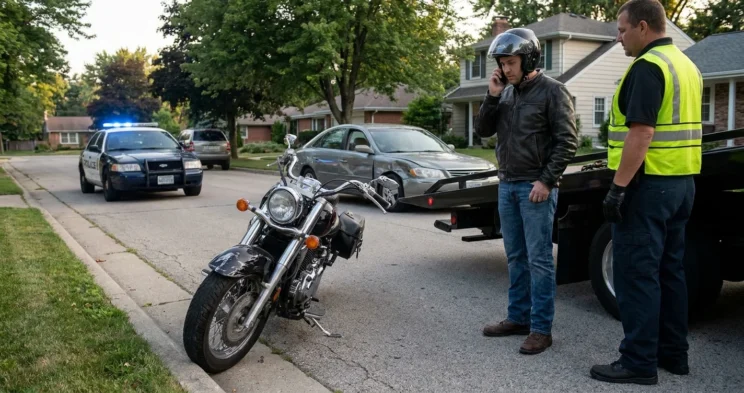
You were riding home from work on I-35 when a driver changed lanes without looking and put you on the ground. The ambulance came, you went to the hospital, and now the other driver’s insurance company is calling you with questions. They sound helpful. The offer they mentioned sounds like a lot of money right now.
That is exactly the moment to stop and call an attorney before you say another word.
The Short Answer: Hire an Attorney
If any one of four conditions applies to your situation, hire an attorney now. Do not wait to see how things develop.
The four triggers are: the blame is disputed, your injuries are serious, your medical bills are already significant, or the insurer has made you a settlement offer. Any single one of these conditions puts the claim beyond what a rider can safely manage alone.
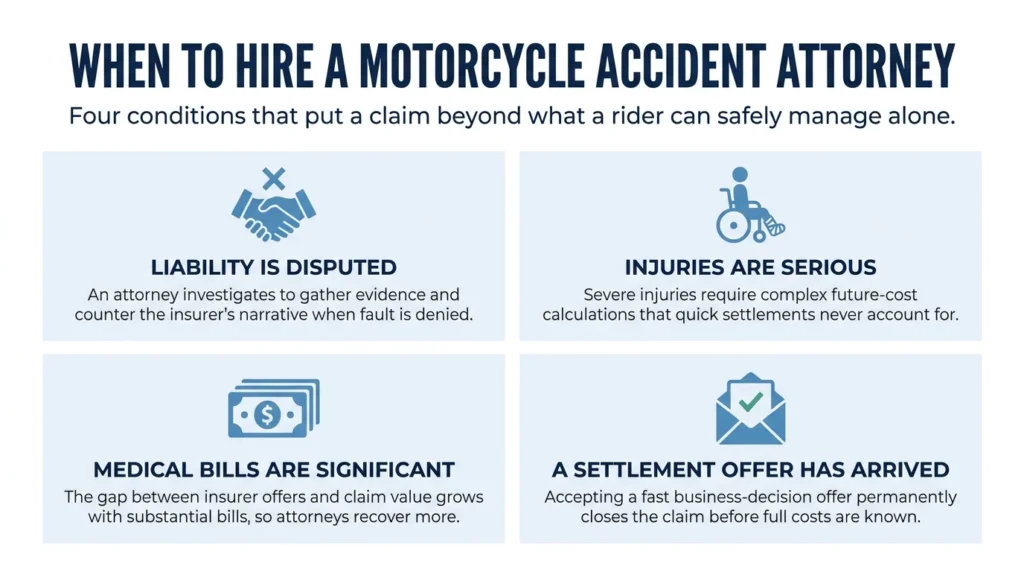
Waiting costs money. Evidence fades within days of a crash. Statements you give early get locked into the claim file and used against you later. Quick settlement offers close doors permanently. Once you accept, the claim is done regardless of what your injuries turn out to cost.
If the other driver or their insurer is denying fault or pointing the blame at you, an attorney can investigate the crash, gather documentation, and counter that narrative before the insurer’s version of events becomes the official record.
Understanding how motorcycle accident settlements work in Texas gives you a clearer picture of what is at stake when liability is in dispute.
Warning Signs the Insurer Is Not on Your Side
Three specific actions signal that the insurer is working to limit your claim. Recognizing them before you respond makes a real difference.
The first is a request for a recorded statement from the other driver’s insurer. Texas law does not require you to give a recorded statement to an opposing insurer. That request is optional, no matter how routine the adjuster makes it sound.
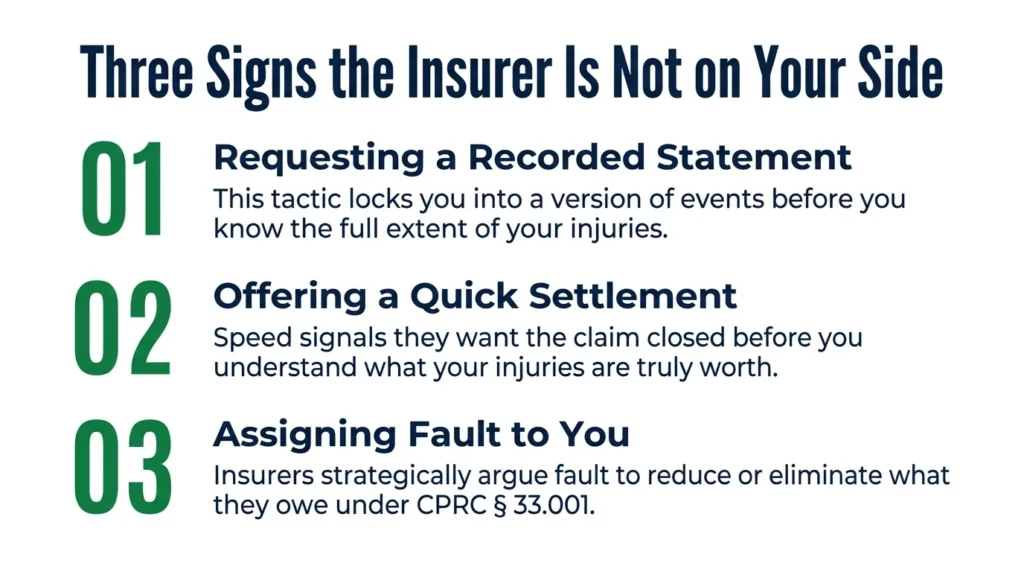
Understanding why insurers push so hard for early recorded statements helps you see why this request is a tactic, not a formality. Early statements lock you into a version of events before you have seen a doctor or know the full extent of your injuries.
The second is a quick settlement offer. A fast offer is a business decision, not a gesture of goodwill. Accepting it means you give up the right to ask for more compensation later, even if your injuries turn out to be worse than they appeared in the first week.
Before you respond to any offer, review what the other driver’s insurer is actually trying to accomplish when they reach out.
The third is the insurer assigning fault to you. Texas uses a modified comparative fault system under the Texas Civil Practice and Remedies Code (CPRC) Chapter 33, which governs proportionate responsibility. If you are found 51% or more at fault for the crash, you receive nothing. Insurers know this rule and use it. An attorney can push back on fault assignments and build the documented record the insurer wants to chip away.
Why Motorcycle Claims Are Different
Motorcycle injury claims carry higher stakes than standard car accident claims for reasons the insurer already understands and you may not.
Adjusters and jurors often assume that riders take on extra risk just by being on a bike. That assumption leads to higher fault percentages and reduced settlements unless the rider has documentation that counters it. The common injuries in motorcycle accidents are also more severe than those in car crashes because riders have no structural protection.
Higher injury severity means more complex future-cost calculations that a quick settlement rarely accounts for.
The evidence window after a crash is narrow. Skid marks fade, road debris gets cleared, and witnesses’ memories change within days. When you are focused on treatment and recovery, you are not preserving evidence. An attorney can move immediately on that front.
Texas gives you two years from the crash date to file a personal injury lawsuit under CPRC Section 16.003. Two years sounds like enough time, but building a complete case requires documentation that gets harder to put together the longer you wait.
What an Attorney Does That You Cannot Do Alone
Here is what changes when you have legal representation on a motorcycle injury claim.
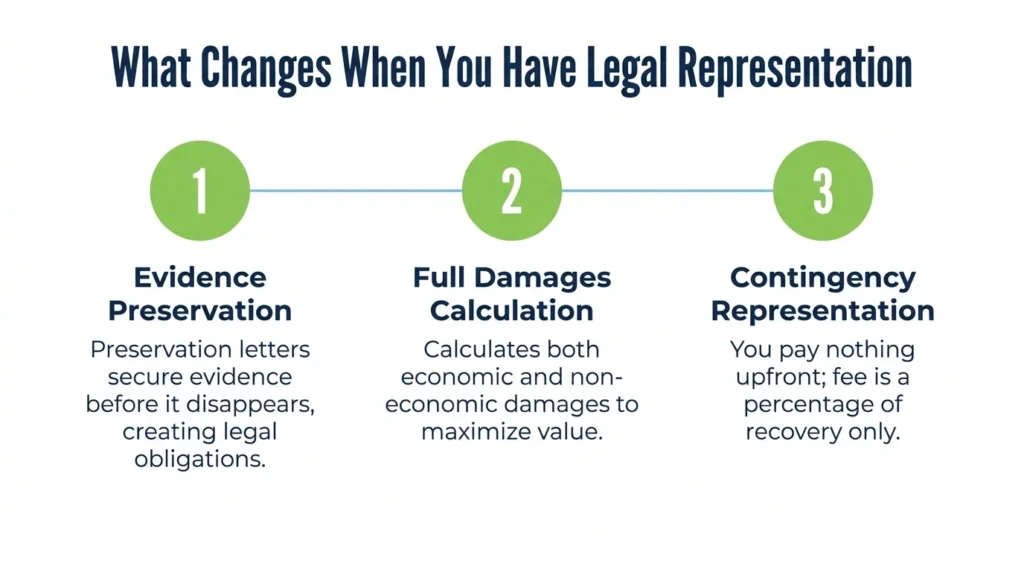
Step 1: Evidence preservation. Your attorney sends legal preservation letters to the insurer, the tow yard, and any other party who controls physical evidence. Those letters create a legal obligation to hold evidence that would otherwise disappear.
Step 2: Damages calculation. Your attorney calculates both your economic damages (medical bills, lost wages, and projected future treatment costs) and your non-economic damages (pain, suffering, and reduced quality of life). These calculations require documentation most riders do not know to gather on their own.
Step 3: Negotiation. Insurers settle more, and for higher amounts, with represented claimants. An unrepresented rider is more likely to accept a first or second offer below the case’s actual value.
Step 4: Cost structure. Attorneys typically work on contingency. You pay nothing upfront, and there is no legal fee unless compensation is recovered for you. You can review what the Texas motorcycle accident practice area covers to understand what working with an attorney actually involves.
Work with Angel Reyes & Associates
Motorcycle crash claims move fast on the insurer’s side from the moment of impact. Having an attorney in your corner from the start changes how the claim develops.
Angel Reyes & Associates has handled motorcycle injury cases across Texas for over 30 years. We work on a contingency basis, so you pay nothing unless we recover compensation for you. We are available 24/7 and offer free initial consultations.
You can also review our case results to see what we have recovered for injured Texans. Contact us today to go over your situation before you make any decisions about your claim. Every case is different, and the sooner we review the facts, the more options you have.
Past results do not guarantee future outcomes.
Hiring an Motorcycle Attorney FAQs
What if the other driver who hit me has no insurance?
You may still have options through your own uninsured motorist (UM) coverage, which pays when the at-fault driver carries no liability insurance. Texas insurers must offer UM coverage with every auto policy, and you must have submitted a signed written rejection to be without it.
Do I need a lawyer if the crash only damaged my motorcycle and not my body?
If you have no injuries and the other driver’s insurer is cooperating on the property damage, you can often handle the property claim without an attorney. The risk is that soft tissue injuries, concussions, and spinal problems sometimes surface days after the crash, so seek a medical evaluation before closing any claim.
What is the deadline to file a claim against a government entity in Texas?
Texas Civil Practice and Remedies Code Section 101.101 requires written notice to a government entity within six months of the accident. Some cities impose even shorter windows. Missing that notice deadline can bar your claim entirely, regardless of how clear the other party’s fault is.
What happens if I was partly at fault for the motorcycle crash?
Under Texas proportionate responsibility rules, you can still recover damages as long as your share of fault stays below 51%. Your compensation is reduced by your percentage of fault. For example, if you are found 20% at fault on a claim worth $80,000, you receive $64,000.
About the Authors

Angel Reyes
Writer
Angel L. Reyes, III is the Founder and Managing Partner of Angel Reyes & Associates. A nationally recognized trial attorney and business leader, Angel has helped over 70,000 injury victims recover more than $1 billion since founding the firm in 1993. Named to the Texas Super Lawyers list annually since 2008, Angel brings Wall Street experience, Ivy League education, and a deep commitment to client advocacy. He is a frequent legal commentator and published author with extensive contributions to legal scholarship, trial strategy, and consumer protection.

Kyle Nicolas
Editor
Kyle Nicolas is the Web Content & SEO Manager at Angel Reyes & Associates. He has more than 10 years of experience as a marketing co...

Angel Reyes
Reviewer
Angel L. Reyes, III is the Founder and Managing Partner of Angel Reyes & Associates. A nationally recognized trial attorney and business...