Motorcycle Accident Evidence: What to Gather to Protect Your Claim


Every article on this site is researched by our internal team, reviewed for legal accuracy against current Texas law, and held to State Bar of Texas advertising standards before publication. We do not publish content that overstates outcomes or makes promises about results.
Learn more about our
editorial standards .
Key Takeaways
- Skid marks and surveillance footage can disappear within 24 to 72 hours of a crash.
- Texas law gives riders two years to file, but evidence preservation starts at the scene.
- Damaged helmets and gear are physical evidence; do not repair or discard them.
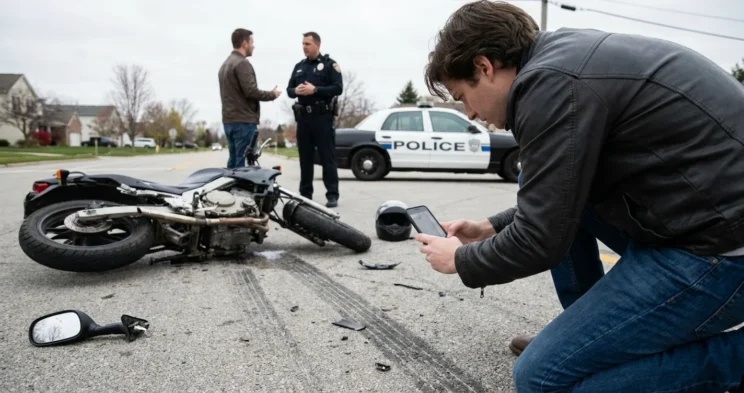
You were heading home from work on a Tuesday evening, riding north on I-35 through San Antonio, when a driver changing lanes without checking his mirror clipped your front wheel and sent you into the concrete barrier. You hit the ground hard. Your helmet cracked.
Your bike is on its side in the breakdown lane.
The crash happened fast. What you do in the next few hours will shape everything that follows.
Evidence to Gather at the Scene
The most valuable evidence in any motorcycle crash exists at the scene, and most of it will be gone by morning. Start documenting as soon as you are physically able to do so safely.
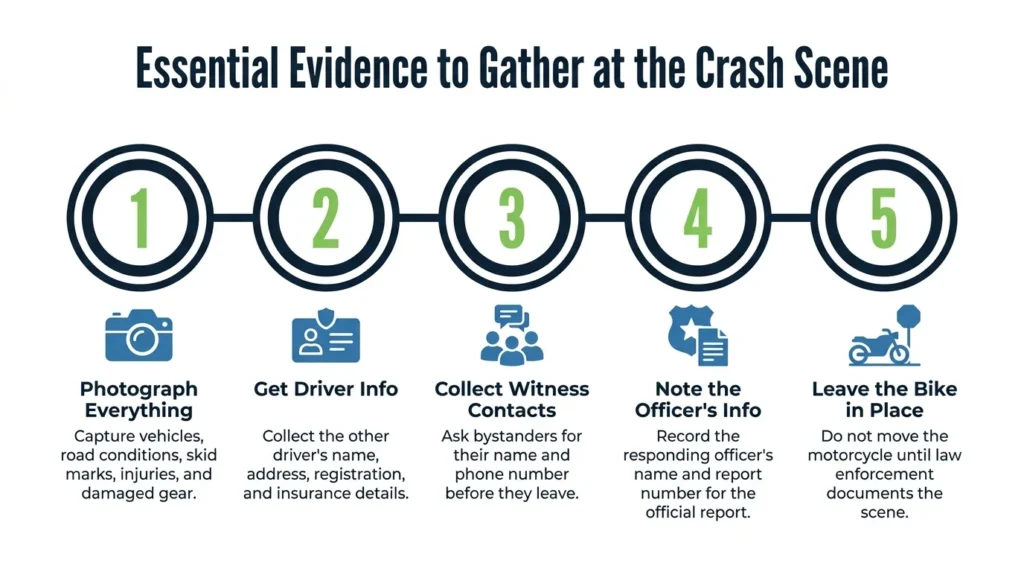
Here is what to gather before you leave the crash site:
Step 1: Photograph everything. Take photos of both vehicles from multiple angles, capturing damage, positions, and the point of impact. Photograph skid marks, road conditions, debris fields, lane markings, traffic signs, and any potholes or hazards that contributed to the crash. Get photos of your injuries and all damaged gear, including your helmet.
Step 2: Collect the other driver’s information. Under the Texas Transportation Code section 550.023, drivers involved in a crash must provide their name, address, vehicle registration, and insurance information. Write it down. Do not rely on memory.
Step 3: Get witness contact information. Ask anyone nearby for their name and phone number before they leave. Witness accounts from neutral third parties carry real weight with insurance adjusters and juries.
Step 4: Note the responding officer’s name and report number. You will need this to obtain your official crash report later. Do not leave the scene without it.
Step 5: Leave the motorcycle where it is until photos are complete. Once the scene is altered, it cannot be restored. Let law enforcement document it before anything moves.
Evidence That Disappears Within 24 to 48 Hours
Some evidence does not wait. If you or someone acting on your behalf does not capture it quickly, it is gone permanently.
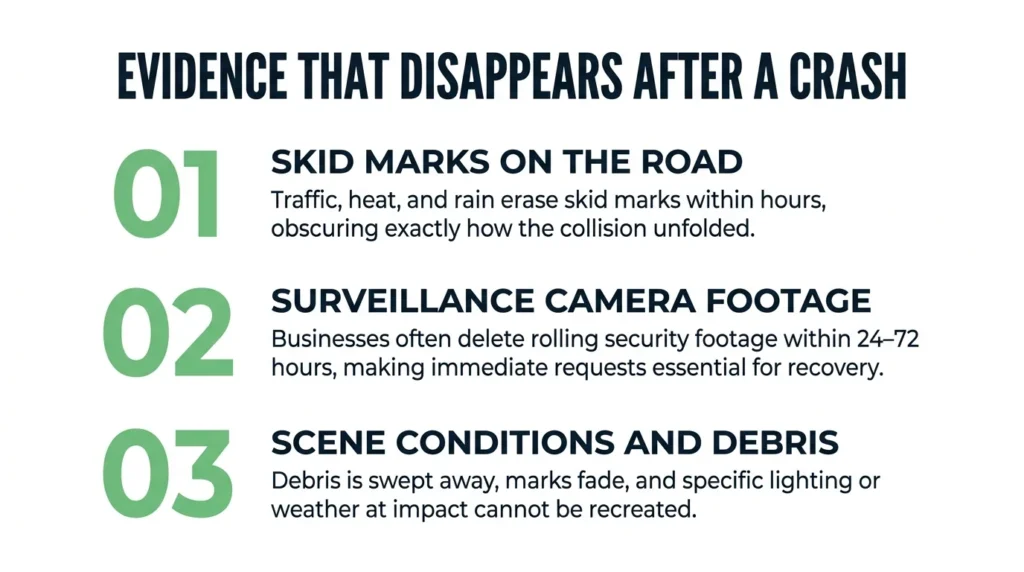
Skid marks are among the fastest to disappear. Traffic, heat, and rain can erase them within hours of a crash. The same road that showed exactly how the collision unfolded will look ordinary by the next morning.
Surveillance footage from businesses near the crash is typically deleted on a rolling 24 to 72 hour cycle. A gas station, convenience store, restaurant, or parking lot camera may have captured the entire sequence, but only if someone requests the footage before the system deletes it. That window closes fast.
Scene conditions change too. Road debris gets swept up. Tire marks fade.
Lighting conditions at the time of the crash cannot be recreated. The weather, the traffic pattern, and the physical state of the road at the moment of impact are all evidence the scene no longer holds a day later.
If you are hospitalized or physically unable to act, contact an attorney as soon as possible. An attorney can send preservation requests to businesses and other parties before footage is erased and evidence disappears.
How to Request Evidence Before It Is Gone
Once you are safe, the next step is requesting the evidence that you cannot collect yourself at the scene.
For surveillance footage, send a written request directly to the business or property owner near the crash site. Identify the date, time, and footage you need. Address it to the property owner or manager.
Put it in writing so you have proof the request was made.
For traffic camera footage from a city or county system, file an Open Records Request under the Texas Public Information Act. You will need the specific intersection, date, and time. Different municipalities respond at different speeds, so submit this request the same day if possible.
For the official crash report, contact the law enforcement agency that responded or use TxDOT’s online purchase portal to obtain the CR-3 report. Reports are typically available 7 to 14 days after the crash. For a deeper look at how to read and use this document, review how to obtain motorcycle accident reports in Texas.
If another driver, trucking company, or commercial vehicle was involved, a preservation request should go out to them immediately. Companies often have document retention schedules that routinely purge data. A formal written demand to preserve specific records changes the legal calculus on spoliation and can be issued by an attorney on your behalf.
Dashcam footage from nearby commercial vehicles, rideshare drivers, or even other private vehicles can also be requested directly. For a closer look at how that kind of footage can affect a claim, review what to know about dashcam and GoPro footage in motorcycle cases.
Physical Evidence to Preserve After the Crash
Three categories of physical evidence require your immediate attention: your motorcycle, your gear, and your medical records.
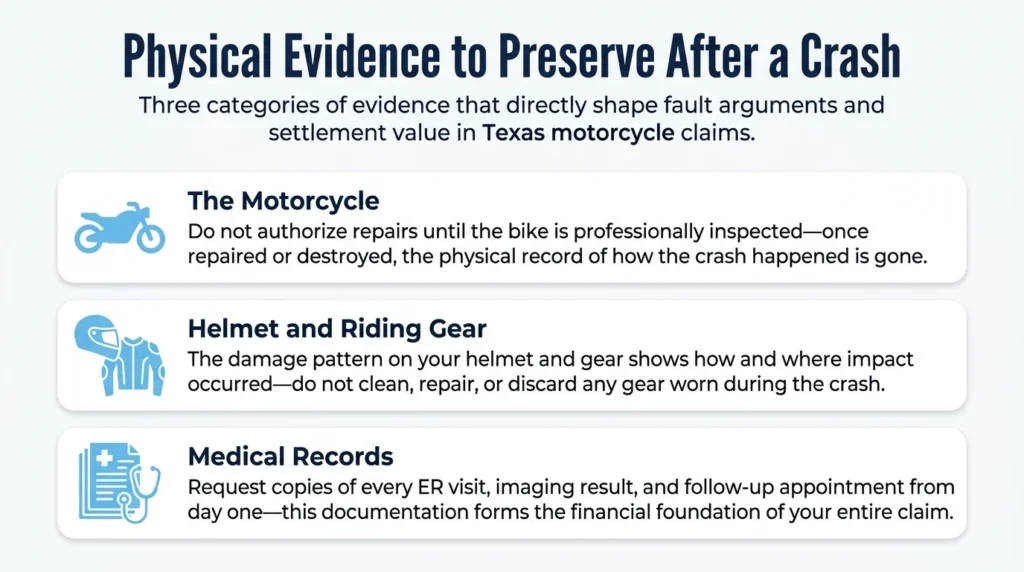
Do not authorize repairs to the motorcycle until it has been professionally inspected. If the bike is at a tow yard and the facility is planning to auction or crush it, act immediately. Contact the tow yard in writing and arrange retrieval.
Once a motorcycle is repaired or destroyed, the physical record of how the crash happened is gone. An attorney can help secure the bike before the facility takes action if you are unable to do so yourself.
Your helmet and riding gear are physical evidence of the crash’s severity. Do not clean them, repair them, or throw them away. The damage pattern on a helmet can show how and where the rider’s head struck the pavement or another vehicle.
Your damaged jacket, gloves, and boots should be stored in a bag and photographed before any contact. The condition of your gear can directly affect how injuries are evaluated and how fault is argued.
Medical records document what your injuries are, how they were treated, and what recovery looks like. Request copies of every emergency room visit, diagnostic test, imaging result, and follow-up appointment from day one. Track every out-of-pocket cost.
This documentation forms the financial foundation of your claim. For a broader understanding of how settlement value is built from evidence like this, review how motorcycle accident settlements work in Texas.
Why Evidence Quality Affects Your Claim
What you document, request, and preserve directly shapes what you can recover.
Texas uses a modified comparative fault system. If you are found 51 percent or more responsible for the crash, you collect nothing. If your share of fault is 50 percent or below, your recovery is reduced by that percentage.
Insurance adjusters look for gaps in documentation to shift fault toward the rider. Photos that show road conditions, a witness statement that corroborates your account, and a surveillance video that shows the other driver’s error all counter those arguments.
Strong physical evidence also supports accident reconstruction, the technical analysis of how a crash happened. Reconstruction specialists can work with skid marks, vehicle damage, and road data to establish speed, angle, and sequence. Without preserved evidence, that analysis has less to work with.
The Texas Civil Practice and Remedies Code (CPRC) section 16.003 gives you two years from the date of the crash to file a personal injury claim. That deadline feels distant when you are focused on recovery, but evidence does not wait for the statute of limitations. A crash scene that went undocumented on day one does not become more recoverable on day 700.
For a full picture of the legal protections available to Texas riders, review what riders should know about building and pursuing a claim.
Talk to an Experienced Attorney Today
If you are dealing with a crash, every day that passes without a preservation request is a day the evidence pool shrinks.
Angel Reyes & Associates has helped injured Texans work through situations like this for over 30 years. We work on contingency, meaning you pay nothing unless we recover for you. We answer calls 24/7 and can begin the evidence preservation process immediately, including sending written requests to businesses, tow yards, and other parties before footage is deleted and physical evidence is lost.
Reach out to us for a free consultation. Our team will review your situation, explain your options, and take the immediate steps that protect your claim. You can also learn about our attorneys to see who would be working on your case.
Past results do not guarantee future outcomes.
Motorcycle Accident Evidence FAQs
Can I still file a motorcycle accident claim if I wasn't wearing a helmet?
Yes, you can still file a claim in Texas even if you were not wearing a helmet. However, the other side may argue that your choice to ride without a helmet contributed to the severity of your head or brain injuries, which could reduce your total recovery under Texas’s comparative fault rules.
What happens if the other driver's insurance company contacts me before I've gathered all my evidence?
You are not required to give a recorded statement to the other driver’s insurer, and doing so before you have gathered evidence can hurt your claim. Politely decline until you have documentation in hand and have had a chance to speak with an attorney.
Does it matter who calls the police first at a motorcycle crash scene?
No, what matters is that a police report gets filed. The responding officer documents the scene independently, so the order in which parties call does not affect the report’s value to your claim.
Can I still recover damages if the other driver fled the scene?
You may still have options through your own uninsured motorist coverage if the at-fault driver cannot be identified or located. Documenting the scene thoroughly, including any witness accounts and surveillance footage, becomes especially important in hit-and-run situations.
What if the tow yard already repaired or auctioned my motorcycle before I could preserve it?
Texas courts can apply spoliation rules when relevant evidence is destroyed after a party knew or should have known that litigation was likely. If the destruction was intentional or severely prejudiced your ability to prove your case, a court may instruct the jury to draw an adverse inference against the responsible party.
About the Authors

Angel Reyes
Writer
Angel L. Reyes, III is the Founder and Managing Partner of Angel Reyes & Associates. A nationally recognized trial attorney and business leader, Angel has helped over 70,000 injury victims recover more than $1 billion since founding the firm in 1993. Named to the Texas Super Lawyers list annually since 2008, Angel brings Wall Street experience, Ivy League education, and a deep commitment to client advocacy. He is a frequent legal commentator and published author with extensive contributions to legal scholarship, trial strategy, and consumer protection.

Kyle Nicolas
Editor
Kyle Nicolas is the Web Content & SEO Manager at Angel Reyes & Associates. He has more than 10 years of experience as a marketing co...

Angel Reyes
Reviewer
Angel L. Reyes, III is the Founder and Managing Partner of Angel Reyes & Associates. A nationally recognized trial attorney and business...