Motorcycle Accident Physical Therapy & Rehabilitation Costs


Every article on this site is researched by our internal team, reviewed for legal accuracy against current Texas law, and held to State Bar of Texas advertising standards before publication. We do not publish content that overstates outcomes or makes promises about results.
Learn more about our
editorial standards .
Key Takeaways
- Texas law limits past PT recovery to amounts actually paid or incurred, not full billed charges.
- A physician referral, progress notes, and outcome scores are the core PT documentation.
- Comparative fault can reduce your PT cost recovery if you share blame for the crash.
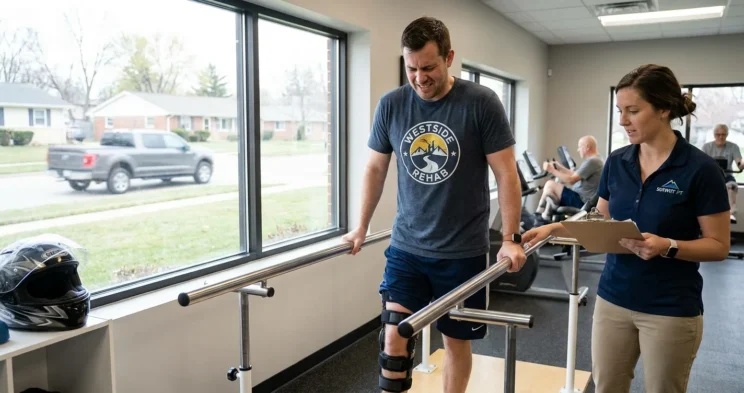
You left the hospital after a crash on I-35 with a referral slip in your hand and a list of injuries that were going to take months to heal. The doctor said physical therapy was the path forward. What nobody told you was that the insurer handling your claim was already looking for reasons to say your PT was unnecessary, excessive, or unrelated to the crash.
PT costs after a motorcycle accident are recoverable under Texas law. The fight is in the documentation.
Physical Therapy Costs After a Motorcycle Crash
Physical therapy after a motorcycle accident covers a wide range of treatment. The type and cost of your rehabilitation depend on the nature of your injuries.
Road rash, fractures, spinal damage, and soft tissue injuries each follow a different recovery path, and your PT program reflects that. A rider recovering from a fractured pelvis faces a fundamentally different treatment plan than one dealing with a shoulder separation or nerve damage from a leg injury. You can see the full picture of what motorcycle crashes actually do to the body in this breakdown of common injuries in motorcycle accidents.
For many motorcycle injuries, PT runs weeks or months. Individual session costs vary by the type of care, the provider’s location, and how long each visit runs. More complex injuries may require specialized therapists or additional services such as occupational therapy or home health aides.
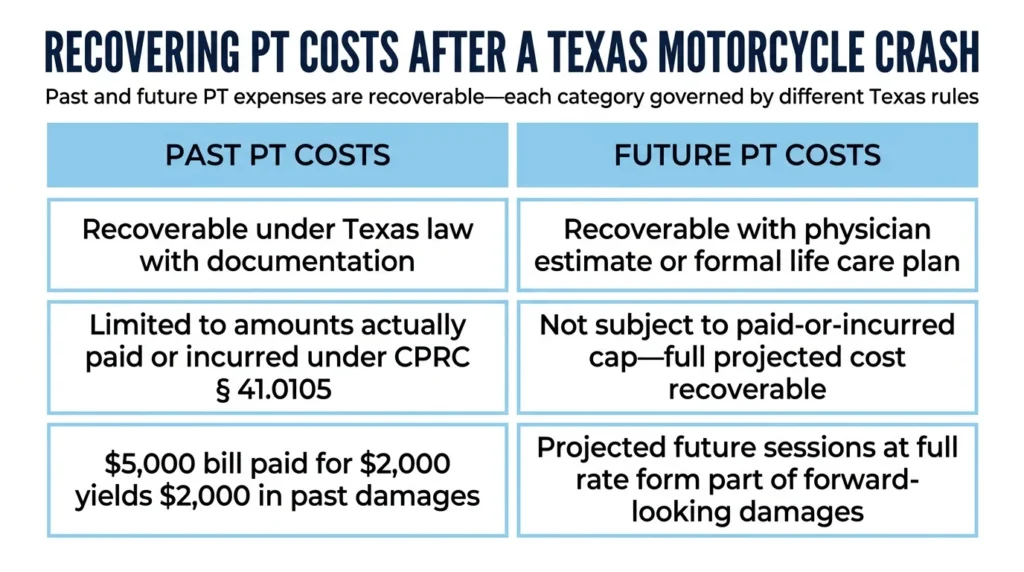
Past PT bills are one recoverable cost. Future PT costs are another. If your doctor or physical therapist projects that your treatment will continue beyond the settlement date, those projected costs must be calculated separately.
They require a treating physician’s estimate or a formal life care plan, and Texas Civil Practice and Remedies Code (CPRC) Chapter 41 governs how both categories enter your damages.
What Texas Law Says About Recovering PT Costs
Texas law limits what you can recover for past medical expenses, including PT. The limits are specific, and understanding them changes how you build your claim.
The Reasonable-and-Necessary Standard
To recover PT costs from the at-fault party, you must show that the treatment was reasonable in cost and necessary to treat your injury. “Reasonable” means the amount charged falls within the range for that type of service. “Necessary” means a qualified medical provider directed the treatment as appropriate for your condition.
The insurer’s job is to challenge both. If they can argue that your PT sessions were not medically directed, ran too long, or treated a pre-existing condition rather than a crash injury, they have a basis to reduce or deny that portion of your claim.
That is why physician referrals and documented progress notes from each session carry so much weight. How PT costs ultimately affect your settlement is part of a larger picture explained in how motorcycle accident settlements work in Texas.
The Paid-or-Incurred Limit
Texas Civil Practice and Remedies Code section 41.0105 limits your past medical expense recovery to amounts actually paid or incurred, not the full billed amount. If your health insurer negotiated a $2,000 payment on a $5,000 PT bill, your recoverable past expense is $2,000 for that bill, not $5,000.
This rule applies to past costs. Future PT expenses are not subject to the same paid-or-incurred cap, which is why a documented projection for future care is important for your total recovery.
If you are unsure which PT costs are actually recoverable under your specific facts, an attorney who handles motorcycle accident cases can walk you through what the numbers look like.
How Insurers Dispute PT Claims
Insurers dispute PT costs in predictable ways. Knowing the playbook helps you respond before the dispute costs you money.
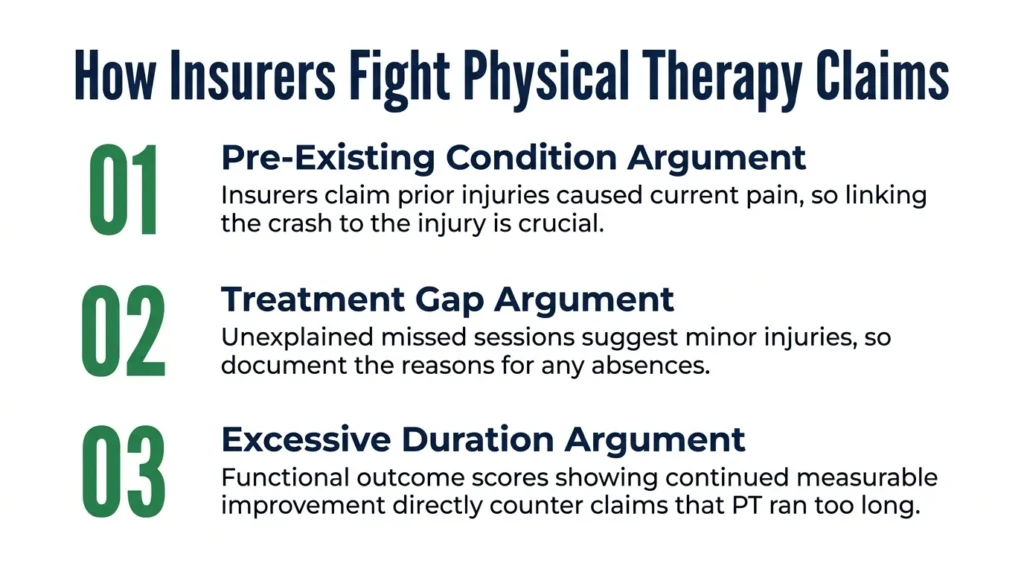
The first challenge is often causation. The adjuster or the insurer’s hired medical reviewer argues that your PT is treating a pre-existing condition rather than injuries from the crash. Your treating physician’s documented causal link between the crash and your injuries is the primary counter to this argument.
A note in your chart stating that the condition was not present or not symptomatic before the crash is worth more than a stack of bills alone.
The second challenge is treatment gaps. If you missed PT sessions, especially back-to-back sessions without explanation, the insurer will argue your injuries were not as serious as claimed.
If you had to miss a session because of work, family obligations, or illness, write it down at the time. Your attorney can use those notes later.
The third challenge is excessive duration. If the insurer decides your PT ran longer than the injury warranted, they will try to cut the tail end of your bills. Functional outcome measures counter this argument.
These are standardized scoring tools your physical therapist uses to track your progress. Range-of-motion scores, strength assessments, and pain-scale documentation create an objective record of whether you were still improving.
If the scores show continued functional gain, the “excessive duration” argument loses ground. You can also find information on how insurer tactics affect medical bill recovery in who pays medical bills after a car accident in Texas.
Documenting PT as Medically Directed
Your PT record is your evidence. Build it from day one. The records listed below are the ones adjusters and defense attorneys look for when they evaluate whether to fight your PT costs.
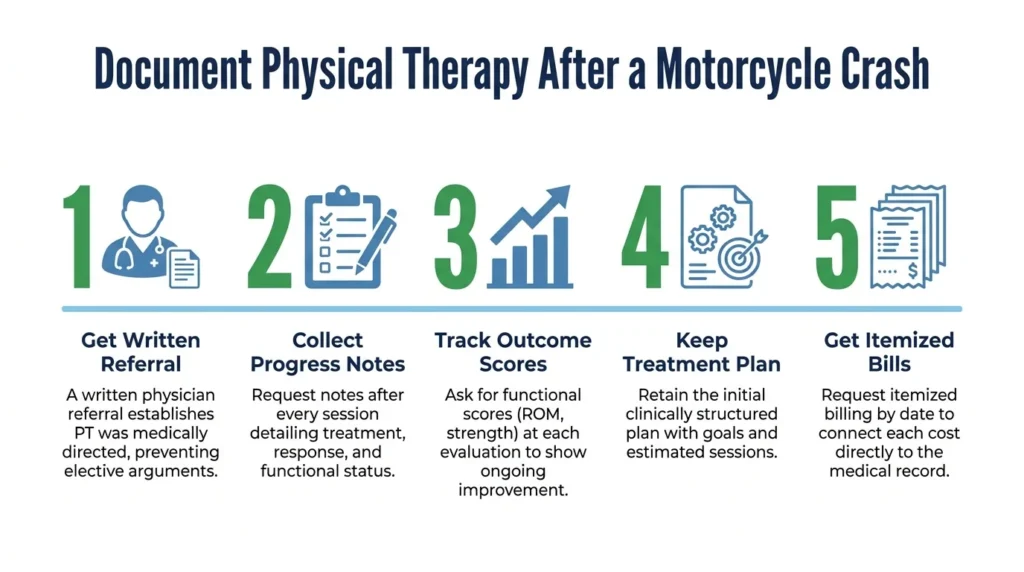
Step 1: Get the physician referral in writing. A written referral from the emergency room doctor or your primary care physician establishes that your PT was medically directed. Self-referring to PT without a referral gives the insurer an opening to argue the treatment was elective.
Step 2: Request copies of every progress note. Your physical therapist writes session notes after each visit. Those notes document your condition at the start of the visit, what treatment was performed, and how you responded. Ask for copies at the end of each visit.
Do not wait until the end of your treatment to collect them.
Step 3: Track your functional outcome measure scores. Ask your therapist what scoring tools they use and request your scores at each assessment. Common tools measure range of motion, strength, and functional capacity. A record showing consistent improvement over several months is far harder to dismiss as “excessive” than a pile of bills with no clinical context.
Step 4: Keep the written treatment plan. When your PT program starts, your therapist creates a treatment plan with goals and an estimated number of sessions. Keep a copy. It shows the program was clinically structured, not open-ended.
Step 5: Keep itemized billing records. Request itemized bills tied to specific dates of service. Summary invoices are harder to use in a claim. An itemized bill shows exactly what service was rendered on each date, which makes it easier to connect each cost to the documented medical record.
An attorney experienced with motorcycle accident claims can review your records and identify gaps before an insurer uses them against your claim.
The Insurance Gap & Your Damages Claim
Most motorcycle riders do not realize there are two separate layers of coverage that may apply to PT costs before a liability settlement ever pays out.
The first layer is your own policy. Personal Injury Protection (PIP) and MedPay, when available on your motorcycle policy, pay your PT costs directly regardless of who caused the crash, up to your policy limits. Texas law requires insurers to offer PIP on standard automobile policies, but motorcycle policies may differ.
Ask your insurer specifically whether PIP or MedPay is available on your coverage and what the limits are. PIP typically covers medical expenses and a portion of lost wages, and using this coverage does not prevent you from pursuing the at-fault party’s liability insurance for full compensation.
The second layer is health insurance. Your health plan may cover PT after the PIP or MedPay limits are exhausted. If health insurance pays your PT bills, the insurer may assert a subrogation lien on your settlement proceeds.
You do not lose those amounts from your claim; the lien is a repayment obligation, not a deduction from damages.
The gap between what these coverage sources pay and what you actually owe out of pocket, combined with the amounts your health insurer paid subject to subrogation, forms the economic damage figure you pursue from the at-fault party. Every dollar your PT cost, regardless of who paid it, should be documented and accounted for.
One more variable affects the final number. Under Texas Civil Practice and Remedies Code section 33.001, Texas uses a modified comparative fault rule. If you are found partly responsible for the crash, your total damages, including PT costs, are reduced by your fault percentage.
A rider found 20% at fault recovers 80% of their total damages. A rider found more than 50% at fault cannot recover anything. Our attorneys’ page has more on what to expect during the claims process.
Talk to an Attorney to Learn More
PT cost disputes are common. Insurers challenge medical necessity, duration, and causation on a routine basis because many injured riders do not know how to respond.
Angel Reyes & Associates has handled motorcycle accident claims across Texas for over 30 years. We review treatment records, identify documentation gaps, and deal with insurers on your behalf. We work on contingency, which means no fee unless we win.
If your PT costs are being disputed or you are not sure what your rehabilitation damages are worth, contact us for a free consultation.
Past results do not guarantee future outcomes.
Physical Therapy & Rehabilitation FAQs
What is maximum medical improvement, and should I settle before I reach it?
Maximum medical improvement (MMI) is the point at which your doctor determines your condition has stabilized and no further recovery is expected. Settling before you reach MMI is risky because your future PT costs and long-term limitations may not be fully known yet, which means you could accept far less than your injuries will ultimately cost.
What if my motorcycle accident made a pre-existing injury worse?
You can still recover PT costs if the crash aggravated a condition you already had. The key is showing that the accident made your pre-existing condition worse, not just that the condition existed before the crash.
Does going to physical therapy without a doctor referral hurt my claim?
It can. Without a referral, the insurer has grounds to argue your PT was self-directed rather than medically necessary, which weakens the medical necessity part of your claim. Getting a written referral from an emergency room or primary care physician before starting PT creates a cleaner record.
What happens if health insurance denies coverage for my physical therapy?
You can appeal the denial by submitting additional medical documentation, including your physician referral and the treating provider’s notes explaining why the treatment is necessary. Out-of-pocket costs you incur while the denial is being resolved may still enter your damages claim against the at-fault party.
Can I use PIP coverage for physical therapy if I do not have health insurance?
Yes. PIP pays for covered medical expenses, including physical therapy, regardless of whether you have separate health insurance. In Texas, PIP is offered with motorcycle policies, and using it does not affect your right to pursue the at-fault party’s insurance for additional compensation.
About the Authors

Alex Ivanov
Writer
Alex Ivanov is a personal injury attorney at Angel Reyes & Associates, focused on car, truck, and motorcycle accident cases. Licensed in Texas and multiple federal districts, Alex brings international legal experience and a global education to his practice. He earned his LL.M. from Texas A&M University School of Law after graduating from Belarussian State University in 2016. Alex is fluent in Russian, English, Ukrainian, and Belarussian, and is recognized by multiple national trial lawyer associations for his results and leadership under 40.

Kyle Nicolas
Editor
Kyle Nicolas is the Web Content & SEO Manager at Angel Reyes & Associates. He has more than 10 years of experience as a marketing co...

Angel Reyes
Reviewer
Angel L. Reyes, III is the Founder and Managing Partner of Angel Reyes & Associates. A nationally recognized trial attorney and business...