Motorcycle Accident Traumatic Brain Injuries in Texas


Every article on this site is researched by our internal team, reviewed for legal accuracy against current Texas law, and held to State Bar of Texas advertising standards before publication. We do not publish content that overstates outcomes or makes promises about results.
Learn more about our
editorial standards .
Key Takeaways
- Head injuries are the leading cause of motorcycle fatalities, accounting for more deaths than any other injury type.
- Delayed TBI symptoms are normal, but gaps in medical care give insurers grounds to dispute your claim.
- Texas's 51 percent fault rule means helmet non-use can reduce or eliminate your TBI recovery.
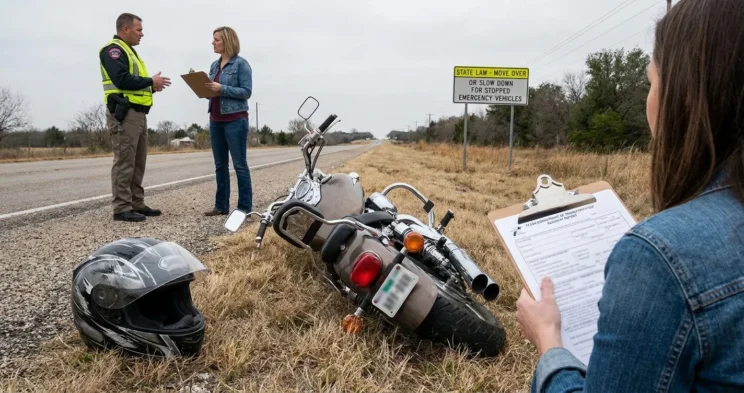
You were riding home on I-35 outside San Antonio when a truck changed lanes without signaling and clipped your front wheel. You hit the pavement. At the ER, they cleared you for fractures and sent you home. Three days later, you can barely concentrate at work, your head won’t stop pounding, and your family says your personality has shifted.
That gap between the crash and your symptoms is not a coincidence. It is one of the most misunderstood signs of traumatic brain injuries, and it is the first thing an insurance adjuster will try to use against you.
Why TBI Is the Most Dangerous Motorcycle Injury
Head injuries are the leading cause of death in motorcycle crashes. According to NHTSA motorcycle safety data, head injury accounts for a greater share of motorcycle fatalities than any other injury type. No other injury category comes close to TBI’s share of fatal outcomes on two wheels.
The reason is physical. When a rider goes down, there is no crumple zone, no airbag, and no steel frame to absorb impact energy. The head absorbs it directly. At highway speeds, the force involved can exceed what even a well-fitted helmet is designed to handle.
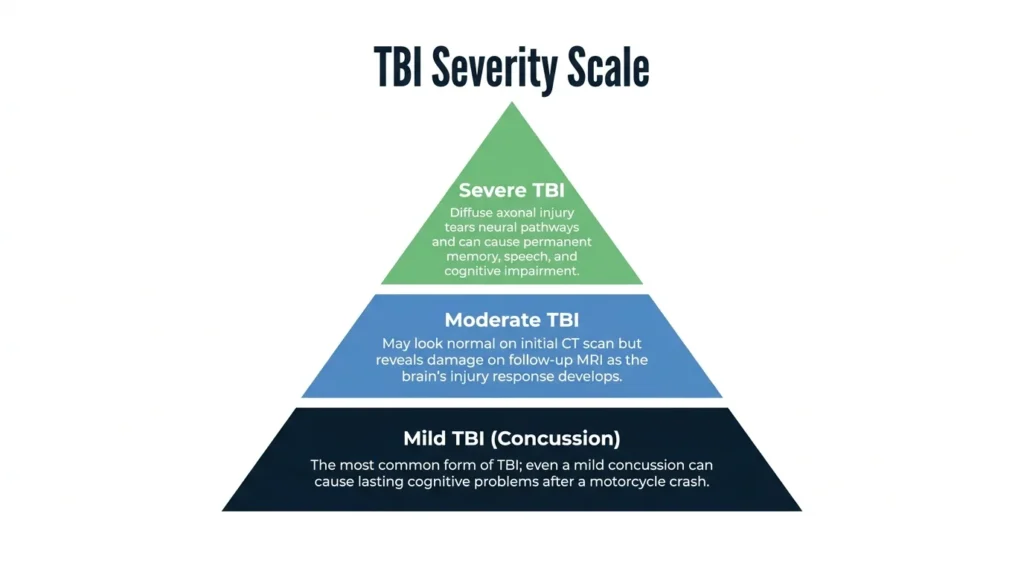
TBI is not a single diagnosis. It ranges from a mild concussion, which can still cause lasting cognitive problems, to diffuse axonal injury, or where brain tissue tears along neural pathways. Severe TBI can produce permanent impairment of memory, executive function, speech, and emotional regulation. Even riders who walk away from a crash may be carrying damage they cannot yet feel.
Unlike a broken arm or road rash, TBI is often invisible on initial imaging. A standard CT scan can look normal while the brain has sustained meaningful injury. That invisibility creates problems for your claim, and understanding it is the first step in protecting your recovery.
Delayed Symptoms & Why Insurers Use Them Against You
TBI symptoms frequently do not surface immediately. Headaches, memory problems, mood changes, difficulty concentrating, and cognitive fog can emerge days or even weeks after the crash. This is a well-documented feature of how the brain responds to trauma, not a sign that the injury is minor.
Insurance adjusters know the pattern too. Their argument goes like this: if you were truly injured in the crash, you would have sought treatment right away. A gap between the crash and your first reported symptoms means the injury either did not happen that day or was caused by something else.
That argument is worth taking seriously because juries sometimes accept it. The best defense is immediate medical evaluation at the scene or emergency room, even when you feel fine. Documenting that you sought medical care right after the crash removes the gap the insurer needs.
How comparative fault and settlement calculations work in Texas motorcycle cases explains how insurers use these tactics broadly in settlement negotiations.
Follow-up imaging also matters. Neuropsychological testing and repeat MRI scans can reveal damage that the initial emergency CT missed. Some injuries only become visible on imaging once swelling resolves or once the brain’s response to trauma fully develops. Keeping every medical appointment and requesting written documentation from each provider builds a paper trail that connects your symptoms directly to the crash date.
Neurological Expert Testimony in TBI Claims
TBI claims almost always require expert medical testimony. The reason is causation: the defense will argue that your symptoms could have other explanations. A qualified expert closes that argument.
A neurologist or neuropsychologist can testify that your symptoms are consistent with the type of crash forces involved in your accident. That opinion does not just describe your condition. It connects your condition to the specific event, which is what the law requires.
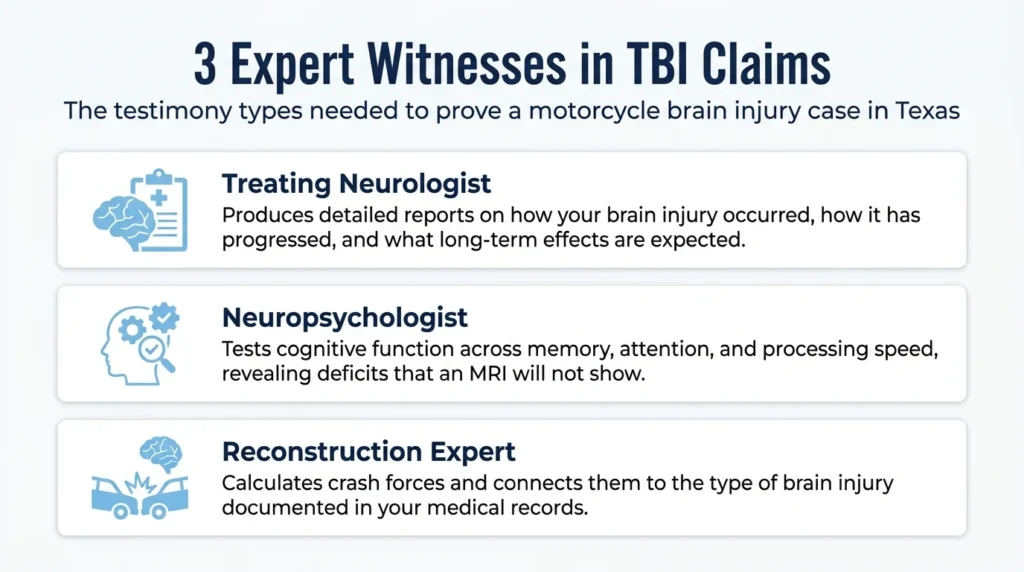
Two types of experts appear regularly in Texas motorcycle TBI cases.
Medical Experts
Treating neurologists and independent neurologists can produce detailed reports on how your injury occurred, how it has progressed, and what long-term effects are expected. A neuropsychologist adds a different layer. Their functional assessments measure cognitive performance across memory, attention, processing speed, and executive function.
Those tests can reveal deficits that an MRI will not show and that an injured person may not even notice in daily life.
Accident Reconstruction Experts
Medical testimony explains what happened to your brain. Reconstruction testimony explains the forces that caused it. A reconstruction specialist can calculate the speed and angle of impact, the g-forces involved, and whether those forces were sufficient to produce the kind of brain injury documented in your medical records.
When both experts align, the causal chain from crash to diagnosis becomes harder to attack.
Helmet Use & Comparative Fault in Texas TBI Cases
Texas does not require all motorcycle riders to wear helmets. Under Texas Transportation Code Chapter 661, riders 21 and older are exempt from the helmet requirement if they have completed an approved motorcycle operator safety course or carry qualifying health insurance coverage. Riders under 21 must wear a helmet regardless.
If you were legally riding without a helmet, you did not break the law. But the defense can still argue that your decision worsened your injury, and that argument carries real legal weight under Texas’s proportionate responsibility rules.
Texas Civil Practice and Remedies Code Chapter 33 governs how fault is allocated in personal injury cases. If the jury finds you more than 50 percent responsible for your own injuries, you recover nothing. At 50 percent or below, your damages are reduced by your percentage of fault.
That rule creates a real risk in helmeted and unhelmeted TBI cases alike. Defense attorneys will push fault percentages as high as the evidence allows. In TBI cases specifically, the argument that a helmet would have reduced severity is a standard defense tactic.
Medical evidence showing the TBI would have occurred regardless of helmet use is the direct counter. An experienced attorney can retain biomechanical experts who can test that argument and limit its impact on your recovery.
Filing Deadlines & What to Do After a TBI Crash
Texas gives you two years from the date of the crash to file a personal injury lawsuit. That deadline is set by Texas Civil Practice and Remedies Code § 16.003. Miss it, and your right to sue is almost certainly gone regardless of how strong your case is.
For TBI cases, that window can feel shorter than it sounds. Gathering neurological records, retaining experts, and fully documenting a delayed-onset injury takes time. Starting early gives your attorney room to build the case properly.
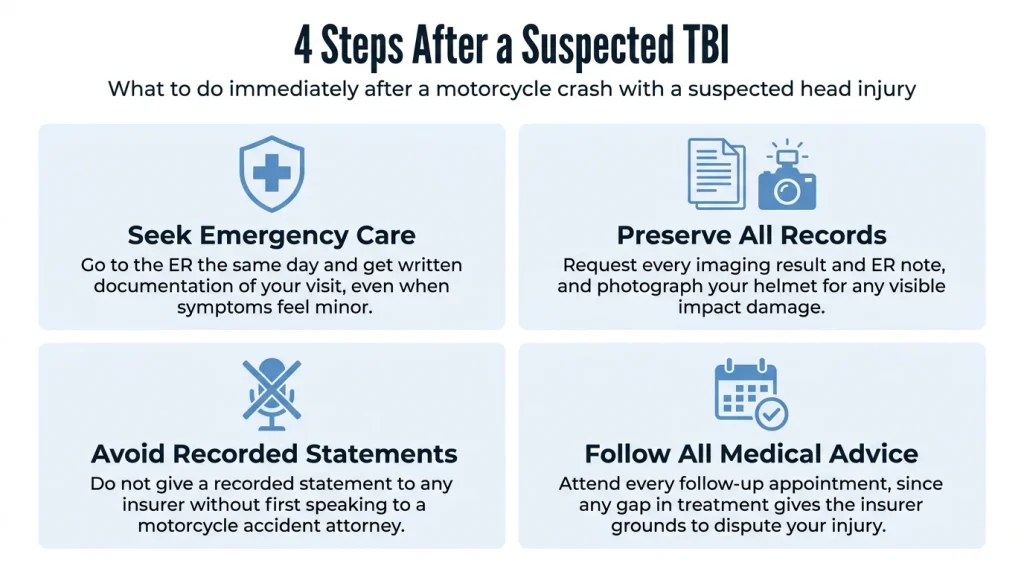
After a suspected head injury in a motorcycle crash, take these steps right away:
- Step 1: Seek emergency evaluation immediately. Go to the ER or urgent care that day, even if you feel fine. Tell the provider about the crash and describe any symptoms, including those that seem minor. Ask for written documentation of your visit.
- Step 2: Preserve all records and evidence. Request copies of every imaging result, ER note, and follow-up record. Photograph your helmet for any impact damage. Collect witness contact information at the scene.
- Step 3: Avoid recorded statements. Report the crash to your insurance carrier, but do not give a recorded statement to any insurer, including your own, without first speaking to an attorney.
- Step 4: Follow all medical recommendations. Attend every follow-up appointment. A gap in treatment gives the insurer another argument that the injury was not serious.
Get Legal Help with a Motorcycle TBI Claim
TBI claims are among the most demanding cases in motorcycle accident law. The medical complexity, the delayed symptom dynamics, and the comparative fault exposure all require experienced legal handling.
Angel Reyes & Associates has spent over 30 years representing seriously injured Texans, including riders with traumatic brain injuries. We work on a contingency basis, meaning you pay no legal fees unless we recover for you.
If you or a family member suffered a head injury in a motorcycle crash, a free consultation can help you understand your options and what your case requires.
Motorcycle TBI Claim FAQs
Can family members file a TBI claim if the rider cannot manage their own affairs?
Yes. In Texas, a family member can file a personal injury claim on behalf of an incapacitated rider through a legal guardian or next friend arrangement. If the rider died from the injury, surviving spouses, children, and parents may file a separate wrongful death claim.
What is the difference between a concussion and a traumatic brain injury?
A concussion is the most common and usually least severe form of TBI. All concussions are traumatic brain injuries, but TBI also includes more serious conditions such as subdural hematoma, diffuse axonal injury, and contusion, which can cause permanent impairment.
How long does a motorcycle TBI claim typically take to resolve in Texas?
Simple cases with clear liability may settle in a few months, but TBI claims with delayed symptoms, disputed fault, or serious long-term impairment often take one to two and a half years or more. Settling before the full scope of the injury is documented can leave significant future care costs uncovered.
Does wearing a helmet guarantee a stronger TBI claim?
Wearing a helmet strengthens your position on comparative fault but does not guarantee a better outcome on its own. The strength of your claim depends on medical documentation, proof of the other party’s negligence, and how the crash forces relate to your specific diagnosis.
Can a prior head injury affect my Texas motorcycle TBI claim?
A pre-existing head injury complicates the claim but does not bar recovery. Texas law uses the “eggshell plaintiff” doctrine, which holds a negligent party responsible for the full extent of harm caused, even if a prior condition made the injury worse than it would have been for someone else.
About the Authors

Angel Reyes
Writer
Angel L. Reyes, III is the Founder and Managing Partner of Angel Reyes & Associates. A nationally recognized trial attorney and business leader, Angel has helped over 70,000 injury victims recover more than $1 billion since founding the firm in 1993. Named to the Texas Super Lawyers list annually since 2008, Angel brings Wall Street experience, Ivy League education, and a deep commitment to client advocacy. He is a frequent legal commentator and published author with extensive contributions to legal scholarship, trial strategy, and consumer protection.

Kyle Nicolas
Editor
Kyle Nicolas is the Web Content & SEO Manager at Angel Reyes & Associates. He has more than 10 years of experience as a marketing co...

Angel Reyes
Reviewer
Angel L. Reyes, III is the Founder and Managing Partner of Angel Reyes & Associates. A nationally recognized trial attorney and business...