Who Is Liable for a Motorcycle Accident at an Intersection?


Every article on this site is researched by our internal team, reviewed for legal accuracy against current Texas law, and held to State Bar of Texas advertising standards before publication. We do not publish content that overstates outcomes or makes promises about results.
Learn more about our
editorial standards .
Key Takeaways
- A left-turning driver who fails to yield is almost always at fault under Texas law.
- A rider 51 percent or more at fault recovers nothing under Texas comparative fault rules.
- Texas gives you two years to file, but crash footage can vanish within days.
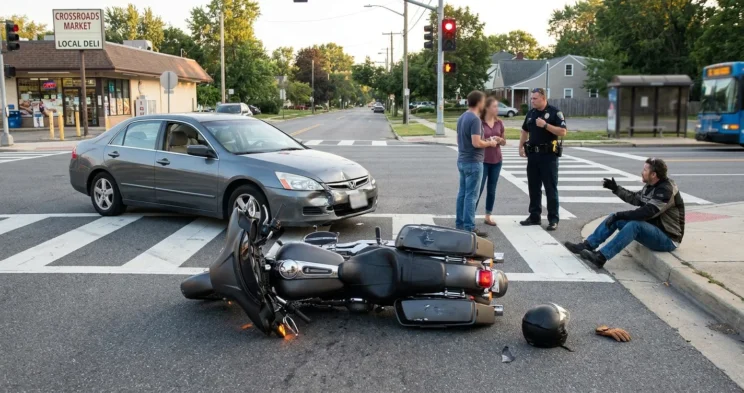
You were riding home through East Austin when a car waiting to turn left suddenly cut across your lane. You had the green light and the right of way. Now the other driver is telling their insurer they never saw you, and the adjuster is already hinting the crash was partly your fault.
Why Intersections Are Dangerous for Motorcyclists
Intersections are where most serious motorcycle crashes happen, and the numbers back that up. Texas crash data shows intersections account for a large share of motorcycle deaths and serious injuries across the state, far out of proportion to the time riders actually spend in them. You can review the state’s full breakdown in the TxDOT motor vehicle crash statistics.
The most dangerous moment is when another driver turns left. Crash data shows many fatal two-vehicle motorcycle crashes nationally involve the other vehicle turning left across the rider’s path. That single fact pattern dominates intersection crashes more than any other.
The reason is partly physical. A motorcycle presents a narrow profile, so drivers misjudge its speed and distance or miss it entirely. Pair that visibility gap with a distracted driver, and you get predictable crashes that turn into fault disputes.
Knowing how Texas law assigns blame in these crashes is the first step toward protecting your claim.
Left-Turn Crashes & Who Bears Fault
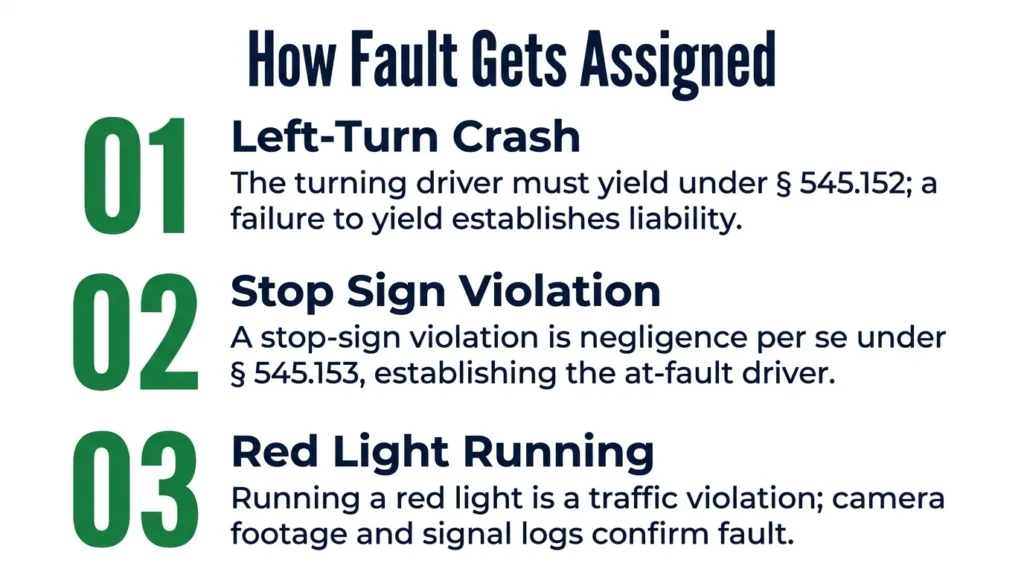
When a car turns left into your path, the turning driver is almost always the at-fault party. Texas Transportation Code § 545.152 requires any driver making a left turn to yield to oncoming traffic, and that includes motorcycles. A failure to yield gives you both the factual and the statutory basis for liability.
The driver’s favorite excuse is that they “didn’t see” you. That does not get them off the hook. Courts and adjusters judge driver attention by an objective standard, asking what a reasonable driver should have seen, not what this one claims they noticed.
Fault can get more complicated if you were speeding or weaving between lanes when the crash happened. In that case the other side will raise comparative fault, arguing you share some blame.
Even so, the turning driver’s duty to yield under § 545.152 usually stays the primary fault factor, and your share rarely erases their violation.
Adjusters know this, so they push hard to shift blame onto riders by pointing to speed or visibility. Understanding the yield obligation helps you counter that move, and so does seeing how these disputes play out when both sides point fingers.
Failure to Yield & Red Light Running
Left turns are not the only way drivers cause intersection crashes. The other two high-frequency patterns involve a driver who blows through a stop sign or runs a red light, and each one ties to a specific Texas statute that helps establish fault.
Failure to Yield at Controlled Intersections
When a driver rolls a stop sign and hits you, the statute does most of the work. Texas Transportation Code § 545.153 governs stop-sign and yield-sign intersections, while Texas Transportation Code § 545.151 sets the right-of-way rules for a vehicle entering or approaching an intersection.
A driver who ignored a stop sign and struck you when you had the right of way violated § 545.153. That violation is strong evidence of negligence per se, which means the law treats the broken rule itself as proof of carelessness.
Red Light Running
A driver who runs a red light and hits you has committed a clear traffic violation, and that directly supports a negligence finding. If the conduct was willful or wanton, Texas Transportation Code § 545.401 on reckless driving may also come into play, which can affect how your claim is valued.
Proving a red-light crash usually comes down to three sources: traffic signal timing data, intersection camera footage, and witness statements. You have to request these records fast, because cities and agencies often overwrite or discard them within days.
How Texas Comparative Fault Affects Your Claim
Texas can reduce or even erase your financial recovery based on your share of the blame. Under Texas Civil Practice and Remedies Code (CPRC) § 33.001, a claimant who is 51 percent or more at fault cannot recover anything at all. This is the rule the other side hopes to use against you.
Below that line, the math is simpler than it sounds. Your damages drop by your percentage of fault. A rider found 30 percent at fault in a $100,000 case still recovers $70,000.
This is exactly why insurers work so hard to pin blame on riders. They lean on tired assumptions about speed, lane position, and whether you wore gear, then inflate your fault number to shrink the payout. Knowing how the rule actually works lets you push back when the percentages do not match the facts, and you can see how these fault fights unfold in real disputes.
Your strongest counterweight is the other driver’s own conduct. A documented failure to yield or a red-light violation pulls fault back where it belongs and makes high percentages much harder to defend.
What Evidence Establishes Fault at an Intersection
The right evidence turns a fault dispute into a clear answer, and most of it has to be collected fast. The strongest proof in an intersection motorcycle crash comes from a handful of specific sources.
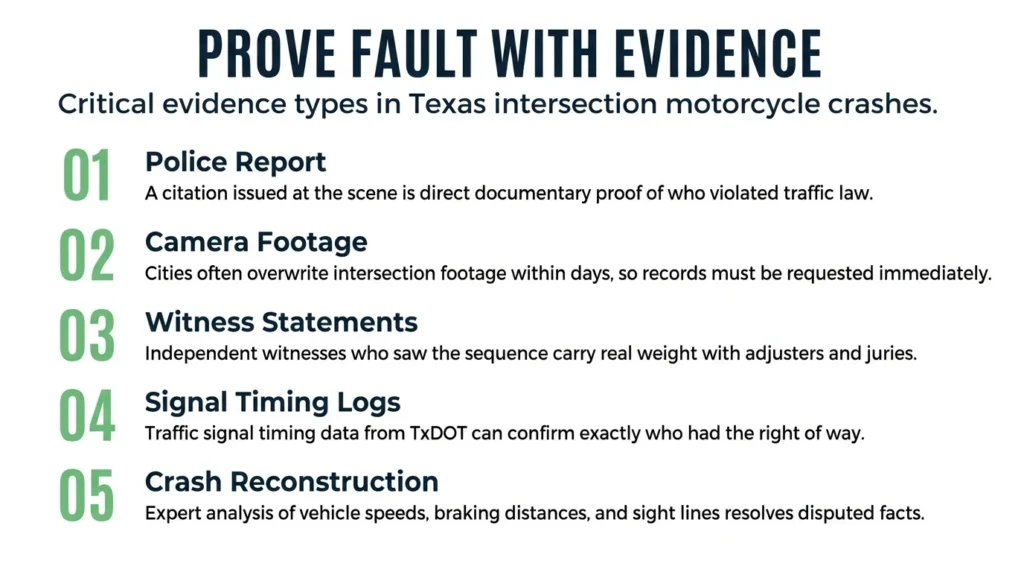
- Police report and traffic citation: An at-fault citation issued to the other driver at the scene is direct documentary evidence of who broke the rules.
- Traffic signal timing logs and camera footage: Cities and TxDOT keep these records, but you usually have to file a public records request within days before they are erased.
- Eyewitness statements and dash camera footage: Independent witnesses who saw the sequence carry real weight with adjusters and juries.
- Crash reconstruction analysis: An expert can pin down vehicle speeds, braking distances, and sight lines from the physical evidence left at the scene.
- Medical records and treatment timeline: These tie your injuries directly to the crash and show the full extent of what you are dealing with.
Side-impact crashes follow many of these same evidence rules.
Texas Filing Deadline for Intersection Crash Claims
You have two years to file. Under CPRC § 16.003, Texas sets a two-year statute of limitations for personal injury claims, and missing that deadline almost always prevents your recovery entirely.
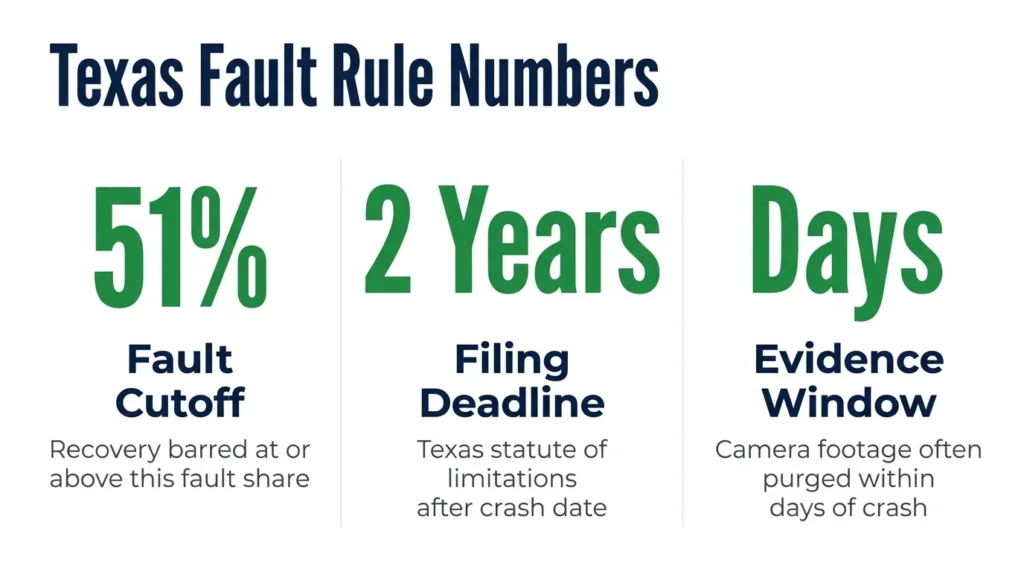
The clock starts on the date of the crash. Severe injuries or a diagnosis that comes weeks later do not automatically buy you more time under the general personal injury rules.
Here is the trap most riders fall into. The evidence that proves your case has a far shorter shelf life than the two-year deadline. Camera footage, signal timing data, and any black-box data can vanish within days or weeks.
Speak with an Experienced Attorney
Talking with an attorney early protects both your right to file and your access to proof.
An intersection crash you did not cause should not leave you fighting an insurer alone while you heal. For over 30 years, Angel Reyes & Associates has represented injured Texas motorcyclists, and we know how the other side tries to shift fault onto riders.
We work on contingency, which means no attorney fee unless we win. You pay no legal fees unless we recover for you, though you may be responsible for certain case costs and expenses regardless of outcome. Your first consultation costs nothing.
We have more than $1 billion recovered for clients across Texas, and we are available 24/7 when you need answers. Reach out for a free consultation so you understand your options before the deadline or the evidence slips away.
Past results do not guarantee future outcomes.
Motorcycle Accidents at Intersections: FAQs
Does not wearing a helmet affect my injury claim in Texas?
It can reduce your damages. Texas law allows riders 21 and older to ride without a helmet if they meet certain requirements, but if a jury finds your injuries were worse because you had no helmet, your compensation may be cut by your share of that fault.
What happens if the driver who hit me at the intersection has no insurance?
You can file a claim under your own uninsured motorist (UM) coverage if you have it on your motorcycle policy. Texas insurers must offer UM coverage, though you can reject it in writing; without it, your main option is suing the at-fault driver directly, which may not result in full payment.
Can more than one driver be at fault for an intersection motorcycle crash?
Yes. If a second vehicle contributed to the collision, Texas’s proportionate responsibility rules allow fault to be split among multiple drivers, and each at-fault party’s insurer can be held responsible for their share of your damages.
Does my motorcycle insurance include coverage for my own medical bills?
It depends on your policy. Texas insurers must offer personal injury protection (PIP) with motorcycle policies, and PIP covers medical expenses and a portion of lost wages regardless of fault. Standard medical payments coverage (MedPay), by contrast, does not apply to motorcycles under Texas law.
About the Authors

Angel Reyes
Writer
Angel L. Reyes, III is the Founder and Managing Partner of Angel Reyes & Associates. A nationally recognized trial attorney and business leader, Angel has helped over 70,000 injury victims recover more than $1 billion since founding the firm in 1993. Named to the Texas Super Lawyers list annually since 2008, Angel brings Wall Street experience, Ivy League education, and a deep commitment to client advocacy. He is a frequent legal commentator and published author with extensive contributions to legal scholarship, trial strategy, and consumer protection.

Kyle Nicolas
Editor
Kyle Nicolas is the Web Content & SEO Manager at Angel Reyes & Associates. He has more than 10 years of experience as a marketing co...

Angel Reyes
Reviewer
Angel L. Reyes, III is the Founder and Managing Partner of Angel Reyes & Associates. A nationally recognized trial attorney and business...