Motorcycle Eye Protection Laws in Texas


Every article on this site is researched by our internal team, reviewed for legal accuracy against current Texas law, and held to State Bar of Texas advertising standards before publication. We do not publish content that overstates outcomes or makes promises about results.
Learn more about our
editorial standards .
Key Takeaways
- Texas requires eye protection for motorcycle riders on all public roads unless the bike has a windshield.
- Goggles, shatter-resistant glasses, and certified face shields all satisfy the legal requirement.
- Riding without required eye protection gives insurers a fault argument that can reduce your recovery.
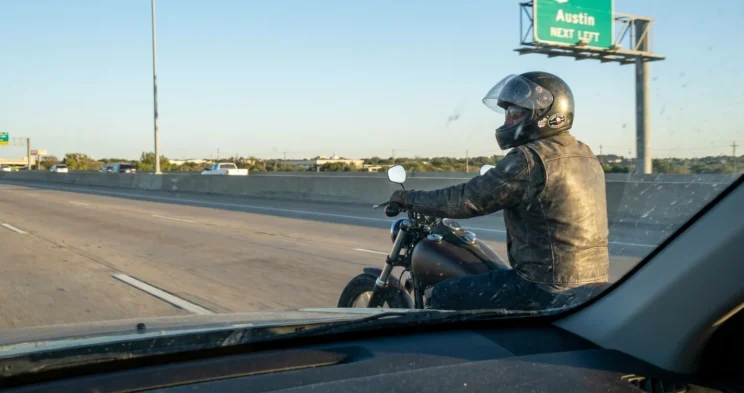
You ride every day, know your bike well, and follow the rules. But when a friend mentions that Texas requires eye protection and you’re not sure whether your windshield counts, the question suddenly feels urgent.
Getting this wrong is not just a matter of a fine. If you’re ever in a crash, what you were or weren’t wearing becomes part of how an insurance adjuster calculates your share of the blame.
What Texas Law Says About Eye Protection
Texas requires eye protection for motorcycle riders on every public road in the state. The rule is in Texas Transportation Code Chapter 661, which governs protective headgear for motorcycle operators and passengers.
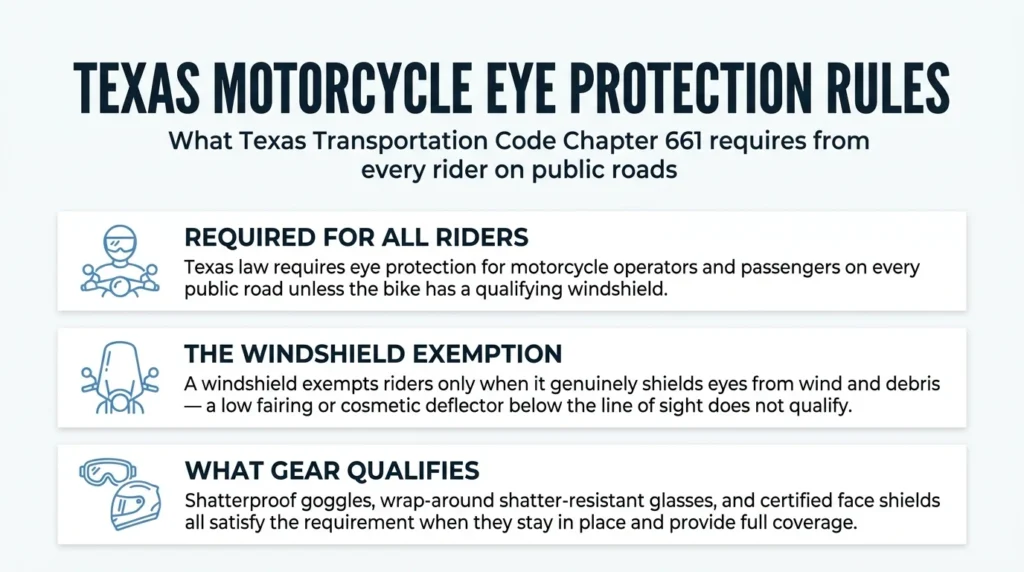
§ 661.003 makes operating or riding a motorcycle on a public street or highway without required protective gear a misdemeanor, punishable by a fine of between $10 and $50. The requirement applies to you and any passengers on the same basis.
The eye protection rule is not limited to new riders or riders under a certain age. It applies statewide to everyone on a public road unless a specific exemption covers them.
When the Windshield Exemption Applies
You do not need separate eye protection if your motorcycle is equipped with a windshield. That is the exemption Texas law provides. A windshield qualifies when it actually protects your eyes from wind and road debris.
The exemption applies to both you and any passenger, provided the windshield covers them adequately. A low fairing or small wind deflector that sits below your line of sight does not satisfy the exemption. The protection must be real, not cosmetic.
A peace officer has the authority under § 661.004 to stop and inspect your protective gear during a traffic stop. If the officer determines the windshield is not adequate and you have no other eye protection, you may receive a citation.
If you were hurt in a motorcycle crash and have questions about how your gear choices factor into your case, an attorney can review the specific facts with you. Understanding common injuries motorcyclists sustain in crashes can help you see why the presence or absence of protective gear is rarely a simple question.
What Qualifies as Compliant Eye Protection?
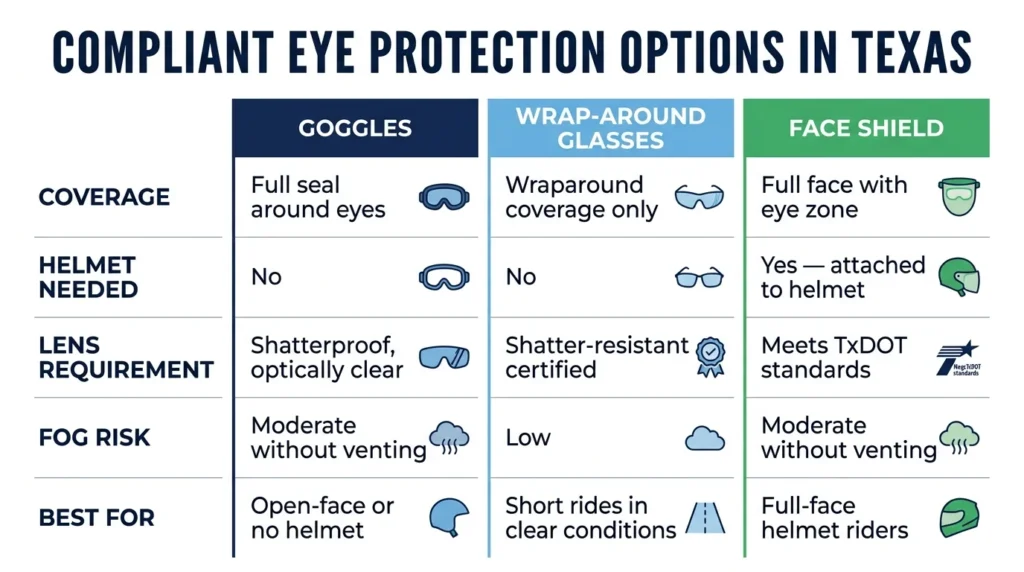
Texas does not specify a brand or a product label. The law requires protection that shields your eyes from wind, debris, and impact. Several types of gear satisfy that standard:
- Goggles: They must be shatterproof, optically clear, and fit securely against the face without blocking peripheral vision. These offer full coverage and are the most reliable option if you don’t wear a full-face helmet.
- Wrap-around safety glasses: Glasses with shatter-resistant lenses that wrap far enough to protect your eyes from wind and debris. Standard fashion sunglasses without shatter-resistant certification do not meet the standard.
- Face shield: You can use a shield attached to your helmet that meets TxDOT safety standards. If the face shield covers your eyes fully and meets the applicable standards, it satisfies the eye protection requirement.
Your gear must stay in place while riding. Equipment that slips, fogs to the point of vision impairment, or leaves gaps where wind and debris can reach your eyes would not provide the protection the law requires.
How Non-Compliance Affects Your Injury Claim
Missing required eye protection does not automatically disqualify you from recovering a motorcycle accident settlement after a crash. What it does is hand the other side a tool.
Texas uses a proportionate responsibility system under Texas Civil Practice and Remedies Code Chapter 33. Your damages are reduced by the percentage of fault assigned to you. If your share of fault exceeds 50%, you recover nothing under the 51% bar rule.
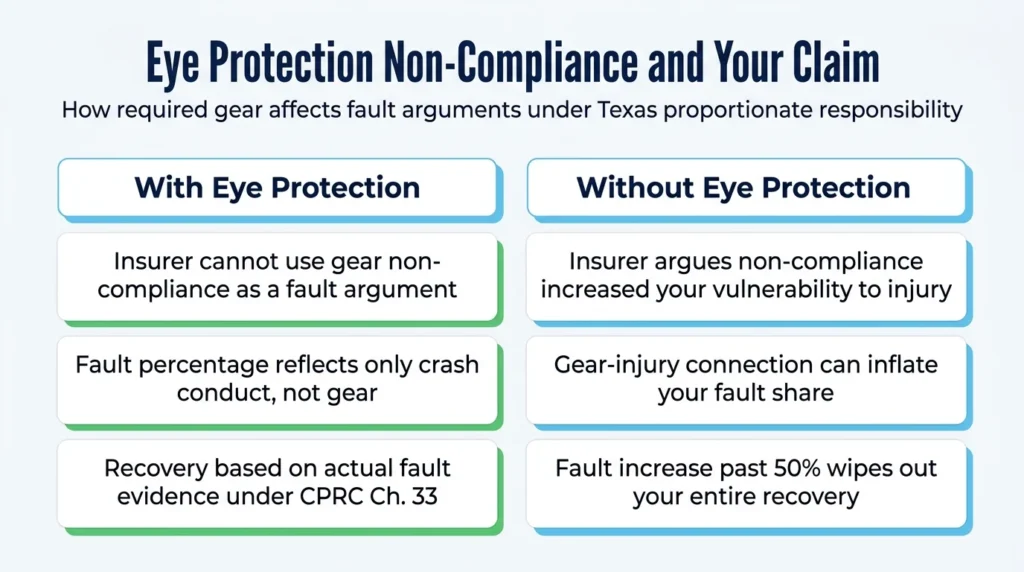
When you were required to wear eye protection and were not, insurers look for ways to tie that fact to the injury. The argument is straightforward: your eyes were unprotected, that increased your vulnerability to injury, and therefore you bear some responsibility for the harm you suffered.
That argument is strongest when the injuries involve your eyes, face, or when the crash involved debris or conditions where vision protection would have made a difference.
The argument weakens when the injury has no plausible connection to eye protection. A broken leg from a collision does not become your fault because you were not wearing goggles. But adjusters are paid to find fault, and they will raise non-compliance even when the connection is thin.
Understanding how Texas proportionate responsibility rules work puts you in a better position to push back.
Talk to an Accident Attorney About Your Case
If you were in a crash and gear compliance is part of the conversation, you should not work through that question alone. Insurers know how to use fault arguments to reduce what they pay. Your job is not to concede anything before you understand the law and the facts.
Angel Reyes & Associates has handled motorcycle accident claims across Texas for over 30 years. We offer free consultations and work on a contingency basis, meaning you pay nothing unless we recover for you. Reach out to us through our contact page to talk through your situation in English or Spanish.
Past results do not guarantee future outcomes.
Motorcycle Eye Protection FAQs
Does the eye protection requirement apply even if I am legally exempt from wearing a helmet?
Yes. The helmet exemption for riders 21 and older who complete a safety course or carry qualifying health insurance does not remove the eye protection requirement. Eye protection is a separate obligation under Chapter 661 and applies regardless of whether you are wearing a helmet.
Does the eye protection law apply to out-of-state riders traveling through Texas?
Yes. Texas law applies to anyone operating or riding a motorcycle on a Texas public road, regardless of where the rider is licensed or where the motorcycle is registered.
Can I use a full-face helmet to meet the eye protection requirement?
A full-face helmet with a face shield that meets TxDOT safety standards satisfies the eye protection requirement. If the face shield covers your eyes and meets the applicable standards, you do not need separate goggles or glasses.
If my crash had nothing to do with my eyes, can an insurer still use missing eye protection against me?
Insurers may try, but the argument carries much less weight when the injury has no connection to the unprotected eyes. A broken arm or a spinal injury from a collision is not worse if you weren’t wearing goggles, and a skilled attorney can contest any fault percentage an insurer assigns based on a connection that does not hold up.
About the Authors

Angel Reyes
Writer
Angel L. Reyes, III is the Founder and Managing Partner of Angel Reyes & Associates. A nationally recognized trial attorney and business leader, Angel has helped over 70,000 injury victims recover more than $1 billion since founding the firm in 1993. Named to the Texas Super Lawyers list annually since 2008, Angel brings Wall Street experience, Ivy League education, and a deep commitment to client advocacy. He is a frequent legal commentator and published author with extensive contributions to legal scholarship, trial strategy, and consumer protection.

Kyle Nicolas
Editor
Kyle Nicolas is the Web Content & SEO Manager at Angel Reyes & Associates. He has more than 10 years of experience as a marketing co...

Angel Reyes
Reviewer
Angel L. Reyes, III is the Founder and Managing Partner of Angel Reyes & Associates. A nationally recognized trial attorney and business...