Pain & Suffering in a Texas Motorcycle Accident Claim


Every article on this site is researched by our internal team, reviewed for legal accuracy against current Texas law, and held to State Bar of Texas advertising standards before publication. We do not publish content that overstates outcomes or makes promises about results.
Learn more about our
editorial standards .
Key Takeaways
- Texas does not cap pain and suffering damages in motorcycle accident personal injury cases.
- Filing a §18.001 affidavit locks in the economic base that drives your non-economic damages award.
- Riders found more than 50% at fault for the crash cannot recover pain and suffering under Texas law.

You walked away from the crash, but you have not walked away from the pain. It follows you into every workday, every night trying to sleep, and every time you try to lift something you used to carry without thinking.
The insurance adjuster has already called. The offer they put on the table does not come close to covering what you have been through. That gap between their number and your reality has a name in Texas law: pain and suffering.
What Pain & Suffering Actually Covers
Pain and suffering is not a vague add-on to a motorcycle accident claim. Under Texas law, it is a recognized category of non-economic damages that includes physical pain, mental anguish, emotional distress, disfigurement, physical impairment, and loss of enjoyment of life.
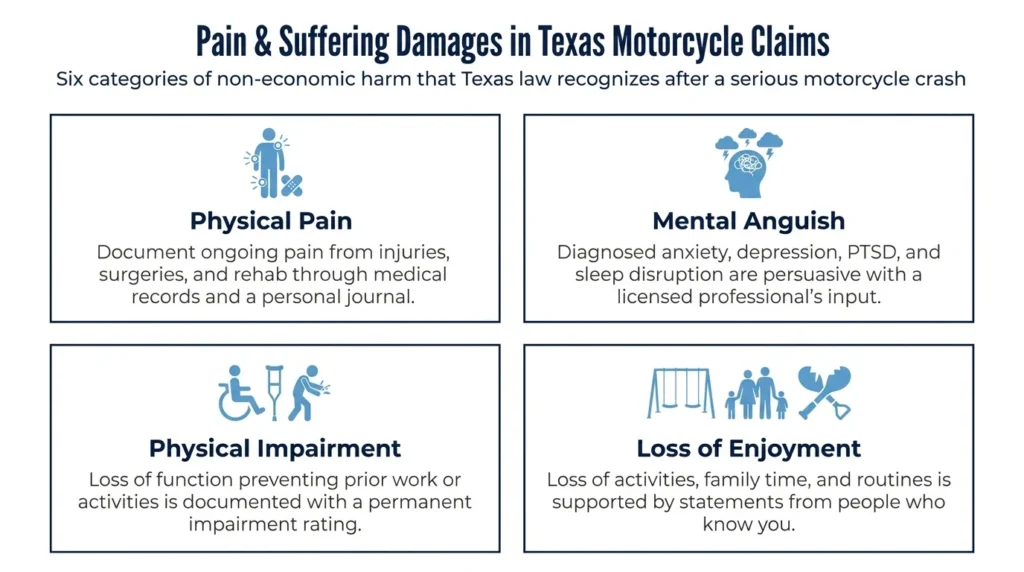
These categories cover real, measurable changes to your life. Physical impairment captures the fact that you can no longer do the job you did before. Loss of enjoyment of life covers the recreational activities, time with family, and daily routines the crash took from you. Mental anguish covers the anxiety, depression, and sleep disruption that follow a serious crash.
Texas does not cap non-economic damages for motorcycle accident claims. The statutory cap that applies in medical malpractice cases does not extend to personal injury cases. Texas Civil Practice and Remedies Code Chapter 33 discusses proportionate responsibility and the compensation structure for personal injury claims, and it sets no limit on what a jury may award for pain and suffering in a standard crash case.
That means the size of the non-economic award depends on the evidence, not on a predetermined limit.
How Texas Calculates Pain & Suffering
There is no statutory formula for calculating pain and suffering in Texas. Two methods are used in practice, and both start from the same place: your economic damages.
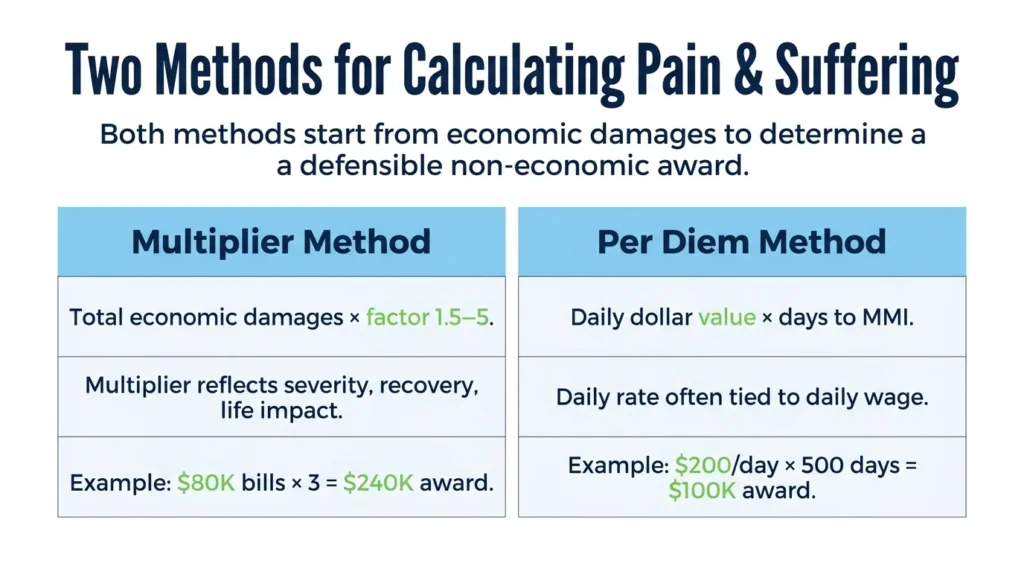
The multiplier method takes your total verifiable economic damages, including medical bills and lost wages, and multiplies them by a number between 1.5 and 5. The multiplier reflects injury severity, length of recovery, need for ongoing care, and the impact on your ability to work and live normally. A rider who needed three surgeries and faces a permanent mobility restriction will carry a higher multiplier than one who recovered fully in six weeks.
The per diem method assigns a daily dollar value to your suffering, starting on the date of the crash and running through maximum medical improvement (MMI). MMI is the point your physician determines your condition has stabilized. The daily rate is often linked to something defensible, such as your daily wage.
Texas juries hold broad discretion when setting non-economic awards. There is no formula they are required to follow. What they see in the record, and how well your attorney presents the human cost of the crash, shapes the outcome.
One factor that can reduce your recovery is your own percentage of fault. Texas uses a modified comparative fault system. If you are found more than 50% responsible for the crash, you cannot recover any damages. If you are found 30% responsible, your total award is reduced by 30%.
This is why insurers will often raise fault questions early. You can learn more about how Texas comparative negligence and the 51% rule works.
The §18.001 Affidavit & Your Economic Foundation
Before pain and suffering can be calculated, the economic damages have to be proven. That is where the Texas § 18.001 affidavit procedure becomes critical.
Texas Civil Practice and Remedies Code § 18.001 allows a plaintiff to establish that their medical bills were reasonable and necessary through a sworn affidavit from the healthcare provider or their records custodian. The affidavit substitutes for live expert testimony on billing. Without it, proving that a $12,000 surgical bill was reasonable requires calling an expert witness to testify in person.
The affidavit must be served to all other parties by 90 days after the defendant files an answer or the plaintiff’s expert designation deadline. If the defense does not file a counter-affidavit challenging the charges, those costs are treated as prima facie reasonable, or “at first sight reasonable,” and necessary. The defense can still contest them at trial, but they lose a significant procedural advantage.
The stakes are practical. If your motorcycle accident produced $80,000 in documented medical expenses that go uncontested under § 18.001, and your attorney argues for a 3x multiplier given your injuries, that economic foundation produces a $240,000 non-economic damages figure before any fault-related decrease. The affidavit procedure is not a legal technicality. It is the structural foundation under every pain and suffering number your attorney puts in front of an adjuster or jury.
Documentation That Supports Your Claim
Insurance adjusters and juries weigh pain and suffering based on what exists in the record. Starting the documentation process immediately after the crash gives you the best position when the claim is eventually valued.
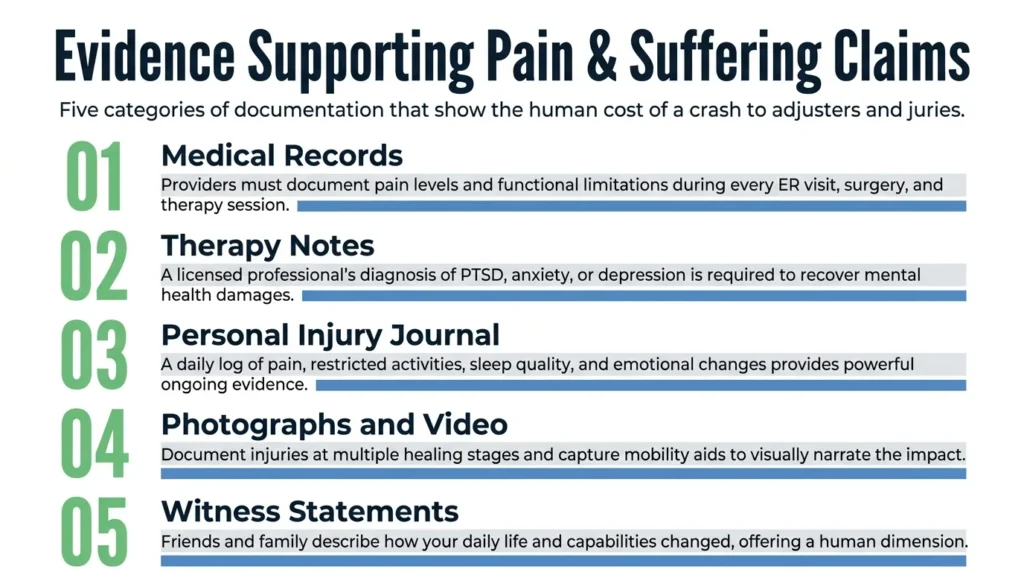
Here are the categories of evidence that carry the most weight:
- Medical records. Every ER visit, specialist consultation, surgical note, physical therapy session, and prescription record. Records should capture ongoing and worsening symptoms, not just the initial diagnosis. Ask your providers to document pain levels, functional limitations, and how your condition affects daily activities at each visit.
- Therapy notes. Mental health treatment records documenting PTSD, anxiety, depression, or sleep disruption are recoverable non-economic damages under Texas law. A documented diagnosis from a licensed mental health professional is far more persuasive to an adjuster or jury than an unsupported description.
- Personal injury journal. Start a daily log on the day of the crash. Record your pain level on a 1-to-10 scale, note activities you could not perform, describe how you slept, and document emotional changes. Consistency over months of entries is powerful evidence.
- Photographs and video. Document your injuries at multiple stages of healing. Photograph mobility aids, assistive devices, and anything that shows physical restriction. A photo of your motorcycle helmet cracked from impact tells a different story than the adjuster’s description of a “minor collision.”
- Statements from people who know you. Friends, family members, and coworkers who can describe how your personality, capabilities, and daily life changed after the crash provide a human dimension the medical record alone cannot capture.
You have two years from the date of the crash to file a lawsuit under Texas Civil Practice and Remedies Code § 16.003. Documentation gaps discovered after that deadline cannot be corrected. The time to build the record is now, not after the adjuster makes a low offer.
The injuries themselves matter too. Learn about common injuries in motorcycle accidents to understand how the medical picture connects to claim value.
Work with an Experienced Attorney
Pain and suffering claims in motorcycle accident cases require documented evidence, knowledge of the §18.001 affidavit procedure, and a clear presentation of how the crash changed your life. Adjusters are trained to minimize non-economic awards, and a low first offer is standard practice.
Angel Reyes & Associates has spent over 30 years helping injured Texans recover full compensation after motorcycle crashes. We handle motorcycle accident claims across the entire state, with more than 20 office locations and a team available 24/7. The consultation is free, and you pay nothing unless we win.
If you are ready to have someone review your claim and tell you what your pain and suffering is actually worth, contact us today.
Past results do not guarantee future outcomes.
Pain & Suffering Claim FAQs
Should I settle my motorcycle accident claim before reaching maximum medical improvement?
Settling before you reach MMI means you may not know the full extent of your injuries or future treatment costs, and once you sign a release you cannot go back for more money if your condition worsens. Waiting until MMI gives your attorney the most accurate picture of your total damages before negotiating.
Can the at-fault driver's insurance company challenge the medical bills I submit?
Yes. The defense can file a counter-affidavit under Texas law challenging whether your medical charges were reasonable and necessary, and they have up to 120 days after filing their answer to do so. If no counter-affidavit is filed by that deadline, your bills are treated as prima facie reasonable, though the defense can still raise the issue at trial.
What happens to my pain and suffering claim if the at-fault driver had no insurance?
You can still pursue the uninsured driver directly through a civil lawsuit, though collecting a judgment against someone with no assets can be difficult. If you carry uninsured or underinsured motorist coverage on your own policy, that coverage can pay your pain and suffering damages up to the policy limits.
Can I recover punitive damages on top of pain and suffering after a motorcycle crash?
Punitive damages, called exemplary damages in Texas, are available only when you can prove by clear and convincing evidence that the defendant acted with fraud, malice, or gross negligence. A drunk driver who caused your crash, for example, may meet the gross negligence standard, which could open the door to exemplary damages beyond your compensatory award.
Does wearing a helmet affect my pain and suffering recovery in Texas?
Texas law does not require all riders to wear helmets, though those over 21 may opt out if they meet certain conditions. If you were not wearing a helmet, the defense may argue that your injuries were more severe because of that choice, which could affect your percentage of fault and reduce your recovery under Texas proportionate responsibility rules.
About the Authors

Angel Reyes
Writer
Angel L. Reyes, III is the Founder and Managing Partner of Angel Reyes & Associates. A nationally recognized trial attorney and business leader, Angel has helped over 70,000 injury victims recover more than $1 billion since founding the firm in 1993. Named to the Texas Super Lawyers list annually since 2008, Angel brings Wall Street experience, Ivy League education, and a deep commitment to client advocacy. He is a frequent legal commentator and published author with extensive contributions to legal scholarship, trial strategy, and consumer protection.

Kyle Nicolas
Editor
Kyle Nicolas is the Web Content & SEO Manager at Angel Reyes & Associates. He has more than 10 years of experience as a marketing co...

Angel Reyes
Reviewer
Angel L. Reyes, III is the Founder and Managing Partner of Angel Reyes & Associates. A nationally recognized trial attorney and business...