Rideshare Accidents in Bad Weather in Texas


Every article on this site is researched by our internal team, reviewed for legal accuracy against current Texas law, and held to State Bar of Texas advertising standards before publication. We do not publish content that overstates outcomes or makes promises about results.
Learn more about our
editorial standards .
Key Takeaways
- Bad weather raises a Texas rideshare driver's duty of care; it never excuses negligence.
- Active-ride Uber and Lyft crashes carry at least $1 million in liability coverage.
- Texas gives you two years from the crash date to file your injury lawsuit.
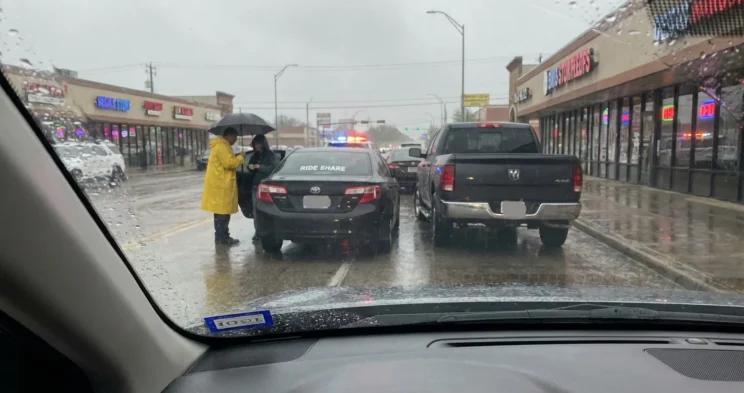
You were riding home in an Uber on I-10 near the Galleria when a sudden downpour turned the road slick. Your driver kept the same speed, the car hydroplaned, and now you are hurt and confused about who pays for it.
The weather makes everything feel murkier. Did the rain cause the crash, or did your driver? And can Uber or Lyft simply blame the storm and walk away?
Rideshare Drivers’ Duty of Care in Bad Weather
A rideshare driver owes you the same legal duty in a storm as on a clear day, and the bad weather raises that standard rather than lowering it. Texas law expects every driver to travel at a speed that is reasonable and prudent for the conditions in front of them.
That standard comes from Texas Transportation Code § 545.351. When rain cuts visibility or ice steals traction, a safe speed drops well below the posted limit.
So bad weather does not excuse a driver. It demands more care, not less.
A driver who holds normal highway speed on an icy road can be found negligent. The same is true for following too closely in heavy rain, even when the weather played a part in the crash.
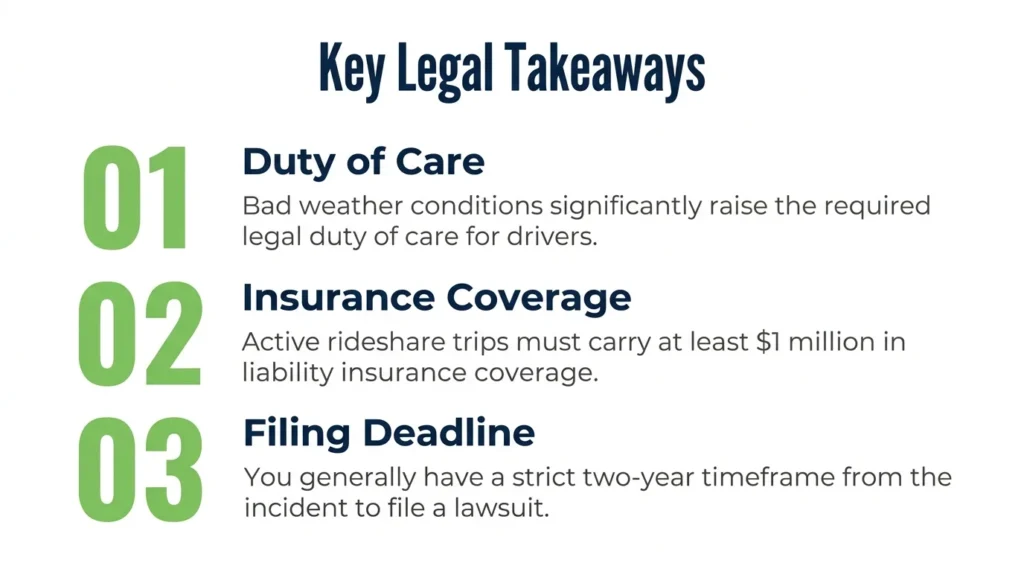
Drivers also have a duty to slow down, pull over, or turn down a trip when conditions make safe driving impossible. Choosing to keep driving through clearly dangerous conditions can itself be a breach of that duty. You can learn more about how these claims work.
Does Bad Weather Change Who Is at Fault?
Weather can shift the math on fault, but it rarely erases a negligent driver’s share. Texas uses a modified comparative negligence rule under Chapter 33 of the Texas Civil Practice and Remedies Code.
Under that rule, fault is split into percentages among everyone who contributed to the crash. A driver can still be found mostly or fully at fault in a storm if their conduct fell below that reasonable-and-prudent standard.
Crash reports add another layer of confusion. TxDOT records list weather as a contributing factor, not as a legal cause that decides liability.
So if the investigation shows your driver’s speed or following distance was unsafe for the conditions, the weather note in the report does not protect them. The negligence finding can still stand.
Other drivers may carry a share too. Another motorist who lost control on the ice can be assigned a percentage of the fault alongside your driver.
In that situation, a jury or a settlement sets the fault percentages across all parties. As an injured passenger, you can pursue every at-fault party for your damages. If your crash involved several drivers, you can read more about pursuing multiple parties after a rideshare accident.
Insurance Coverage for Bad-Weather Rideshare Crashes
The insurance that covers your crash depends entirely on the driver’s app status at the moment of impact, not on the weather. Texas Insurance Code Chapter 1954 splits rideshare driver coverage into three periods tied to that app status.
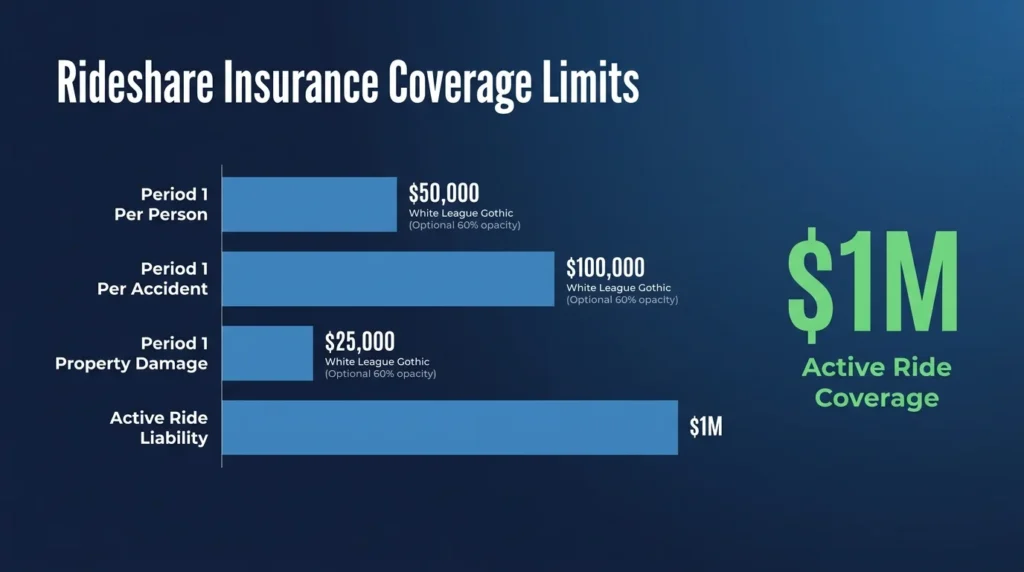
Finding out which period was active when you were hurt is the first step toward the right policy.
Period 1 Coverage (App On, No Ride Accepted)
When the app is on but the driver has not yet accepted a trip, the platform’s contingent coverage applies at reduced limits. Texas law requires at least $50,000 per person and $100,000 per accident in bodily injury coverage during this period, plus a minimum of $25,000 for property damage.
If the driver’s personal auto policy excludes rideshare activity, this contingent coverage becomes your primary source of compensation. The driver’s personal insurer may deny the claim outright. That happens when the driver was using the car for commercial purposes without a rideshare endorsement on the policy.
These crashes often spark coverage fights in bad weather. The driver may claim personal use, while the platform contests whether the app was even on at the time of impact.
Period 2 & 3 Coverage (Ride Accepted Through Drop-Off)
Once a driver accepts your trip or you are in the car, Uber and Lyft must carry at least $1,000,000 in third-party liability coverage per occurrence. This is the policy most often at stake when a passenger gets hurt in a storm.
That commercial policy covers passengers and other injured parties during the active ride. The weather does not change whether it applies, because the policy holds regardless of the conditions outside.
Protecting your claim starts with proof of the driver’s app status when the crash happened. Uber and Lyft keep detailed trip records, and an attorney can subpoena them to confirm which period was active. Knowing the right steps to take after a rideshare accident helps you protect that evidence early.
Can Uber or Lyft Be Responsible for a Weather Crash?
Uber and Lyft can be held responsible in some cases, but they fight hard to avoid it by calling their drivers independent contractors. Texas courts usually honor that label unless there is proof the platform controlled the driver’s day-to-day conduct.
That classification blocks many claims that try to hold the platform responsible for the driver’s actions. You can read more about what happens when an Uber crashes in Texas.
A direct claim against the platform can still survive on a different theory. If Uber or Lyft kept dispatching drivers during a declared weather emergency or known hazardous conditions, that choice may show the platform created an unreasonable risk.
Texas does set rules for how these companies operate. Texas Occupations Code Chapter 2402 sets the statewide framework for rideshare companies.
It confirms that Uber and Lyft are not common carriers in Texas, which shapes the standard of care. It does not, however, give the platforms immunity from direct negligence claims.
This deployment theory is still being tested in court. No Texas appellate court has settled it in a weather case yet, so documenting the facts of your crash carefully matters more than usual since they may shape how your case is argued.
After a Weather Crash: Time Limits & Next Steps
You generally have two years from the date of the crash to file a personal injury lawsuit in Texas. That deadline comes from Texas Civil Practice and Remedies Code § 16.003. The clock usually starts the day you are hurt. Waiting too long can cost you the right to sue at all.
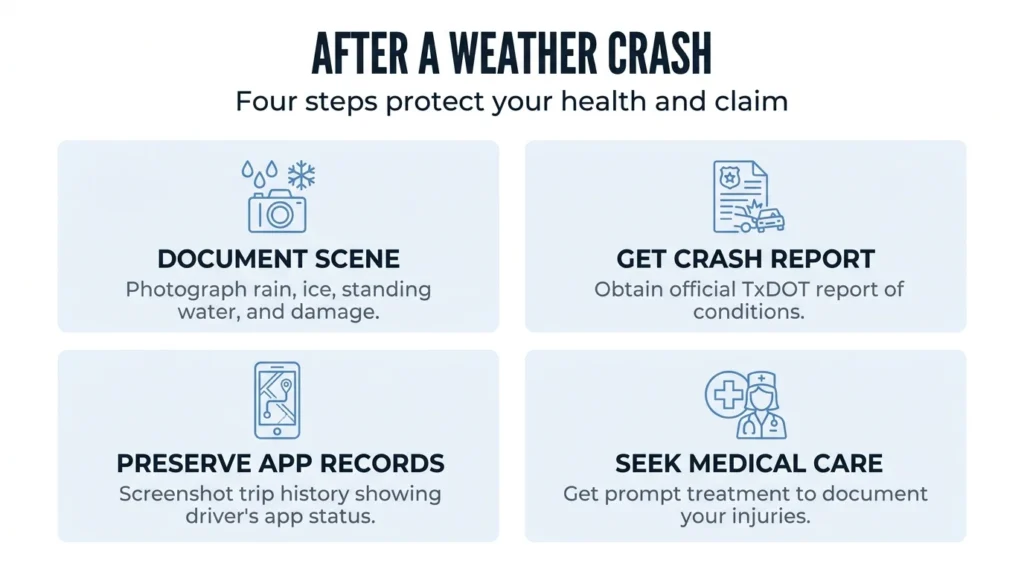
A few clear steps right after the crash protect both your health and your claim.
- Step 1: Document the road and weather at the scene. Take photos and video of the rain, ice, standing water, and any damage while everything is still fresh.
- Step 2: Get a copy of the TxDOT crash report. This report records the official details of how the crash happened and what conditions were noted.
- Step 3: Preserve the in-app trip records. Screenshot your ride history so you can show the driver’s app status at the time of impact.
- Step 4: Seek prompt medical attention. A timely medical record ties your injuries directly to the crash and supports your damages.
One more piece of advice protects you from a common trap. Do not give a recorded statement to the rideshare company’s insurer, and do not accept an early settlement before you know the full extent of your injuries.
Adjusters may argue the weather caused the crash to shrink your payout. You can find help close to home through our office locations across Texas.
Talk to Angel Reyes & Associates About Your Weather Crash
A bad-weather rideshare crash leaves you sorting through layers of fault, app status, and insurance coverage at the worst possible time. You do not have to sort through it alone. Our attorneys are here to help.
Angel Reyes & Associates has spent over 30 years helping injured Texans hold negligent drivers and companies accountable. We work on contingency, so you pay no fee unless we win, and we have recovered more than $1 billion for clients across the state.
Your first consultation is free, and we are available 24/7 to answer your questions. Reach out to us to review your options.
Past results do not guarantee future outcomes.
Rideshare Accidents in Bad Weather FAQs
Can a passenger be found partly at fault for requesting an Uber or Lyft during bad weather?
Simply choosing to ride during a storm does not make a passenger negligent under Texas law. Fault is assigned based on conduct, and requesting a ride is not considered a breach of any duty you owe to others on the road.
Does Uber or Lyft carry uninsured motorist coverage if another driver caused the bad-weather crash?
Yes. Texas law requires TNCs to maintain uninsured and underinsured motorist coverage during active trips (Periods 2 and 3). If an uninsured driver causes a crash while you are a passenger on an active ride, that coverage can step in to pay for your injuries.
Can my rideshare driver still be liable if they were following the posted speed limit when the crash happened?
Yes. Texas’s “reasonable and prudent” standard goes beyond posted limits. A driver traveling at the legal speed limit on an icy road or through heavy rain can still be found negligent if that speed was unsafe for the actual conditions.
Can I use my own health insurance while my rideshare accident claim is being resolved?
Yes, and it is often a practical way to keep medical bills out of collections while the liability claim is pending. Be aware that your health insurer may seek reimbursement from your eventual settlement through a subrogation claim, so tracking all medical costs from the start matters.
About the Authors

Angel Reyes
Writer
Angel L. Reyes, III is the Founder and Managing Partner of Angel Reyes & Associates. A nationally recognized trial attorney and business leader, Angel has helped over 70,000 injury victims recover more than $1 billion since founding the firm in 1993. Named to the Texas Super Lawyers list annually since 2008, Angel brings Wall Street experience, Ivy League education, and a deep commitment to client advocacy. He is a frequent legal commentator and published author with extensive contributions to legal scholarship, trial strategy, and consumer protection.

Kyle Nicolas
Editor
Kyle Nicolas is the Web Content & SEO Manager at Angel Reyes & Associates. He has more than 10 years of experience as a marketing co...

Angel Reyes
Reviewer
Angel L. Reyes, III is the Founder and Managing Partner of Angel Reyes & Associates. A nationally recognized trial attorney and business...