T-Bone Motorcycle Accidents: Causes, Injuries, and Compensation


Every article on this site is researched by our internal team, reviewed for legal accuracy against current Texas law, and held to State Bar of Texas advertising standards before publication. We do not publish content that overstates outcomes or makes promises about results.
Learn more about our
editorial standards .
Key Takeaways
- Broadside motorcycle crashes cause pelvic, femur, hip, and internal organ injuries.
- Signal-phase logs and camera footage settle most disputed green-light fault claims.
- Texas gives injured riders two years to file a t-bone motorcycle accident claim.
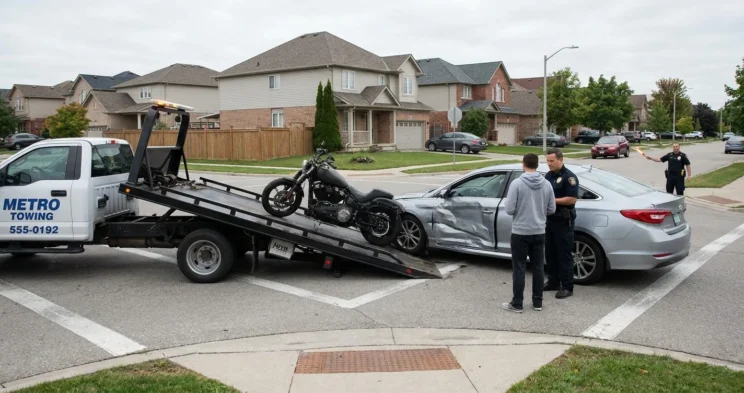
You were riding home through Fort Worth one evening when a car crossed the intersection and slammed into your side. There was nothing between you and two tons of metal.
Now the other driver swears the light was green for them, and the insurance adjuster is already hinting that you share the blame.
Why T-Bone Crashes Devastate Unprotected Riders
A broadside hit harms a rider far worse than it harms a car occupant because nothing shields your body. A car has door panels, pillars, and seat belts that absorb the lateral force. On a motorcycle, your body takes the full impact directly.
That direct force transfer creates a recognizable injury pattern. Pelvic fractures, broken femurs, hip dislocations, and internal organ damage from blunt force to the abdomen are the wounds most often documented in broadside motorcycle trauma.
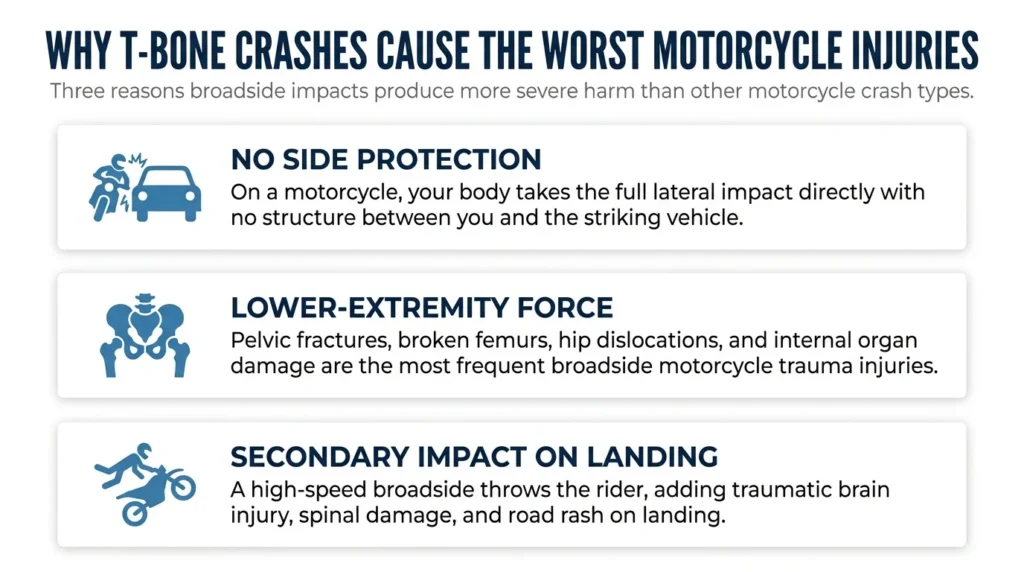
Research on lower-extremity injuries in motorcycle crashes has found that riders in broadside collisions face more than twice the risk of lower-extremity fractures compared with other crash types.
The damage rarely stops there. A high-speed broadside throws the rider, and the landing adds traumatic brain injury, spinal damage, and severe road rash on top of the first impact. A helmet helps, but it cannot protect your pelvis, your legs, or your organs.
These secondary injuries are why a t-bone motorcycle injury so often turns into a long recovery.
The numbers reflect the danger. Motorcyclists are far more likely to suffer fatal or life-altering injuries in intersection crashes than people inside enclosed vehicles. The latest Texas motorcycle accident statistics show how often these intersection collisions turn serious.
Fault in a T-Bone Crash When Both Drivers Claim a Green Light
Texas does not force you to be blameless to receive compensation for your injuries. Under the state’s modified comparative fault system, you can still collect compensation as long as your share of fault stays at 50 percent or below. The Texas Civil Practice and Remedies Code (CPRC) § 33.001 sets that rule, and any percentage assigned to you reduces what you collect.
So a disputed green light is not the end of your claim. It is a question of evidence and percentages.
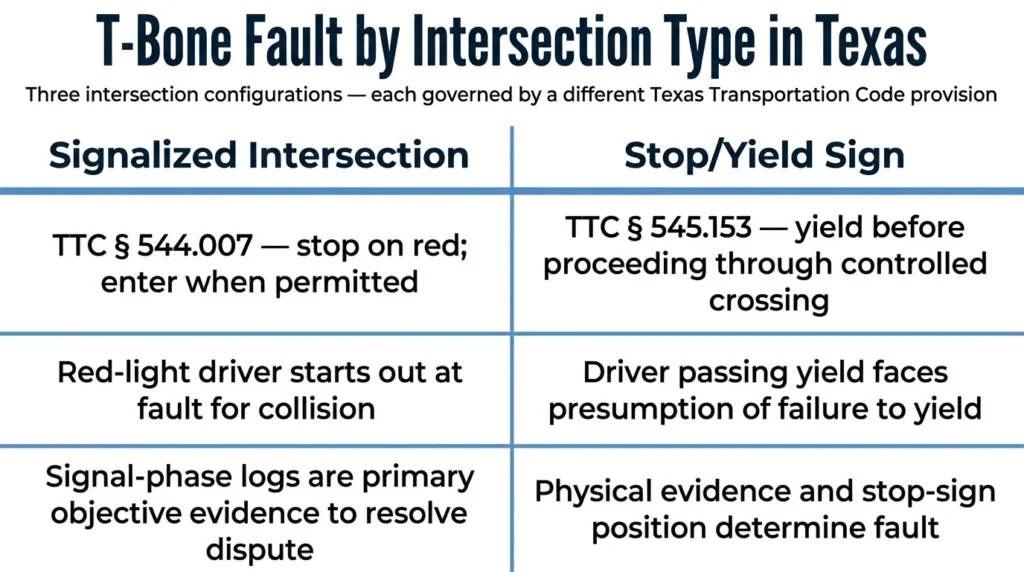
At a signalized intersection, the law is plain. A driver must stop on red and cannot enter until the signal allows it, a duty set out in the Texas Transportation Code § 544.007. The driver who entered against the light carries the greater share of fault.
Some intersection motorcycle accident cases in Texas happen where no signal controls traffic at all.
At uncontrolled crossings, Texas Transportation Code § 545.151 decides who must yield, while at stop-sign or yield-sign controlled intersections, Texas Transportation Code § 545.153 applies. A driver who enters after passing a yield sign without stopping faces a “prima facie”, or at first sight, presumption that they failed to yield.
Either way, a driver who ignores that duty starts out at fault.
Adjusters know all of this, and they still try to pin part of the blame on you. They assume you were speeding, riding in the wrong part of the lane, or not paying attention. Those assumptions are guesses, and you can challenge them with hard evidence rather than letting the insurer’s story stand. Disputes like this come up constantly.
If your crash was a car-versus-car broadside rather than a motorcycle collision, the injury and liability picture differs.
Evidence That Resolves a Disputed Green-Light Claim
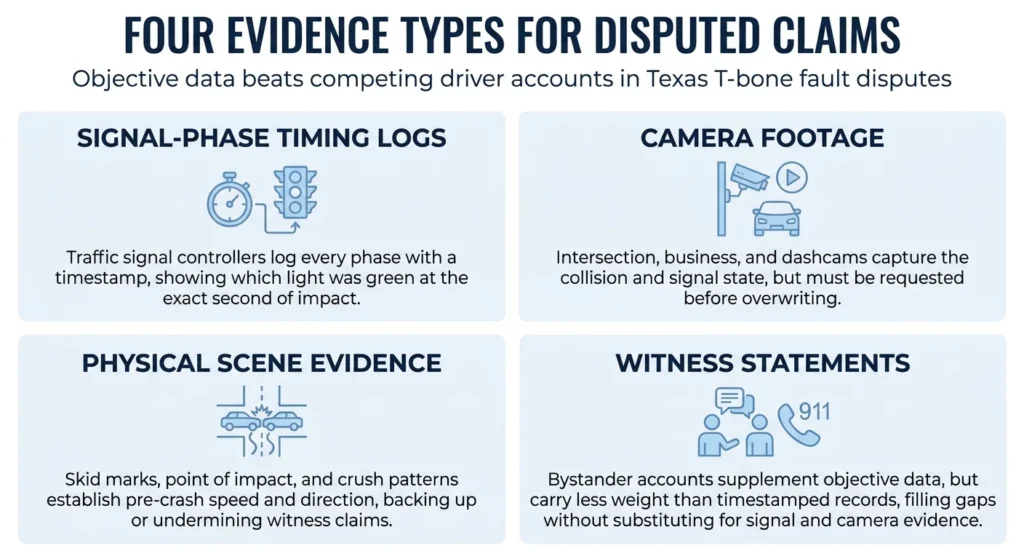
Two kinds of objective evidence usually settle a disputed signal faster than any argument: timing data from the traffic signal itself, and camera footage of the crossing. Both can confirm or contradict each driver’s account of the light. Here is how each one works in a side impact motorcycle crash:
- Signal-phase timing data. Traffic signal controllers log every phase, green, yellow, and red, with a timestamp. Subpoenaed or pulled through a public records request, those logs can show which light was green at the exact second of impact.
- Intersection camera footage. Municipal traffic cameras, red-light enforcement cameras, and nearby business surveillance can capture both the crash and the signal state. This footage is often erased on a 30-to-90-day cycle, so an early preservation demand letter is important.
- Physical evidence at the scene. Skid marks, the point of impact inside the intersection, and the crush pattern on each vehicle can establish pre-crash speed and direction. That physical record can back up or undercut what a witness claims to have seen.
- Witness statements and 911 records. These help fill gaps, but they carry less weight than objective data once timing logs or footage exist. Memory is unreliable; a timestamp is not.
If your crash happened in North Texas, our team of Dallas t-bone accident attorneys handles intersection collision cases like these. State crash data analysis from the Texas Department of Transportation also tracks how often intersection collisions occur statewide.
Compensation After a Broadside Motorcycle Crash
You can pursue both economic and non-economic damages after a broadside crash. Economic damages cover your hard costs: emergency treatment, surgery, rehabilitation, future medical care, lost wages, lost future earning capacity, and the damage to your bike.
Non-economic damages cover what the injuries cost you beyond dollars. Pain and suffering, physical impairment, disfigurement, and lost enjoyment of life fall here. In a catastrophic case involving pelvic, femur, and hip damage, these often make up the largest part of a side impact motorcycle crash settlement.
The value of a claim depends heavily on the severity and permanence of the injury. You can review how motorcycle accident settlements work in Texas for a breakdown of what shapes the final number.
When a t-bone crash takes a rider’s life, the family’s options change. Surviving relatives may bring a wrongful death claim alongside the survival action the estate can file.
You do not have unlimited time to act. Texas sets a two-year deadline on personal injury claims under CPRC § 16.003. Miss it and you lose the right to sue, no matter how strong your case is.
Talk to an Experienced Attorney
That two-year deadline is one reason to preserve evidence and get advice early, since footage disappears long before two years pass.
Angel Reyes & Associates has spent over 30 years helping injured Texans hold the right party accountable, with more than $1 billion recovered for clients. We work on contingency, so there is no fee unless we win, and your first consultation is always free. With more than 20 office locations across the state, help is never far away.
What’s more, we bring the same scrutiny we bring to every motorcycle accident claim we handle. Schedule a free consultation and we will review your crash, the evidence, and your options. Every case is different.
Past results do not guarantee future outcomes.
T-Bone Motorcycle Accident FAQs
What if the driver who hit me doesn't have enough insurance to cover my injuries?
If the other driver’s policy limits are too low to cover your losses, your own uninsured/underinsured motorist (UM/UIM) coverage can make up the gap. Texas law requires insurers to offer UM/UIM coverage on every policy, so you may have it even if you never specifically requested it, unless you rejected it in writing.
Can a motorcycle passenger injured in a t-bone crash file their own claim?
Yes. A passenger on the motorcycle is treated as a third party, not an at-fault driver, so they can file claims against the driver who caused the crash and, if the motorcycle operator shared any fault, against that rider’s insurance as well. Passengers rarely bear any portion of fault, which generally gives them a clear path to recovery.
Does not wearing a helmet affect how much compensation I can recover in Texas?
Texas allows riders over 21 to ride without a helmet if they meet certain insurance or safety-course requirements, but an insurer or defense attorney may argue that your head injuries were worse because you weren’t wearing one. If a jury agrees, your compensation for those specific injuries could be reduced in proportion to any fault percentage assigned to you.
What happens if the traffic signal was malfunctioning when the crash occurred?
When a signal fails, Texas law generally requires drivers to treat the intersection as a four-way stop. A government entity, such as a city or county, may share liability if it knew the signal was broken and failed to fix it within a reasonable time.
Does lane splitting affect fault if I was involved in a t-bone crash?
Lane splitting is illegal in Texas, so a rider who was splitting lanes at the time of a crash may be assigned a share of fault for violating traffic law. That said, Texas’s comparative fault system still allows a rider to recover if their percentage of fault stays at 50 percent or below.
About the Authors

Alex Ivanov
Writer
Alex Ivanov is a personal injury attorney at Angel Reyes & Associates, focused on car, truck, and motorcycle accident cases. Licensed in Texas and multiple federal districts, Alex brings international legal experience and a global education to his practice. He earned his LL.M. from Texas A&M University School of Law after graduating from Belarussian State University in 2016. Alex is fluent in Russian, English, Ukrainian, and Belarussian, and is recognized by multiple national trial lawyer associations for his results and leadership under 40.

Kyle Nicolas
Editor
Kyle Nicolas is the Web Content & SEO Manager at Angel Reyes & Associates. He has more than 10 years of experience as a marketing co...

Angel Reyes
Reviewer
Angel L. Reyes, III is the Founder and Managing Partner of Angel Reyes & Associates. A nationally recognized trial attorney and business...