Passenger and Bystander Claims in Truck Accidents


Every article on this site is researched by our internal team, reviewed for legal accuracy against current Texas law, and held to State Bar of Texas advertising standards before publication. We do not publish content that overstates outcomes or makes promises about results.
Learn more about our
editorial standards .
Key Takeaways
- Your right to compensation as a passenger does not depend on the driver of your car’s share of fault.
- Texas prohibits recovery only if your own share of fault reaches 51% or more in a crash.
- Texas law generally gives you two years from the crash date to file an injury claim.
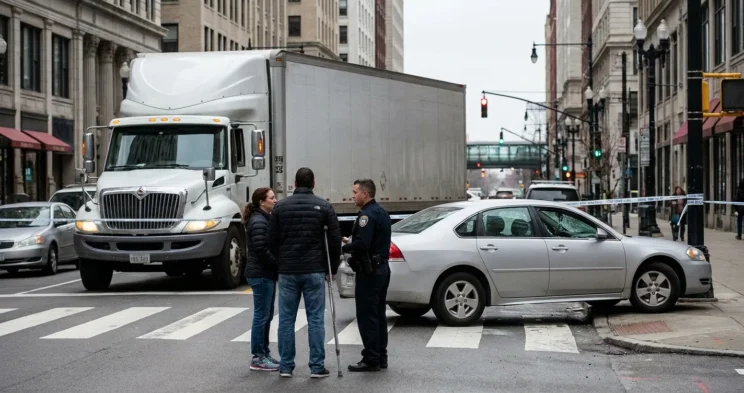
You were riding in the passenger seat on Interstate 10 near downtown Houston when a loaded 18-wheeler suddenly forced its way into your lane. You were not the driver, yet you are the one dealing with medical bills, missed paychecks, and an injury you did not cause.
The good news is that even if the driver shares some responsibility for the crash, you may still have a right to compensation. The first step is figuring out who may be legally responsible for your injuries.
Who Is Liable in a Truck Accident?
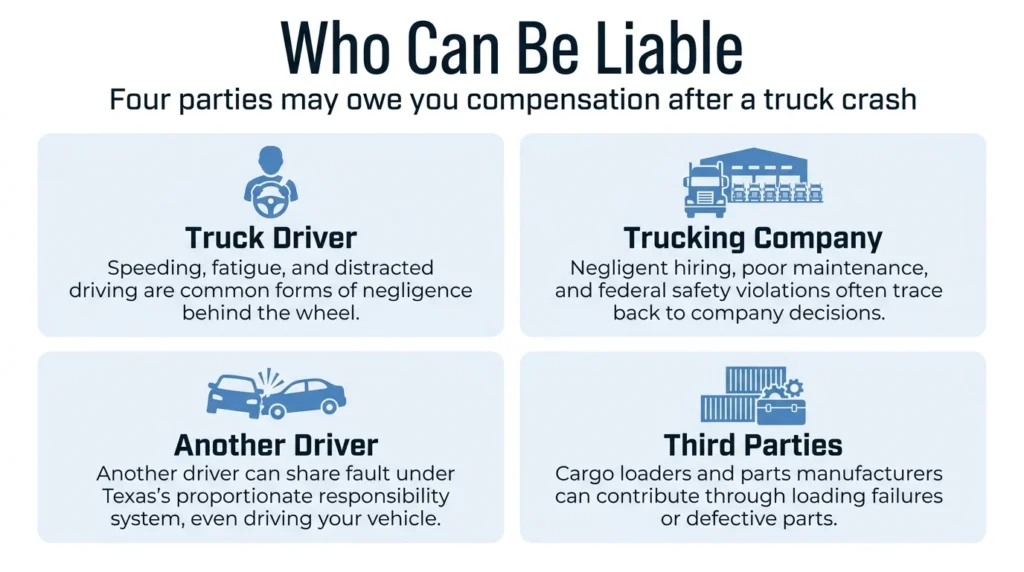
Texas law does not require you to have been the driver to file a claim after a crash. Four different parties can be sued for compensation after a truck accident, regardless of whether you were the driver:
- The truck driver is often the first source of liability. Speeding, fatigue, and distracted driving are common forms of negligence that point directly at the person behind the wheel of the truck.
- The trucking company can also be held responsible. Negligent hiring, poor maintenance, and federal safety violations often trace back to company decisions. Federal law sets minimum financial responsibility requirements for trucking companies, which can expand the coverage available to you.
- Another driver (including the person who was driving your vehicle) can share fault under Texas’s proportionate responsibility system. Determining who owes what in a shared-fault crash is exactly the kind of dispute an experienced truck accident attorney handles regularly.
- Third parties can also be liable. Cargo loaders and parts manufacturers sometimes contribute to a crash because of a loading failure or a defective part.
How Comparative Negligence Affects Your Claim
Under Texas Civil Practice and Remedies Code § 33.001, a claimant who is found to be 51% or more at fault for the crash cannot recover any damages at all.
If a claimant is found to be 50% or less responsible for the crash, then their damages are reduced by their percentage of fault under Section 33.012. This means that a claimant who is found to be 40% at fault for the crash can still recover 60% of the total damages awarded.
As a passenger, pedestrian, or bystander, you were likely not behind the wheel at all. That makes it far less likely that an insurer will assign you any meaningful share of fault.
Insurance Options for Injured Passengers
Your right to compensation as a passenger does not depend on the fault assigned to the person behind the wheel. If another driver caused or contributed to the crash, you can pursue that driver’s liability policy first. This remains true even if the at-fault driver was the one in your car. In this case, you would first seek compensation from the truck driver’s insurance, then from the insurance policy held by the driver of your car.
Uninsured or underinsured motorist coverage for either vehicle may provide additional protection if the other drivers’ insurance does not fully cover your losses. Texas insurers must offer uninsured and underinsured motorist coverage on auto policies under Texas Insurance Code § 1952.101. This coverage generally protects passengers who are riding in the vehicle covered by the policy, not just the policyholder who bought the coverage.
If a family member was behind the wheel, it usually does not change how your claim is handled. In this case, the driver’s insurer (not your relative personally) is typically who pays the claim. However, the policy may have household exclusions that can limit coverage. Check how the driver’s insurance policy applies to family members or friends before you assume that you cannot file a claim.
If you were in a rideshare or a vehicle owned by a coworker at the time of the crash, this can make the situation more complicated. Check for commercial or employer coverage, which may provide an additional source of recovery on top of a personal policy.
If you were hurt as a passenger in a crash, our guide to passenger claims after a car accident covers the claims process in more detail.
Who Pays If You’re a Truck Passenger?
If you were riding inside the truck, then the truck’s commercial liability policy is typically the first source of coverage, not a personal auto policy.
If you and the driver both work for the same trucking company, Texas workers’ compensation usually applies. Under Texas Labor Code § 408.001, workers’ compensation is generally your only path to compensation against your employer or coworker. However, there are limited exceptions, such as intentional injuries or certain wrongful death cases involving gross negligence.
You may also still be able to file a claim against a third party, such as another driver or a parts manufacturer, even if a workers’ compensation rule prevents you from suing your employer directly.
Truck Debris Injury Claims for Bystanders
You do not need to be riding in a car that is hit by a truck to file a claim. A cyclist or pedestrian who is injured in a truck crash or while trying to avoid a truck may also be able to file their own claim, which is separate from any dispute between the drivers involved in the crash.
Additionally, if a cyclist or pedestrian is struck by cargo that fell off a truck, then you can file a claim against the driver, the owner of the truck, or the trucking company. Improperly secured cargo may prove that the trucking company or cargo loader was negligent, which may have nothing to do with what the driver did behind the wheel.
If you were injured by improperly secured cargo, document the scene and preserve the debris if you can. These claims often depend on proving exactly where the debris came from, so it’s important to gather evidence as quickly as possible.
Filing Your Truck Accident Claim
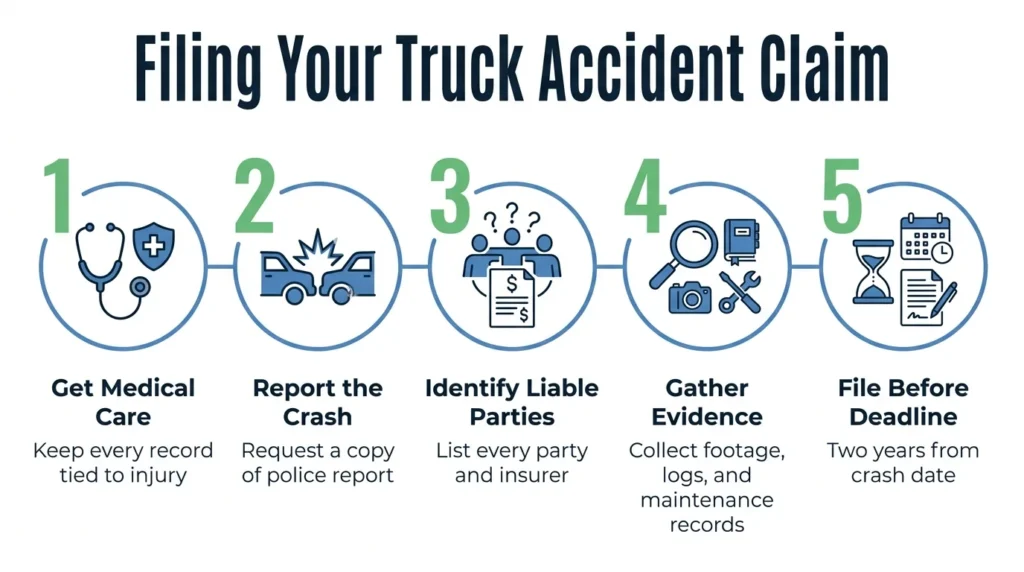
A strong claim follows a clear series of steps, no matter what your role was in the crash:
- Get medical care immediately and keep every record tied to your injury.
- Report the crash to the police and request a copy of the police report.
- Identify every party who might be liable, along with their insurers.
- Gather evidence, including dashcam or surveillance footage, trucking logs, maintenance records, and proof of federal safety violations.
File your claim before the deadline approaches. Texas Civil Practice and Remedies Code § 16.003 gives most personal injury claimants two years from the date of the crash to file a claim. Our guide on the truck accident statute of limitations covers exceptions that may change this deadline.
Work with an Attorney on Your Truck Accident Claim in Texas
You do not have to figure out who was at fault, which insurance policy applies first, or how long you have to file a claim on your own. Angel Reyes & Associates represents passengers, pedestrians, cyclists, and other bystanders hurt in Texas truck accidents, including cases involving a relative’s insurance or a shared employer.
If your medical bills and missed paychecks are already piling up, rest assured that we work on a contingency fee basis, so you pay no fee unless we win your case. Contact Angel Reyes & Associates today for a free consultation about your truck accident claim.
Passenger & Bystander FAQs
Can my own car insurance help pay my medical bills if I was hurt while walking, biking, or riding as a passenger?
Often, yes. Personal injury protection (PIP) or medical payments coverage on either your own policy or a family member’s policy will typically cover medical bills for injuries suffered while walking, biking, or riding in someone else’s car, regardless of who was at fault.
What happens if the truck or vehicle that dropped debris can't be identified after the crash?
Uninsured motorist coverage can still pay for a hit-and-run crash, including one caused by an unidentified truck’s falling debris, but only if the crash is reported to police.
How much insurance is a driver in Texas required to carry?
Texas law requires drivers to carry at least $30,000 per person and $60,000 per accident for injuries, plus $25,000 for property damage. However, these state minimums often will not cover your losses after a serious truck collision.
About the Authors

Alex Ivanov
Writer
Alex Ivanov is a personal injury attorney at Angel Reyes & Associates, focused on car, truck, and motorcycle accident cases. Licensed in Texas and multiple federal districts, Alex brings international legal experience and a global education to his practice. He earned his LL.M. from Texas A&M University School of Law after graduating from Belarussian State University in 2016. Alex is fluent in Russian, English, Ukrainian, and Belarussian, and is recognized by multiple national trial lawyer associations for his results and leadership under 40.

Kyle Nicolas
Editor
Kyle Nicolas is the Web Content & SEO Manager at Angel Reyes & Associates. He has more than 10 years of experience as a marketing co...

Angel Reyes
Reviewer
Angel L. Reyes, III is the Founder and Managing Partner of Angel Reyes & Associates. A nationally recognized trial attorney and business...