Uber and Lyft Arbitration Clauses in Accident Claims


Every article on this site is researched by our internal team, reviewed for legal accuracy against current Texas law, and held to State Bar of Texas advertising standards before publication. We do not publish content that overstates outcomes or makes promises about results.
Learn more about our
editorial standards .
Key Takeaways
- Creating an Uber or Lyft account usually binds you to private arbitration, instead of a jury trial.
- You can opt out of the arbitration clause, but only within 30 days of creating the account.
- Texas gives you two years to file an injury claim, and arbitration does not pause that clock.

You were riding home from Uptown Dallas one night when your Uber driver got rear-ended hard on US-75. Now, you have medical bills, a claim to file, and a sinking feeling after you read online about “binding arbitration.” Did you sign away your right to sue?
What Rideshare Arbitration Clauses Actually Say
When you created your Uber or Lyft account, you agreed to settle most disputes through private arbitration, instead of in court. Both companies require you to waive your right to a jury trial as a condition of using the app. Most riders never even notice this clause buried in the fine print of their user agreement.
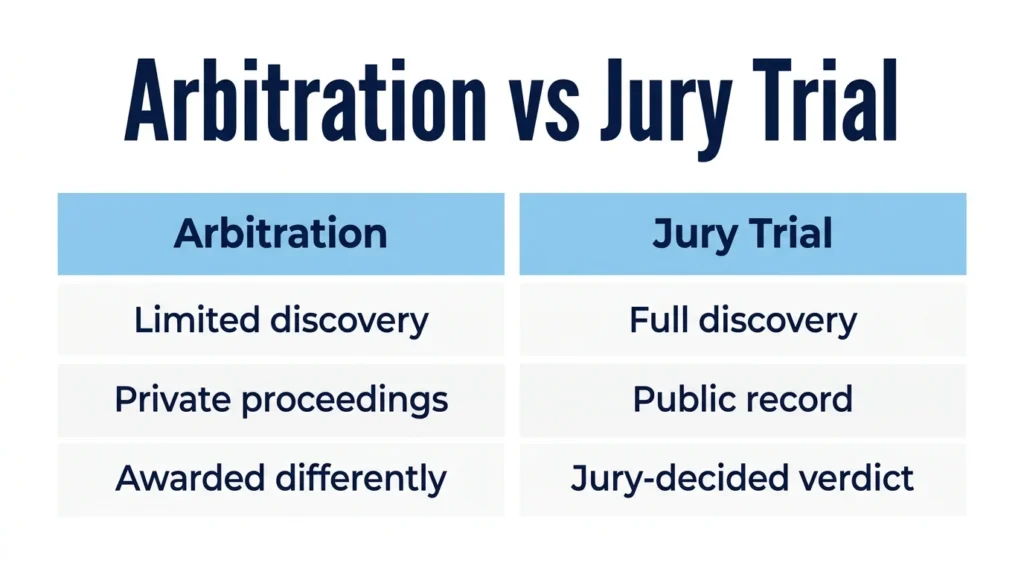
Arbitration is a private process in which a single arbitrator hears the case and makes a decision with no jury or public record. The outcome is usually final, and your right to appeal is very limited.
These clauses also include a class action waiver. That means you generally cannot file a single combined lawsuit with other injured riders, even if many people are injured the same way you were.
The difference between arbitration and a jury trial can have a major impact on your case:
- Arbitration does not allow the same level of evidence gathering as a lawsuit filed in civil court.
- The court proceedings stay confidential.
- Damages are awarded differently than a court verdict.
The federal law behind these differences is the Federal Arbitration Act, which makes written arbitration clauses strongly enforceable.
If you are weighing whether to file a claim at all, our guide on whether you can sue Uber after an accident in Texas can walk you through the options that remain open to you.
Who Is Bound by the Arbitration Clause?
If you accepted Uber’s or Lyft’s Terms of Service when you made an account, you are bound by the arbitration clause, even if you never actually read the terms of your agreement. Courts treat clicking “agree” as a binding agreement. However, the clause has limits, some of which may work in your favor, depending on your role in the accident.

One issue that surprises a lot of passengers is that courts have enforced arbitration clauses against people who accepted terms of service agreements through a different product, like Uber Eats, even though the injury happened during an Uber ride. This means having a single account for all Uber services legally binds you to arbitration clauses, no matter which Uber product you’re using.
However, if you never created an Uber account at all, your position is much stronger, as pedestrians and people in other vehicles who never agreed to the terms of service are generally not legally bound to the arbitration clause, so they can pursue a claim in court.
Passengers who did not book the ride on their own account have a less clear role. Some courts have ruled they are not bound by the arbitration clause because they never personally accepted it. Other courts rule that the arbitration clause applies, depending on how the ride was booked. In this case, the specific facts of your ride determine the outcome of your claim.
Drivers face a separate set of rules entirely. A rideshare driver signs an independent contractor agreement with its own arbitration clause, which is different from the terms of service that passengers agree to. Our overview of rideshare accident claims covers how these roles change your path to compensation.
How to Opt Out & When the Window Closes
Both Uber and Lyft allow new users to opt out of the arbitration clause, but only within a short window after the account is created. This window is typically 30 days.
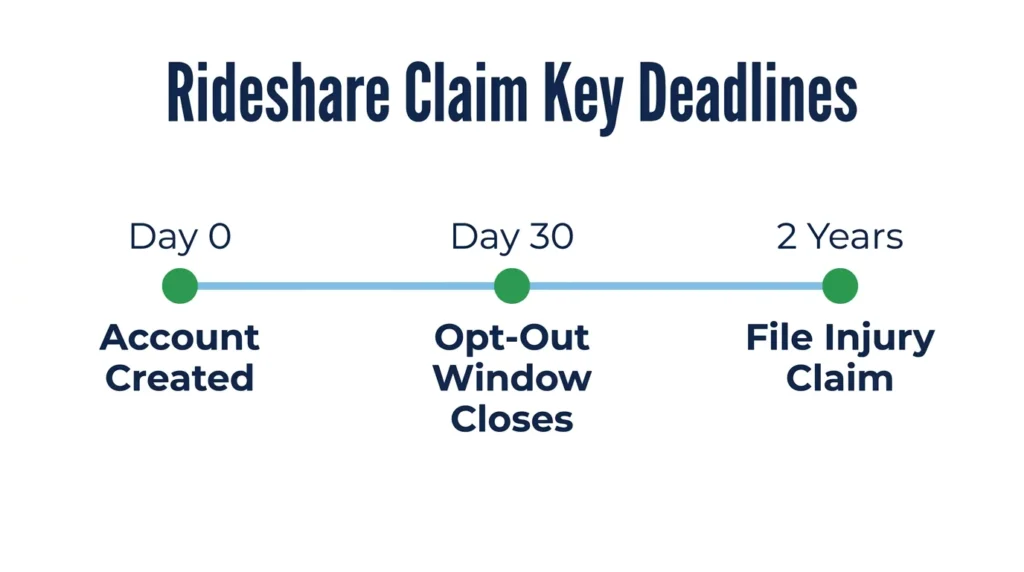
Opting out requires that you take action, as silence is consent in this case, which means doing nothing legally binds you to the arbitration clause. Don’t simply ignore it. To opt out, you must send a written notice to the email or mailing address listed in the terms of service. The notice must include your name, phone number, and the email address tied to your account.
Opting out does not change the way you use the app; you can keep using it exactly as before. All it does is preserve your right to sue in court if you are later injured in a rideshare accident.
Most people read about opting out only after a crash has already happened, and the window has already closed. However, even if the opt-out deadline has already passed, you still have options. Certain legal arguments or specific claim exceptions may still apply.
However, there is one strict deadline that always applies. Texas gives you two years from the date of the crash to file a personal injury claim, under the Texas Civil Practice and Remedies Code § 16.003. Filing an arbitration claim does not pause that clock, so it’s important to be mindful of the deadline, no matter how your claim is classified.
If you missed the opt-out window and are unsure what comes next, our breakdown of what to do after a rideshare accident in Texas lays out the immediate steps.
Grounds for Challenging the Arbitration Clause
An arbitration clause is not automatically the end of the road. Under CPRC § 171.001, a written arbitration agreement is valid and enforceable, unless ordinary contract law gives you a reason to challenge it.
One common challenge is known as “unconscionability.” This meant looking at how the arbitration clause was presented to you and deciding whether it was unfair. Some examples of unconscionability are:
- If the arbitration clause was buried in pages of fine print
- If the arbitration clause was offered with no chance to negotiate the terms
- If the arbitration clause was forced on you as a “take-it-or-leave-it” requirement (meaning if you opted out of the clause, you would not be able to use the service)
Challenging an arbitration clause is difficult because of the Federal Arbitration Act, which prevents states from treating arbitration clauses more strictly than other contracts. In other words, federal law allows you to challenge arbitration clauses, but only if the same legal argument would also work against a normal contract clause that is not specifically about arbitration.
There is one powerful exception to this rule. The Ending Forced Arbitration of Sexual Assault and Sexual Harassment Act of 2021, signed into law in March 2022, prevents mandatory arbitration of sexual assault and harassment claims. This exception still applies, even if you agreed to the arbitration clause when you signed up.
If you have gone through the arbitration process, but you believe the outcome was unfair, a court can only overturn the decision in limited situations under CPRC § 171.088. These situations include:
- Fraud
- Misconduct
- An arbitrator’s evident bias
- An arbitrator who exceeded their authority
Before you respond to any arbitration demand, it is worth having an attorney assess whether the arbitration clause holds up in your specific case.
Get Legal Help with Your Rideshare Claim
Arbitration clauses make rideshare accident claims harder to handle alone, but you may still have options. Angel Reyes & Associates has spent over 30 years helping injured Texans work through complicated claims, including the arbitration terms that Uber and Lyft build into their apps. We know how to test whether an arbitration clause holds up, and how to pursue the full compensation you are owed.
We work on a contingency basis, which means you pay no fee unless we win, and your first consultation is free. Over the years, we have recovered more than $1 billion for clients. Review our client reviews and testimonials and case results to see how we have handled claims like yours.
If a rideshare accident has left you facing bills and an arbitration clause you do not understand, reach out for a free consultation. We will walk you through your options and tell you what comes next.
Past results do not guarantee future outcomes.
Uber and Lyft Arbitration Clauses FAQs
What organization handles rideshare arbitration, and who pays for it?
Uber and Lyft typically send arbitration cases to the American Arbitration Association (AAA) or a similar provider, and both companies pay the administrative fees for the arbitration process. You are usually responsible only for the initial filing fee, which can be waived if you cannot afford it.
Does the arbitration clause apply if another driver caused the crash, not the rideshare driver?
If a third-party driver caused your accident, and that driver’s insurance covers your claim, the arbitration clause may not apply because your dispute is with the other driver, not with Uber or Lyft. The arbitration clause generally only applies to claims you file against the rideshare company itself.
Can a minor who was a rideshare passenger be forced into arbitration?
In most states, including Texas, a minor cannot be bound by any legal contract. So, if a parent accepted the terms of service on a child’s behalf, the child may still be able to file a claim. Courts have generally allowed minors’ claims to be filed in court, instead of arbitration.
Does arbitration prevent you from filing a complaint with a Texas state agency?
No. Filing a complaint with the Texas Department of Licensing and Regulation (TDLR) or another state agency is a government process, not a civil lawsuit. In this case, the arbitration clause does not stop you from filing a complaint. The arbitration clause only covers private civil disputes between you and the rideshare company.
If you win an arbitration award against Uber or Lyft, can they refuse to pay?
No. An arbitration award is a legally binding court judgment under Texas law, which means it is enforced the same way any court-ordered payment is enforced. The company cannot simply refuse to pay a final award decision.
About the Authors

Angel Reyes
Writer
Angel L. Reyes, III is the Founder and Managing Partner of Angel Reyes & Associates. A nationally recognized trial attorney and business leader, Angel has helped over 70,000 injury victims recover more than $1 billion since founding the firm in 1993. Named to the Texas Super Lawyers list annually since 2008, Angel brings Wall Street experience, Ivy League education, and a deep commitment to client advocacy. He is a frequent legal commentator and published author with extensive contributions to legal scholarship, trial strategy, and consumer protection.

Kyle Nicolas
Editor
Kyle Nicolas is the Web Content & SEO Manager at Angel Reyes & Associates. He has more than 10 years of experience as a marketing co...

Angel Reyes
Reviewer
Angel L. Reyes, III is the Founder and Managing Partner of Angel Reyes & Associates. A nationally recognized trial attorney and business...