How an Uber Accident Affects Your Personal Auto Insurance


Every article on this site is researched by our internal team, reviewed for legal accuracy against current Texas law, and held to State Bar of Texas advertising standards before publication. We do not publish content that overstates outcomes or makes promises about results.
Learn more about our
editorial standards .
Key Takeaways
- Passengers paid by Uber's commercial policy usually face no hit to their own premium.
- Most Texas auto policies require you to report any crash, even when it was not your fault.
- Filing a not-at-fault claim through your own insurer can trigger a rate review at renewal.
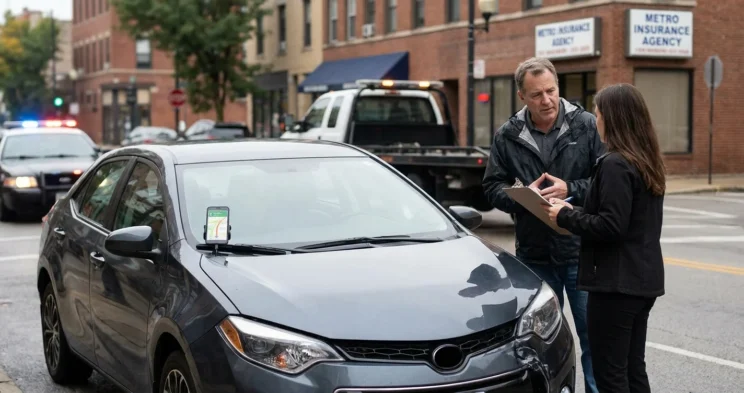
You were riding home from the Galleria late on a Friday when your Uber driver got rear-ended on I-610. Nobody warned you about this part. Now your phone is full of questions from adjusters, and you are wondering whether your own car insurance is about to take a hit, even though you were just a passenger.
Your Role in the Crash Changes Everything
What you owe your own insurer, and whether your rates move at all, depends on one thing: were you a passenger, a driver struck by an Uber, or the Uber driver? Each role triggers a different set of rules.
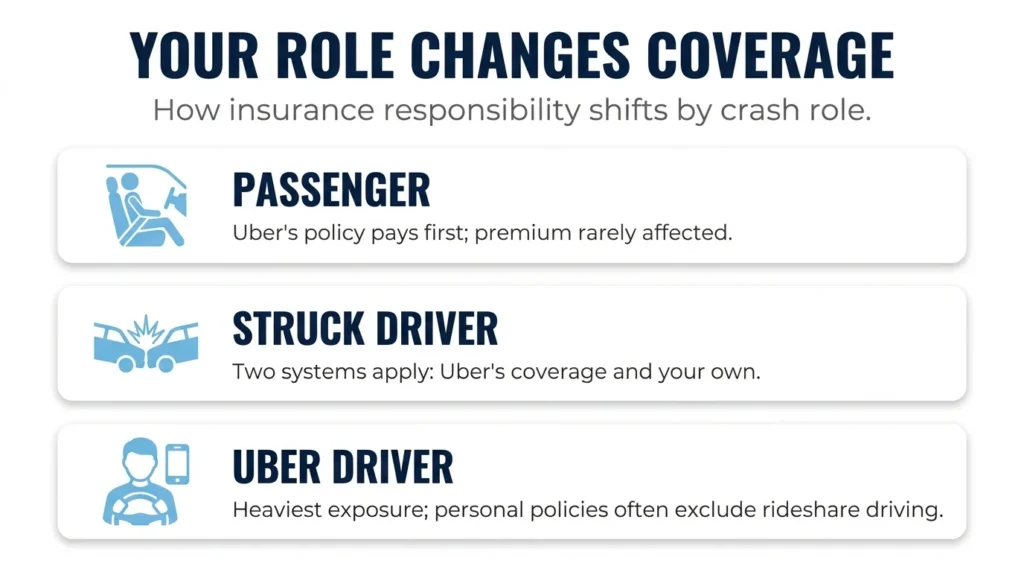
Passengers sit in the safest spot. Uber’s commercial policy usually pays first, so most passengers never have to file through their own insurer. Your premium exposure stays low because your carrier is rarely billed.
Drivers struck by an Uber face two insurance systems at once. The Uber driver’s commercial coverage is in play, and so is your own collision or uninsured motorist coverage. You may end up dealing with both.
Uber drivers carry the heaviest load. Personal policies often exclude driving for hire, and Uber’s three coverage periods can pull a personal policy into the gap. The same crash plays out very differently depending on which seat you were in.
Texas TNC Coverage Periods & Your Personal Policy
Texas law splits Uber coverage into three periods, and the period your crash fell into decides whether your personal policy gets touched at all. Texas Insurance Code (Insurance Code) Chapter 1954 sets these tiers based on what the driver’s app was doing at the moment of impact.
The trigger is simple. The rules change depending on whether the app was off, on with no ride accepted, or on with a ride underway.
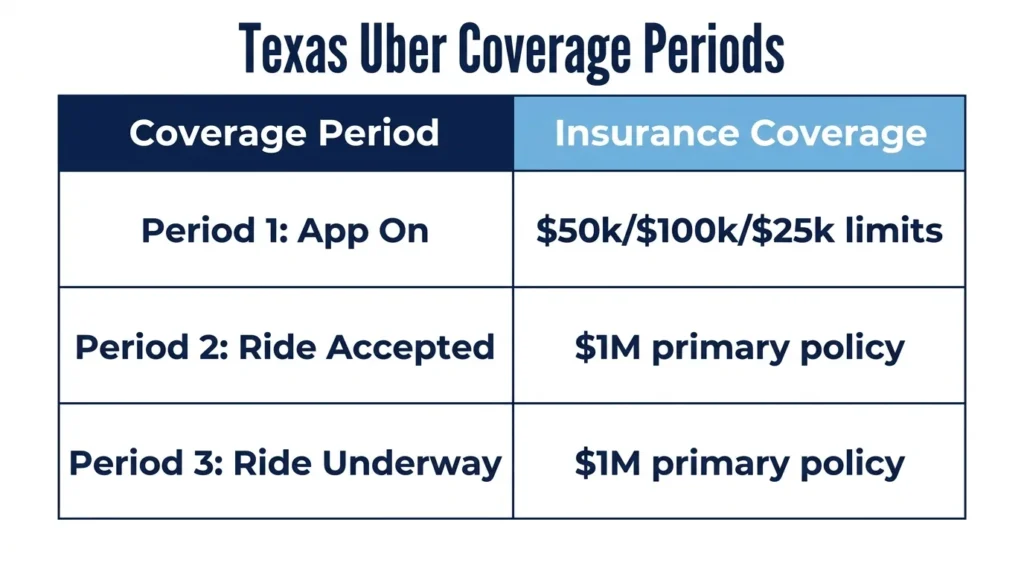
Period 1 is the danger zone for personal policies. When the app is on but no ride has been accepted, Uber carries only contingent minimums of $50,000 per person, $100,000 per accident, and $25,000 for property damage under Texas Insurance Code § 1954.052. Many personal policies exclude driving for hire, so this is the period most likely to leave a coverage gap.
Periods 2 and 3 look very different. Once a ride is accepted and through completion, Uber’s $1 million primary commercial policy is active under Texas Insurance Code § 1954.053. For passengers and drivers struck by an Uber, a personal policy is generally not the first payer here.
Not sure which period applied? Ask one question: had the driver accepted a ride on the app when the crash happened? That single fact tells you more about coverage than anything else.
Do You Have to Report the Accident to Your Own Insurer?
In most cases, yes. Almost every personal auto policy includes a prompt-notification clause that requires you to report any accident, no matter who was at fault. Skip that step and your insurer may have grounds to deny coverage later, even if it would have paid nothing.
Reporting is not the same as filing a claim. You can notify your insurer of the accident without opening a formal claim or triggering a premium review. The exact terms vary by carrier, so check your policy language.
A few situations force you to engage your own insurer whether you planned to or not. 1) Your vehicle was damaged and you want to use your collision coverage. 2) Someone files a liability claim against you. 3) The at-fault driver is underinsured and your uninsured motorist coverage is the only path to financial recovery.
If you are weighing whether to pursue your own coverage, learn more about how UM, UIM, and PIP coverage work. The Texas Department of Insurance also publishes guidance on handling the other driver’s insurance that you can lean on when a not-at-fault claim gets complicated.
Unsure whether your notification clause requires disclosure after an Uber crash? Reviewing your declarations page is a smart first step before you call anyone.
Will Your Insurance Rates Go Up After an Uber Crash?
There is no blanket answer, because the outcome depends on whether your own insurer ever gets billed. Texas limits when carriers can raise your rates after a not-at-fault crash, but those limits are not absolute.
Not-at-Fault Passengers & Rate Risk
If your claim runs entirely through Uber’s commercial policy and your insurer is never billed, your premium is usually safe. Your carrier has no claim record to act on, so nothing flags your account.
The risk climbs the moment you file through your own insurer first. Texas rules limit surcharges after a not-at-fault accident, but the Texas Department of Insurance confirms that carrier practices vary. What one insurer overlooks, another may treat as a reason to review your rate.
Third-Party Drivers & Premium Exposure
If you were driving your own car when an Uber hit you, filing a collision or uninsured motorist claim creates a record on your policy. That record can prompt a premium review at renewal, even though the crash was not your fault.
Texas limits when your carrier can cancel your policy mid-term. Filing a not-at-fault claim is not among the authorized grounds. Non-renewal at the end of your term is a separate question, and a claim record can still factor into that decision.
Steps to Protect Your Policy After an Uber Accident
The gap between knowing the rules and protecting yourself comes down to documentation. Take these steps to preserve your personal policy position after a rideshare crash.
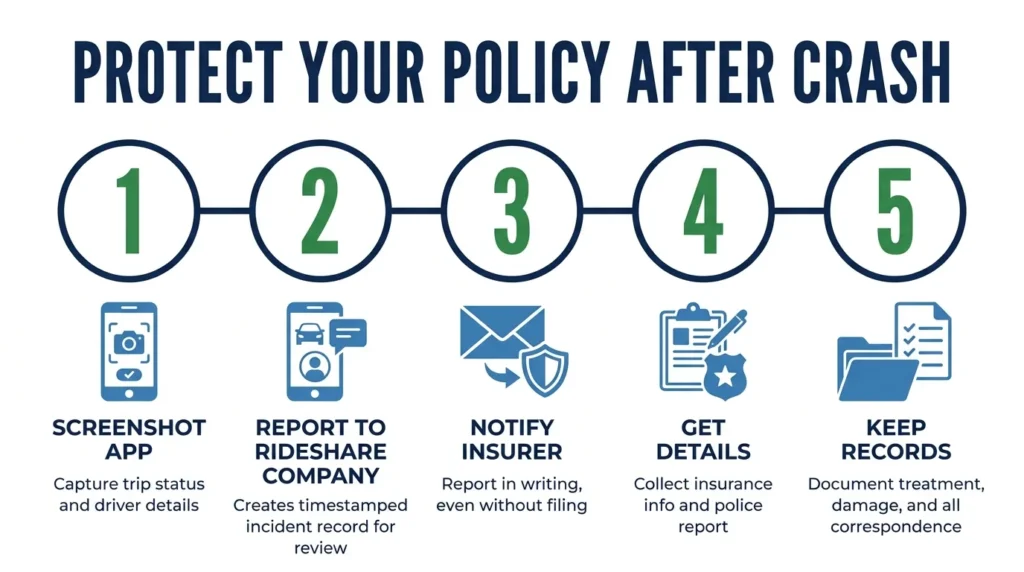
- Step 1: Screenshot the Uber app. Capture the trip status, the driver’s name, and whether a ride was accepted or the driver was simply available. This evidence pins down which coverage period applied.
- Step 2: Report the crash to Uber through the app. This creates a timestamped incident record and starts Uber’s commercial insurer review.
- Step 3: Notify your personal insurer as your policy requires. Do this even if you do not plan to file your own claim, and get the notification in writing.
- Step 4: Get the Uber driver’s insurance details and the police report number. You need both to support a claim against Uber’s commercial policy.
- Step 5: Keep records of all treatment, damage, and correspondence. Documentation gaps are the most common reason people lose personal policy rights without realizing it.
For a closer look at how these claims unfold, review what happens when an Uber gets in an accident in Texas.
Talk to an Experienced Attorney
If your insurer is mishandling the claim or you have received a denial, talking with an attorney before you respond can protect your position.
Sorting out whose policy pays after an Uber crash is rarely simple, and the wrong move with your own insurer can cost you. Angel Reyes & Associates has spent over 30 years helping injured Texans untangle the overlap between Uber’s commercial coverage and their own personal policies.
We work on contingency, which means no fee unless we win, and we have more than $1 billion recovered for clients across the state. Our team can review your policy, deal with the adjusters, and make sure a not-at-fault crash does not quietly damage your coverage.
You can schedule a free consultation to walk through your options, and you can learn more about our experience and approach.
Past results do not guarantee future outcomes.
Uber Accidents & Personal Auto Insurance FAQs
How long do I have to file a claim after an Uber accident in Texas?
Texas gives you two years from the date of the crash to file a personal injury lawsuit. Missing that deadline typically means losing your right to recover compensation, so starting the process early protects your options.
Can I use my own PIP or MedPay coverage if I was a passenger in an Uber?
Yes. If your personal auto policy includes personal injury protection (PIP) or medical payments (MedPay) coverage, those benefits can pay your medical bills regardless of who was at fault, even when you were riding as a passenger. Check your declarations page to confirm whether you carry either coverage.
What should Uber drivers do to close the Period 1 coverage gap?
Uber drivers can add a rideshare endorsement to their personal auto policy, which bridges the gap that opens when the app is on but no ride has been accepted. Without it, the personal policy’s livery exclusion leaves drivers without personal coverage during Period 1.
How do I know if I still have UM/UIM coverage on my personal policy?
Texas law requires insurers to offer uninsured and underinsured motorist coverage, but policyholders can reject it in writing. If your insurer says you rejected it, they must produce your signed rejection; if they cannot, Texas law treats you as covered.
About the Authors

Angel Reyes
Writer
Angel L. Reyes, III is the Founder and Managing Partner of Angel Reyes & Associates. A nationally recognized trial attorney and business leader, Angel has helped over 70,000 injury victims recover more than $1 billion since founding the firm in 1993. Named to the Texas Super Lawyers list annually since 2008, Angel brings Wall Street experience, Ivy League education, and a deep commitment to client advocacy. He is a frequent legal commentator and published author with extensive contributions to legal scholarship, trial strategy, and consumer protection.

Kyle Nicolas
Editor
Kyle Nicolas is the Web Content & SEO Manager at Angel Reyes & Associates. He has more than 10 years of experience as a marketing co...

Angel Reyes
Reviewer
Angel L. Reyes, III is the Founder and Managing Partner of Angel Reyes & Associates. A nationally recognized trial attorney and business...