Rideshare Driver Fatigue Accidents in Texas


Every article on this site is researched by our internal team, reviewed for legal accuracy against current Texas law, and held to State Bar of Texas advertising standards before publication. We do not publish content that overstates outcomes or makes promises about results.
Learn more about our
editorial standards .
Key Takeaways
- Federal hours-of-service rules cover truckers, not Uber or Lyft rideshare drivers.
- A fatigued rideshare driver is usually the primary at-fault party in a crash.
- Texas gives most crash victims two years from the injury date to file suit.
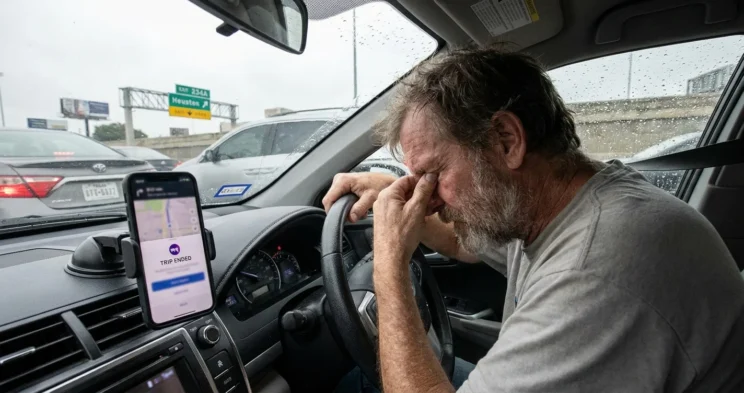
You were heading home late from a concert in Midtown when your Uber drifted across the lane on the way to I-45. The driver jerked the wheel back, mumbled an apology, and admitted he had been driving since early that morning. Minutes later, he rear-ended the car ahead of you at a stoplight.
Now you are hurt, and you are wondering who pays for a crash caused by a driver who was too tired to be behind the wheel.
Why Rideshare Driver Fatigue Happens
Rideshare driver fatigue happens because the pay model rewards long hours. Drivers earn money only while they are moving riders, so many work back-to-back shifts and chase surge pricing late into the night.
Plenty of drivers also run more than one app at once. When one platform goes quiet, they switch to another and keep working. A rideshare driver pulling long hours before a crash may have been awake far longer than a single app would suggest.
Fatigue does real damage behind the wheel. It slows reaction time, blurs judgment, and makes a driver miss things they would normally catch. The connection between tiredness and crash risk is well documented in federal research on drowsy driving.
The danger is hard to spot after the fact. A drunk driver leaves a breath test behind, but a drowsy one often leaves nothing obvious at the scene. Federal safety guidance notes that fatigue tends to peak in the early morning hours and mid-afternoon, which is exactly when a tired driver may not realize how impaired they are.
No Hours of Service Rules for Rideshare
Here is the part that surprises most people: no federal hours-of-service rule limits how long an Uber or Lyft driver can work. Those rules apply to commercial truckers, not rideshare drivers.
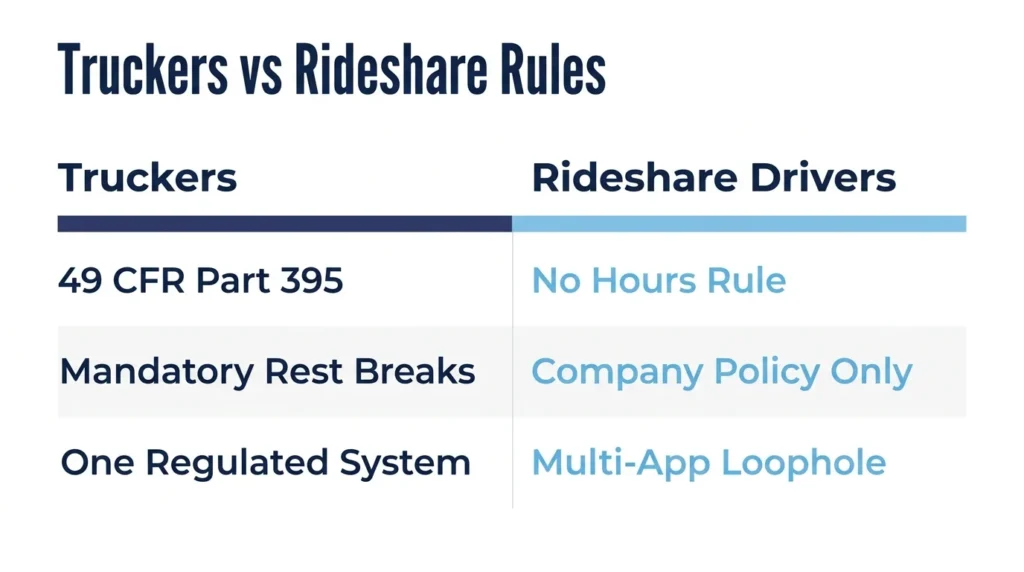
The federal hours-of-service regulation under 49 CFR Part 395 caps driving time for commercial motor vehicle operators. It forces truckers to take breaks and rest. A rideshare driver in a personal car falls outside that system entirely.
Texas regulates rideshare companies through Texas Occupations Code Chapter 2402, which governs Transportation Network Companies. That chapter sets rules for insurance and driver screening. It does not include trucking-style driving-hour caps.
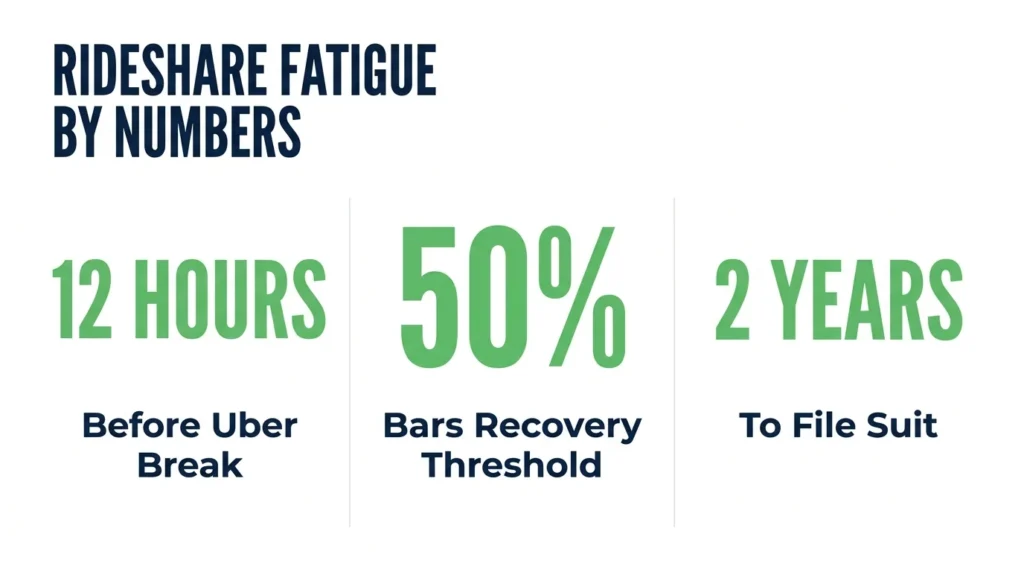
Uber and Lyft do set their own limits. Uber’s policy requires a driver to go offline for 6 consecutive hours after 12 hours of driving time. That is company policy, not a legal standard, and the platforms can change it whenever they choose.
These app limits also have a gap. A driver who hits one platform’s cap can simply open another and keep going. If you were hurt by a tired driver, the steps you take right after a rideshare crash can help preserve the proof of how long they had really been working.
How Fatigue Affects Liability in Texas
A fatigued driver who causes your crash is usually the primary at-fault party. Driving while too tired to react safely is a form of negligence, the same as speeding or running a light.
Texas uses a fault-sharing system that can change what you recover. Under the proportionate responsibility rules in the Texas Civil Practice and Remedies Code (CPRC) Chapter 33, fault gets divided among everyone involved. If you are found more than 50% at fault, you cannot recover anything.
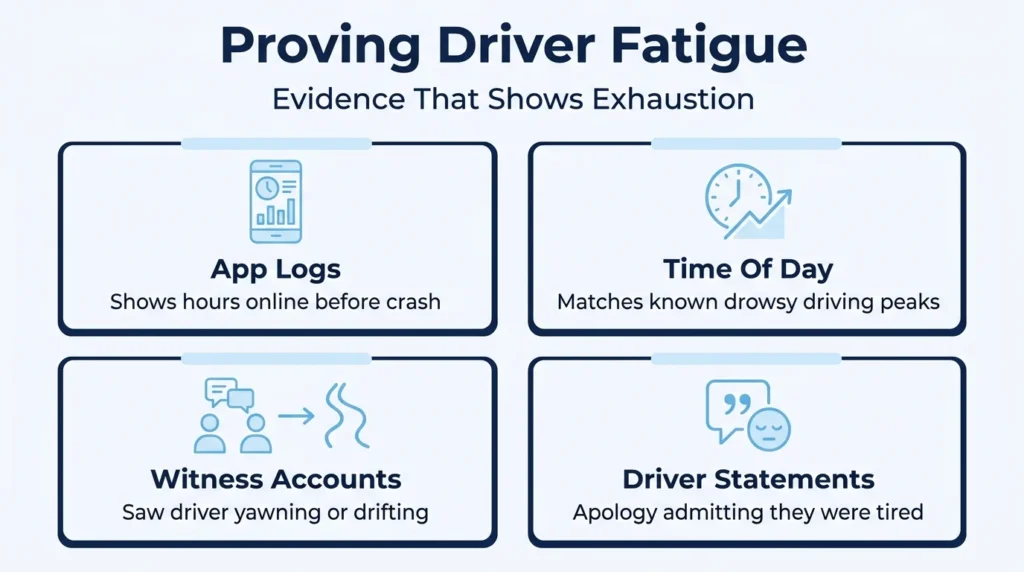
Fatigue rarely announces itself, so proving it takes the right evidence. A few sources can show a driver was exhausted when they hit you.
- App trip logs: The platform’s records can show how many hours the driver had been online and active before the crash.
- Time of day: A wreck in the early morning hours lines up with known peaks in drowsy driving.
- Witness accounts: Passengers and bystanders may have seen the driver yawning, drifting, or nodding off.
- The driver’s own statements: Admissions at the scene, like an apology for being tired, can become powerful proof.
Gathering this proof early matters because some of it disappears fast. Any strong Texas car accident claim requires securing records before they are lost.
You also have a deadline. Texas Civil Practice and Remedies Code Section 16.003 gives most injury victims two years from the crash date to file a lawsuit. Miss that window and your right to sue is almost certainly gone.
When Uber or Lyft May Share Responsibility
Uber and Lyft may share responsibility in some situations, but it is not automatic. The biggest hurdle is that rideshare drivers are classified as independent contractors, not employees, which limits direct liability for the platform.
That classification does not close every door. A drowsy Uber driver crash can still open up theories that reach the company. Negligent entrustment may apply if the platform let someone drive when it knew or should have known they posed a risk. A platform may also face a duty question if it had knowledge of a driver’s condition and did nothing.
These are potential theories, not guaranteed paths. Whether they apply depends on the facts of your case and what the company actually knew. You can read more about the situations where you may be able to sue Uber directly to understand how these claims take shape.
Often the more practical question is which insurance policy pays. Coverage depends on what the driver was doing at the moment of the crash, and the answer changes across the three rideshare insurance coverage periods. Knowing which period applied to your crash can decide whether a personal policy or a million-dollar commercial policy is on the hook.
These claims get complicated quickly, and the companies have experienced teams working to limit what they pay. Working with someone who handles rideshare accident claims can help you push back against that pressure.
Speak with an Experienced Attorney
A crash caused by an exhausted rideshare driver leaves you with bills, questions, and a company that may try to deny responsibility. You do not have to sort it out alone.
Angel Reyes & Associates has spent over 30 years helping injured Texans hold negligent drivers and the platforms behind them accountable. You can learn more about our Texas injury practice and the more than $1 billion recovered for clients across the state. We work on a no fee unless we win basis, offer free consultations, serve all of Texas, and can handle most, if not all, of your case remotely.
If a tired Uber or Lyft driver hurt you, reach out to us for a free consultation so we can review what happened and explain your options.
Past results do not guarantee future outcomes.
Rideshare Driver Fatigue Claim FAQs
Can I recover for fatigue if I was the passenger in the Uber, not another driver?
Yes. An injured passenger can pursue a claim whether the at-fault party is the rideshare driver or a third party, and the active insurance period still decides which policy pays.
How is a drowsy driving claim different from a drunk driving claim?
Both involve impairment, but a drowsy driver leaves no breath or blood test behind. Fatigue usually has to be shown through app logs, crash timing, and witness accounts instead of a chemical result.
What if the driver denies they were tired?
A denial does not end your claim. Trip records, the time of the crash, and statements from passengers or witnesses can still support fatigue even when the driver disputes it.
Does it matter which app the driver was using if they switched between Uber and Lyft?
It can. The platform active at the moment of the crash usually determines whose insurance applies, even if the driver had been logged into another app earlier that day.
About the Authors

Angel Reyes
Writer
Angel L. Reyes, III is the Founder and Managing Partner of Angel Reyes & Associates. A nationally recognized trial attorney and business leader, Angel has helped over 70,000 injury victims recover more than $1 billion since founding the firm in 1993. Named to the Texas Super Lawyers list annually since 2008, Angel brings Wall Street experience, Ivy League education, and a deep commitment to client advocacy. He is a frequent legal commentator and published author with extensive contributions to legal scholarship, trial strategy, and consumer protection.

Kyle Nicolas
Editor
Kyle Nicolas is the Web Content & SEO Manager at Angel Reyes & Associates. He has more than 10 years of experience as a marketing co...

Angel Reyes
Reviewer
Angel L. Reyes, III is the Founder and Managing Partner of Angel Reyes & Associates. A nationally recognized trial attorney and business...