What Happens If Someone Else Is Driving My Car and Gets in an Accident?


Every article on this site is researched by our internal team, reviewed for legal accuracy against current Texas law, and held to State Bar of Texas advertising standards before publication. We do not publish content that overstates outcomes or makes promises about results.
Learn more about our
editorial standards .
Key Takeaways
- In Texas, insurance follows the car, so your policy usually pays first.
- Named driver exclusions and unlicensed borrowers can leave a crash with no coverage.
- Lending your car to an unfit driver can create separate negligent entrustment liability.
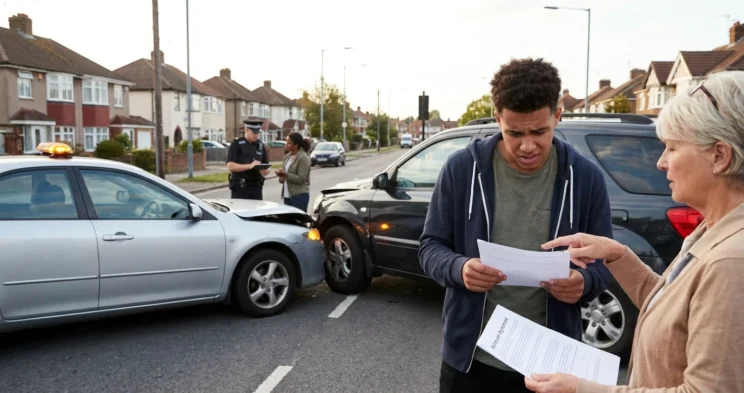
You’re at your desk in downtown Houston when your phone rings. Your cousin borrowed your car for a grocery run and just rear-ended someone near the Galleria. Now you’re wondering whose insurance actually pays, and whether you could be personally on the hook. The answer starts with a rule most car owners never learn until they need it.
Types of Car Insurance Policies
Every car insurance policy in Texas is built from a few core coverage types.
Liability coverage pays for the other driver’s injuries and property damage when the at-fault driver is covered under the policy.
Comprehensive and collision coverage work differently. They pay to repair or replace the insured vehicle itself, regardless of who was behind the wheel when the damage happened.
Does Insurance Follow the Car or Driver?
In Texas, car insurance follows the vehicle, not the driver. That means your policy is usually the first one that pays when someone you allowed to drive crashes your car.
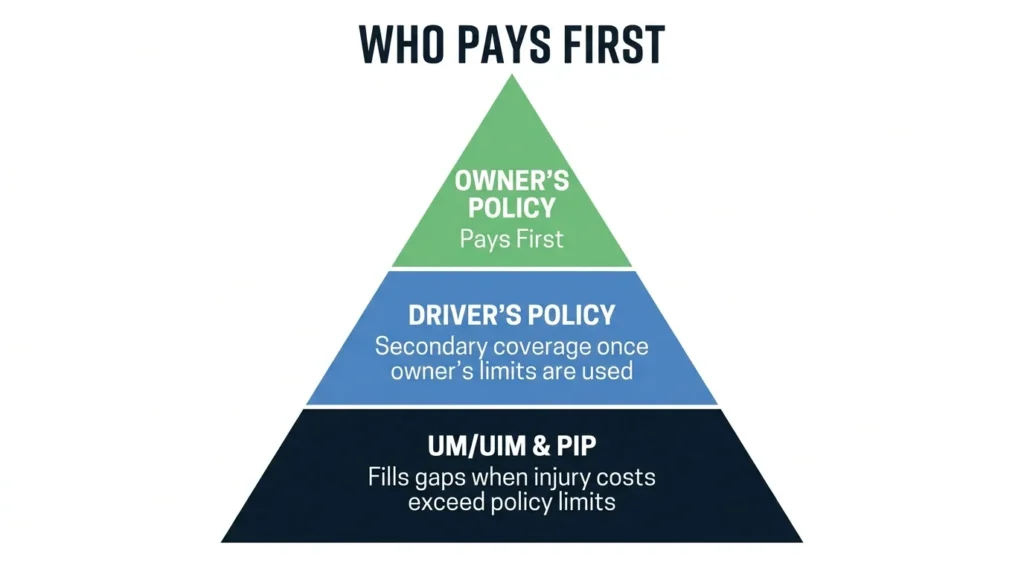
Most Texas auto policies extend to the owner, household members, and anyone the owner allows to drive, according to the Texas Department of Insurance. That is why your policy usually pays first, even when you were not the one driving.
Texas also sets minimum liability limits that apply no matter who is behind the wheel. Under Texas Transportation Code § 601.072, every policy must meet the state’s minimum coverage amounts.
If the driver who crashed your car carries their own policy, it can act as secondary coverage once your policy limits are used up.
Who Is Covered to Drive Your Car?
Not everyone who gets behind the wheel of your car is automatically covered. Permission, licensing, and policy exclusions each change who pays after a crash.
Permissive Use in Texas
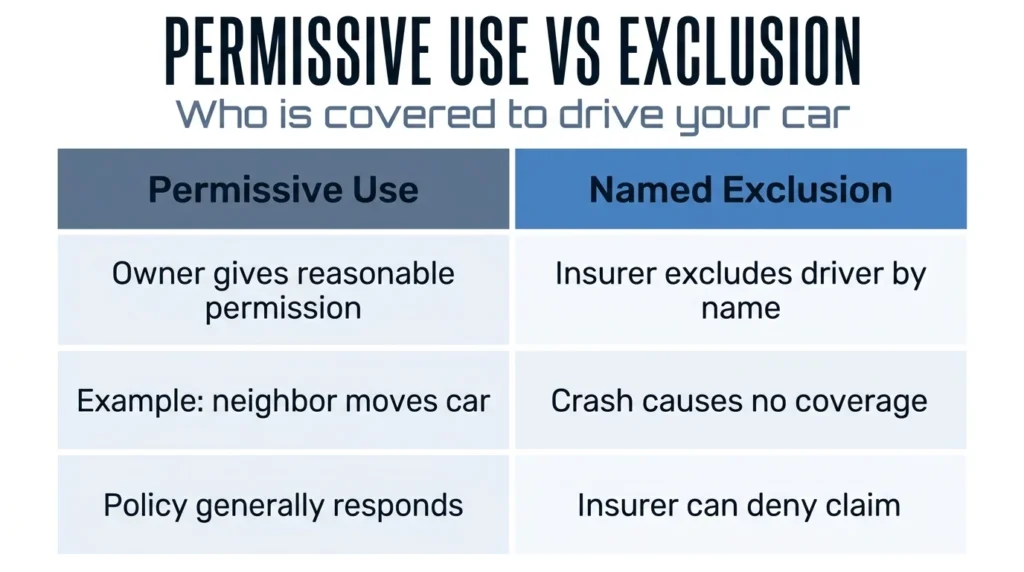
Permissive use means you gave the driver reasonable permission to use your car, and that permission is generally what triggers your policy to respond. Texas does not spell out permissive use in a single statute. It depends on the language written into your specific policy.
Letting a neighbor move your car for street cleaning, or handing your keys to a family member for the weekend, both count as permissive use in most cases.
Named Driver Exclusions
Texas law also lets insurers exclude specific people from your policy by name, and an excluded driver has no coverage under your policy if they cause a crash. Texas Insurance Code § 1952.351 defines what a named driver exclusion is. Section 1952.353 requires your insurer to name each excluded driver individually and in writing.
Unlicensed drivers and someone who took your car without permission fall outside permissive use entirely. An insurer can deny a claim on that basis alone.
A crash caused by a permitted driver can still raise your premium. A crash involving an excluded or unauthorized driver carries a higher risk of a denied claim, which shifts more of the cost onto the driver and onto you as the owner.
Liability When a Friend Crashes Your Car
The driver who caused the crash is usually the one legally responsible for the damage, but Texas law can split that responsibility among more than one party.
Under Texas Civil Practice and Remedies Code § 33.001, Texas follows a modified comparative responsibility rule. Fault, and the payout responsibility that comes with it, can be divided among everyone who contributed to the crash.
Lending your car can create liability of its own. If you knew, or should have known, that the driver was unfit or unlicensed, you could face a separate negligent entrustment claim, apart from any question of insurance coverage.
When injuries cost more than the policy limits allow, uninsured and underinsured motorist coverage and personal injury protection can help fill the gap.
Reviewing your policy’s limits and any listed exclusions before you lend out your car can clarify your exposure ahead of time.
Steps to Take After the Crash
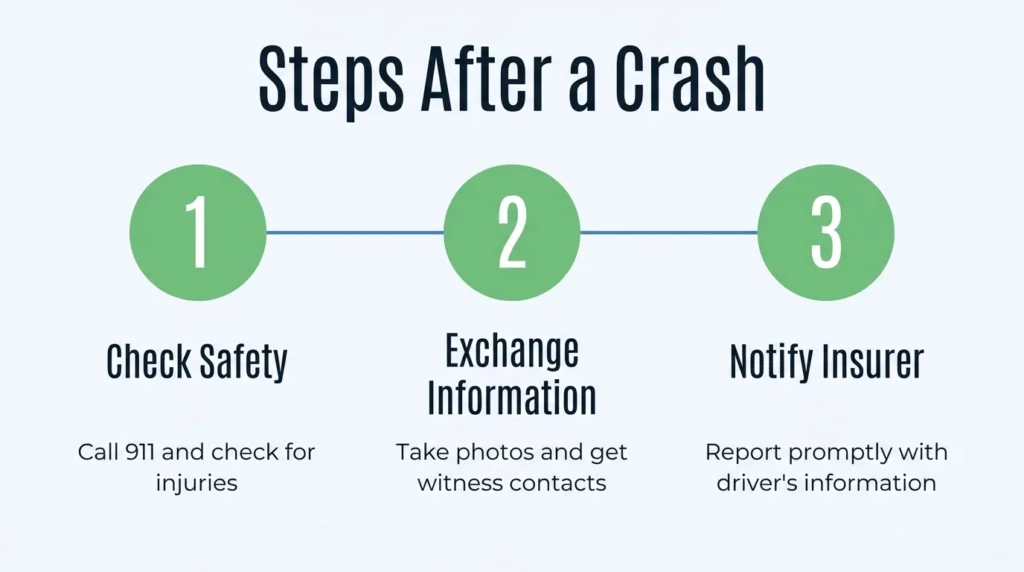
A few key steps in the first hours after the crash protect both the driver and you as the owner:
- Check for injuries, move to safety if you can, and call 911 to report the crash.
- Exchange information at the scene, take photos, and get contact details for any witnesses.
- Notify your insurer promptly, and give them the driver’s information along with your own. Prompt, accurate reporting often shapes how smoothly a claim resolves.
A few habits also lower your risk before a crash ever happens. Keep a written record of who you authorize to drive your car. Confirm any driver is licensed before you hand over the keys, and review your policy every year for named driver exclusions.
Work with an Experienced Attorney Today
If someone else was driving your car and the claim gets complicated, you do not have to sort it out alone. Angel Reyes & Associates has represented Texas drivers and car owners through liability disputes, denied claims, and coverage gaps after a crash, with more than $1 billion recovered for clients.
Angel Reyes & Associates works on a contingency basis, so you pay nothing unless we win your case. Learn more about our team today.
Whether the driver was a family member, a friend, or someone you had never met before that day, you deserve a clear answer about who pays and what happens next. Contact us for a free consultation.
Past results do not guarantee future outcomes.
When Someone Wrecks Your Car: Insurance FAQs
Is my car still covered if someone else driving it gets in an accident in another state?
Most auto policies, including those written in Texas, extend coverage to accidents that happen in other states or Canada, so a permitted driver who crashes your car outside Texas would generally still be covered. It is still worth checking your declarations page to confirm your specific policy has no state limitations.
Does my insurance cover a crash if the driver was using my car for a rideshare or delivery job?
Most personal auto policies exclude accidents that happen while a car is being used for a ride hailing service or a paid delivery job, so a friend who crashes your car while working for one of these services may not have coverage under your regular policy. A rideshare or delivery endorsement can close that gap if the car is used this way regularly.
Do I have to add every driver in my household to my car insurance policy?
Some insurers require you to list everyone in your household who is of legal driving age, and failing to disclose a driver, including a teenager who just started driving, can lead to a denied claim or a canceled policy. Tell your insurer as soon as someone new in your home begins driving regularly.
Will I get a rental car while my vehicle is being repaired after someone else crashed it?
If the other driver caused the crash, their insurer typically pays for a rental car while your vehicle is repaired. If fault is unclear or you were at fault, you will need rental reimbursement coverage on your own policy to get a rental car paid for.
About the Authors

Spencer Browne
Writer
Spencer Browne is a partner at Angel Reyes & Associates and a Board Certified personal injury trial lawyer with nearly 100 jury trials across Texas. He focuses on car, truck, and wrongful death cases, with notable verdicts including a landmark win in the Choctaw Casino bus crash case. A recognized speaker and legal educator, Spencer is a member of the American Board of Trial Advocates and has been honored as a Texas Super Lawyer and one of D Magazine’s Best Lawyers in Dallas. He brings deep trial experience and relentless advocacy to every client he represents.

Graham Griffin
Editor
Graham Griffin is the Web & Content Manager at Angel Reyes & Associates, where he oversees content strategy, AI-powered workflows, a...

Angel Reyes
Reviewer
Angel L. Reyes, III is the Founder and Managing Partner of Angel Reyes & Associates. A nationally recognized trial attorney and business...