Who Is Liable for Left-Turn Motorcycle Accidents?


Every article on this site is researched by our internal team, reviewed for legal accuracy against current Texas law, and held to State Bar of Texas advertising standards before publication. We do not publish content that overstates outcomes or makes promises about results.
Learn more about our
editorial standards .
Key Takeaways
- Left-turning vehicles cause more than four in ten fatal two-vehicle motorcycle crashes in the U.S.
- Texas law requires turning drivers to yield; "I didn't see the motorcycle" is not a legal defense.
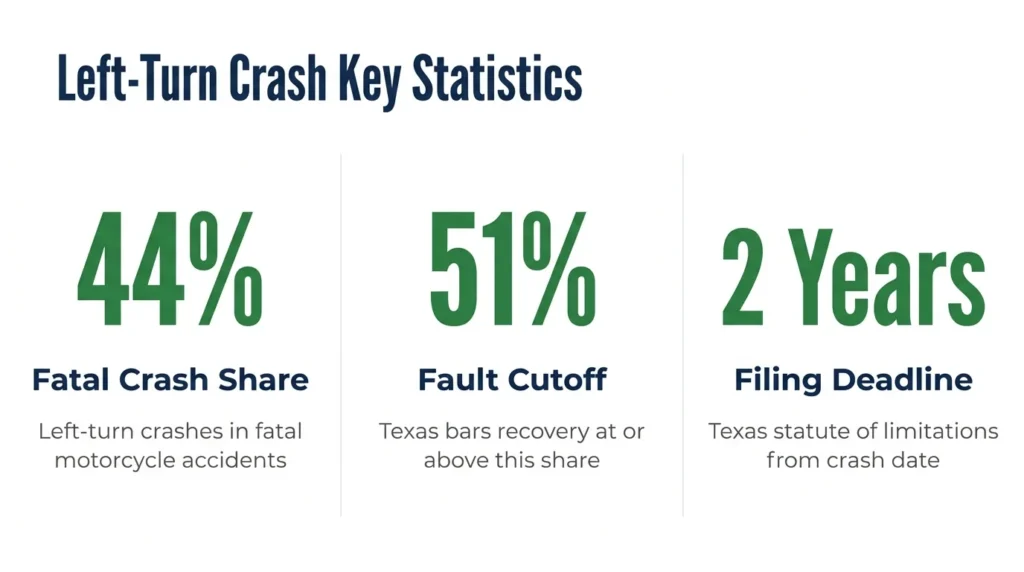
- Texas proportionate responsibility rules reduce your recovery by your fault percentage, and bar it entirely above 50%.
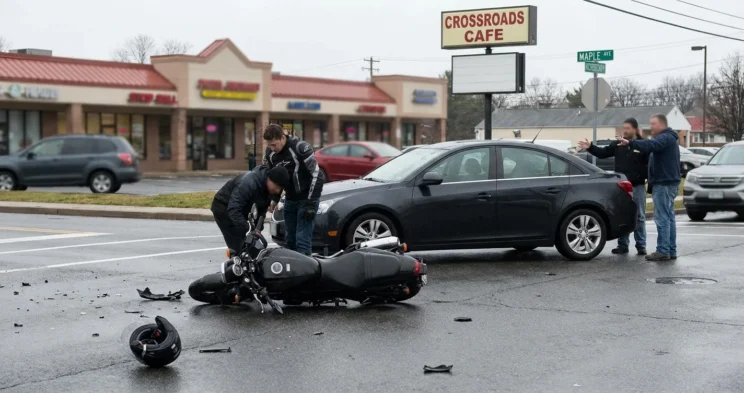
You were riding through an intersection on Loop 1604 when a car crossed the center line and turned left directly into your path. You had no time to brake. The driver told the police they never saw you. Now the insurance adjuster is asking whether you were speeding and hinting that your speed was the real problem.
This scenario plays out on Texas roads every day. Understanding what the law says about left-turn crashes can make the difference between accepting a lowball offer and recovering what your injuries actually cost.
Left Turns Are a Leading Cause of Motorcycle Deaths
Left-turning vehicles are one of the single deadliest hazards a motorcyclist faces. According to NHTSA’s Traffic Safety Facts data, in the most recent reporting year available, 44 percent of fatal two-vehicle motorcycle crashes involved a car or truck turning left while the rider traveled straight, passed, or overtook another vehicle. No other crash configuration comes close in frequency or severity.
The reason this crash type is so common comes down to how drivers perceive motorcycles. A motorcycle’s narrow profile creates a visual illusion: the bike appears farther away and slower than it actually is. A driver waiting to turn left looks both ways, sees the motorcycle, and miscalculates the gap. By the time the driver realizes the error, the bike is already there.
This is not a fluke. It is a documented, predictable pattern that shows up in Texas crash data year after year. The frequency of this crash type is exactly why Texas law places a legal duty on the driver making the turn.
Who Is Legally at Fault When a Car Turns Left into a Motorcycle?
The turning driver is almost always the primary at-fault party. Texas law is direct on this point.
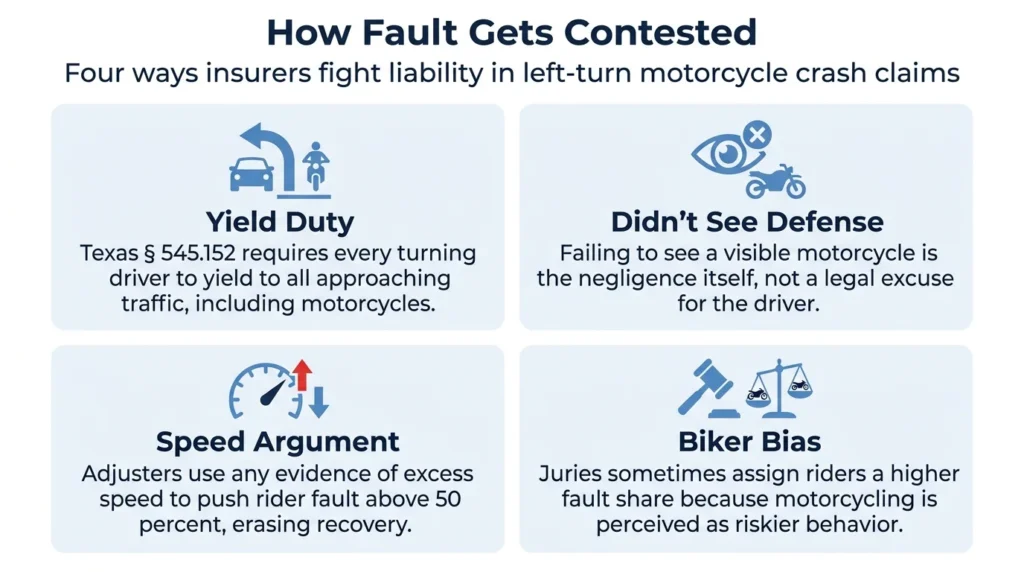
Texas Transportation Code § 545.152 requires a driver turning left at an intersection to yield the right-of-way to any vehicle approaching from the opposite direction that is in the intersection or close enough to be an immediate hazard. The law does not say yield if you see the other vehicle. It says yield, period.
“I didn’t see the motorcycle” is not a legal defense. If the motorcycle was in the road and the driver failed to look properly before turning, that driver breached the duty of care. Failing to see what was there to be seen is the breach, not an excuse for it.
Proving negligence in a left-turn motorcycle crash requires four elements: the other driver had a duty to yield, the driver breached that duty by turning, the turn caused the crash, and the rider suffered injuries as a result. In most left-turn cases, the facts of the turn itself satisfy the first three elements.
The fight in these cases is usually not about whether the driver was negligent. It is about whether the rider was too.
If the turning driver’s insurer is arguing that their driver had no duty or that the rider caused the crash, an attorney who handles motorcycle accident liability cases can evaluate the strength of those arguments against the evidence.
How Your Speed Can Be Used Against You in Texas
The most common insurance defense in left-turn motorcycle crashes is the speed argument: if the rider had been going slower, the driver would have had enough time to complete the turn safely. This argument is more powerful than it sounds, and you need to understand exactly how it works.
Texas uses a proportionate responsibility system. Under Texas Civil Practice and Remedies Code Chapter 33, fault is divided as percentages among all parties involved in the crash. A rider found more than 50 percent at fault recovers no compensation. A rider found 50 percent or less at fault has their compensation reduced by that percentage.
Texas Transportation Code § 545.351 governs speed limits. If an adjuster or jury finds that the rider was traveling above the posted limit, that violation supports a fault percentage assignment to the rider. The insurer does not need to prove the rider caused the crash outright. They only need to push the rider’s fault number above 50 percent.
Speed alone, though, does not eliminate the turning driver’s negligence. The driver still had a legal duty to yield to approaching traffic. The question in dispute is not whether the driver was negligent. It is how much of the total fault belongs to each party.
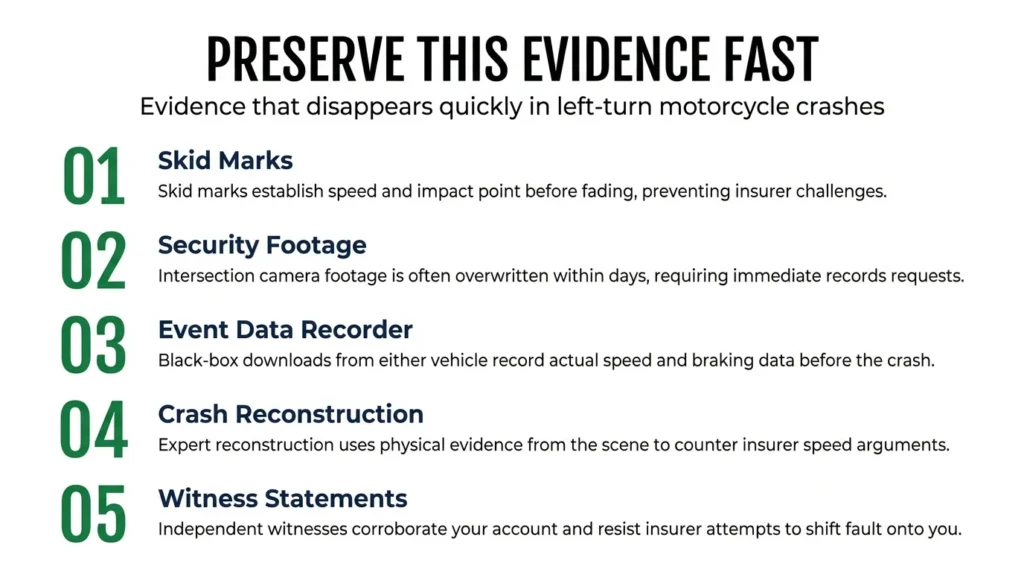
Countering the speed argument requires evidence: crash reconstruction analysis, skid marks, point of impact, event data recorder downloads from either vehicle, traffic camera footage, and witness statements. These sources can establish what the rider’s actual speed was and whether that speed was a cause of the collision or simply a fact the insurer is using to shift blame.
You can review how Texas calculates those percentages and what they mean for your settlement value.
What Your Claim Is Worth After a Left-Turn Crash
After a left-turn motorcycle crash, you can seek compensation for medical bills (past and future), lost wages, reduced earning capacity, pain and suffering, and damage to your motorcycle.
The number that controls your actual recovery is the fault percentage assigned to you. A jury that finds the turning driver 80 percent at fault and you 20 percent at fault will reduce a $200,000 award to $160,000. A jury that finds you 51 percent at fault awards you nothing.
Insurance adjusters know this math. An early fault estimate that puts the rider at 30 or 40 percent can dramatically reduce the offer before you’ve had a chance to gather evidence. The preliminary estimate is not a final number. It is a starting position.
Evidence gathered quickly, before it disappears, changes these percentages. Skid marks fade. Security footage gets overwritten, or deleted. Vehicle data recorders can be lost if vehicles are repaired or junked. The timeline for preserving evidence is short.
Texas also places bias against riders into the mix: adjusters and juries sometimes assign riders a higher fault percentage than the facts support simply because riding a motorcycle is perceived as riskier behavior. Understanding how that bias affects claims is one of the most important things injured riders can learn before accepting any offer.
Reviewing Texas’s proportionate responsibility rules is also helpful.
Get Legal Help After a Left-Turn Motorcycle Crash
Left-turn crashes are legally straightforward in structure but contested in practice. The turning driver was almost certainly negligent. The fight is over how much of the fault the insurer can transfer to you.
Angel Reyes & Associates has handled motorcycle crash claims across Texas for over 30 years. We work on contingency, which means you pay nothing unless we recover compensation for you. If you were hurt in a left-turn motorcycle crash and the insurer is pushing back on fault, contact us today for a free consultation.
Our team has reviewed case results involving motorcycle accident claims and can evaluate the specific facts of your crash.
Past results do not guarantee future outcomes.
Left-Turn Motorcycle Accident FAQs
How long do I have to file a lawsuit after a left-turn motorcycle accident in Texas?
Texas gives you two years from the date of the crash to file a personal injury lawsuit. If you miss that deadline, your right to sue is almost always gone, regardless of how clearly the other driver was at fault.
Does it help my claim if the turning driver got a traffic ticket?
A traffic citation for failing to yield is useful evidence, but it does not decide your civil case. A civil court looks at all the facts, not just whether a ticket was issued. A driver who was not cited can still be found negligent, and a driver who was cited can still argue you shared some fault.
What if the driver who turned left in front of me has no insurance?
If the at-fault driver is uninsured, your own uninsured motorist (UM) coverage steps in to cover your damages up to your policy limits. If you carry UM coverage on your motorcycle policy, file a claim with your own insurer using the same evidence you would use against the at-fault driver.
Can not wearing a helmet reduce my motorcycle accident settlement in Texas?
Texas allows riders 21 and older to ride without a helmet under certain conditions. However, insurers may argue that riding without a helmet increases your head or facial injuries, which can raise your fault percentage and reduce your payout under Texas comparative fault rules.
What should I do at the scene to protect my left-turn crash claim?
Call 911, get a police report, and photograph the vehicle positions, skid marks, road conditions, and any traffic signs or signals before they change. Ask witnesses for their names and contact information. Do not repair your motorcycle before an attorney or insurer can inspect it, and preserve your riding gear in a sealed bag as physical evidence.
About the Authors

Angel Reyes
Writer
Angel L. Reyes, III is the Founder and Managing Partner of Angel Reyes & Associates. A nationally recognized trial attorney and business leader, Angel has helped over 70,000 injury victims recover more than $1 billion since founding the firm in 1993. Named to the Texas Super Lawyers list annually since 2008, Angel brings Wall Street experience, Ivy League education, and a deep commitment to client advocacy. He is a frequent legal commentator and published author with extensive contributions to legal scholarship, trial strategy, and consumer protection.

Kyle Nicolas
Editor
Kyle Nicolas is the Web Content & SEO Manager at Angel Reyes & Associates. He has more than 10 years of experience as a marketing co...

Angel Reyes
Reviewer
Angel L. Reyes, III is the Founder and Managing Partner of Angel Reyes & Associates. A nationally recognized trial attorney and business...