Who Pays Medical Bills After a Bus Accident in Texas?


Every article on this site is researched by our internal team, reviewed for legal accuracy against current Texas law, and held to State Bar of Texas advertising standards before publication. We do not publish content that overstates outcomes or makes promises about results.
Learn more about our
editorial standards .
Key Takeaways
- Whether the bus was private or government-owned controls your caps, deadlines, and coverage.
- Texas government bus claims cap recovery at $250,000 per person, or $100,000 for many units.
- Your PIP, MedPay, and health insurance pay medical bills first, before any settlement arrives.
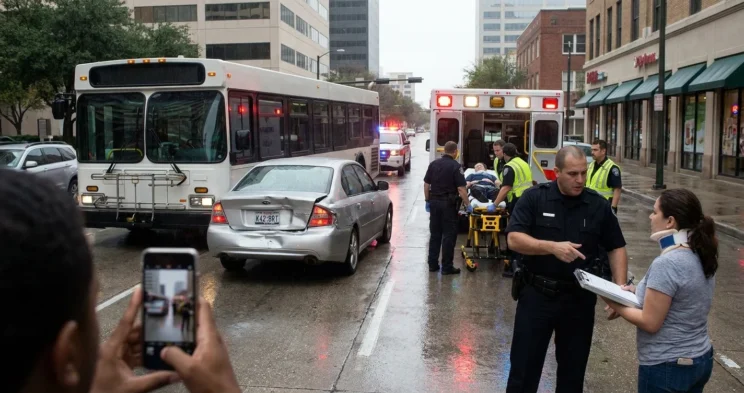
You were riding a metro bus down Westheimer Road one morning when the driver braked hard and threw you into the seat in front. Now the emergency room bills are arriving, but no one’s told you who actually pays them. The answer depends almost entirely on one thing: who owned the bus.
Private Bus vs. Government Bus: What Controls Your Claim
Whether the bus was privately operated or government-operated controls everything that happens to your medical bills. This single fact decides which insurer is responsible, how much you can recover, and how fast you must act.
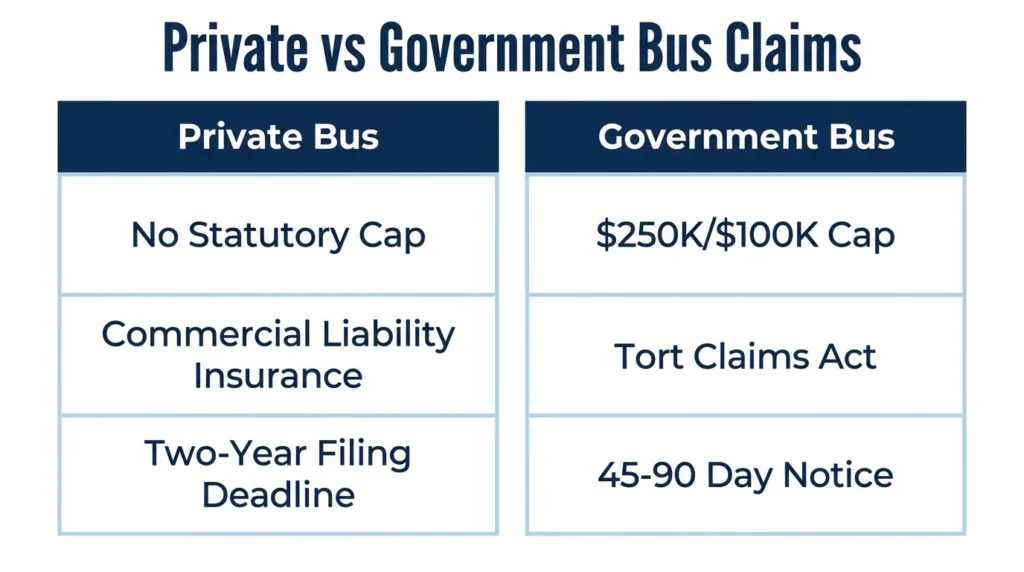
Private bus operators include charter companies, intercity carriers, and tour buses. They carry commercial liability insurance with no statutory limit on what you can recover for serious injuries.
Government-operated buses are a different story. Transit agencies, school districts, and city or county buses fall under the Texas Tort Claims Act. That law caps your recovery and forces you to give notice on a tight deadline.
Why does the operator type matter so much? Every later question in your case, from which coverage pays first to which liens attach to your settlement, traces back to this split. Our Texas bus accident claims page explains which category applies to your crash. If you’re still figuring out the parties involved, our guide to who can be held liable in a bus crash explains each one.
Your Own Coverage Pays First: PIP, MedPay, & Health Insurance
Your own coverage pays your medical bills first, long before any claim against the bus operator resolves. Using it doesn’t waive your right to recover from the at-fault party later.
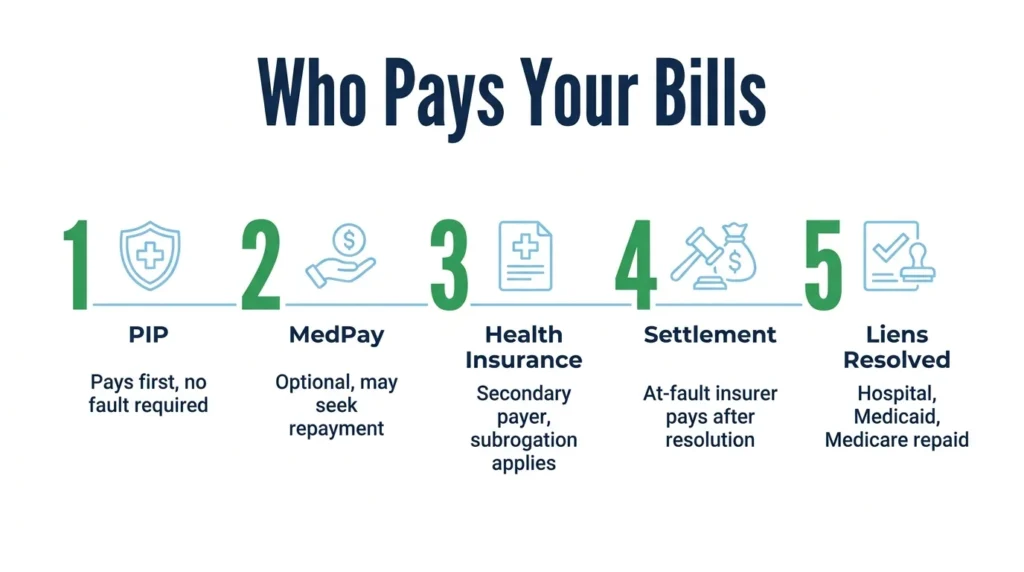
Personal Injury Protection (PIP) is the first payer under a Texas auto policy. It covers accident-related medical costs no matter who caused the crash. Texas auto insurers must offer PIP, and you can only reject it in writing. If you never signed that rejection, you likely have coverage you can use right now.
PIP has another advantage. In virtually all bus accident cases, your PIP insurer can’t take away these benefits from your settlement. The Insurance Code § 1952.155 bars PIP subrogation against your recovery, unless the at-fault party was uninsured. This situation rarely occurs when the bus is operated by a commercial carrier or government entity, both of which are required to carry financial responsibility. The money you receive stays yours.
MedPay is an optional add-on that also covers medical bills without a fault requirement. Unlike PIP, it may carry subrogation rights, so the insurer can sometimes seek repayment depending on your policy language.
Health insurance steps in as a secondary payer once PIP and MedPay run out. Most plans include a subrogation clause, which means the insurer can claim part of your eventual settlement. See how PIP, MedPay, and uninsured motorist coverage compare.
If you only have health insurance, confirm it applies to accident-related care. Some plans exclude injuries that another policy should cover. Figuring out which coverages are active before your first appointment can change how your bills are routed and which liens attach to your recovery.
Government Bus Caps & What Happens When Bills Exceed Them
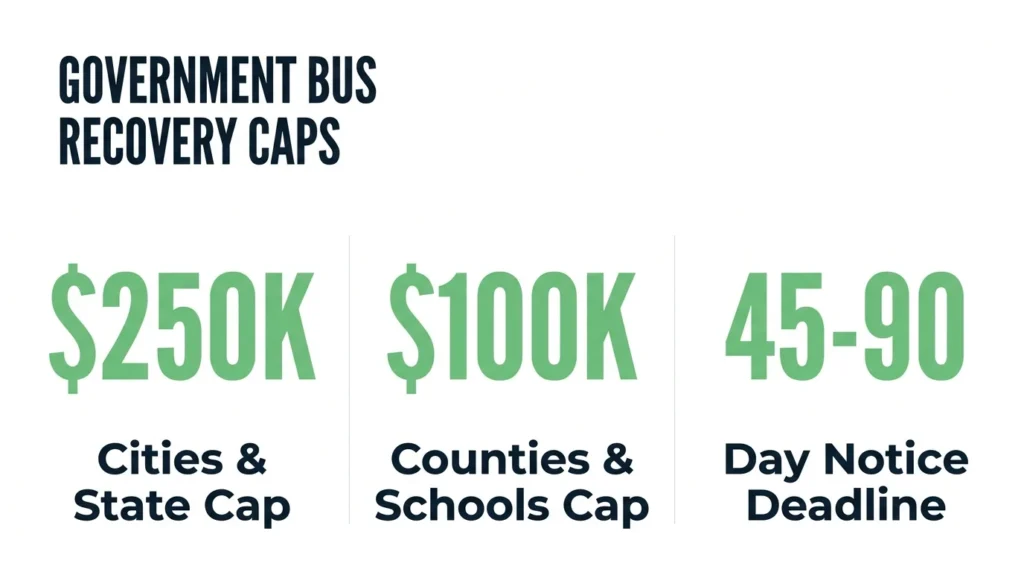
A government bus claim is capped, and the cap can fall far below what serious injuries cost. The Texas Civil Practice and Remedies Code (CPRC) § 101.023 limits recovery to $250,000 per person for cities and the state. Counties and school districts often carry a lower $100,000 per-person cap.
A catastrophic injury blows past those numbers fast. Spinal surgery, a traumatic brain injury, or weeks in the hospital can generate bills beyond the cap within the first month of treatment.
When the cap is reached, the government entity owes nothing more. The gap falls to your own resources: PIP, MedPay, and health insurance. When none of these cover it, a letter of protection from a treating provider can keep care going until your case resolves.
There is also a clock you may not know about. Government bus claims require pre-suit notice, sometimes within 45 to 90 days under a local ordinance. The waiver of immunity that lets you sue at all comes from Chapter 101 of the Texas Tort Claims Act. If you miss the notice deadline, your claim can be barred, which leaves every bill to you.
This notice rule is separate from the standard filing deadline. The two-year limit under CPRC § 16.003 doesn’t govern the notice obligation, which comes earlier. An attorney can pin down the exact deadline and cap for the specific entity involved before this window closes. Our breakdown of how the Tort Claims Act limits bus recovery covers the cap mechanics in depth. Our guide to filing a bus accident claim also explains the notice steps.
Hospital Liens, Subrogation, & Lien Resolution
Several creditors can claim part of your settlement before the money reaches you. Even after you win, hospital liens, health plan subrogation, and government liens can shrink your net recovery well below the headline number.
Hospital liens come first. Under Texas Property Code Chapter 55, a hospital that admits you within 72 hours of the crash and treats you within 100 days can secure its charges against your recovery. That lien is capped at half of your settlement proceeds.
Health insurance subrogation comes next. When your health plan pays for crash-related care, it usually claims repayment from your settlement. Self-funded employer plans that fall under the federal Employee Retirement Income Security Act hold the strongest rights, while state-regulated plans must follow Texas negotiation rules.
Government coverage carries its own liens. If Medicaid paid for your treatment, the Texas Human Resources Code § 32.033 and the federal Medicaid recovery statute at 42 U.S.C. § 1396p require repayment from your recovery. The Texas Office of the Attorney General handles that resolution.
Medicare works the same way. When Medicare makes conditional payments, the Medicare Secondary Payer Act at 42 U.S.C. § 1395y(b) requires repayment to Medicare. You can review the official steps for the Center for Medicare and Medicaid Services recovery process. Resolving a Medicare lien before you distribute funds protects you from federal liability.
A letter of protection completes the picture. Your provider and attorney agree that treatment costs wait until the case resolves. This lets you keep getting care without paying upfront, though it creates a contractual lien settled at the end. These same mechanics appear in who pays medical bills after a car accident. Our past case results show how we’ve resolved complex liens for injured clients.
Talk to a Texas Bus Accident Attorney
Bus accident medical bills in Texas run through layered coverage, statutory caps, short government deadlines, and competing liens. One wrong move for any of these can leave you paying for someone else’s negligence. Angel Reyes & Associates has guided injured Texans through exactly these problems for over 30 years.
We’ve recovered more than $1 billion for clients in cases involving government entities, commercial carriers, and tangled lien resolution. We work on contingency, so there’s no fee unless we win. Your first consultation is always free, so reach out to us for a free case evaluation.
Past results do not guarantee future outcomes.
Frequently Asked Questions
Does the bus company's insurance pay my medical bills as they arrive?
No. The at-fault operator’s liability insurer doesn’t pay bills while treatment is ongoing. It pays after fault and damages are settled, either through a negotiated settlement or a court judgment.
What if I don't own a car and have no PIP or MedPay coverage?
Riders without vehicles have no PIP or MedPay to draw on, so health insurance becomes the first payer. If health coverage is limited or absent, a letter of protection from a treating provider can keep care going until the claim resolves.
Can a hospital lien be negotiated before the settlement is paid out?
Yes. Texas law caps a hospital lien at 50% of the settlement proceeds, but the charged amount can also be challenged if it exceeds a reasonable rate for the services provided. Attorneys routinely negotiate hospital lien balances down before settlement funds are distributed.
Does workers' compensation apply if I was hurt on a bus while traveling for work?
Standard commutes are not covered under the Texas workers’ compensation law’s “coming and going” rule. If the bus trip was part of your job duties, such as traveling between job sites on a route arranged by your employer, workers’ compensation may apply alongside or instead of a personal injury claim.
How much liability insurance must a private bus company have in Texas?
Intrastate buses carrying 15 to 26 passengers must have at least $500,000 in liability coverage; buses with more than 26 seats must have $5 million. Buses operating across state lines must meet higher federal minimums set by the FMCSA.
About the Authors

Angel Reyes
Writer
Angel L. Reyes, III is the Founder and Managing Partner of Angel Reyes & Associates. A nationally recognized trial attorney and business leader, Angel has helped over 70,000 injury victims recover more than $1 billion since founding the firm in 1993. Named to the Texas Super Lawyers list annually since 2008, Angel brings Wall Street experience, Ivy League education, and a deep commitment to client advocacy. He is a frequent legal commentator and published author with extensive contributions to legal scholarship, trial strategy, and consumer protection.

Graham Griffin
Editor
Graham Griffin is the Web & Content Manager at Angel Reyes & Associates, where he oversees content strategy, AI-powered workflows, a...

Spencer Browne
Reviewer
Spencer Browne is a partner at Angel Reyes & Associates and a Board Certified personal injury trial lawyer with nearly 100 jury trials a...