Bus Runs a Red Light and Causes an Accident in Texas


Every article on this site is researched by our internal team, reviewed for legal accuracy against current Texas law, and held to State Bar of Texas advertising standards before publication. We do not publish content that overstates outcomes or makes promises about results.
Learn more about our
editorial standards .
Key Takeaways
- A bus running a red light violates Texas law and proves negligence per se automatically.
- Government bus claims require written notice within six months and face strict damage caps.
- Private bus operators face no Tort Claims Act caps, so your recovery can be much larger.
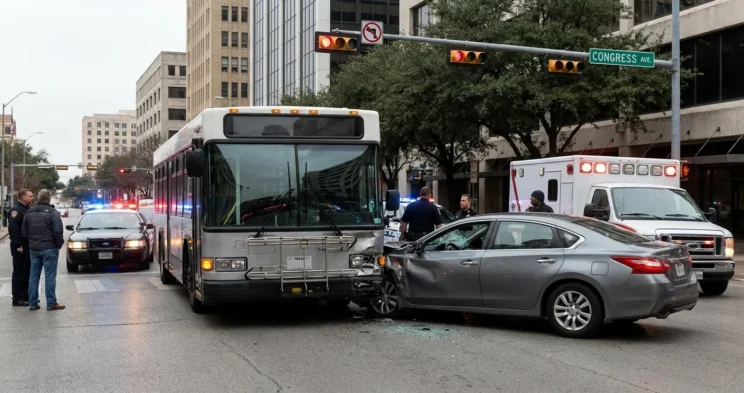
You were stopped at a light on Westheimer Road near the Galleria when a city bus rolled through the cross-street signal and slammed into your door. The crash was not your fault, and you saw the light turn. Now you are facing medical bills, missed paychecks, and a knot of questions about who actually pays for this.
Bus Red Light Violations & Negligence Per Se
A bus that runs a red light has broken a specific Texas law, and that broken law can do much of the work of proving your case. Under the Texas Transportation Code § 544.007, any driver facing a steady red signal must stop before entering the intersection. A bus that proceeds through that red light violates this statute outright.
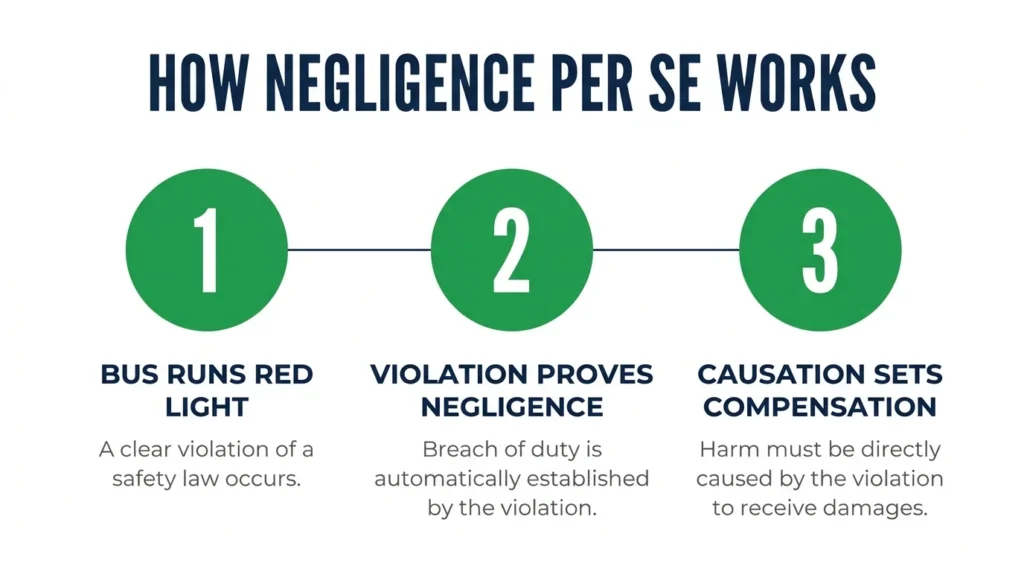
That violation matters because of a rule called negligence per se. When a driver breaks a safety statute meant to protect people like you from exactly this kind of harm, the law treats the driver as negligent automatically. You do not have to prove the driver was careless. The broken law proves it for you.
This shifts the whole fight. The defense cannot argue the bus driver acted reasonably when the driver blew a red light. Instead, the dispute moves to how the violation caused your specific injuries and what your claim is worth.
You still carry some burden, though. You must show the red-light run actually caused the crash and your injuries. If you want a closer look at how fault works in these cases, our guide on what to do after a red-light crash walks through the basics before you talk to anyone.
Strong evidence makes the causation question easy to answer. A police report noting the violation, intersection camera footage, witness statements, and the bus operator’s own incident records all help. For a fuller picture of who can be held responsible, our team can give you an explanation of bus accident liability in Texas.
Common Carrier Duty of Care for Texas Buses
If you were riding the bus when it ran the light, you have an even stronger position. Buses that carry the public are common carriers, and under Texas law they owe passengers a high degree of care: the standard of a very cautious, competent, and prudent person acting under the same circumstances. This applies to public transit buses, private charter operators, and school buses carrying riders.
That heightened duty means a bus company must take real steps to protect you from foreseeable harm. Driver error at an intersection is exactly that kind of risk. A properly run bus does not blow through red lights, so a red-light run is a clear breach of the duty owed to you.
For a passenger, the two failures stack. The operator faces a statutory violation under the negligence per se rule and a breach of the elevated duty owed to the people it carries. Our bus accident claims practice covers how these overlapping theories strengthen a passenger’s recovery.
If you were not on the bus, your path looks a little different. Pedestrians and people in other vehicles rely mainly on the negligence per se doctrine. The common carrier duty protects passengers aboard the bus, but the broken traffic law still anchors your claim either way.
Operator Type Determines Who You Sue
Who you sue depends entirely on who runs the bus. A public transit authority, a school district, a charter company, and a private operator each come with different rules, deadlines, and limits on what you can recover. Sorting out the operator type is the first real decision in your case.
Public Transit & School District Buses
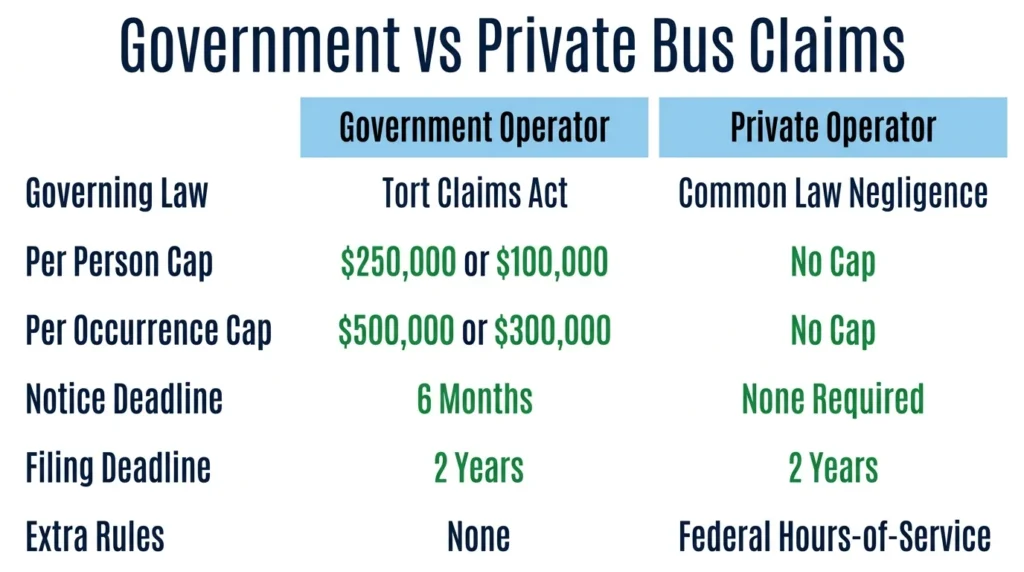
Public transit buses run by agencies like DART, METRO Houston, or VIA, along with public school district buses, are government-owned vehicles. Claims against them fall under the Texas Tort Claims Act. The Act waives the government’s usual immunity for negligent vehicle operation, but it adds caps and a strict notice deadline.
The waiver fits your situation cleanly. The Texas Civil Practice and Remedies Code (CPRC) § 101.021 waives immunity when a government employee negligently operates a motor vehicle and causes injury. A red-light run by a bus driver squarely meets that vehicle-operation test.
The trade-off is a hard ceiling on damages. Under CPRC § 101.023, cities and the state are capped at $250,000 per person and $500,000 per occurrence. Other local government units, including some school districts, are capped at $100,000 per person and $300,000 per occurrence.
The deadline is where many strong claims die. Under CPRC § 101.101, you must deliver a written notice of your claim to the government unit within six months of the crash. If you miss that window, your claim is usually barred, no matter how clearly the bus ran the light.
Because the rules are this unforgiving, learning how to pursue a claim against a government entity early can keep your case alive. It’s important to learn more about how the Texas Tort Claims Act limits bus cases and how the caps and notice rules shape what you can realistically recover.
Charter & Private Bus Operators
Charter buses, private intercity carriers, and privately run school buses are not government entities. That means no Tort Claims Act caps apply to your claim. The negligence per se and common carrier rules still control, and federal safety rules may add another layer.
Without the government caps, your recovery is limited only by what a jury awards. That award is still subject to Texas fault-sharing rules, but the dollar ceiling is gone. For many injured riders, a private operator means a fuller recovery.
Federal rules can also help prove fault. The federal hours-of-service rules for passenger carriers limit how long a bus driver can stay behind the wheel. When fatigue from a violation contributes to a red-light run, you gain a second regulatory breach to point to.
The operator’s employer can be on the hook too. Under respondeat superior, a bus company is liable when its driver caused the crash while working. Our team can further explain how to file a bus accident claim, laying out the steps for pursuing both the driver and the company.
Filing Deadlines & Fault Allocation in Texas
For a private bus operator, you have two years from the crash date to file suit. The CPRC § 16.003 sets this two-year statute of limitations for personal injury claims. Miss it and your claim is permanently barred.
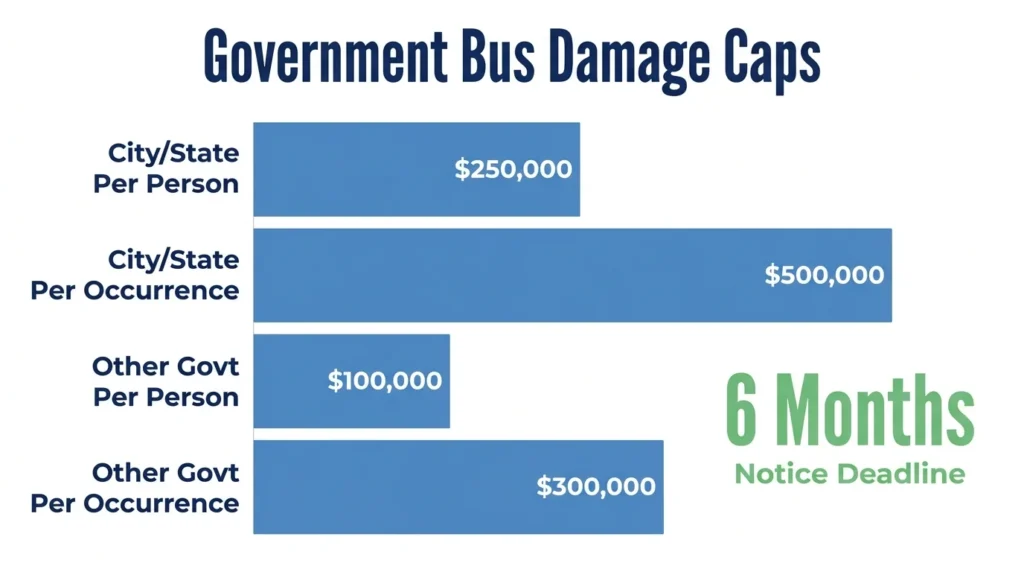
Government bus claims carry a second, earlier clock. The six-month notice requirement under the Tort Claims Act runs at the same time as the two-year deadline. You must satisfy both, and the six-month notice almost always comes first.
Texas also shares out fault among everyone involved. Under Texas proportionate responsibility rules, your recovery drops by your share of the blame. A driver found more than 50% at fault recovers nothing at all.
A clear red-light violation usually pushes the bus operator’s share of fault well past that line. That is good news for you. It puts the operator on the wrong side of the 51% bar and leaves little room to blame you.
Expect the defense to try anyway. They may claim you entered the intersection without checking cross traffic. Physical evidence, camera footage, and police report data are what beat that argument, the same proof that supports Texas red-light fault claims generally.
Work with a Texas Bus Accident Attorney
A bus that runs a red light hands you a strong starting point, but the deadlines and government rules can sink a good case fast. Angel Reyes & Associates has recovered more than $1 billion for clients injured in Texas vehicle accidents, including bus crashes involving negligent operators and transit authorities.
With over 30 years of experience, we handle bus accident claims across the state, and you pay no fee unless we win. You can review our case results to see how we have handled serious injury claims. Contact us for a free consultation to talk through your options.
Past results do not guarantee future outcomes.
Frequently Asked Questions
What types of damages can I recover after a bus runs a red light in Texas?
You can pursue compensation for medical bills, lost wages, and pain and suffering. If the injuries are permanent, future medical costs and lost earning capacity are also recoverable.
Can my family file a wrongful death claim if someone was killed in a Texas bus red-light crash?
Yes. Under the Texas Wrongful Death Act, a spouse, child, or parent of the deceased can file a claim against the bus operator. The same negligence per se doctrine applies, and government notice deadlines still govern if a public transit agency or school district ran the bus.
What should I do at the scene to protect my claim?
Call 911 so an officer documents the crash and notes any traffic violations in the police report. If you can, photograph the intersection, the bus, your vehicle, and any visible injuries before anything is moved.
Does Texas workers' compensation affect my bus accident claim if I was injured while traveling for work?
If your employer carries workers’ comp and you were injured in the course of employment, workers’ comp may be your primary recovery against your employer. You can still pursue a separate personal injury claim against the bus operator, who is a third party unrelated to your employment.
What if the bus driver denies running the red light and there is no camera footage?
Witness statements, skid marks, the point of impact on each vehicle, and the police officer’s assessment can all support your version of events. An accident reconstruction expert can also use physical evidence to show how the crash happened.
About the Authors

Angel Reyes
Writer
Angel L. Reyes, III is the Founder and Managing Partner of Angel Reyes & Associates. A nationally recognized trial attorney and business leader, Angel has helped over 70,000 injury victims recover more than $1 billion since founding the firm in 1993. Named to the Texas Super Lawyers list annually since 2008, Angel brings Wall Street experience, Ivy League education, and a deep commitment to client advocacy. He is a frequent legal commentator and published author with extensive contributions to legal scholarship, trial strategy, and consumer protection.

Graham Griffin
Editor
Graham Griffin is the Web & Content Manager at Angel Reyes & Associates, where he oversees content strategy, AI-powered workflows, a...

Angel Reyes
Reviewer
Angel L. Reyes, III is the Founder and Managing Partner of Angel Reyes & Associates. A nationally recognized trial attorney and business...