Can You Sue a School District for a School Bus Accident in Texas?


Every article on this site is researched by our internal team, reviewed for legal accuracy against current Texas law, and held to State Bar of Texas advertising standards before publication. We do not publish content that overstates outcomes or makes promises about results.
Learn more about our
editorial standards .
Key Takeaways
- Texas law lets you sue a school district only for bus and motor vehicle crash claims.
- You must give the district written notice within six months of the crash.
- School district recovery is capped at $100,000 per person and $300,000 per crash.

Less than an hour after your child climbed onto the school bus, you get a call from their school saying that there was a crash on the way home, and your child is hurt.
Now, you’re being told that you cannot sue the school district, and you are not sure what to believe.
School Districts & Sovereign Immunity in Texas
School districts are governmental units, and they carry what is called “sovereign immunity,” which means you cannot sue them unless a law specifically allows it.
Normally, the Texas Tort Claims Act does not apply to school districts, but there is an exception for claims involving a motor vehicle crash. This exception makes it possible to sue a Texas school district after a school bus crash, according to the law stated in the Texas Civil Practice and Remedies Code (CPRC) § 101.051.
When this exception applies, CPRC § 101.021 allows a school district to be held legally responsible for injury or death if the crash involved a district employee operating a vehicle on the job. This is an important distinction because the driver had to be working for the school district when the crash happened.
If the employee was off duty and using the bus for something other than their job duties, the exception does not apply. Our overview of the Tort Claims Act and bus accident limits will illustrate whether the motor vehicle exception applies in your case.
School District-Operated Bus vs. Contractor-Operated Bus
The first thing to find out is who was actually driving the bus. This one fact decides which set of rules apply to your claim, because a district-run bus and a contractor-run bus are handled under completely different legal systems.

Bus Operated by the School District
When the district employed the driver and controlled the bus, the Tort Claims Act applies. In this case, the district can be held responsible because of the motor vehicle crash exception, but there is still a damages cap that limits what you can recover.
The first step is confirming who employed the driver on the day of the crash. This information can be found by reviewing district employment records and transportation contracts.
If your child attends a charter school, that is a gray area. Some charter buses count as governmental units, but some do not. Therefore, a charter bus claim requires its own analysis. Our breakdown of who is liable in a Texas bus accident can shed some light on this.
Bus Operated by a Private Contractor
When a private company is contracted by the school district to operate the school bus, the driver works for the contractor, not the school district. That means the contractor is a private defendant with no government protection from lawsuits.
A contractor-operated crash works like any ordinary negligence claim. There is no six-month notice rule, no cap on damages, and the standard two-year deadline to file your claim applies.
You can still sue the school district separately if careless hiring or management practices helped cause the crash. This claim would be handled under government immunity, unlike a claim against a private bus company.
Determining who is responsible requires employment records and transportation contracts. An attorney can pull these documents quickly after a crash.
Filing Deadlines for School District Claims
A school district claim has two separate deadlines that are easy to confuse. One is a six-month notice rule, and the other is a two-year filing deadline. If you miss either deadline, your claim is dismissed.

The Six-Month Texas Tort Claims Act Notice Deadline
You must give the school district formal written notice within six months of the crash under CPRC § 101.101. If you miss that deadline, your claim is dismissed.
Furthermore, the notice cannot be vague. It must describe the injury or damages you are claiming, the time and place of the incident, and how the incident happened. A general statement that “someone got hurt” will not cut it.
Additionally, some districts have adopted local notice policies with deadlines that are even shorter than six months. Be sure to check whether your specific district has a shorter deadline.
There is a narrow exception to this rule called “actual notice.” This applies if the school district already knew about your injury, as well as the time, place, and circumstances of the crash before the deadline. In this case, formal written notice may not be required. However, it’s risky to rely on this exception, so it should never replace timely written notice. Our guide on how to file a bus accident claim in Texas can tell you what to do next.
The Two-Year Statute of Limitations
The second deadline is the two-year statute of limitations. This means you must file your lawsuit within two years of the crash, under Texas Civil Practice and Remedies Code § 16.003.
These two deadlines run independently of each other. That means if you miss the two-year deadline, your lawsuit will be dismissed, even if you delivered timely written notice within six months of the crash.
If your claim involves an injured minor, then the two-year deadline is usually paused until the child turns 18. However, the six-month notice requirement still applies, and it starts on the date of the crash, no matter how old the child is at the time of the crash.
Damages Cap for School District Claims
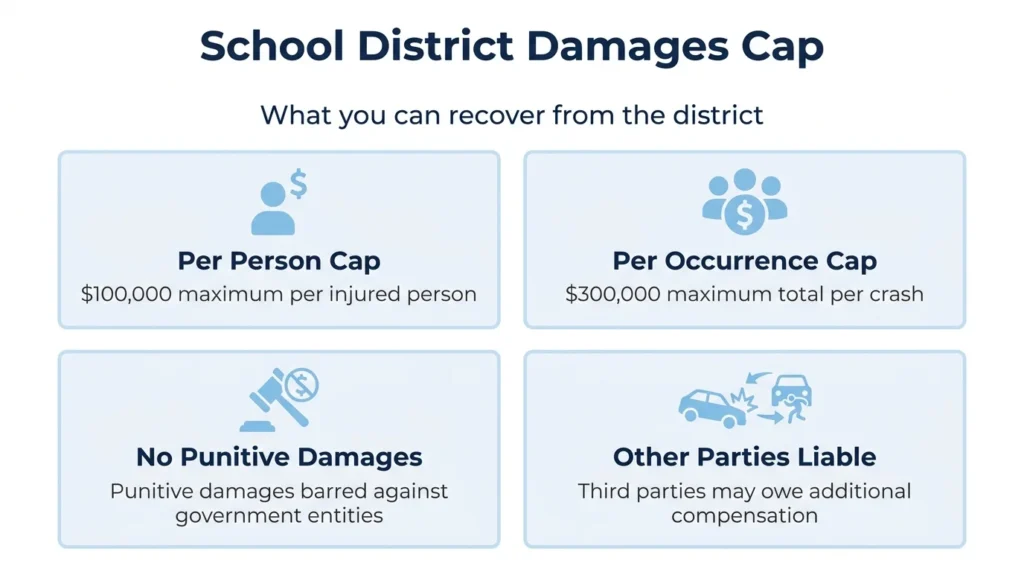
A school district claim is capped at $100,000 per person and $300,000 per occurrence for bodily injury or death under CPRC § 101.023. These limits apply because a district is a unit of local government.
However, this cap only limits what you can collect from the school district itself. You may be able to collect more from other parties who helped cause the crash, such as a third-party driver, a defective parts maker, or a private road contractor. This is why identifying every responsible party can shape your entire recovery. If a manufacturer or another driver shares the blame, then your school bus injury claim may reach well above the district’s limits.
Additionally, the damages cap does not limit the types of compensation you can seek within the allowed amount. These types of compensation typically include punitive damages and economic/non-economic losses.
Punitive damages are extra money that a court can order a defendant to pay with the intention of punishing especially bad behavior and discouraging others from doing the same thing. However, under the Tort Claims Act, you cannot recover punitive damages against a government entity, including a school district.
That said, you can still pursue economic losses (like medical bills, lost income, and future medical treatment), along with non-economic losses (like pain, suffering, and impairment).
To see how these claims are typically resolved, see our guide on average bus accident settlements in Texas, as well as how to pursue a claim against a government entity.
Talk to an Attorney About Your School Bus Accident in Texas
A school bus crash involves strict deadlines, government immunity, and recovery limits. Getting it right requires an attorney who has done it all before. Angel Reyes & Associates has spent over 30 years helping injured Texans work through personal injury claims, including bus accidents and government liability cases.
We work on a contingency basis, which means you pay no fee unless we win. Our team has recovered more than $1 billion for clients over the years. See how others have rated their experience in our client reviews and testimonials.
Remember, with deadlines this short, the sooner you call, the more options are available to you. Contact us for a free consultation today.
Past results do not guarantee future outcomes.
School District Lawsuit FAQs
Can you sue the bus driver personally instead of the school district?
In most cases, no. When a district employee causes a crash while on duty, Texas law directs the claim to the school district as the employer. Legal immunity typically protects the driver from personal liability for actions taken while on the job.
What happens if an uninsured driver caused the school bus crash?
Texas school districts cannot purchase uninsured or underinsured motorist coverage, so the injured party will have to cover their own damages in this case. If your own auto insurance policy includes uninsured motorist coverage, that coverage may help pay for your losses if the at-fault driver has no insurance or not enough insurance to cover all your damages.
Can a parent file a claim on behalf of an injured child, or does the child have to wait to file a claim themselves when they turn 18?
A parent can file a claim right away on the child’s behalf. If the case settles, Texas courts typically require court approval of any settlement for a minor, and a judge may appoint an independent attorney to confirm that the terms are fair to the child.
How quickly do you need to act to preserve school bus camera footage?
Within the first few days of the crash. School districts and contractors store bus camera footage on their own servers, and they often overwrite it within 30 to 90 days. A written preservation demand sent immediately after a crash is the only reliable way to stop the footage from being deleted.
Are school district buses subject to the same federal safety rules as commercial buses?
No. Buses operated directly by a public school district are exempt from Federal Motor Carrier Safety Administration regulations. Private contractors who operate school buses are not exempt, so the federal driver qualification and vehicle maintenance rules still apply to them.
About the Authors

Angel Reyes
Writer
Angel L. Reyes, III is the Founder and Managing Partner of Angel Reyes & Associates. A nationally recognized trial attorney and business leader, Angel has helped over 70,000 injury victims recover more than $1 billion since founding the firm in 1993. Named to the Texas Super Lawyers list annually since 2008, Angel brings Wall Street experience, Ivy League education, and a deep commitment to client advocacy. He is a frequent legal commentator and published author with extensive contributions to legal scholarship, trial strategy, and consumer protection.

Graham Griffin
Editor
Graham Griffin is the Web & Content Manager at Angel Reyes & Associates, where he oversees content strategy, AI-powered workflows, a...

Angel Reyes
Reviewer
Angel L. Reyes, III is the Founder and Managing Partner of Angel Reyes & Associates. A nationally recognized trial attorney and business...