How Insurance Companies Undervalue Motorcycle Accident Claims


Every article on this site is researched by our internal team, reviewed for legal accuracy against current Texas law, and held to State Bar of Texas advertising standards before publication. We do not publish content that overstates outcomes or makes promises about results.
Learn more about our
editorial standards .
Key Takeaways
- Texas law bars motorcycle riders found more than 50% at fault from recovering any compensation.
- Insurers use proprietary software to generate claim valuations that adjusters can influence through data entry choices.
- Round-number offers and quick-close pressure are signs the insurer did not calculate your actual losses.

You were riding home on I-35 north of San Antonio when another driver drifted into your lane and knocked you off your bike. The crash was not your fault, and the police report says so. Three weeks later, the other driver’s insurance company calls with an offer. The number on the table does not come close to covering your hospital bills, and the adjuster is pushing you to decide quickly.
That pressure is not an accident. It is a business strategy.
Why Motorcycle Claims Get Lowballed
Motorcycle accident claims are treated differently from standard car accident claims from the moment a file is opened.
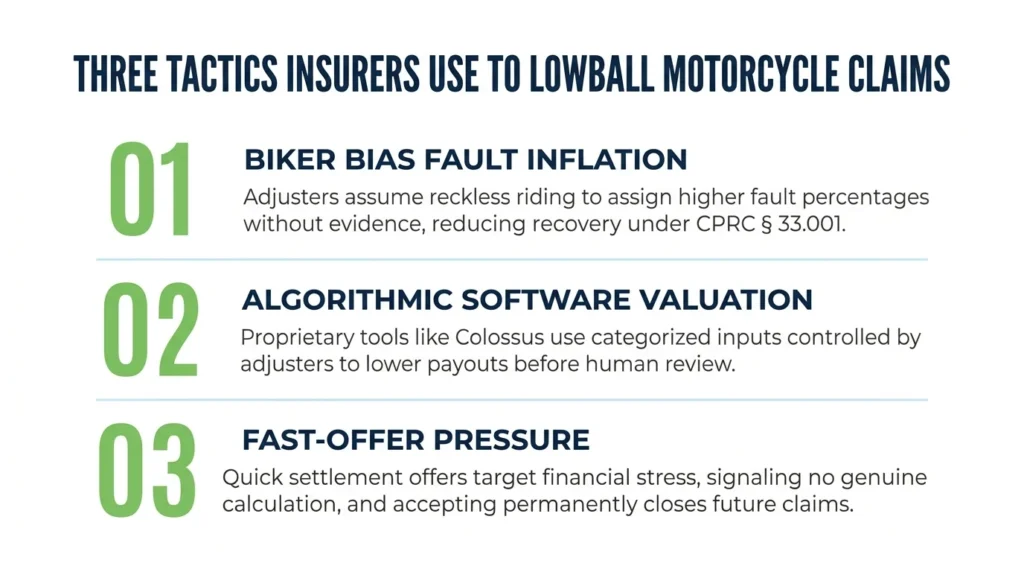
Before reviewing dashcam footage or witness statements, many adjusters enter a motorcycle claim with the working assumption that the rider was speeding, weaving, or riding recklessly. That assumption does not need to be proven to influence the settlement. It just needs to sound plausible when the adjuster explains why your fault percentage is higher than you believe it should be.
The insurer’s goal is to close the claim for as little as possible. Motorcycle injuries tend to be severe, which means the potential payout is large and the insurer’s financial incentive to minimize the claim is even stronger.
Insurers are known for underpaying all types of personal injury claims, but motorcycle riders often face additional pressures on top of that. Because of this, it is often a good idea to seek legal advice from an attorney with experience handling these types of claims.
The Comparative Fault Trap
Texas uses a modified comparative fault system that gives insurers enormous leverage in motorcycle cases. Under the Texas Civil Practice and Remedies Code §33.001, a rider found more than 50% at fault for an accident recovers nothing at all.
Adjusters exploit this rule. By inflating your assigned fault percentage, they reduce the claim value by a corresponding amount. If they can argue you were 30% at fault, your recovery shrinks by 30%. If they can push that number past 50%, you collect zero.
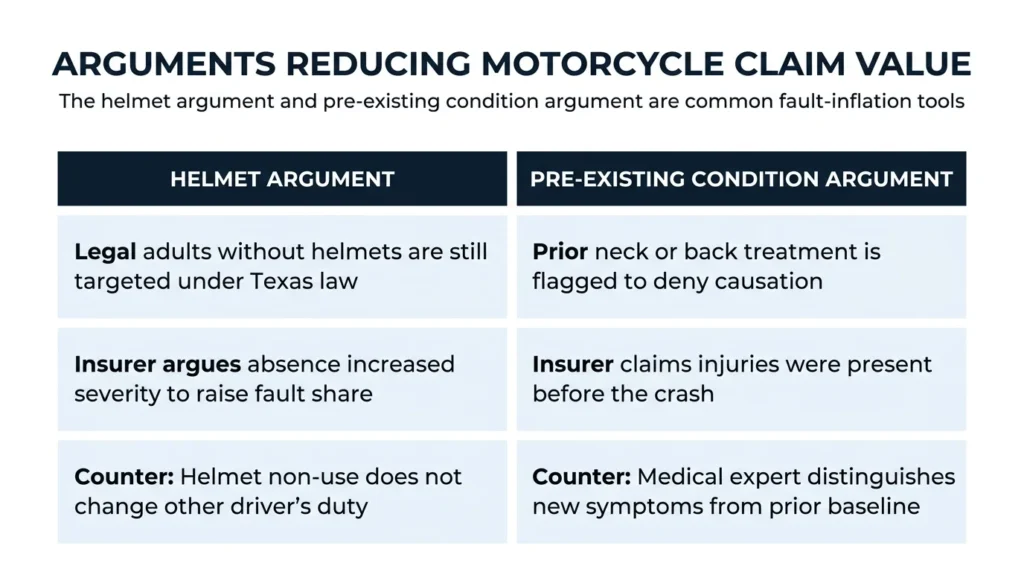
Insurance companies often use two common tactics to blame the rider for a motorcycle accident.
The Helmet Argument
Texas Transportation Code Chapter 661 allows riders over the age of 21 to ride without a helmet under certain conditions, including completing an approved safety course or carrying qualifying insurance. When a rider exercises that legal right and suffers a head or neck injury, insurers argue that the choice to ride helmetless contributed to those injuries. The argument is legally aggressive, but adjusters use it to push for comparative fault reductions even when helmet use would not have changed the crash itself.
The Pre-Existing Condition Argument
Riders with prior back, neck, or shoulder issues are especially vulnerable. Adjusters pull medical records, identify any prior treatment, and claim that the post-crash injuries were already present before the accident. Proving which symptoms are new and which are aggravations of prior conditions requires medical expert opinion. Without documentation, the insurer’s version of events often prevails at the negotiating table.
How Algorithmic Valuation Software Plays a Role in Your Offer
Some insurers run injury claims through proprietary valuation software that generates a dollar figure based on coded inputs rather than the specific facts of your case. Software products such as Colossus and ClaimIQ are tools some insurers use for this purpose. They are designed to process claims at volume and generate outputs that sit within ranges the insurer considers acceptable.
The problem is that adjusters control what goes into the system. An injury coded as less severe than documented, a treatment record left out of the data entry, or an injury classification that places your diagnosis in a lower-value category all produce a lower output. The software does not read your medical records and decide what your pain is worth. It calculates a number based on how the adjuster summarizes your case.
The number the software generates is not a verdict. It is the insurer’s opening offer, made to look objective. Many riders accept these initial offers because a computer-generated figure sounds authoritative. It is not.
If you receive a settlement figure with no explanation of how it was calculated, you can ask the adjuster what valuation method was used.
Be Wary of Fast Offers
The fastest offer is almost always the lowest. Insurers know that an injured rider who is out of work, behind on bills, and uncertain about the future is far more likely to accept a number that falls short of full recovery.
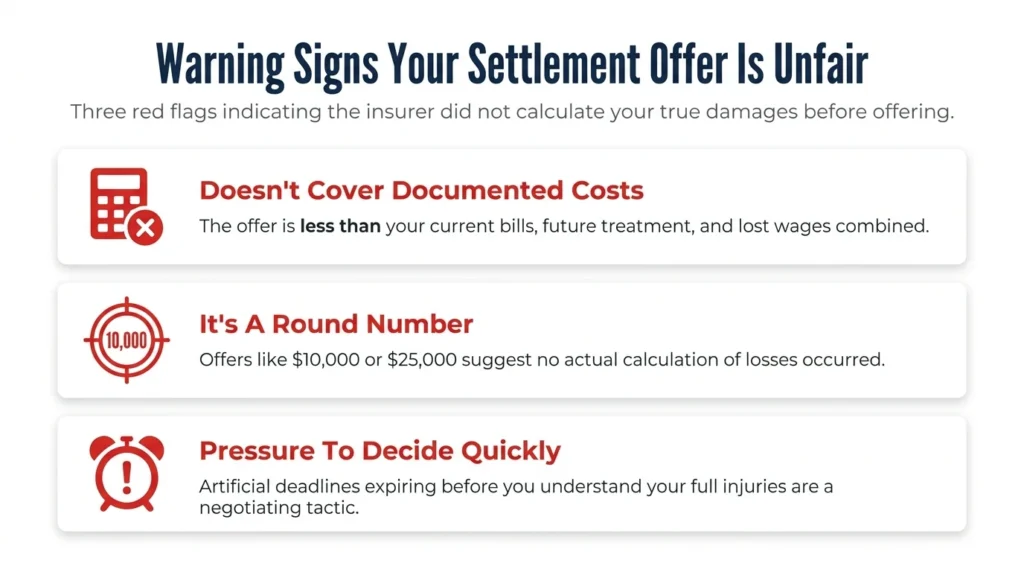
Here are some warning signs that an offer has not been calculated honestly:
- The number doesn’t cover documented costs. Add up your current medical bills, projected future treatment costs, and lost wages. If the offer does not cover those figures, it is not a complete calculation.
- Round numbers. Offers of exactly $10,000, $15,000, or $25,000 are a signal that no genuine calculation occurred. Actual claim values based on real losses rarely land on round numbers.
- Pressure to decide quickly. Adjusters who tell you an offer expires in 48 hours or that a supervisor will not approve the figure again are using artificial urgency. Withdrawing an offer arbitrarily before you have had time to review it is the kind of conduct that can raise bad-faith concerns under Texas law, and it rarely happens in practice.
Motorcycle crashes frequently produce injuries that take weeks or months to become clear. Traumatic brain injuries, spinal cord damage, and soft tissue tears may not show their full impact until after you have returned to work or resumed normal activity. Accepting a settlement before a treating physician has established a final prognosis means releasing the insurer from all future liability, even if your recovery takes longer and costs more than anyone anticipated.
Do not sign anything before understanding your full diagnosis. A signed release is permanent. Before signing, confirm with your treating doctor that your condition has stabilized and that all expected future treatment has been documented.
Get Legal Guidance Before Accepting Any Offers
When an adjuster is pushing a number that does not reflect your actual losses, you have options. The insurer is counting on you not knowing what your claim is worth or believing that the first offer is the only offer.
Angel Reyes & Associates has spent more than 30 years helping injured Texans recover compensation after motorcycle crashes. We handle cases on contingency, meaning there is no upfront cost and no fees unless we win. Our team includes investigators who can build the evidentiary records to challenge inflated fault percentages and the documented medical foundation that counters pre-existing condition arguments.
We’re available 24/7 to discuss your case. Contact us today for a free consultation.
Insurance Companies & Motorcycle Claims FAQs
How long do I have to file a motorcycle accident claim in Texas?
Texas gives most injured riders two years from the date of the accident to file a personal injury lawsuit. Missing that deadline ends your right to sue, regardless of how strong your case is.
Do I have to give the other driver's insurance company a recorded statement?
No. In Texas, you are not legally required to provide a recorded statement to the other driver’s insurer. Adjusters use these calls to gather information that can be used to dispute your account or inflate your fault percentage, so it is best to decline until you have spoken with an attorney.
What happens if the at-fault driver does not have enough insurance to cover my injuries?
If the other driver’s liability limits are too low to cover your losses, your own uninsured/underinsured motorist (UM/UIM) coverage may pick up the difference. Texas insurers are required to offer UM/UIM coverage, and if you did not reject it in writing, you likely have it.
Why do insurance adjusters ask about injuries I had before the accident?
Adjusters look for prior injuries because they can argue that those conditions were not caused by the crash, which reduces what the insurer must pay. You can still recover compensation for injuries that were aggravated or worsened by the accident, even if the underlying condition existed before.
About the Authors

Alex Ivanov
Writer
Alex Ivanov is a personal injury attorney at Angel Reyes & Associates, focused on car, truck, and motorcycle accident cases. Licensed in Texas and multiple federal districts, Alex brings international legal experience and a global education to his practice. He earned his LL.M. from Texas A&M University School of Law after graduating from Belarussian State University in 2016. Alex is fluent in Russian, English, Ukrainian, and Belarussian, and is recognized by multiple national trial lawyer associations for his results and leadership under 40.

Kyle Nicolas
Editor
Kyle Nicolas is the Web Content & SEO Manager at Angel Reyes & Associates. He has more than 10 years of experience as a marketing co...

Angel Reyes
Reviewer
Angel L. Reyes, III is the Founder and Managing Partner of Angel Reyes & Associates. A nationally recognized trial attorney and business...