Comparative Fault in Rideshare Accidents in Texas


Every article on this site is researched by our internal team, reviewed for legal accuracy against current Texas law, and held to State Bar of Texas advertising standards before publication. We do not publish content that overstates outcomes or makes promises about results.
Learn more about our
editorial standards .
Key Takeaways
- A rideshare passenger 50% or less at fault can still recover reduced damages in Texas.
- A passenger found 51% or more at fault recovers nothing under Texas comparative fault.
- Texas gives you two years from the crash date to file a rideshare injury lawsuit.
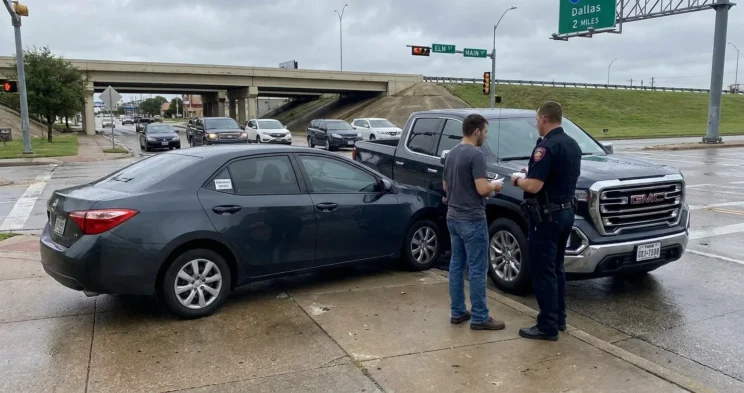
You were waiting on a busy stretch of Greenville Avenue late one night, watching your Uber inch toward the pin. You stepped off the curb mid-block to flag it down, and a car blew through the intersection and hit the rideshare as it pulled over. Now the adjuster keeps asking why you crossed where you did, and the question feels less like curiosity and more like blame.
Can you still recover anything if part of the accident was on you?
Texas Proportionate Responsibility & Rideshare Passengers
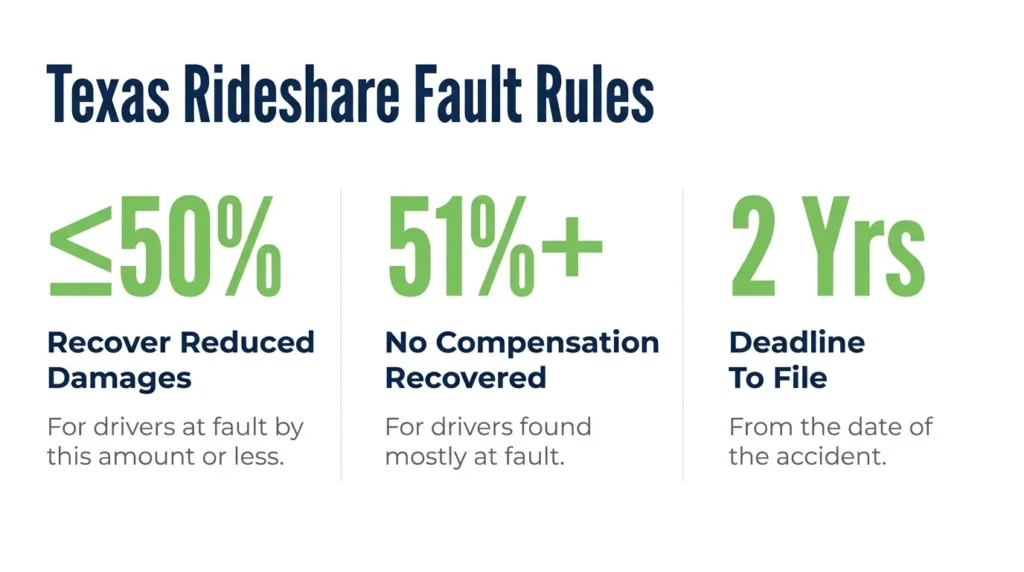
Texas lets you recover compensation as an injured rideshare passenger as long as you are 50% or less at fault. Cross that line to 51% or more, and you recover no compensation. This rule comes from Texas Civil Practice and Remedies Code (CPRC) § 33.001, the modified comparative fault standard that controls every personal injury claim in the state.
The 51% bar looks at your individual share of the blame, not a combined total across everyone involved. If a court finds you 30% at fault, you still recover 70% of your proven damages and receive compensation.
Rideshare crashes usually involve more than one responsible party. The rideshare driver, a third-party motorist, and sometimes you as the passenger can all carry a slice of the fault.
Texas Civil Practice and Remedies Code § 33.003 directs the trier of fact to assign each party a percentage at the same time. The same framework appears in our general resource on the Texas 51% bar rule for accident claims, but rideshare crashes raise passenger-specific fault questions that general car accident content does not reach.
When a Rideshare Passenger May Share Fault
You can share fault as a passenger when your own conduct helped cause the crash or made your injuries worse. These are the situations injured riders worry about most, and they are exactly what an adjuster will look at.
Jaywalking to reach a pickup spot is the most common one. Crossing mid-block or against a signal to board your Uber or Lyft can support a partial-fault result. How much fault you carry depends on whether your crossing actually contributed to the collision.
Boarding distractions are another. Reaching into the driver’s line of sight or leaning across the console can pull the driver’s eyes off the road. An insurer will use that moment to argue you caused part of the crash.
In-ride conduct can also come up. If a working seatbelt was available and you did not buckle, the insurer may say it’s a fault issue. Texas courts look at whether skipping the belt made your injuries worse, not whether it caused the crash itself.
Adjusters raise these arguments routinely to shrink or deny a payout, so spotting the tactic early protects your claim.
How Fault Is Divided Among Multiple Parties
Fault gets split as percentages that must add up to exactly 100%. Under § 33.003, the trier of fact assigns each party who contributed to the crash a share of the blame.
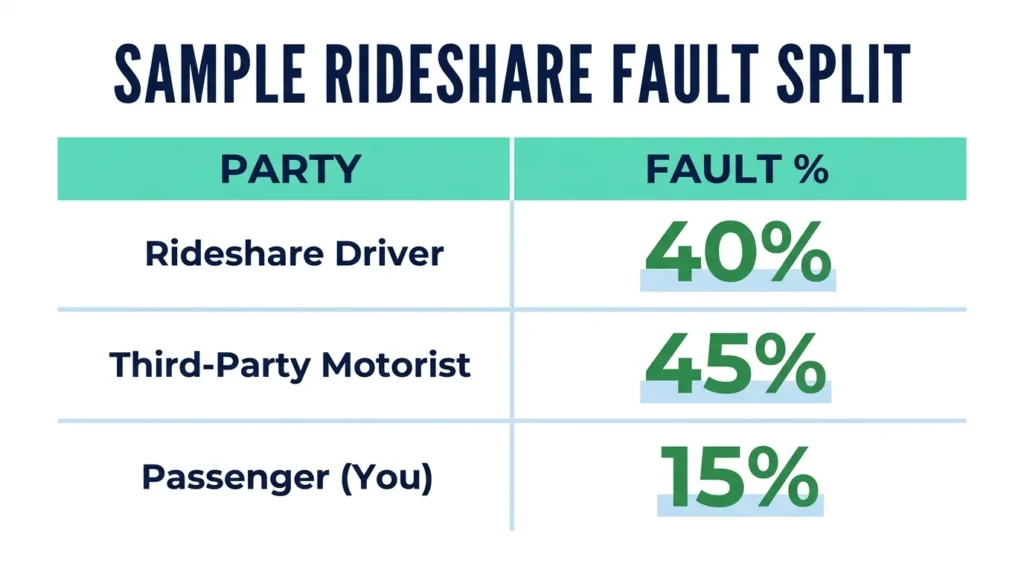
Picture a realistic split. The rideshare driver is 40% at fault for being distracted, the third-party motorist is 45% for running a red light, and you are 15% for jaywalking to the pickup zone. At 15%, you clear the 51% bar with room to spare. You recover 85% of your proven damages.
Your compensation shrinks in proportion to your share, but it does not vanish unless your individual percentage hits 51% or higher. The same math applies no matter which insurance period was active when the crash happened. Which insurer covers the rideshare driver’s share depends on the driver’s app status at the time.
Filing Deadlines & Steps After a Partial-Fault Accident
You have two years from the date of the crash to file a personal injury lawsuit in Texas. Texas Civil Practice and Remedies Code § 16.003 sets that deadline, and missing it prevents you from receiving compensation, no matter how the fault shakes out.
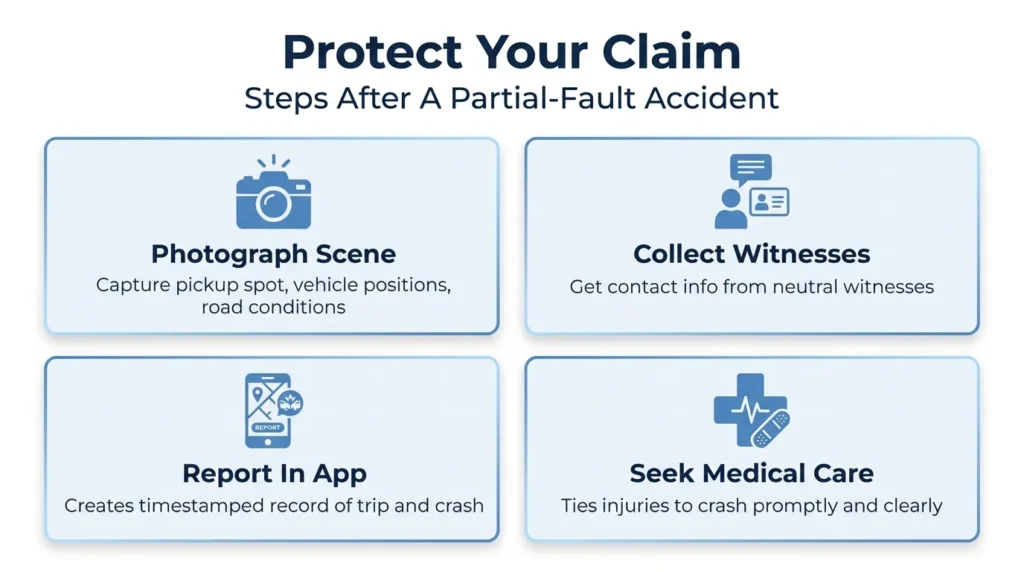
When fault will be contested, documentation is your strongest protection. Take these steps as soon as you safely can.
- Step 1: Photograph the full scene. Capture the pickup or drop-off location, where each vehicle ended up, and any road conditions that may have played a role.
- Step 2: Collect witness contact information. A neutral witness who saw the other driver run the light can directly offset a partial-fault argument against you.
- Step 3: Report the accident through the rideshare app. This creates a timestamped record of the trip and the crash that you can rely on later.
- Step 4: Seek a medical evaluation promptly. Prompt treatment ties your injuries to the crash and limits the insurer’s room to blame something else.
Preserve anything tied to your own conduct, too. The pickup pin in the app, your path to the pickup spot, and the timestamp of your ride request can all support or undercut a fault argument.
An adjuster’s early read on fault is not the final word. Fault gets decided through the claims or litigation process, not by the insurer’s first guess.
Legal Options When You Share Some Blame
You still have real options even when you carry part of the blame. A partial-fault passenger can pursue a claim against the rideshare driver’s insurer, the third-party motorist’s insurer, or both, depending on how the percentages land. The same recovery principles that govern any Texas car accident claim apply to your rideshare injury.
Coverage depends on the driver’s activity at the moment of the crash. Texas Insurance Code Chapter 1954, with updates effective January 1, 2026, sets minimum coverage levels for each driver activity period. The period that was active when you were hurt determines which coverage option applies.
Suing Uber or Lyft directly is a separate path. Claims for negligent hiring or supervision stand on their own, and your partial fault does not close that door.
The state also regulates rideshare companies through the Texas Department of Licensing and Regulation rules for rideshare operations. Knowing that framework can help you see whether the company’s own conduct is part of your case.
Talk to an Experienced Attorney Today
Partial-fault worry is usually the first thing on an injured passenger’s mind, and it rarely ends a claim the way people fear. Angel Reyes & Associates has spent over 30 years helping injured Texans understand exactly where they stand and what they can recover.
With more than $1 billion recovered for clients across the state, we know how to push back when an adjuster inflates a passenger’s share of the blame. You can read what our clients say about working with us before you ever pick up the phone.
We work on contingency, so you pay no fee unless we win, and your first consultation is always free. You can reach us 24/7, and we can handle most, if not all, of your case remotely. Schedule a free consultation to review your options.
Past results do not guarantee future outcomes.
Comparative Fault in Rideshare Accidents FAQs
Can I use my own uninsured motorist coverage if a rideshare driver's insurer denies my claim?
Yes. Your personal auto policy’s uninsured or underinsured motorist coverage may apply when another driver’s insurance falls short or rejects your claim. Filing a claim under your own policy does not affect your right to pursue separate claims against other at-fault parties.
Does Texas comparative fault apply if I was standing outside the vehicle when the crash happened?
Yes. Texas proportionate responsibility applies to any personal injury claim, including injuries that occur outside the vehicle while boarding or waiting at a pickup spot. Your fault percentage is based on your conduct at the moment you were injured, not on whether you were seated inside.
What if the rideshare driver's app was completely off when the crash happened?
When the driver’s app is off, neither Uber’s nor Lyft’s insurance applies. The crash is treated like a standard private-vehicle accident, and only the driver’s personal auto policy covers your claim.
Can an insurer or another driver sue me to recover money because of my share of fault?
Texas law limits how fault percentages affect your compensation but does not automatically expose you to a lawsuit from an insurer seeking reimbursement. Each party’s liability is generally limited to their assigned fault percentage, and passengers are not typically counter-sued in rideshare injury claims.
What if my rideshare accident happened in another state but my trip started in Texas?
The state where the crash occurred typically controls which fault rules apply, not where the trip began. If the accident happened outside Texas, that state’s comparative fault standard governs, which may differ from Texas’s 51% bar.
About the Authors

Angel Reyes
Writer
Angel L. Reyes, III is the Founder and Managing Partner of Angel Reyes & Associates. A nationally recognized trial attorney and business leader, Angel has helped over 70,000 injury victims recover more than $1 billion since founding the firm in 1993. Named to the Texas Super Lawyers list annually since 2008, Angel brings Wall Street experience, Ivy League education, and a deep commitment to client advocacy. He is a frequent legal commentator and published author with extensive contributions to legal scholarship, trial strategy, and consumer protection.

Graham Griffin
Editor
Graham Griffin is the Web & Content Manager at Angel Reyes & Associates, where he oversees content strategy, AI-powered workflows, a...

Angel Reyes
Reviewer
Angel L. Reyes, III is the Founder and Managing Partner of Angel Reyes & Associates. A nationally recognized trial attorney and business...