Do Motorcycles Need Mirrors in Texas?


Every article on this site is researched by our internal team, reviewed for legal accuracy against current Texas law, and held to State Bar of Texas advertising standards before publication. We do not publish content that overstates outcomes or makes promises about results.
Learn more about our
editorial standards .
Key Takeaways
- Texas requires at least one motorcycle mirror with 200 feet of rear visibility.
- Riding without a compliant mirror is a misdemeanor offense under the Texas Transportation Code that carries a fine.
- A missing mirror can cut your crash payout under the Texas 51% fault rule.
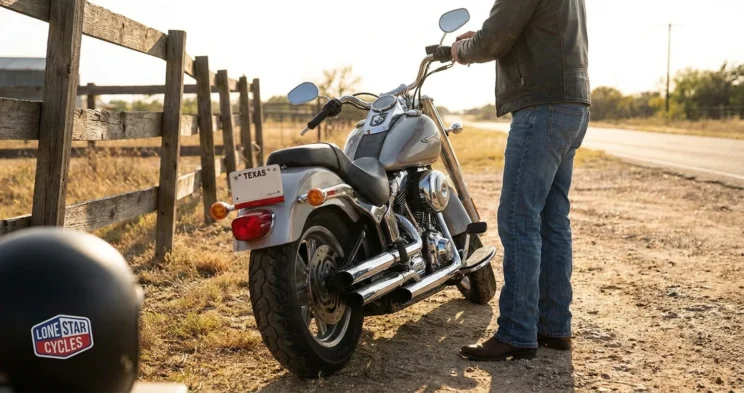
You were heading north on I-35 out of Austin on a clear morning, weaving through Round Rock traffic on your bike. A trooper pulls you over and points at your handlebars, asking about your mirror. Suddenly, a quick ride to work feels like it could cost you a ticket, or worse, money after a crash.
Texas Law & Motorcycle Mirror Requirements
Texas law requires you to have at least one rearview mirror on your motorcycle when you ride it on public roads. The rule comes from Texas Transportation Code § 547.602, which sets the standard for what that mirror must do.
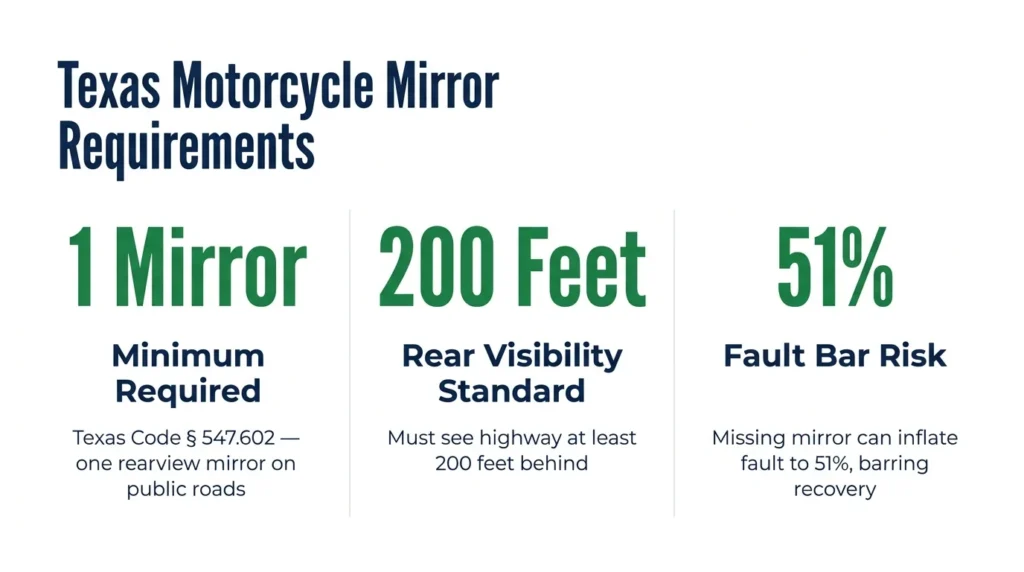
That mirror has to give you a clear view of the highway for at least 200 feet behind your bike. A cracked, missing, or poorly aimed mirror that cannot meet this visibility standard does not satisfy the law.
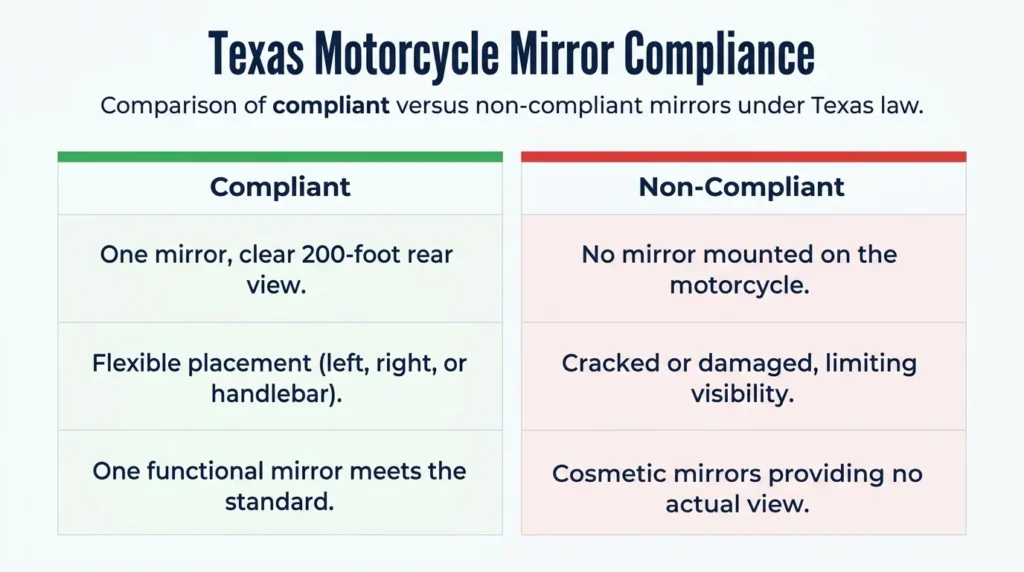
Many riders ask whether they need both a left and a right mirror. You do not. Texas requires only one, not two, as long as that single mirror meets the 200-foot rear visibility standard.
The law also doesn’t have requirements on mirror placement. You can mount your mirror on the left, the right, or the handlebar, and you stay compliant as long as the rear view holds. Other motorcycle equipment rules under the Transportation Code follow the same practical logic.
Cars and trucks follow different mirror rules than motorcycles do. If you’re driving a car, it is illegal to have no side mirror in Texas.
Motorcycle Inspections & Mirrors After 2025
The mirror requirement did not go away when inspections did. Texas ended mandatory safety inspections for non-commercial vehicles, including motorcycles, on January 1, 2025.
That change means you no longer have to pass a periodic equipment check. It does not repeal § 547.602. Your mirror obligation stays on the books, and an officer can enforce it during any traffic stop.
Some riders assume the end of inspections wiped out the mirror rule. That assumption can cost you. The duty to carry a compliant mirror is still in full effect today.
If you’re not sure your current setup meets Texas standards after a crash, reviewing the facts with a lawyer who handles motorcycle accident claims can help you understand where you stand.
Mirror Violations & Citation Risk in Texas
An officer who spots a motorcycle with no mirror, or with a mirror that fails the rear visibility test, can write a citation under § 547.602. The stop itself is usually all it takes.
This kind of equipment violation is a misdemeanor offense under the Texas Transportation Code. It carries a fine and can show up in your driving record just like other traffic infractions.
A mirror citation does more than dent your wallet. It creates a documented record of an equipment problem on your bike. That record can resurface later in an insurance dispute or a lawsuit if you are ever in an accident.
You don’t even need a prior ticket for this to come back on you. If a mirror is missing or non-compliant at the scene of a crash, an officer or an insurer can raise it during the investigation right then.
How Non-Compliant Mirrors Affect Accident Claims
A missing or non-compliant mirror can shrink your compensation after a crash. Texas uses a fault-sharing system called proportionate responsibility under Texas Civil Practice and Remedies Code Chapter 33. Your damages drop by your share of fault, and if you are 51% or more at fault, you recover nothing. Understanding the 51% rule in Texas is crucial to your claim.
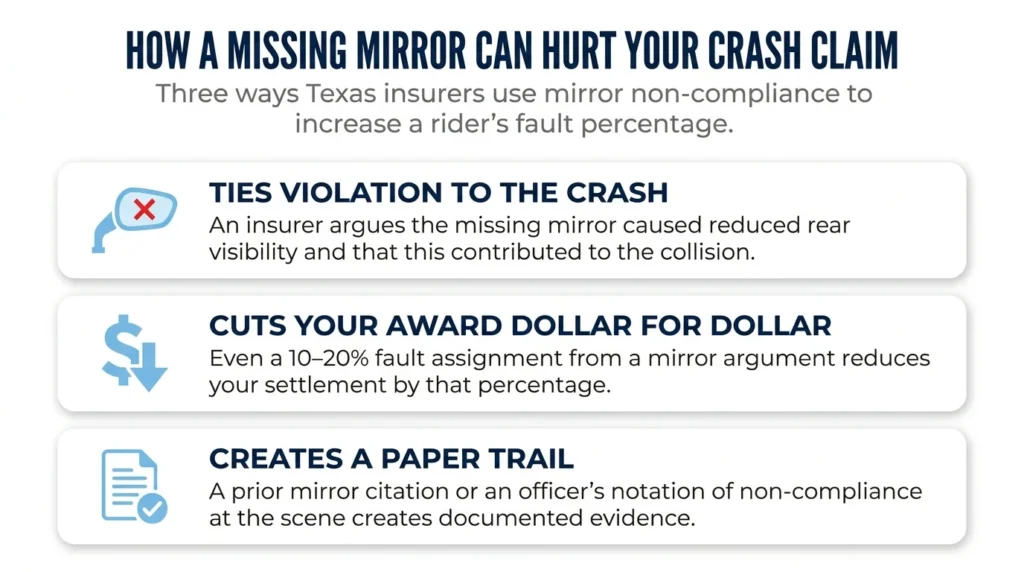
Here is how a mirror issue can feed that argument.
The insurer ties the violation to the crash. An insurer or opposing lawyer may argue your bike broke § 547.602 and that the missing mirror helped cause the wreck. This comes up most in rear-end or lane-change crashes where seeing behind you matters directly.
Even a small fault share costs you real money. Fault reduces your award dollar for dollar. If you’re found 20% at fault, you lose 20% of your potential motorcycle accident settlement.
The argument lands hardest when you could have avoided the crash. A mirror argument is strongest when better rear visibility might have changed the outcome. Insurance lawyers raise it even when the causal link is thin, which is why understanding partial fault in a Texas crash is important before you respond.
Get guidance before you talk to the insurer. If you were in a crash and worry a mirror issue will be turned against you, talk to a lawyer first. Knowing how fault gets determined in Texas helps you avoid saying something an adjuster can use.
Injured on a Motorcycle in Texas?
A mirror question can turn into a fight over your compensation fast, and you shouldn’t have to face an insurer alone. Angel Reyes & Associates has handled Texas motorcycle accident claims for over 30 years. We offer free initial consultations, and we work on contingency, so you pay no fee unless we win.
We have recovered more than $1 billion for clients across the state. When you’re ready, reach out for a free consultation so you understand your options before speaking with an adjuster.
Past results do not guarantee future outcomes.
Motorcycle Mirror Law FAQs
Does a cracked or damaged motorcycle mirror still meet Texas law?
Texas law only requires that your mirror provide a clear view of the highway for at least 200 feet behind your bike. A mirror that is cracked or damaged but still delivers that visibility may satisfy the statute, while one so damaged it limits your rear view likely does not.
Do out-of-state riders have to meet Texas mirror requirements when riding here?
Yes. Texas equipment laws apply to every motorcycle operated on Texas public roads, regardless of where the bike is registered. If an officer stops you and your mirror does not meet the 200-foot standard, you can receive a citation.
Is a motorcycle mirror citation a moving violation in Texas?
No. A mirror citation under Texas Transportation Code §547.602 is an equipment violation, not a moving violation. It generally does not add points to your driving record, but the citation itself still creates a paper trail that can matter if you are later in an accident.
Can you get a Texas equipment violation dismissed if you fix the mirror?
In many Texas courts, a defective equipment citation can be dismissed after you repair the problem and pay a small administrative fee, often around $20. The process varies by court, so contact your local municipal court to confirm the exact steps.
Do mopeds and scooters need mirrors under the same Texas rule?
Yes. Texas Transportation Code § 547.602 applies to motor vehicles broadly, which includes mopeds and motor-driven cycles. If you ride a moped or scooter on public roads, it must have at least one mirror meeting the 200-foot rear visibility standard.
About the Authors

Alex Ivanov
Writer
Alex Ivanov is a personal injury attorney at Angel Reyes & Associates, focused on car, truck, and motorcycle accident cases. Licensed in Texas and multiple federal districts, Alex brings international legal experience and a global education to his practice. He earned his LL.M. from Texas A&M University School of Law after graduating from Belarussian State University in 2016. Alex is fluent in Russian, English, Ukrainian, and Belarussian, and is recognized by multiple national trial lawyer associations for his results and leadership under 40.

Kyle Nicolas
Editor
Kyle Nicolas is the Web Content & SEO Manager at Angel Reyes & Associates. He has more than 10 years of experience as a marketing co...

Angel Reyes
Reviewer
Angel L. Reyes, III is the Founder and Managing Partner of Angel Reyes & Associates. A nationally recognized trial attorney and business...