How Rideshare Accident Settlement Negotiations Work


Every article on this site is researched by our internal team, reviewed for legal accuracy against current Texas law, and held to State Bar of Texas advertising standards before publication. We do not publish content that overstates outcomes or makes promises about results.
Learn more about our
editorial standards .
Key Takeaways
- The driver's trip phase decides which of up to three insurers carries primary responsibility.
- Each insurer gets its own demand letter; Texas law requires a response within 15 business days of receiving all requested documents.
- Texas gives you two years from the injury date to settle or file your accident lawsuit.
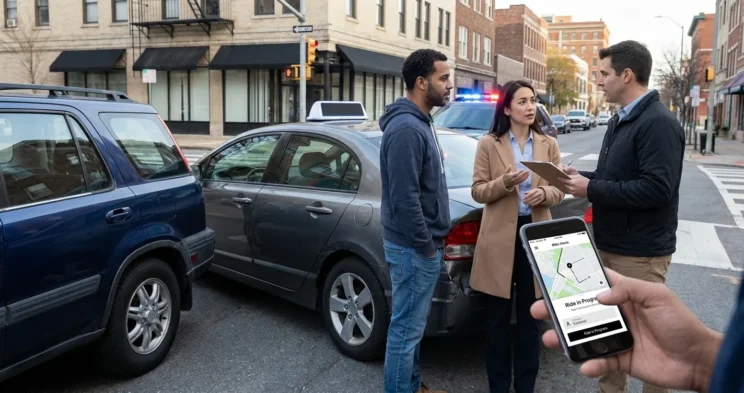
You were riding home from dinner near South Congress when your Uber driver got T-boned by a car running a red light. Now two insurance companies are emailing you, each one suggesting the other should pay, and the first settlement offer barely covers your medical bills. Who are you actually negotiating with, and how do you keep one mistake from costing you?
Which Insurers Are Involved in Your Claim?
A rideshare accident can involve up to three different insurance companies: the rideshare company’s commercial insurer, the driver’s personal auto insurer, and the insurer for any other driver involved in the crash. Which policy pays depends on the driver’s status in the rideshare app at the time of the collision.
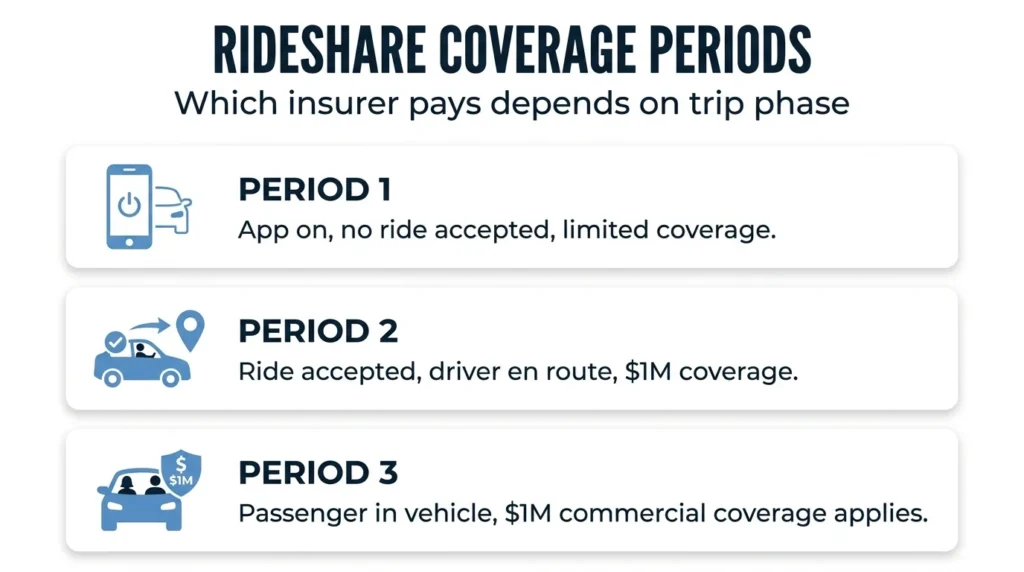
Texas divides rideshare trips into three coverage periods. During Period 1, when the driver has the app on but has not accepted a ride, only limited contingent coverage applies. Once the driver accepts a ride request and while a passenger is in the vehicle (Periods 2 and 3), Uber and Lyft provide up to $1 million in commercial liability coverage.
Texas Insurance Code Chapter 1954 establishes the minimum insurance requirements for each coverage period, while Texas Occupations Code Chapter 2402 regulates transportation network companies operating in the state.
Identifying the correct coverage period is one of the first steps in any rideshare settlement because it determines which insurer has primary responsibility for paying your claim. The same coverage periods apply whether your accident involved Uber or Lyft.
Sending Demand Letters to Multiple Insurers
A demand letter is not legally required before you file suit in Texas, but it is standard practice and starts the formal negotiation window with each insurer. When more than one insurer is in play, each one gets its own demand tailored to its coverage position and policy limits.
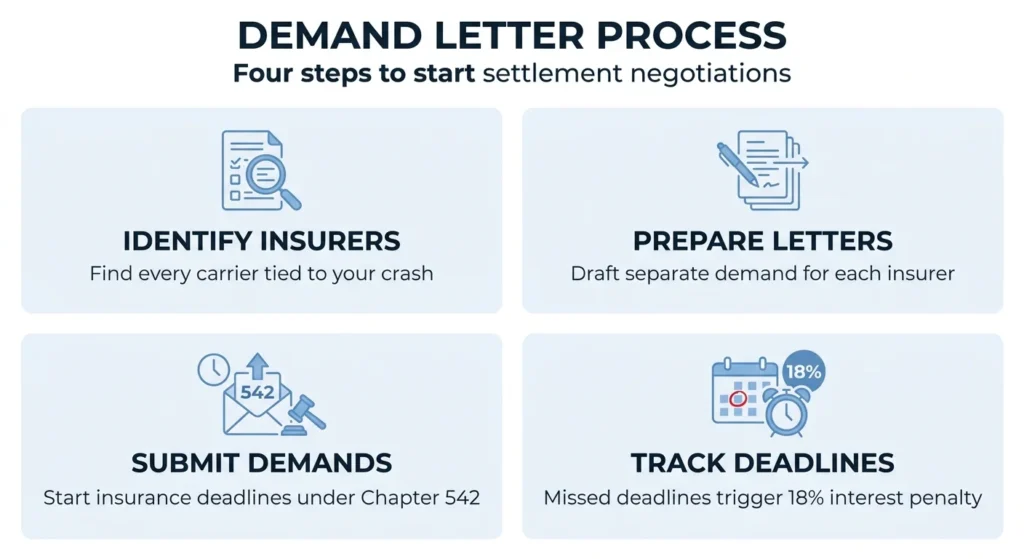
Here is how the demand stage usually works.
Step 1: Identify every insurer tied to your crash. This means the rideshare company’s carrier, the at-fault driver’s personal insurer, and any third-party insurer, based on the trip phase at the moment of impact.
Step 2: Prepare a separate demand letter for each insurer. Each letter documents your injuries, your costs, and the coverage position that applies to that specific carrier.
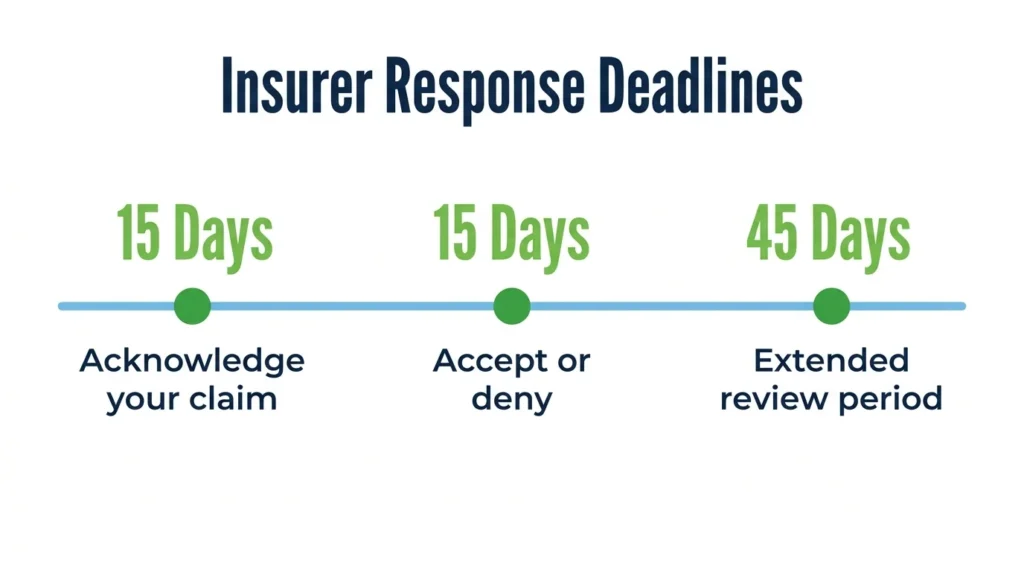
Step 3: Submit your demand and start the insurance deadlines. Texas Insurance Code Chapter 542 sets specific deadlines for insurers to respond. They generally have 15 business days to acknowledge your claim and 15 business days to accept or deny it after receiving all the information they need. If the insurer cannot decide within that time, it must notify you in writing. Texas law then gives it up to 45 additional days to complete its review.
Step 4: Track every deadline across every insurer. Carriers that miss these settlement timeline windows face 18% annual interest on the unpaid amount plus attorney fees.
You do have a deadline. Texas Civil Practice and Remedies Code § 16.003 gives you two years from the date of the crash to file a personal injury lawsuit. Settlement negotiations can continue during that time, but once the deadline passes, you may lose your right to recover compensation.
How Three-Way Coverage Disputes Unfold
A coverage dispute happens when two or more insurers each argue that the other policy carries primary responsibility. The fight usually turns on the exact trip phase or on whether the driver’s personal policy excludes commercial use.
The law places limits on how insurers handle these disputes. Texas Insurance Code Chapter 541 prohibits insurers from engaging in unfair settlement practices, including refusing to make a good-faith effort to settle a claim when liability is reasonably clear.
Fault also affects how much each insurer may owe. Under the Texas Civil Practice and Remedies Code Chapter 33, responsibility gets divided among the rideshare driver, any third-party driver, and the company, which changes each insurer’s exposure and how hard it pushes back. According to the Texas comparative negligence rule, if you are found more than 50% at fault, you recover nothing.
When a personal policy includes a commercial-use exclusion, the insurer may refuse to participate altogether. For a Phase 1 crash, the rideshare company’s contingent coverage then becomes your practical target.
The Texas Department of Licensing and Regulation oversees these companies through its TNC insurance compliance rules. Those rules set a baseline that an insurer cannot dodge by pointing only to policy exclusions.
When Mediation Enters the Process
Mediation usually enters after direct negotiations stall. That happens when an insurer denies your claim, insurers fight over coverage, or offers and counteroffers fail to close the gap. Most injury cases never reach a jury because mediation often resolves disputes well before a verdict is reached.
A Texas court can refer your dispute to mediation under the Texas Civil Practice and Remedies Code Chapter 154. Mediation stays confidential, and any agreement you reach becomes binding once it is written down and signed by everyone.
For a multi-insurer rideshare case, mediation has a real advantage. It puts you, the rideshare company’s insurer, the driver’s personal insurer, and any third-party insurer at the same table at the same time, eliminating the delay of negotiating with each carrier in sequence.
Mediation gives the parties another opportunity to resolve the dispute before trial while preserving your right to continue with a lawsuit if negotiations fail.
One thing mediation does not do is buy you more time. The two-year deadline under § 16.003 continues to run regardless of where your negotiations stand.
Work with an Accident Attorney
Sorting out which insurer pays, sending the right demands, and pushing back on a coverage dispute is a lot to manage while you are trying to heal. That is the kind of multi-party case we handle every day.
Angel Reyes & Associates has spent more than 30 years helping injured Texans, and we have recovered more than $1 billion for clients. We work on a no-fee-unless-we-win basis, so you owe us nothing in attorney fees unless we recover for you, and court costs and expenses are paid from any recovery.
You can see how we have handled rideshare accident claims and review our past case results to understand our track record. You can also meet the attorneys who handle these cases. Reach out to us for a free consultation.
Past results do not guarantee future outcomes.
Rideshare Settlement Negotiation FAQs
How long does a rideshare accident settlement typically take in Texas?
A straightforward single-insurer claim can be resolved within 60 to 90 days of a demand letter. Still, multi-insurer disputes that stall and move to mediation commonly extend the process to six months or more.
Should I accept the first settlement offer from the insurance company?
Usually not. Early settlement offers often arrive before the full extent of your injuries and future medical needs are known. Once you accept a settlement, you generally cannot go back and ask for more compensation, even if your condition worsens later.
Can I sue Uber or Lyft directly, or can I only go after their insurance?
You can name Uber or Lyft as a defendant in a Texas personal injury lawsuit, not just their insurer. A direct claim against the company typically rests on a negligent hiring or retention theory, meaning the company allowed a driver onto the platform who should have been disqualified.
What evidence should I preserve immediately after a rideshare crash?
Take screenshots of the trip receipt, driver profile, vehicle plate, and route map in the app before closing it, because that record establishes which coverage phase was active at the moment of impact. Rideshare companies control this data, and some logs may be harder to obtain as time passes, so a preservation letter sent early can help secure records beyond what your own account shows.
Will my health insurance or medical provider take money from my rideshare settlement?
If your health insurer paid for crash-related treatment, it may assert a subrogation right and seek repayment from your settlement proceeds. Hospital liens arise under Texas Property Code Section 55.002 and can attach to your recovery if you were admitted within 72 hours of the accident, though most liens are negotiable before the final distribution is made.
About the Authors

Angel Reyes
Writer
Angel L. Reyes, III is the Founder and Managing Partner of Angel Reyes & Associates. A nationally recognized trial attorney and business leader, Angel has helped over 70,000 injury victims recover more than $1 billion since founding the firm in 1993. Named to the Texas Super Lawyers list annually since 2008, Angel brings Wall Street experience, Ivy League education, and a deep commitment to client advocacy. He is a frequent legal commentator and published author with extensive contributions to legal scholarship, trial strategy, and consumer protection.

Graham Griffin
Editor
Graham Griffin is the Web & Content Manager at Angel Reyes & Associates, where he oversees content strategy, AI-powered workflows, a...

Angel Reyes
Reviewer
Angel L. Reyes, III is the Founder and Managing Partner of Angel Reyes & Associates. A nationally recognized trial attorney and business...