Motorcycle Accident Claim vs. Lawsuit: What’s the Difference?


Every article on this site is researched by our internal team, reviewed for legal accuracy against current Texas law, and held to State Bar of Texas advertising standards before publication. We do not publish content that overstates outcomes or makes promises about results.
Learn more about our
editorial standards .
Key Takeaways
- A motorcycle accident claim is an insurer negotiation; a lawsuit is a formal Texas court filing.
- Lowball offers, denied liability, and the two-year deadline are the top triggers for filing suit.
- Filing a lawsuit does not mean going to trial; most cases settle before a jury hears them.
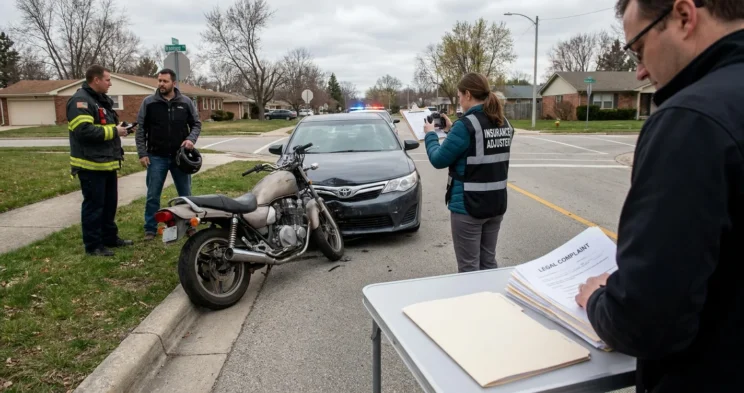
You were riding home through the outskirts of San Antonio on Loop 410 when a driver changed lanes without looking and took you down. The injuries were real. The other driver was clearly at fault.
But now the insurer is making an offer that barely covers your emergency room visit, and your attorney is talking about “filing a lawsuit.”
That phrase can sound alarming if you have never been through this process before. It does not have to be.
Claim vs. Lawsuit: Two Different Tracks
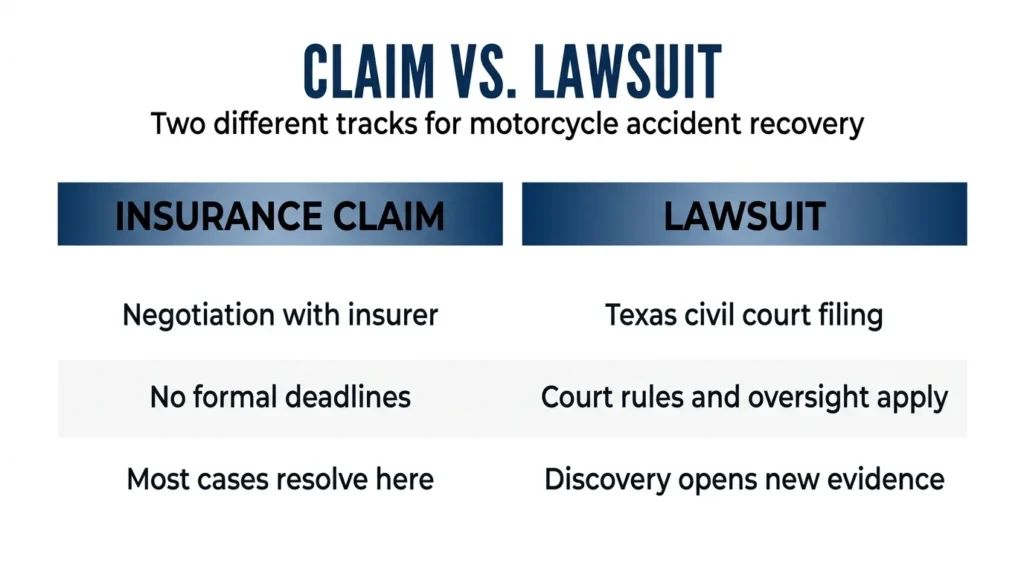
A claim and a lawsuit are not two names for the same thing. They are two distinct legal tracks with different rules, different timelines, and different levels of formality.
What a Claim Is
A claim is a request for compensation made directly to an insurance company. When you report the accident to the at-fault driver’s insurer and ask them to pay for your injuries, you are filing a claim. The process happens entirely outside of court.
The insurer assigns an adjuster to investigate the crash, review your medical records, and determine what they believe your case is worth. From there, negotiations begin. Most motorcycle accident cases in Texas are resolved at this stage through a negotiated insurance claim. No judge. No jury. No courtroom.
What a Lawsuit Is
A lawsuit is something different. It is a formal legal action filed in a Texas civil court. Your attorney submits a complaint naming the at-fault driver as the defendant, and the case enters the court system.
That step triggers formal legal deadlines, court oversight, and a process called discovery. Filing a lawsuit does not mean you are headed to trial. What it does mean is that the case is now governed by court rules, not just insurer timelines. Understanding what litigation means in a Texas personal injury case helps clarify why this step changes the entire dynamic.
What Triggers the Decision to File Suit
Three situations most commonly push a motorcycle accident case from the claim stage into litigation.
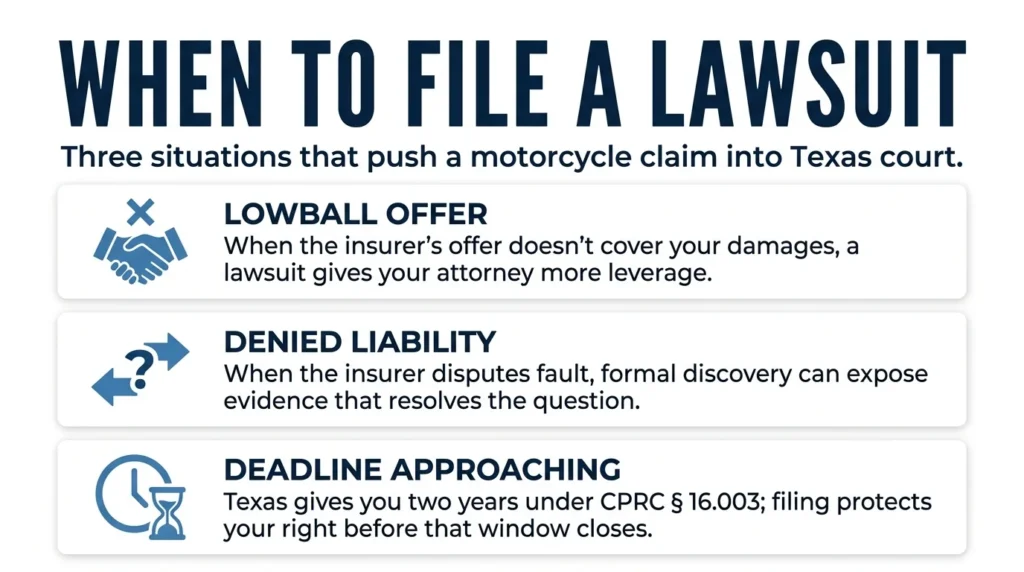
The first is a lowball offer. If the insurer’s offer does not cover your actual damages and negotiations have stalled, filing suit gives your attorney more leverage to push toward a fair number.
The second is denied liability. When the insurer disputes that their policyholder caused the crash, informal negotiations often go nowhere. A lawsuit opens formal discovery, which can show evidence that resolves the liability question.
The third is an approaching deadline. Texas law gives you two years from the date of your accident to file a personal injury lawsuit. That deadline comes from Texas Civil Practice and Remedies Code (CPRC) § 16.003. If that window is closing and negotiations have not produced a fair resolution, your attorney may file suit to protect your right to seek compensation, even while talks continue.
Filing suit is not a declaration of war. It is a strategic step. An attorney familiar with motorcycle accident cases can assess whether your situation calls for it before time runs out.
How Filing Changes the Negotiation Dynamic
When you file a lawsuit, the pressure on the insurer changes. What was a voluntary negotiation becomes a formal legal proceeding with real consequences for delay and bad faith.
Discovery is the biggest shift. Both sides must exchange evidence, respond to written questions, and sit for depositions under oath. That process often includes information the insurer was not eager to share during the claim stage. Depositions of the at-fault driver or their insurer’s representatives can expose weaknesses in the defense.
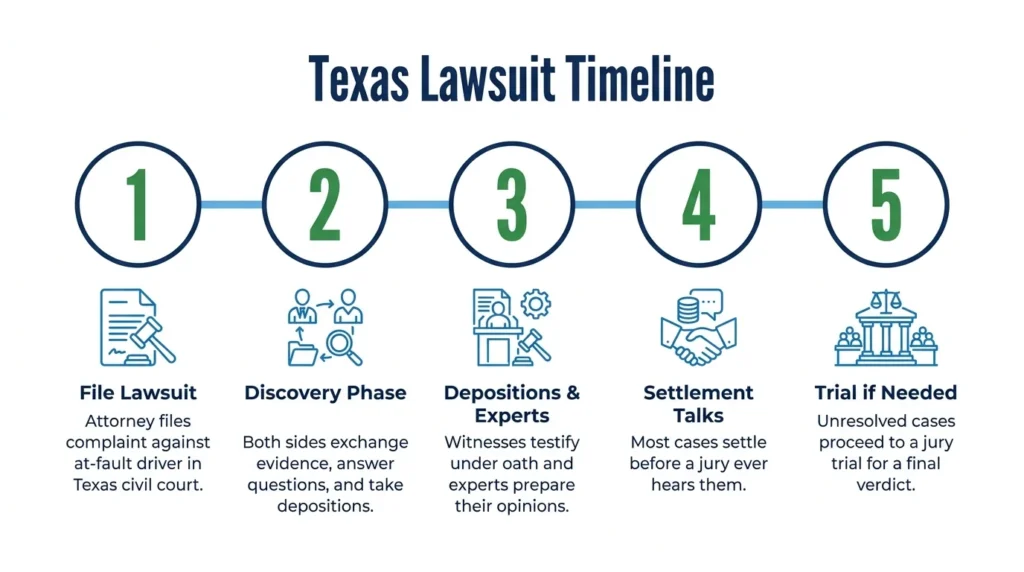
That exposure changes the math. Insurers weigh the risk of a jury verdict, which can be higher than a negotiated settlement, against the cost of continuing to fight. Many cases that were stalled at the claim stage begin moving toward resolution once the lawsuit is on file and discovery has started.
How often injury cases actually go to trial may surprise you: the majority settle before a verdict is ever reached.
Understanding why insurance companies underpay injury claims in Texas can also clarify why this shift in leverage matters. Adjusters operate under financial pressure to minimize payouts. Filing suit introduces consequences that ordinary claim negotiations do not carry.
Why Most Cases Still Settle
Filing a lawsuit and going to trial are not the same thing. Most motorcycle accident lawsuits in Texas settle before a jury ever hears the case.
Settlement can happen at any point in the process. Some cases settle shortly after a lawsuit is filed, once the insurer sees that you are serious. Others settle during or after discovery. A small number settle on the courthouse steps, days or hours before trial.
The point is that filing a lawsuit is a tool for reaching a fair resolution, not a commitment to fight things out in a courtroom. The process stays in your hands. You and your attorney decide whether a settlement offer is worth accepting at each stage.
Talk to an Attorney Before the Clock Runs Out
The two-year deadline under CPRC § 16.003 is not a suggestion. Miss it, and your right to sue is almost certainly gone, regardless of how strong your case is.
Angel Reyes & Associates has guided injured Texans through motorcycle accident cases for over 30 years. We handle the full process, whether your case resolves at the claim stage or requires filing suit.
We work on a contingency basis, which means no fee unless we win. Reach out for a free consultation and find out where your case stands before the deadline becomes the deciding factor. Reviewing our case results can give you a sense of how cases like yours have been resolved.
Past results do not guarantee future outcomes.
Claim vs. Lawsuit FAQs
Can I still settle with the insurance company after a lawsuit is filed?
Yes. Filing a lawsuit does not end settlement negotiations. Many cases settle during or after the discovery phase, and some reach agreement on the courthouse steps before trial ever begins.
How long does a motorcycle accident lawsuit take in Texas?
Straightforward cases often resolve within 6 to 12 months of filing. Cases with disputed liability or serious injuries can take 12 to 24 months or longer, depending on court scheduling and the complexity of evidence.
Who is the defendant in a motorcycle accident lawsuit: the driver or the insurance company?
The lawsuit names the at-fault driver as the defendant, not the insurance company. The insurer typically pays any judgment or settlement on the driver’s behalf, but the legal action runs against the person who caused the crash.
What if the at-fault driver had no insurance?
You can still file a lawsuit against the driver personally, but collecting a judgment from someone with no assets is difficult. Your own uninsured motorist (UM) coverage is often the more practical path for recovering compensation in that situation.
Does filing a lawsuit cost me anything upfront?
If your attorney handles the case on a contingency basis, you pay no legal fees unless you recover compensation. Court filing fees and case expenses are typically advanced by the firm and repaid from any settlement or verdict.
About the Authors

Georgi Manov
Writer

Kyle Nicolas
Editor
Kyle Nicolas is the Web Content & SEO Manager at Angel Reyes & Associates. He has more than 10 years of experience as a marketing co...

Angel Reyes
Reviewer
Angel L. Reyes, III is the Founder and Managing Partner of Angel Reyes & Associates. A nationally recognized trial attorney and business...