Multi-Vehicle Uber or Lyft Accidents in Texas


Every article on this site is researched by our internal team, reviewed for legal accuracy against current Texas law, and held to State Bar of Texas advertising standards before publication. We do not publish content that overstates outcomes or makes promises about results.
Learn more about our
editorial standards .
Key Takeaways
- Texas splits fault by percentage, but a defendant over 50% at fault can be responsible for the entire claim.
- Uber and Lyft coverage shifts by period, so app data decides which policy applies.
- Evidence in rideshare pile-ups vanishes within days, long before the two-year deadline expires.
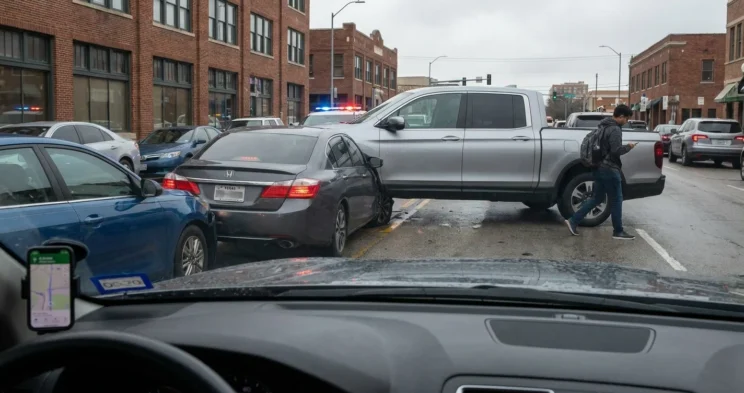
You were riding in a Lyft on a San Antonio freeway when the car ahead braked hard, your driver crashed into it, and a third vehicle slammed into you from behind. Now, three drivers are pointing fingers at each other, and three insurers are calling you. All you want to know is who will actually pay for your injuries.
How Texas Law Assigns Fault When Three or More Vehicles Are Involved
In a two-car crash, fault usually points in one direction. In a three-or-more-vehicle pile-up involving a rideshare, fault can point at every driver at once.
Fortunately, Texas law has a specific framework to sort it all out. It falls under Texas Civil Practice and Remedies Code (CPRC) Chapter 33, the proportionate responsibility statute, which governs how blame gets divided when more than one party caused damages.
Under this statute, each at-fault party is assigned a percentage of responsibility. These percentages total 100% across all defendants, including the plaintiff if they share any fault. This follows Texas’s proportionate responsibility rules.
Under Texas modified comparative fault rules, a plaintiff who is more than 50% responsible for the crash recovers no compensation. A plaintiff who is 50% or less responsible can recover damages that are reduced by their percentage of fault.
Can One Defendant Be Liable for the Entire Judgment?
When a single defendant is found more than 50% responsible for the crash, they can be held liable for the entire judgment. This means they have to pay the whole amount, not just their assigned share of fault, under CPRC Section 33.013.
This can have a big impact in a rideshare pile-up. For example, if an Uber driver is found to be 60% at fault, then you can recover 100% of the judgment from Uber’s insurer alone. That insurer will then pursue the remaining defendants for reimbursement.
In a more typical case, fault is spread across multiple defendants, and none of them are more than 50% responsible. In this case, you must collect damages from each defendant separately.
Rideshare Drivers in Multi-Defendant Accident Cases
Often, the rideshare driver shares fault with one or two other drivers. The Uber or Lyft commercial policy covers the rideshare driver’s share of the damages, and each of the other driver’s personal liability policy covers their own assigned share. If you were injured in a rideshare pile-up and multiple drivers share responsibility, understanding how fault percentages translate into actual payments requires reviewing every policy involved.
Sometimes, the assigned fault percentages don’t fully cover your damages because a driver is underinsured or uninsured. In this case, UM/UIM coverage may apply.
How the Uber or Lyft Coverage Period Changes Everything
Uber and Lyft commercial insurance does not provide fixed coverage. It changes depending on what the driver was doing at the exact moment of the crash.
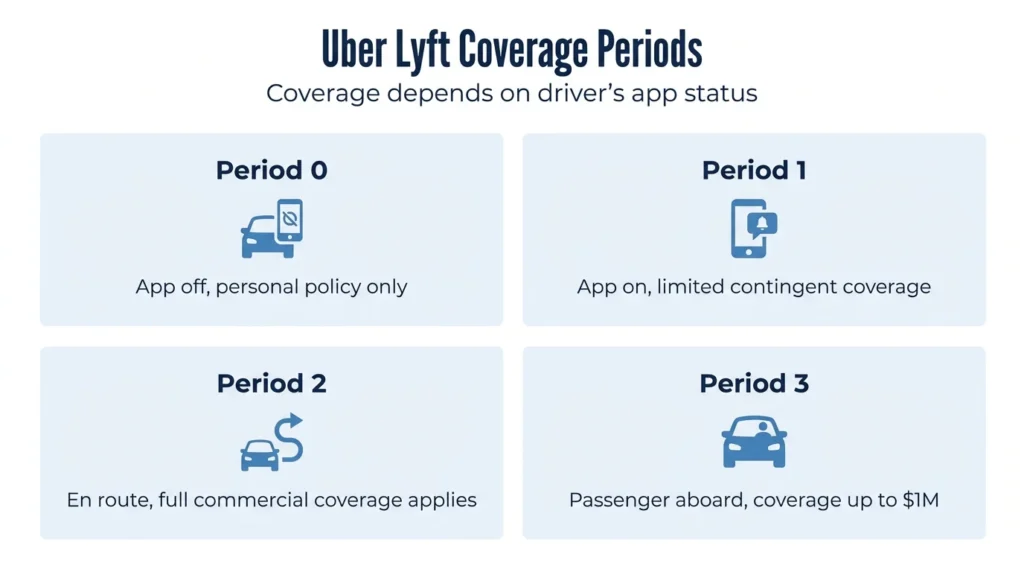
Texas Insurance Code Chapter 1954 controls rideshare company insurance requirements. Texas law defines different insurance coverage periods for Uber and Lyft, depending on the driver’s status at the time of the crash:
- Period 0 (app off): In this period, no rideshare coverage applies. The driver’s personal auto policy is the only available source for compensation.
- Period 1 (app on, no ride accepted): In this period, only contingent liability coverage applies, with lower limits.
- Period 2 (ride accepted, en route to passenger): In this period, full commercial coverage applies.
- Period 3 (passenger in vehicle): In this period, full commercial coverage applies, with limits up to $1 million per incident for Uber and Lyft.
In a multi-vehicle crash, pinning down the active period requires accessing the rideshare driver’s trip log, timestamped app data, and dispatch records. The driver’s statement alone is not enough to determine the active period, and insurers routinely dispute which period was active at the time of the crash.
The rideshare company’s own data records are the definitive source, and obtaining them quickly is critical. It may be useful to learn more about what happens when an Uber gets in an accident in Texas.
Coordinating Claims Across Multiple Insurers
A multi-vehicle rideshare crash is not a single insurance claim. It is a set of overlapping claims that must be filed separately, tracked simultaneously, and coordinated strategically.
Each at-fault driver has a separate insurer. The rideshare driver is covered by a commercial policy, and every other driver is covered by their own personal auto policy.
Subrogation adds another layer. This occurs when one insurer pays out on your behalf (such as your own insurer under UM/UIM coverage), after which they can recover reimbursement from the other at-fault parties’ insurance. Learn more about how subrogation works under Texas law.
UM/UIM coverage serves as a backup when one or more drivers in a pile-up are uninsured or underinsured. This typically occurs when the crash involves unknown drivers or hit-and-run drivers.
Policy limits across multiple at-fault carriers can be added together, but you cannot be paid twice for the same loss. Your total recovery cannot exceed your actual damages.
Insurers in multi-defendant cases frequently shift the blame to each other to avoid paying. That’s why it’s important to document and preserve your own evidence, rather than relying on just one insurer’s investigation. Passengers pursuing multiple defendants can benefit from having one attorney coordinate the claim, instead of negotiating with each adjuster on their own.
Gathering Evidence in Multi-Vehicle Rideshare Crashes
The more vehicles involved in a crash, the faster physical evidence disappears. In a rideshare case, the most valuable data is inside platforms and third parties that have no obligation to preserve it without a formal request.
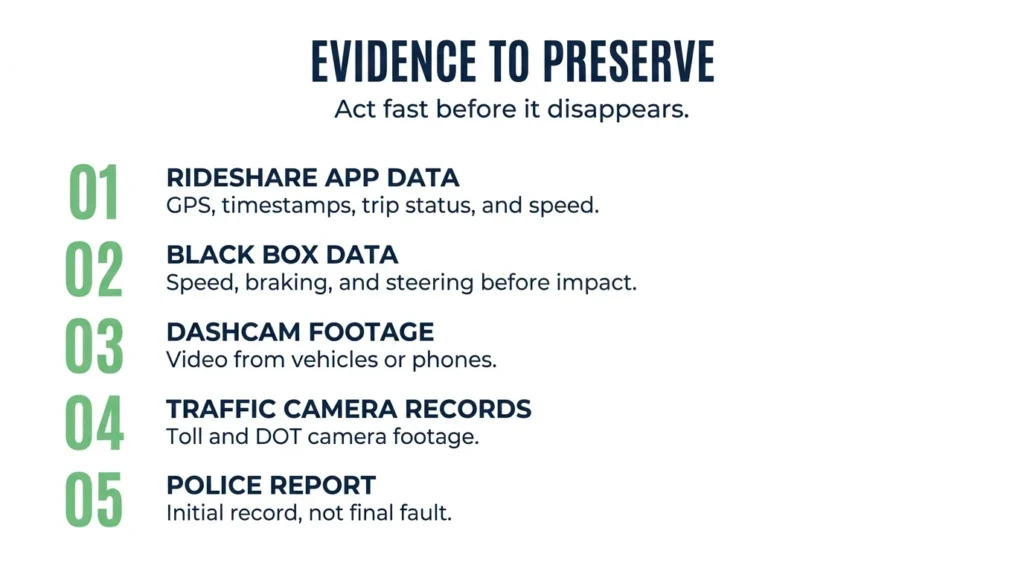
The most important data is as follows:
- Rideshare App Data: This includes GPS tracking, timestamps, trip status, and speed data. Request this data from Uber or Lyft immediately via preservation letter, because data retention periods are short.
- Black Box/EDR Data: This is available on most modern vehicles. It records speed, braking, and steering inputs in the seconds before impact. However, it is subject to being overwritten, so it requires a legal hold.
- Dashcam Footage: Try to secure this from any or all of the vehicles involved in the crash. Passenger cell phone video also counts if it exists. This information can be automatically deleted or rapidly overwritten.
- Toll and Traffic Camera Records: Texas DOT and local tollway authorities hold footage for a short time, but a public records request or legal hold is required.
- Police Report: This is a good start to your claim, but it does not determine who was at fault. Multi-vehicle reports may list contributing factors for each vehicle separately. Request and review it immediately.
- Witness Accounts: These decay quickly, and contact information collected at the scene is often incomplete. You may need to conduct an independent search.
In a three-or-more-vehicle crash, determining which impact happened first affects how fault percentages are assigned. In this case, expert accident reconstruction is also an important piece of evidence.
Preservation letters should go to Uber or Lyft, each driver’s insurer, each driver individually, and any government entity controlling relevant surveillance or traffic data. Send them all simultaneously, ideally within days of the crash. Review what to do after a rideshare accident in Texas for a step-by-step process.
Filing Deadlines and the Importance of Early Action in Multi-Vehicle Accident Claims
Under Texas Civil Practice and Remedies Code Section 16.003, personal injury claims must be filed within two years of the date of injury.
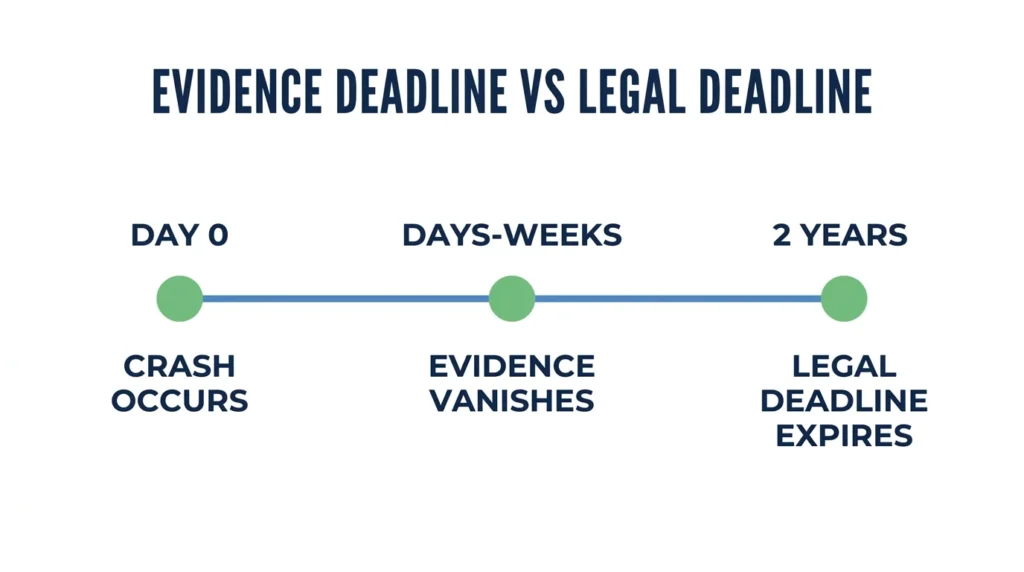
Two years may sound like a long time, but in multi-vehicle rideshare cases, it is not. Here’s why:
- Rideshare app data and company records may be overwritten or purged before the two-year mark if you don’t send a preservation letter.
- Black box data may be overwritten once a vehicle is repaired or scrapped.
- Uninsured or underinsured defendants may become harder to collect compensation from as time passes.
- Witnesses relocate, memories fade, and dashcam and traffic camera footage disappears within days or weeks of the crash.
To make matters worse, insurers begin building their defense case immediately, so any delay lets them set the narrative before you get a chance to. This means that while the legal deadline is two years, the evidence deadline is often measured in days.
In a multi-vehicle rideshare crash, the steps you take in the first few days after the collision can have a dramatic effect on the strength of your claim. Prompt evidence preservation protects your right to recover compensation. An attorney who understands rideshare accidents in Texas can start preserving evidence right away.
Angel Reyes & Associates
In multi-vehicle accident cases, you are not facing a single claim or a single insurer. You are facing a tangled set of overlapping fault percentages, competing policies, and disappearing evidence, and you’re racing against the clock to file your claim. Our firm coordinates everything, so you don’t have to manage it alone.
Angel Reyes & Associates has spent more than 30 years handling complex personal injury cases across Texas and has recovered more than $1 billion for clients. Past results do not guarantee future outcomes.
Your consultation is free, and there is no fee unless we win. We are available 24/7, and se habla espanol. Contact us today to get started. You can also read about what a Lyft accident settlement may be worth in Texas.
Multi-Vehicle Rideshare Accident FAQs
Can people in other vehicles that are not the rideshare vehicle file claims against Uber or Lyft's commercial policy?
Yes. Uber and Lyft’s bodily injury liability coverage extends to injured third parties, including occupants of other vehicles who were struck by the rideshare driver, not just passengers riding inside the Uber or Lyft. The available amount depends on which coverage period was active when the crash occurred.
Can a rideshare passenger name all at-fault drivers in a single Texas lawsuit?
Yes. Texas allows an injured passenger to file a single lawsuit against every party who contributed to the crash. Fault percentages are assigned to each defendant in the same claim. Filing a lawsuit against all responsible parties at once is practical because it allows you to avoid having to go over the same facts multiple times, and it ensures that each driver’s share of fault is accurately determined.
Does Texas allow injured people to sue Uber or Lyft directly, or only the driver?
Texas law allows you to sue Uber or Lyft directly if they are responsible for negligent hiring. This claim is separate from any claim against the driver individually. Both companies classify their drivers as “independent contractors” to limit their liability, but that does not automatically prevent you from filing a claim against the company itself if the facts support one.
If one of the non-rideshare drivers was on the job at the time of the crash, can their employer also be held liable?
Under the Texas law known as “respondeat superior,” an employer can be held liable for their employee’s negligence if the crash occurred while they were on the job. Courts distinguish between a “detour” (a minor deviation from a work route that typically means the employer was responsible) and a “frolic” (a substantial personal errand that the employer is not responsible for). Therefore, whether the employer is responsible depends on what the driver was actually doing at the time of the crash.
What does an accident reconstruction expert specifically determine in a multi-vehicle rideshare case?
A reconstruction expert uses physics, vehicle damage patterns, electronic data, and debris fields to establish the sequence of impacts and identify which collision was the triggering event. This distinction directly affects how fault percentages are assigned among the defendants. In rideshare pile-ups, sequencing analysis also helps pinpoint what each driver’s vehicle was doing at the moment of the crash, including speed and braking inputs that the rideshare app data may not fully capture.
About the Authors

Angel Reyes
Writer
Angel L. Reyes, III is the Founder and Managing Partner of Angel Reyes & Associates. A nationally recognized trial attorney and business leader, Angel has helped over 70,000 injury victims recover more than $1 billion since founding the firm in 1993. Named to the Texas Super Lawyers list annually since 2008, Angel brings Wall Street experience, Ivy League education, and a deep commitment to client advocacy. He is a frequent legal commentator and published author with extensive contributions to legal scholarship, trial strategy, and consumer protection.

Kyle Nicolas
Editor
Kyle Nicolas is the Web Content & SEO Manager at Angel Reyes & Associates. He has more than 10 years of experience as a marketing co...

Angel Reyes
Reviewer
Angel L. Reyes, III is the Founder and Managing Partner of Angel Reyes & Associates. A nationally recognized trial attorney and business...