What Are the Steps in a Personal Injury Claim?


Every article on this site is researched by our internal team, reviewed for legal accuracy against current Texas law, and held to State Bar of Texas advertising standards before publication. We do not publish content that overstates outcomes or makes promises about results.
Learn more about our
editorial standards .
Key Takeaways
- Texas gives injury victims two years to file a personal injury lawsuit.
- Insurers must accept or reject a claim within 15 business days once complete.
- Reporting a workplace injury within 30 days protects workers' comp benefits.
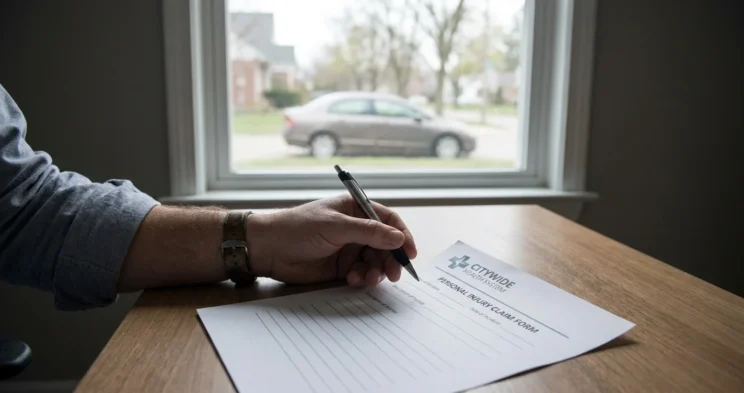
Last week, you tripped on cracked concrete outside a supermarket in East Austin, and now your neck is so stiff you can’t work. You’ve heard that you might be able to file a claim against the supermarket, but you don’t know where to start.
A lawyer can help walk you through the steps of a personal injury claim in Texas to pursue compensation while you focus on your recovery.
What Happens at Your Initial Consultation?
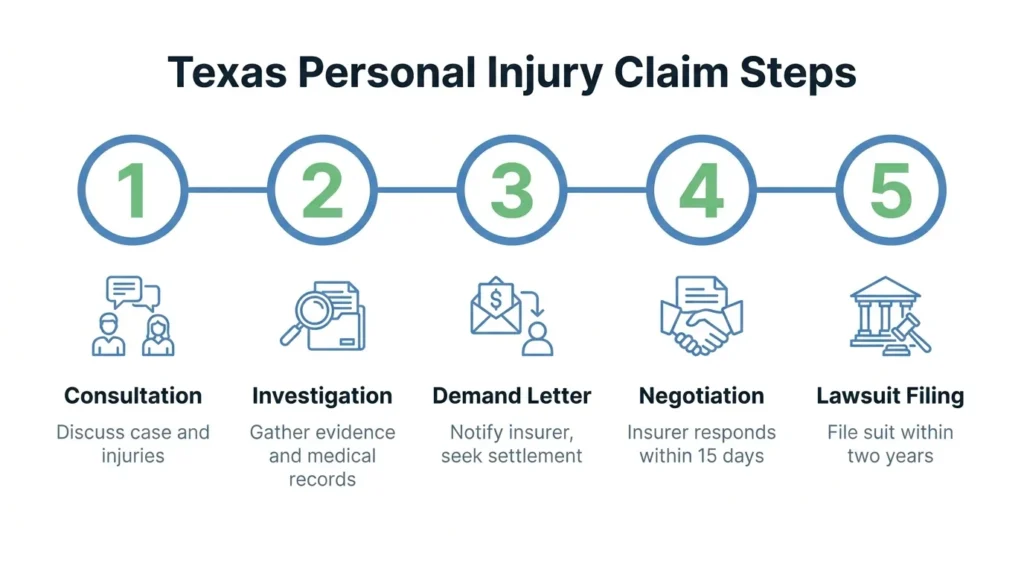
Your claim starts with a consultation with a personal injury attorney, and many firms can schedule this first meeting quickly after your call. Navigating a complex personal injury case in Texas can feel like an insurmountable challenge, so this meeting is designed to walk you through your options. You and your lawyer will:
- Review the details of your accident
- Assess minor and major injuries
- Discuss a plan of action
This first meeting is essential, as it lets your attorney fully understand the nuanced details of your case. It also allows you to ask questions and decide if a partnership with that firm fits your needs.
How Is Your Injury Claim Investigated?
Once you retain a personal injury attorney, the investigation usually begins immediately. Your attorney’s team gathers witness statements, obtains the police report, and reviews your medical records. This process often takes several weeks depending on how quickly those records come in.
Your lawyer may gather expert witness statements if your case needs them. This documentation gives your claim the kind of evidentiary backing that insurance companies take more seriously than a claim you handle alone.
How Do You Notify the At-Fault Party?
Notifying the at-fault party happens through a formal demand letter sent to their insurance company, or occasionally to the person directly when no insurer is involved. The letter puts every party on notice that you intend to seek a settlement.
Most demand letters go out once your treatment reaches a clear endpoint, not immediately after the accident, so the insurer is negotiating against a complete picture of your damages rather than a guess.
How Does Settlement Negotiation Work?
With your demand letter filed, your attorney negotiates with the insurance company on your behalf. Under Texas Insurance Code § 542.056, the insurer must accept or reject your claim within 15 business days of having everything it needs, though that window can stretch to 45 days if it explains the delay in writing.
Negotiation weighs every category of damage, medical bills, lost wages, and pain and suffering, against how much fault each side carries. Texas follows a modified comparative negligence rule. Under Texas Civil Practice and Remedies Code (CPRC) § 33.001, you recover nothing if you’re found more than half responsible for the accident, so insurers often argue for a bigger share of fault on your side.
Negotiation length varies with how quickly both sides agree on the numbers. Knowing general Texas insurance settlement timelines helps you understand what speeds it up or slows it down. Settlement amounts vary widely across Texas personal injury claims, from a few thousand dollars for minor injuries to seven figures for the most severe cases.
What Happens If You Have To File a Lawsuit?
When the insurance company will not offer a fair settlement, filing a lawsuit is the next step. Texas gives you two years from the date of the accident to file suit under Texas CPRC § 16.003. Miss that date, and the court dismisses the case regardless of how clear the other side’s fault was.
After filing, the case moves into discovery, where both sides exchange records and take sworn testimony before either side is ready to talk numbers again.
Filing suit does not necessarily mean going to trial. In fact, most personal injury lawsuits settle before reaching that stage. A complex dispute or a backed-up court docket can stretch the timeline considerably longer.
How Long Does a Personal Injury Claim Take in Texas?
Overall, a straightforward personal injury claim in Texas can resolve in as little as a few months or take considerably longer, depending on how quickly treatment and documentation come together. A claim that ends up in litigation can take considerably longer, since it adds negotiation, discovery, and court scheduling on top of the steps above.
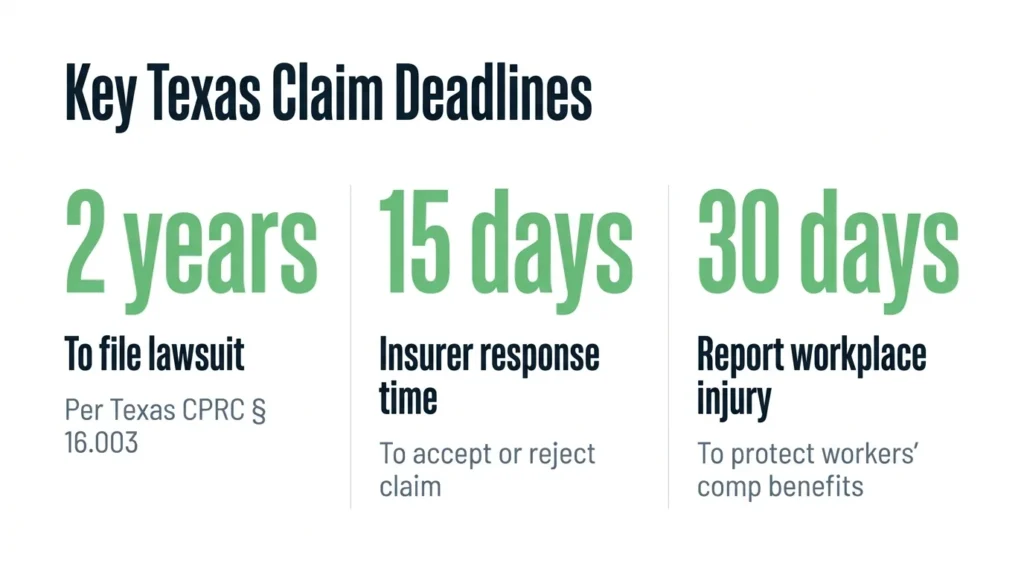
If your injury happened on the job, a separate clock applies. You must report it to your employer within 30 days under Texas Labor Code § 409.001 to protect your workers’ compensation benefits.
Discuss Your Claim with a Personal Injury Attorney
Angel Reyes & Associates has spent more than 30 years fighting for injury victims across Texas. You pay nothing unless we win your case, so pursuing a claim never adds financial risk to an already difficult time. Our case results reflect more than $1 billion recovered for clients, and our team offers 24/7 support in both English and Spanish.
Contact us for a free consultation to discuss your case with a member of our team.
Personal Injury Claim FAQs
What if the at-fault driver doesn't have insurance?
Your own uninsured or underinsured motorist coverage typically becomes your main source of recovery, since Texas insurers must offer that coverage unless you reject it in writing, according to the Texas Department of Insurance.
Will my own insurance pay my medical bills while my claim is still pending?
Yes, if you carry personal injury protection, since Texas auto policies include PIP coverage automatically unless you reject it in writing. PIP pays your medical bills regardless of who caused the crash.
What is the minimum car insurance coverage required in Texas?
Texas requires at least $30,000 in coverage per injured person, up to $60,000 per accident, and $25,000 for property damage, according to the Texas Department of Insurance. If the at-fault driver carries only that minimum, it may not fully cover a serious injury claim.
About the Authors

Angel Reyes
Writer
Angel L. Reyes, III is the Founder and Managing Partner of Angel Reyes & Associates. A nationally recognized trial attorney and business leader, Angel has helped over 70,000 injury victims recover more than $1 billion since founding the firm in 1993. Named to the Texas Super Lawyers list annually since 2008, Angel brings Wall Street experience, Ivy League education, and a deep commitment to client advocacy. He is a frequent legal commentator and published author with extensive contributions to legal scholarship, trial strategy, and consumer protection.

Kyle Nicolas
Editor
Kyle Nicolas is the Web Content & SEO Manager at Angel Reyes & Associates. He has more than 10 years of experience as a marketing co...

Angel Reyes
Reviewer
Angel L. Reyes, III is the Founder and Managing Partner of Angel Reyes & Associates. A nationally recognized trial attorney and business...